You already know that acquiring a new customer costs far more than keeping an existing one, yet most teams still pour their budget into acquisition while retention runs on autopilot. Customer loyalty and retention get treated as one thing when they're actually two different problems with two different fixes, and mixing them up is why so many retention campaigns fall flat.
Retention is behavioral: a customer keeps paying because switching is annoying or the product still works for them. Loyalty is emotional: they stay because they trust you and would recommend you even if a cheaper option showed up tomorrow. Understanding what customer loyalty actually is and how it differs from retention changes how you build your roadmap, respond to feedback, and decide what to fix first.
This article breaks down 8 practical strategies that address both sides. Some focus on reducing churn with proven retention strategies through better onboarding and support, others focus on building genuine loyalty through transparency and involving customers in product decisions. If you're running a SaaS product, you'll see how a public roadmap and an open feedback loop, the kind of thing Koala Feedback was built for, feed directly into both goals at once.
Customer feedback is the fastest way to find out where your product is quietly losing people. Most companies only hear from customers when something breaks or when a contract is up for renewal, which means they're reacting instead of preventing. Building a habit of collecting feedback continuously, and then visibly acting on it, turns customers from silent bystanders into stakeholders who feel some ownership over what you build next.
How to build a feedback loop comes down to three parts: a place for customers to submit ideas, a system to organize and prioritize what comes in, and a way to show people what happened to their suggestion. Tools like a portal where customers submit and vote on requests let people comment too, which does double duty as both a data source and an engagement channel. Instead of feedback scattered across support tickets, sales calls, and app store reviews, everything lands in one place where you can spot patterns.
On the retention side, feedback surfaces the friction points that quietly drive cancellations before they show up in your churn report. On the loyalty side, something more interesting happens: customers who see their input shape the product develop a sense of co-ownership. They stop being users and start being advocates, because they recognize their own fingerprints on features you ship.
Customers don't need every request built, they need proof that someone is listening.
That proof is what separates a company people tolerate from one they defend to their friends when a competitor undercuts your price.
Start small and make the loop visible. Here's a sequence that works for most SaaS teams:
Running this manually in spreadsheets works for a while, but it breaks down fast once volume grows. A dedicated platform for customer retention loyalty work, like Koala Feedback's prioritization boards, keeps the process consistent even as your customer base scales past a few hundred active voices.
Generic experiences train customers to treat you as interchangeable. Personalization signals that you actually know who you're talking to, and that recognition is a big part of what turns a one-time buyer into someone who sticks around and tells others to try you too.
Personalization means using what you already know about a customer (their plan, usage patterns, past support tickets, industry) to tailor what you show them and how you talk to them. That could be an onboarding flow that skips steps irrelevant to their use case, an email that references the feature they use most, or in-app messages that only fire for the segment they belong to. None of this requires guesswork; it requires paying attention to data you're probably already collecting but not using.
Built correctly, personalization does more retention work than most support teams combined. A customer who gets relevant recommendations sticks with a product longer because it keeps proving its value in their specific context. On the loyalty side, feeling understood is sticky in a way that discounts never are.
People stay loyal to brands that treat them like individuals, not like ticket numbers.
Combined, customer retention and loyalty both improve when personalization replaces one-size-fits-all messaging.
Focus effort where it compounds:
Start with your highest-value segment first, since that's where personalization pays off fastest.
A rewards program gives customers a tangible reason to keep choosing you over a competitor, even when the competitor is cheaper or shinier. For SaaS specifically, this isn't always points and badges; it's often tiered access, early feature releases, or discounts tied to tenure. Programs run on customer loyalty software work best when the reward actually matches what your customers value, not what's easiest for you to automate.
Most programs run on a simple exchange: customers earn credit, status, or perks for actions you want more of, like renewing early, referring a colleague, or upgrading their plan. B2B SaaS companies often skip points systems entirely and instead offer perks like priority support, beta access, or locked-in pricing for long-term customers. The mechanism matters less than the consistency of the payoff.
Retention improves because switching now means giving up something earned, not just re-learning a new tool. Loyalty improves because a well-designed program feels like recognition rather than a transaction.
A good loyalty program rewards behavior you want repeated, not just purchases you want repeated.
That distinction is why customer retention and customer loyalty move together once a program rewards genuine engagement, not just spend, and it's a core part of how to build customer loyalty step by step.
Keep the structure simple enough to explain in one sentence:
Customers now bounce between email, live chat, social media, and your app without thinking twice about it, and they expect you to keep up. Omnichannel consistency means a customer never has to repeat themselves or start over just because they switched between the channels and types of customer communication you offer. When that consistency breaks down, it doesn't just annoy people, it quietly erodes the trust that customer loyalty and retention both depend on.
A consistent experience means every channel pulls from the same customer record: the same support history, the same plan details, the same open tickets. If someone emails support on Monday and follows up on live chat Wednesday, the agent should see the full thread instantly, not ask them to explain the issue again. This requires connecting your tools, not just adding more of them.
Retention suffers the moment customers feel like they're managing your internal silos instead of getting help. Loyalty suffers even faster, because a disjointed experience reads as a company that doesn't have its act together. Solve this and customer retention and loyalty both benefit, since the customer spends their energy on your product instead of on repeating themselves.
Every time a customer has to repeat themselves, you lose a little of the trust you worked to build.
Audit where your channels currently disconnect before adding anything new:
Most support teams wait for the phone to ring or the ticket to arrive. Proactive customer service flips that: you reach out before the customer even realizes something's wrong, or before they get frustrated enough to open a ticket, which is exactly the line between customer success and customer service. That shift alone changes how customers perceive your entire relationship, from reactive vendor to genuine partner.
Proactive service means using data you already have, like usage drops, failed payments, or repeated errors, to trigger outreach before the customer complains. A customer whose usage suddenly falls off a cliff gets a check-in email, not silence until their renewal date. Someone who hits the same error twice gets a heads-up from support, not a support ticket they had to file themselves.
Retention improves because you catch churn signals early, while there's still time to fix the underlying problem. Loyalty improves because customers notice when a company pays attention without being asked, and that noticing builds trust fast.
The best support ticket is the one your customer never had to open.
This is where customer retention and loyalty overlap most directly: both depend on customers feeling looked after rather than ignored until they raise their hand.
Start with signals you can already track:
Friction is everything that makes a customer stop and think twice before completing an action, whether that's signing up, upgrading, or asking for help. Removing friction rarely feels urgent because no single instance of it looks like a crisis, but stacked together, small annoyances quietly push people toward the exit. If you want stronger customer retention loyalty outcomes, hunting down friction is often more effective than adding new features.
Friction shows up in confusing pricing pages, multi-step cancellation flows, slow load times, and support forms that ask for information you already have. Reducing it means walking through your own product as a new customer would, not as someone who already knows every shortcut, and gathering customer journey insights along the way. Every extra click, unclear label, or unnecessary form field is a chance for someone to abandon what they were trying to do.
Retention improves because a smoother path means fewer people quit halfway through something they intended to finish, like an upgrade or a setup step. Loyalty improves too, since ease of use becomes something customers mention when recommending you to a colleague.
A frustrated customer rarely complains, they just leave quietly and don't come back.
That quiet exit is exactly what makes friction dangerous: you often won't see it in your metrics until retention has already dropped.
Run this as a recurring audit, not a one-time project:
Too many companies treat the sale as the finish line, then wonder why customers vanish before renewal. Post-purchase support is what happens between the sign-up and the next invoice, and it's often where the real relationship gets built or lost. If your onboarding email is the last thing a customer hears from you until the renewal reminder, you've left the entire middle of the journey unattended.
Post-purchase support covers onboarding follow-ups that cut churn, usage check-ins, and education that helps customers get real value from what they bought. It's not a single email sequence; it's an ongoing rhythm of nudges, tips, and check-ins tied to how the customer is actually using the product. A customer who signed up for one feature but never touched it needs a different nudge than one who's using everything and ready to upgrade.
Retention depends on customers reaching the point where they'd feel a real loss if they canceled, and that only happens if they actually use the product well enough to see results. Loyalty follows once customers realize you kept helping after the money changed hands, which is rarer than it should be.
Customers remember who showed up after the sale, not just who closed it.
That memory is a big part of why customer retention and loyalty move together once support extends past the first thirty days.
Build a follow-up cadence instead of a single onboarding blast:
Customers who only interact with your product in isolation have nothing holding them there except the product itself. A brand community gives them something extra: other people to talk to, compare notes with, and learn from. Once customers start relying on each other, not just on you, leaving becomes a bigger decision than canceling a subscription.
A community can be as simple as a public forum tied to your feedback portal, a Slack group for power users, or regular events where customers swap tips. The goal is a space where customers help each other troubleshoot, share workflows, and vote on what should get built next. Your feedback board already does part of this job, since community voting on feature requests naturally puts customers in conversation with each other, not just with you.
Retention improves because customers embedded in a community have social reasons to stay, not just functional ones. Loyalty improves even faster, since people who feel part of something are far less likely to jump ship over a minor price difference.
A customer who has friends inside your product is a customer who doesn't leave over a price difference.
This is where customer retention and customer loyalty reinforce each other most visibly: the community keeps people engaged, and that engagement is what retention numbers eventually reflect.
Start with what you already have before building something new:
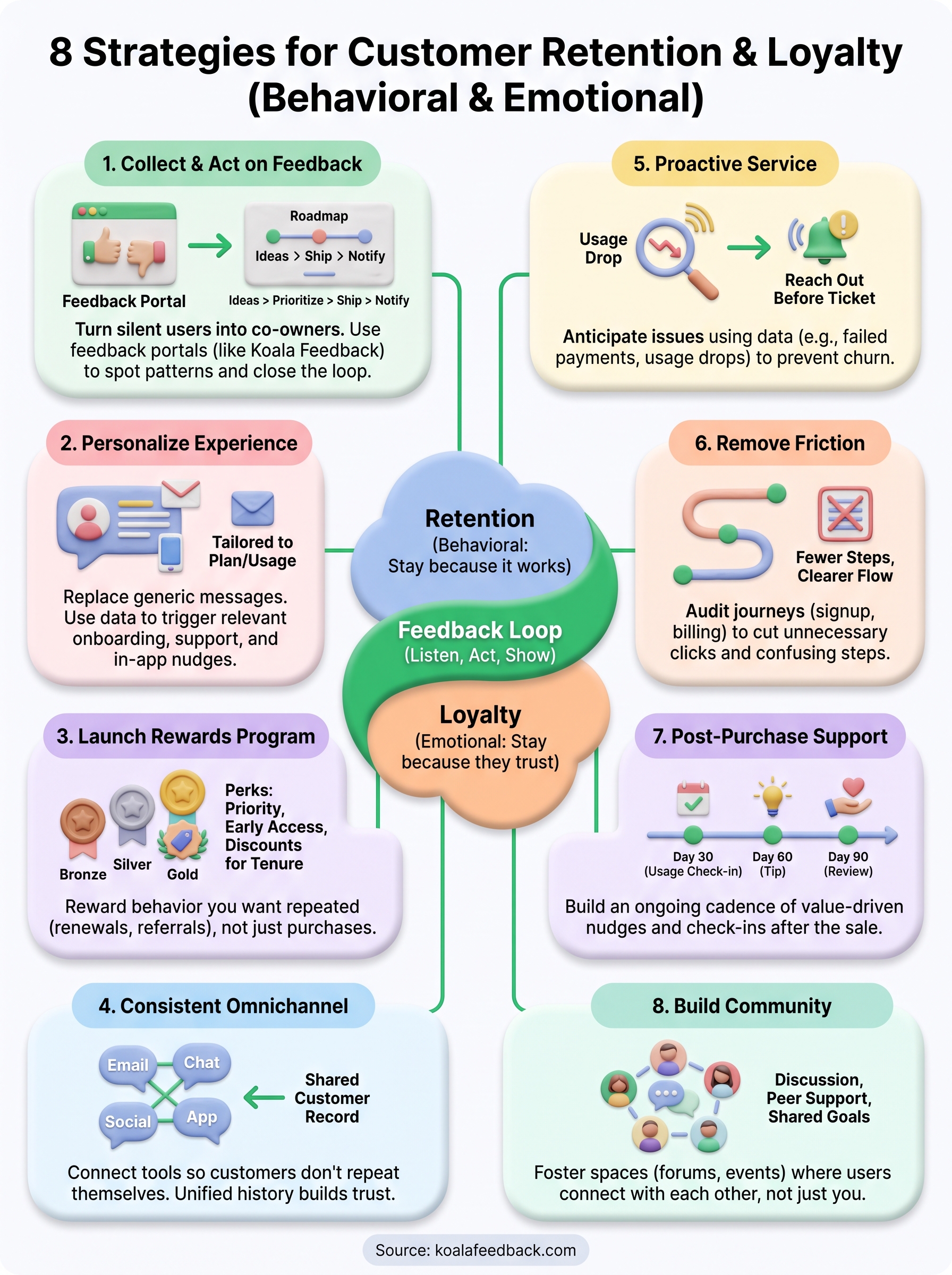
None of these 8 strategies work in isolation. Customer loyalty and retention both grow from the same root: customers who feel heard, understood, and supported long after they've handed over their credit card. Feedback loops feed personalization, proactive service prevents the friction that would otherwise go unnoticed, and community turns individual users into a group with a reason to stick around.
Start with whichever strategy addresses your biggest gap right now, not all eight at once. If you don't have a system for collecting and prioritizing feedback yet, that's usually the highest-leverage place to begin, since it feeds directly into everything else on this list. A visible feedback loop and public roadmap turn silent churn risks into engaged customers who feel some ownership over what you build.
Ready to put this into practice? Centralize, prioritize, and act on user feedback with Koala Feedback so retention and loyalty grow together instead of competing for your attention.

Start today and have your feedback portal up and running in minutes.