Every interaction a user has with your product tells a story. Customer journey insights are the patterns, behaviors, and signals you extract from that story, from the moment someone discovers your product to the point they become a loyal advocate (or quietly churn). Understanding these insights means you stop guessing what users want and start making decisions backed by real behavior data.
But here's where most teams hit a wall: they collect data from analytics dashboards, support tickets, and scattered spreadsheets, yet struggle to turn any of it into action. The missing piece is often structured feedback tied directly to each stage of the customer journey. That's exactly the problem tools like Koala Feedback solve, by giving users a voice through feedback portals, voting, and public roadmaps, you capture context-rich signals that analytics alone can't provide.
This article breaks down what customer journey insights actually are, how they differ from raw data, and how to apply them across your product development process. Whether you're a product manager prioritizing your next sprint or a SaaS founder trying to reduce churn, you'll walk away with a clear framework for turning journey data into features your users genuinely need. No buzzwords, no fluff, just practical guidance you can put to work.
A customer journey is the full sequence of interactions a user has with your product, from the first time they hear about it to the moment they either become a long-term customer or leave. Customer journey insights are the conclusions you draw from studying that sequence: where users get confused, where they find value, and what pushes them toward or away from key actions. They are not the raw numbers sitting in your analytics tool. They are the meaning you extract when you connect behavior patterns to specific stages of the user experience.
Think of it this way: a 40% drop-off rate on your onboarding screen is data. Understanding that users drop off because they cannot figure out how to import their existing data, which you know because multiple users submitted that exact feedback through your portal, is an insight. One tells you something is wrong. The other tells you what to fix.
Raw data comes from many sources: clickstream analytics, session recordings, support ticket volume, NPS scores, and usage metrics. Each source gives you a fragment of the picture. Insights emerge when you layer those fragments together and ask why a pattern exists, not just that it exists. Most product teams have access to plenty of data. The real bottleneck is the process of connecting that data to user intent and stage-specific behavior.
The teams that build better products faster are not the ones with the most data. They are the ones with the clearest understanding of what that data means at each stage of the journey.
Structured user feedback is one of the most underused sources for generating real insights. When users can vote on feature requests, leave comments, and submit ideas tied to specific pain points, you get qualitative signal that explains the quantitative patterns you are already seeing in your analytics.
Every customer journey runs through a set of recognizable stages: awareness, activation, retention, referral, and revenue (commonly referenced as the AARRR framework, originally described by Dave McClure). Insights that belong to the awareness stage look very different from insights at the retention stage. A user who churned after 30 days has a completely different story than a user who never finished onboarding.
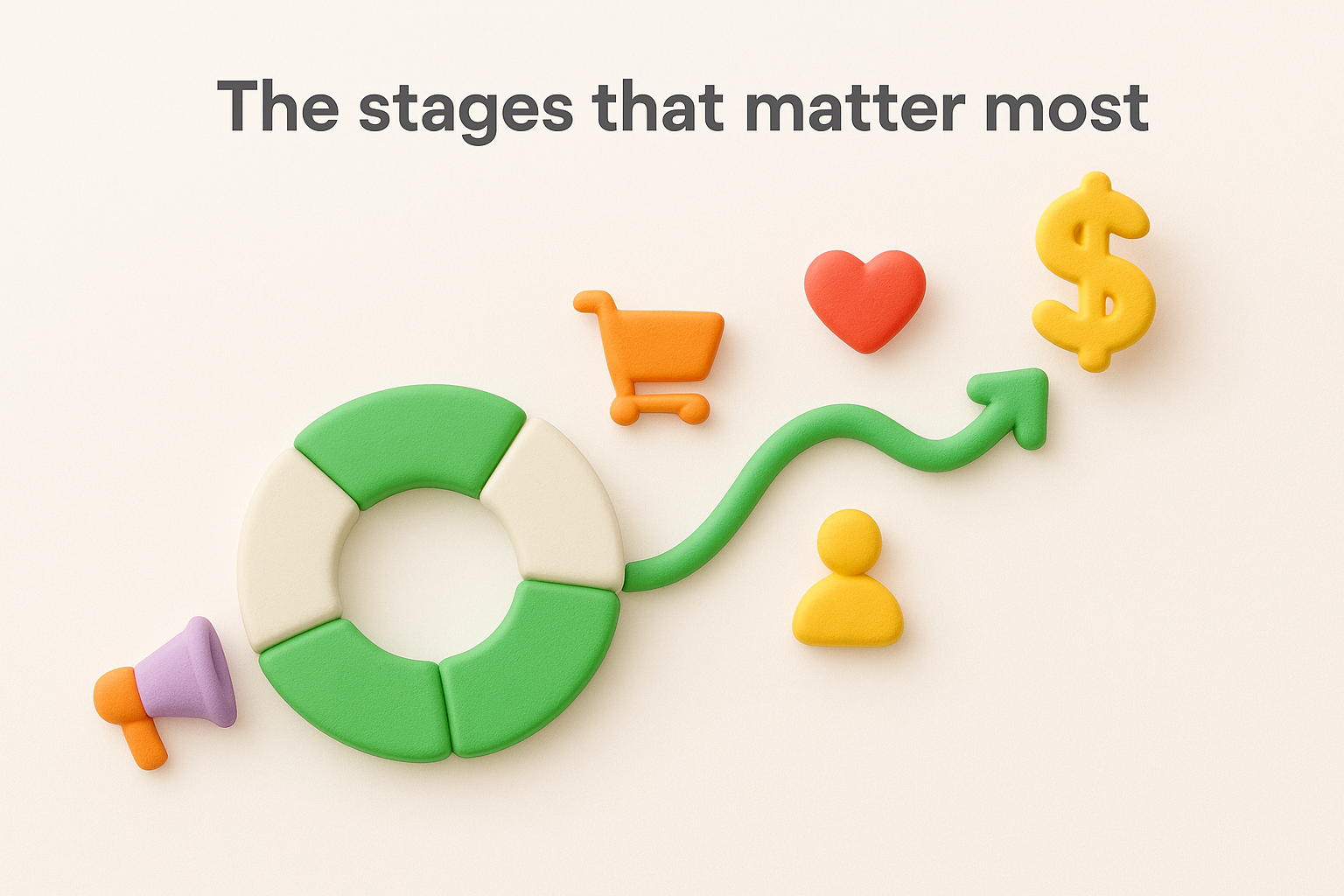
Mapping your insights to specific stages lets you prioritize fixes and features with much more precision. If your activation rate is low, insights from that stage should drive your next sprint. If retention is the problem, you need signals from users who stayed long enough to see value but eventually left. Treating all journey data as a single pile makes it nearly impossible to act on effectively.
Customer journey insights give you a direct line to the decisions that actually move your product forward. Without them, your team ends up prioritizing features based on gut instinct or whoever speaks loudest in a meeting. That is a slow and expensive way to build a product. With structured insights tied to specific journey stages, you can make faster decisions with higher confidence because you know exactly what users need and when they need it.
Every sprint planning session carries risk. When your roadmap is based on assumptions rather than observed user behavior, you are gambling your development time on things that may not matter. Customer journey insights change that equation by surfacing the patterns that show you which friction points are costing you users and which requested features would create the most value at each stage.
Teams that build from confirmed user signals consistently ship features with higher adoption rates than teams that build from internal assumptions alone.
Feedback data tied to specific stages, such as users flagging confusion during onboarding or requesting integrations after hitting a usage threshold, helps you allocate resources toward work that has already proven demand. You stop building features nobody asked for and start building the ones users are actively waiting on.
Churn rarely announces itself. Users do not usually send an email explaining why they left; they simply stop logging in. Structured journey data gives you the early warning signals: a drop in feature engagement, an uptick in support requests around a specific workflow, or a surge in feedback votes around a missing capability.
When you catch those signals before users reach their breaking point, you have room to act. That might mean shipping a fix, updating your documentation, or reaching out directly to users who flagged the same issue. The insight itself is not the goal; what matters is how quickly you respond to it.
Capturing useful data starts with knowing what questions you are trying to answer at each stage of the journey. If you track everything, you end up with noise that obscures the signal you actually need. The goal is to instrument your product and feedback channels so that data collection maps directly to user behavior at each touchpoint, from first login to long-term use.
The most valuable data you can collect is the data that explains behavior, not just measures it.
No single data source gives you the full picture. Behavioral analytics shows you what users do: which features they use, where they drop off, and how often they return. Qualitative feedback explains why those patterns exist. When you run both streams in parallel, you build a loop where quantitative signals point you toward a problem and qualitative signals reveal what is causing it.
A structured feedback portal gives users a direct channel to describe their experience in their own words. Those submissions, especially when users can vote and comment on shared ideas, surface customer journey insights that behavioral data alone simply cannot provide.
Different journey stages produce different types of signal. New users in the activation phase will flag completely different problems than users who have been active for months and hitting feature limits. If you pool all feedback together without tagging it by stage, you lose the context that makes each signal actionable. Design your collection approach with that distinction in mind from the start.
One practical approach is to trigger feedback prompts at specific moments: after onboarding is complete, after a user first engages with a core feature, or when someone hits an inactivity threshold. This keeps the feedback relevant and easy to categorize later, saving your team significant time when it comes to prioritization.
Collecting data is only half the work. The real value comes from connecting the dots between what users do and why they do it. Raw numbers become customer journey insights when you run them through a structured process that ties behavior patterns to specific stages, friction points, and user goals. Without that process, data sits in dashboards and never reaches the product decisions that would actually move your product forward.
The fastest way to waste good data is to skip the analysis step and jump straight to building.
Start by grouping your data by journey stage rather than by feature or date. When you see a cluster of feedback votes around the same pain point during activation, that is a signal worth investigating. Pull the relevant behavioral data for that stage, including session length, feature engagement, and drop-off points, and match it against what users described in their feedback submissions. When the qualitative and quantitative signals point to the same problem, you have a confirmed insight you can act on with confidence.
Your data will also surface discrepancies between what users say and what they do. Sometimes users request a specific feature, but behavioral data shows they rarely visit the area of the product where that feature would live. That gap tells you the real problem may sit elsewhere, and investigating it further will often reveal a more fundamental friction point worth fixing before anything else.
Insights lose value fast if they stay with one person. Share findings in a format your whole team can reference, whether that is a prioritization board, a shared document, or a regular review session. When everyone on your team understands the evidence behind each roadmap decision, you build with alignment rather than assumption, and your product moves forward with fewer wasted sprints and stronger results.
Gathering and analyzing customer journey insights only pays off when you translate them into concrete decisions about what to build next and how to grow. This is where most teams stall: they understand the insight but hesitate to commit to action because they are not sure how to weigh it against competing priorities. The answer is to build a direct link between your insights and your roadmap, so that every item you ship has a clear line back to an observed user need.
Not all insights carry the same weight. A friction point reported by a handful of users in the activation stage hits differently than a pattern showing that 60% of your users never complete a core workflow. When you score roadmap items against the frequency and severity of the underlying signal, you give your team a clear, defensible way to decide what ships next. Tools that let users vote on feature requests make this even more precise, because the vote count itself becomes a direct measure of demand.
Your roadmap should reflect what the data shows, not what feels urgent in the moment. When you tie each roadmap item to a specific journey stage and insight source, stakeholders can see exactly why something is prioritized and what outcome you expect from shipping it.
Growth decisions work the same way. If your activation rate is low, insights from that stage should drive your messaging, your onboarding flow, and your first-week email sequence. If retention is the bottleneck, insights from users who hit engagement walls tell you where to invest in product improvements or proactive outreach.
The product teams that grow fastest treat every journey stage as a distinct growth lever and use stage-specific insights to pull it.
Acting on stage-specific signals removes the guesswork from growth and turns your product decisions into a repeatable, evidence-based process.
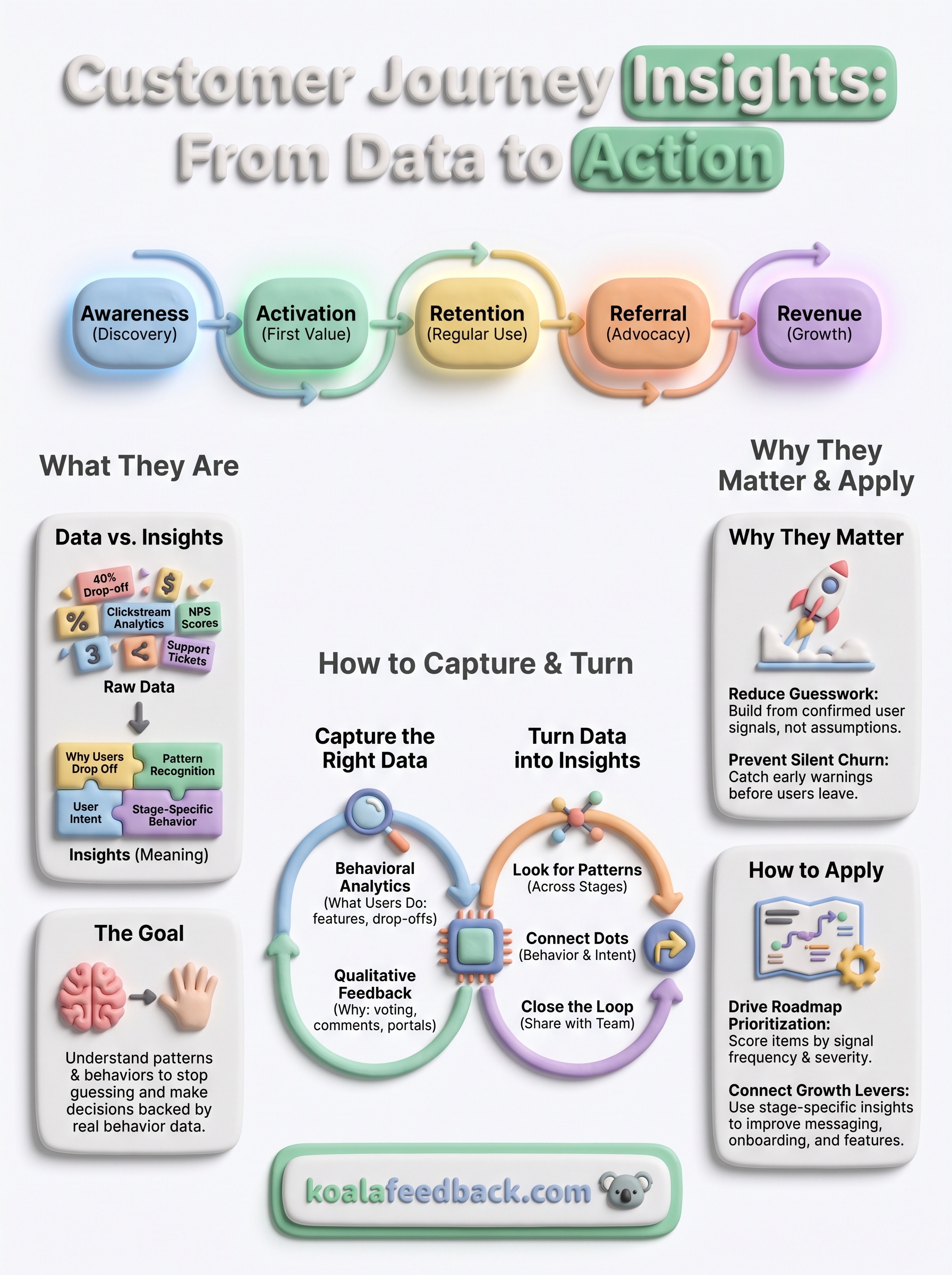
Customer journey insights are not a one-time project. They are a continuous practice that gets sharper as you collect more feedback, observe more behavior, and refine your understanding of what users actually need at each stage. The framework in this article gives you a starting point: map your journey stages, combine behavioral and qualitative data, and tie every roadmap decision back to a confirmed signal rather than a guess.
Your next move is to set up a structured feedback channel so users can tell you exactly where the journey breaks down. When users can submit ideas, vote on shared requests, and see your roadmap respond to their input, you build both a better product and a stronger relationship with the people using it. Koala Feedback gives you the tools to do exactly that, from a customizable feedback portal to a public roadmap that closes the loop between user needs and product decisions.

Start today and have your feedback portal up and running in minutes.