Every support ticket, feature request, product update, and onboarding email your team sends is part of something bigger: what is customer communication, and how well does your business actually do it? At its core, customer communication covers every interaction between a company and its users, from the first touchpoint to long-term relationship building. Get it right, and you earn trust, loyalty, and retention. Get it wrong, and users quietly move on.
The problem most teams run into isn't a lack of communication, it's fragmented, one-directional communication. Users submit feedback that disappears into a void. Product updates go unannounced. Roadmap decisions happen behind closed doors. That disconnect erodes trust, even when the product itself is solid. Tools like Koala Feedback exist specifically to close that gap by giving users a voice and keeping them in the loop through feedback portals and public roadmaps.
This article breaks down customer communication into its core components: what it actually means, the channels and types you should know about, real examples you can learn from, and practical strategies to strengthen how your team connects with users. Whether you're a product manager, a SaaS founder, or part of a development team, you'll walk away with a clear framework to improve every conversation your product has with its audience.
Understanding what is customer communication is just the starting point. The real question is why it deserves deliberate attention from product teams and business owners. Communication shapes how users perceive your product, not just how they use it. Every message you send, or fail to send, contributes to a mental model users build about whether your company actually listens, cares, and delivers on its promises. That perception compounds quietly over months until users either become advocates or quietly churn.
Users don't just evaluate your product on features. They evaluate it on how reliably you keep them informed and how honest you are when things go wrong. If a user submits a feature request and never hears back, they don't assume you're busy. They assume their input doesn't matter. Consistent, timely communication signals that your company is organized, responsive, and worthy of continued investment from the user's side.
The companies users trust most are not always the ones with the best products. They're the ones that communicate clearly and consistently, even when the news isn't good.
Transparency matters just as much as frequency. When you explain why a feature didn't make the roadmap or when a known issue will be resolved, users feel like partners in the process rather than passive subscribers. That shift from passive to engaged is what separates companies with strong retention rates from those that bleed users quietly every quarter.
Retention is where communication pays off most clearly. Research from large-scale studies consistently shows that customers who feel heard are significantly more likely to stay with a product long-term. When users believe their feedback influences your roadmap, they develop a personal stake in your product's success. That emotional investment reduces churn in ways that discounts and promotions simply cannot replicate.
Poor communication also raises your support costs. When users don't receive proactive updates about outages, feature changes, or billing issues, they flood your support channels with questions that one well-timed email or status update could have answered entirely. Every reactive support ticket is a sign that a proactive communication step was missed somewhere upstream.
Most companies treat communication as a one-way broadcast: announcements, newsletters, and changelogs sent outward to users. The ones that build durable, loyal user bases treat it as a two-way loop. They create structured ways for users to submit ideas, vote on priorities, and see exactly where their suggestions land in the development process.
Closing the feedback loop means users don't just send input into a void. They can see that their request is under review, planned, or shipped. That transparency transforms passive users into active advocates who recommend your product because they feel genuine ownership over its direction.
When you build communication into your product development process rather than treating it as an afterthought, you also make better decisions. The signals you gather through structured feedback channels tell you what users actually want, not what you assume they want. That data reduces the risk of shipping features nobody uses while ignoring the changes that would meaningfully improve retention and satisfaction.
These three terms get used interchangeably, but they describe distinct concepts with different scopes. Understanding where each one starts and stops helps you build a more intentional approach to every interaction your business has with its users. Conflating them leads to gaps where no one owns the full picture, and users end up experiencing that confusion firsthand.
Customer service is reactive. A user runs into a problem, contacts your team, and your support staff resolves the issue. It's a critical function, but it represents only a slice of the broader relationship your company has with its users. Customer service happens when something needs fixing.
Customer communication is the broader category that includes customer service but extends far beyond it. It covers every outbound message you send, every channel you use to gather input, every product update you announce, and every response you give to a feature request. What is customer communication at its widest scope? It's the full body of interactions between your company and your users across the entire relationship, not just the moments when something breaks.
Treating customer service as synonymous with customer communication is like treating a single chapter as the whole book.
The practical difference matters for your team structure. If only your support team "owns" communication, large portions of the user relationship go unmanaged. Product managers, marketers, and developers all play a role in how users experience your company through the messages and updates their work produces.
Customer communications management, commonly shortened to CCM, refers to the strategy and toolset a company uses to create, deliver, and track the messages it sends to users across all channels. It's the operational layer that sits above individual conversations and governs how communication happens at scale.
CCM covers decisions like which channels you use for which message types, how you personalize outreach based on user behavior, and how you measure whether your communication is actually reaching and landing with your audience. For SaaS companies specifically, CCM often includes everything from automated onboarding sequences to public roadmap updates that keep users informed about where the product is heading.
Getting CCM right means your users receive consistent, relevant, and timely messages regardless of which team or system generated them. Done poorly, it produces noisy, conflicting signals that erode user trust over time.
When you think about what is customer communication, channels are the infrastructure that makes it possible. Choosing the right channel for each type of message is as important as the message itself. Sending a billing dispute through a chatbot or a complex onboarding guide via SMS creates friction before you've even delivered the content. Matching channel to context keeps users in the right mindset and improves the likelihood that your message actually lands.
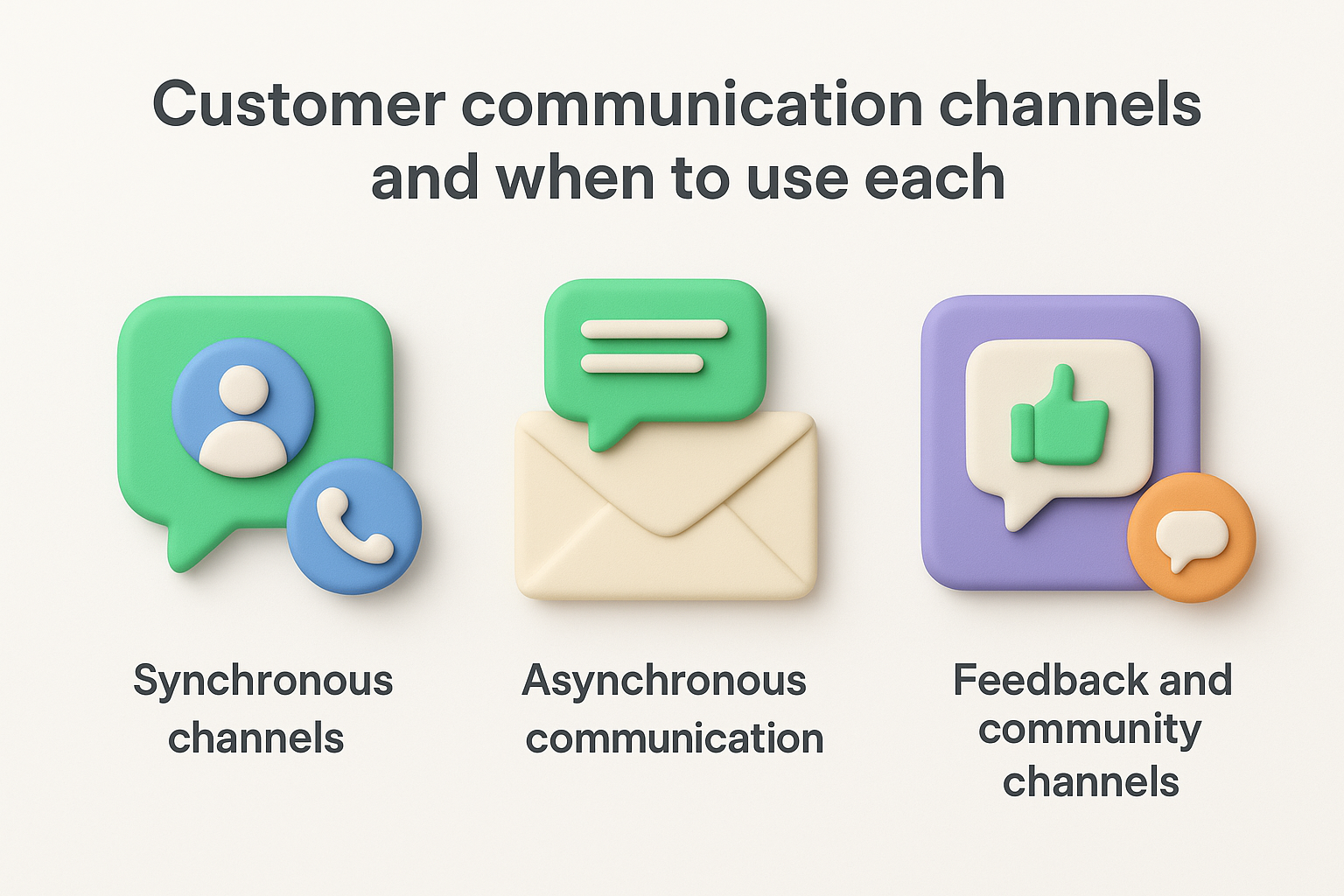
Synchronous channels require both parties to be present at the same time. Live chat, phone support, and video calls fall into this category. These channels work best when urgency, complexity, or emotion is involved. A user troubleshooting a critical integration failure needs a live response, not a three-day email thread. The operational cost of synchronous communication is higher in terms of staff time and scheduling, so reserve it for situations where real-time back-and-forth genuinely accelerates resolution rather than just mimics responsiveness.
Use synchronous channels when the cost of delay or misunderstanding outweighs the overhead of real-time support.
Asynchronous channels allow users to engage on their own time. Email, help documentation, and in-app notifications are the most common examples for SaaS businesses. Email works well for onboarding sequences, product updates, and billing communications because it creates a record users can reference later. In-app notifications are effective for contextual guidance, where the message appears exactly when a user is performing a relevant action, without requiring them to switch to a separate platform.
Help documentation sits in a slightly different category. Users go there actively looking for answers, which means your writing carries more weight when it is clear and well-organized. Investing in thorough documentation reduces inbound support volume and empowers users to solve problems independently before they need to contact your team.
Feedback portals, public roadmaps, and community forums represent a channel type that most businesses underinvest in. These channels let users communicate back to you, which is what separates one-directional broadcast communication from a genuine ongoing relationship. When users can submit ideas, vote on priorities, and track where their input lands in the development process, they stay more engaged with your product over time.
Choosing the right mix of channels depends on your team size, your users' preferences, and the complexity of your product. Start with the channels that address your highest-friction touchpoints first, then expand from there as your communication practice matures.
Once you understand what is customer communication at the channel level, the next layer to grasp is message type. Not every message your company sends serves the same purpose, and confusing them leads to tone mismatches that users notice even if they can't articulate exactly why something felt off. Organizing your communication by type helps your team apply the right voice, timing, and structure to each interaction.
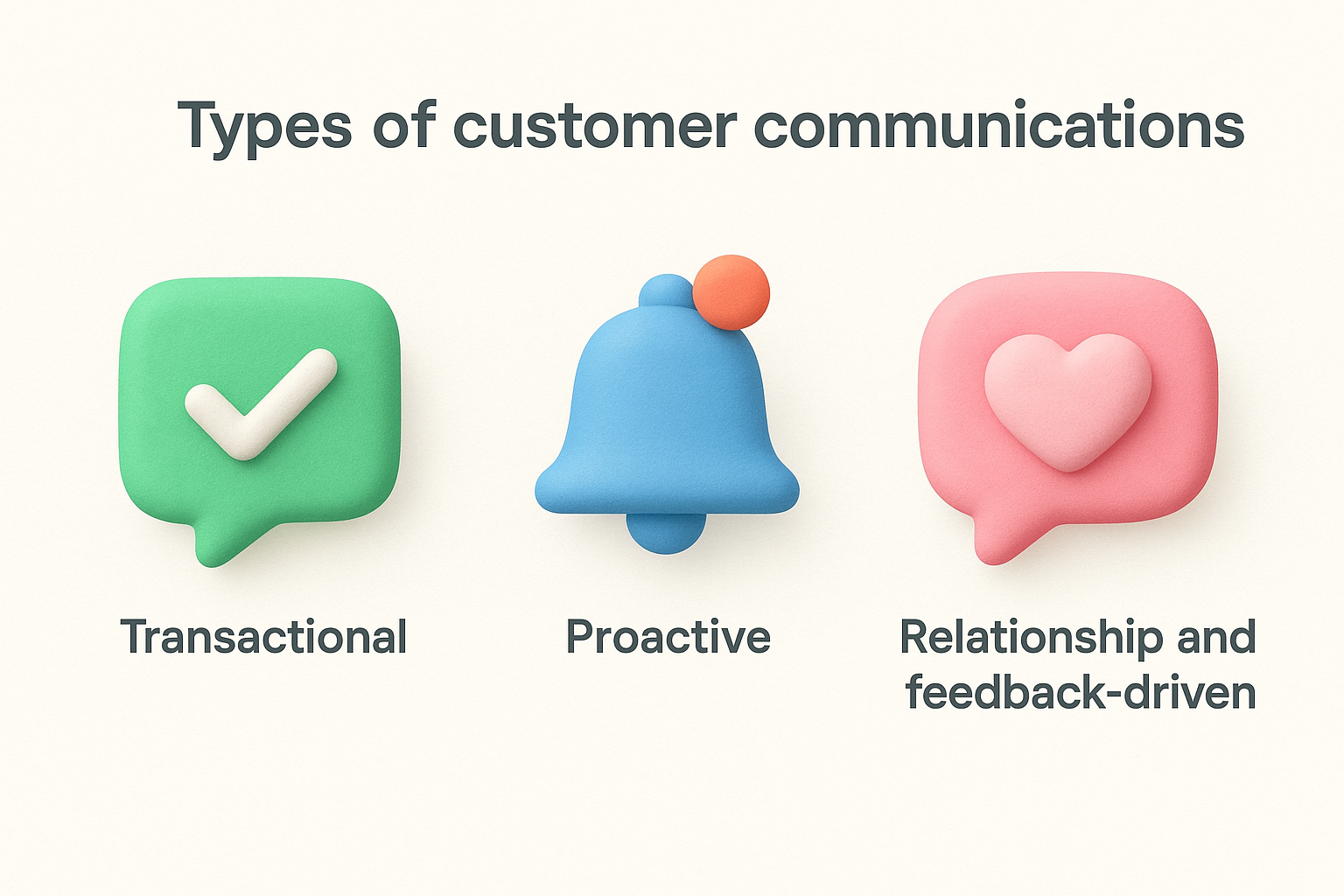
Transactional messages are triggered by a specific user action. Purchase confirmations, password resets, invoices, and account alerts all fall here. Users expect these messages immediately and treat them as functional, not conversational. The primary job of a transactional message is to confirm that something happened and give the user the information they need to proceed. Keep them concise, accurate, and branded consistently so users recognize them at a glance.
Proactive messages go out before users ask. Product update announcements, planned maintenance notices, changelog emails, and public roadmap posts are examples of proactive communication done well. These messages demonstrate that your team is ahead of the curve rather than constantly catching up. When you announce a new feature or acknowledge an upcoming change before users notice it themselves, you reinforce the impression that your company is organized and transparent.
Proactive communication turns potential frustration into confidence because users feel informed rather than surprised.
Changelog updates and roadmap status changes sit in this category and are especially valuable for SaaS products. When users see that a request they voted on moved from "planned" to "in progress," that single status update communicates more than a lengthy newsletter ever could.
Relationship messages build the long-term connection between your company and its users. Onboarding sequences, re-engagement campaigns, and milestone check-ins are designed to deepen familiarity rather than prompt a specific action. These messages work best when they feel personal and relevant to where the user is in their journey with your product.
Feedback-driven communications are the responses and updates tied directly to user input. Acknowledging a feature request, replying to a support ticket, or closing the loop on a reported bug all count here. This type of communication matters more than most teams realize because it signals to users that their voice has a direct line to your product decisions, which is what keeps engagement high over time.
Knowing what is customer communication in theory is useful, but seeing how it applies at each stage of the customer journey makes it actionable. Every stage of the user lifecycle calls for a different communication approach, from the first email a new signup receives to the message a churned user sees six months later. Matching your message to the moment reduces friction and makes each interaction feel purposeful rather than generic.
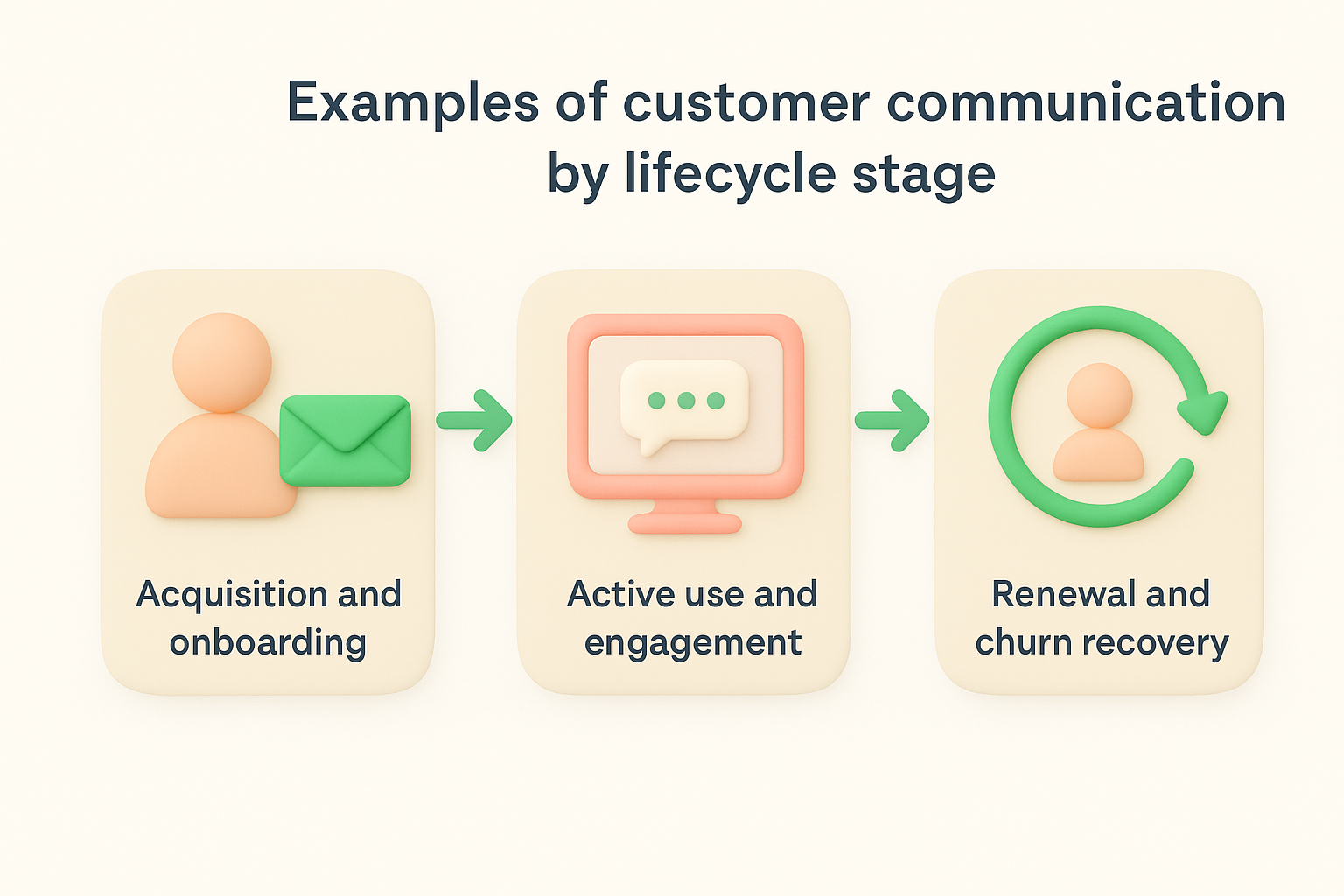
The moment a user signs up, your communication sets the tone for the entire relationship. A well-structured onboarding sequence introduces your product's core value quickly, addresses the most common early questions, and guides users toward their first meaningful action. For a SaaS product, that might mean a three-to-five email series that covers account setup, key features, and how to get help, spaced over the first week to avoid overwhelming new users.
The onboarding stage is where churn begins if your communication doesn't clearly connect users to the value your product delivers.
During acquisition, your communication focus shifts to setting accurate expectations before a user even commits. Confirmation emails, free trial instructions, and clear next-step guidance all reduce the drop-off that happens when users feel confused about what to do after signing up.
Once users are inside your product, proactive in-app messages and contextual tips keep them moving forward. A user who has not activated a core feature after two weeks is a signal, and a targeted in-app nudge or a short email explaining that feature's value can convert passive users into active ones. Changelog updates and roadmap announcements also land here, reinforcing that your team continuously improves the product based on real user input.
Feedback-driven communication becomes especially important during active use. Inviting users to submit feature requests, vote on priorities, and check the public roadmap gives them a structured channel to influence your product direction. That participation deepens their investment in your product beyond the features they already use.
At renewal time, proactive communication about upcoming billing cycles, plan changes, or new features reduces the friction that leads to cancellation. Users who feel informed about what they are paying for are far less likely to cancel out of surprise or frustration. For users who do churn, a straightforward win-back message that acknowledges their absence and highlights meaningful product improvements since they left can reopen conversations that seemed closed.
A strategy takes everything you know about what is customer communication and turns it into a repeatable system your team can execute consistently. Without a defined approach, communication defaults to reactive and fragmented, where different teams send conflicting messages, no one owns the full user relationship, and gaps appear exactly where users need clarity most. Building a strategy does not require perfection upfront. It requires a clear starting point, defined ownership, and a commitment to closing the loop with users at every stage.
Before you write a single message, audit every place your users currently receive communication from your company. List the channels you use, the types of messages you send at each stage, and who on your team owns each one. This map reveals two things quickly: where you are communicating well and where users are left without guidance at critical moments like post-signup, pre-renewal, or after submitting a feature request.
An honest touchpoint audit often shows that companies communicate most at acquisition and least during the active use phase, which is exactly when engagement needs reinforcement.
Once you have the full picture, prioritize the gaps with the highest impact on retention and satisfaction. A user who submits feedback and never hears back is a higher-risk gap than a missing newsletter. Fix the interactions that directly affect whether users stay or leave before optimizing the ones that simply inform them.
Every communication your company sends should have a clear owner. Product managers should own roadmap updates and feature announcements, support leads should own ticket resolution standards, and marketing should own lifecycle email sequences. When ownership is ambiguous, messages either do not get sent or arrive with inconsistent tone and timing that confuses users.
Consistency standards include your response time targets, the voice and tone your team uses across channels, and the criteria for when to send a proactive message versus wait for a user to reach out. Document these standards in a shared reference your team can actually use, not a lengthy policy document that no one reads.
Your strategy is incomplete if communication only flows outward. Create structured channels where users can submit ideas, vote on priorities, and see where their input goes in your development process. When users can track the status of a feature they requested, you turn a passive audience into an invested one, and that investment is what drives the kind of retention no broadcast campaign can manufacture.
Knowing what is customer communication is useful, but knowing whether yours is working requires clear metrics and honest standards. Without measurement, you are guessing about what resonates and what drives users away. The right metrics give you a concrete baseline to improve from rather than a vague sense that things are going well or poorly.
Response time and first contact resolution rate are the two most straightforward indicators of communication health. Response time measures how quickly your team acknowledges a user inquiry, while first contact resolution tracks how often those inquiries close fully without requiring a follow-up. Together, they reveal whether your communication is fast and effective or just fast.
Tracking feedback closure rate, meaning how often you respond to user-submitted ideas or requests with a status update, reveals whether your product communication loop is actually closed or just appears to be.
Customer satisfaction scores (CSAT) and net promoter scores (NPS) add a qualitative dimension that response time alone cannot capture. These scores tell you whether users feel heard and valued after an interaction, which connects directly to long-term retention. Measure both at key touchpoints like post-onboarding and post-support resolution to identify where your communication earns trust and where it loses it.
Communicating only when something breaks is the most common pattern product teams fall into. When users hear from you primarily during outages or billing issues, they associate your messages with problems. Consistent proactive updates, roadmap announcements, and acknowledgment of user feedback shift that association toward confidence over time.
Ignoring feedback after collecting it is equally damaging. If you open a feedback portal and users never see what happened to their input, they stop submitting. Worse, they stop trusting that your company listens at all. Closing the loop on feedback, even with a simple status update moving a request from "under review" to "planned," keeps users engaged and prevents the cynicism that builds when input disappears into silence.
Sending too many messages in a short window or using the wrong channel for a sensitive topic are patterns that erode trust quietly. A billing dispute handled through an automated chatbot, or an outage announced after users already discovered it themselves, signals that your team has lost control of its own process. Setting clear standards for channel selection and message timing prevents both problems before they compound into a broader reputation for poor communication.
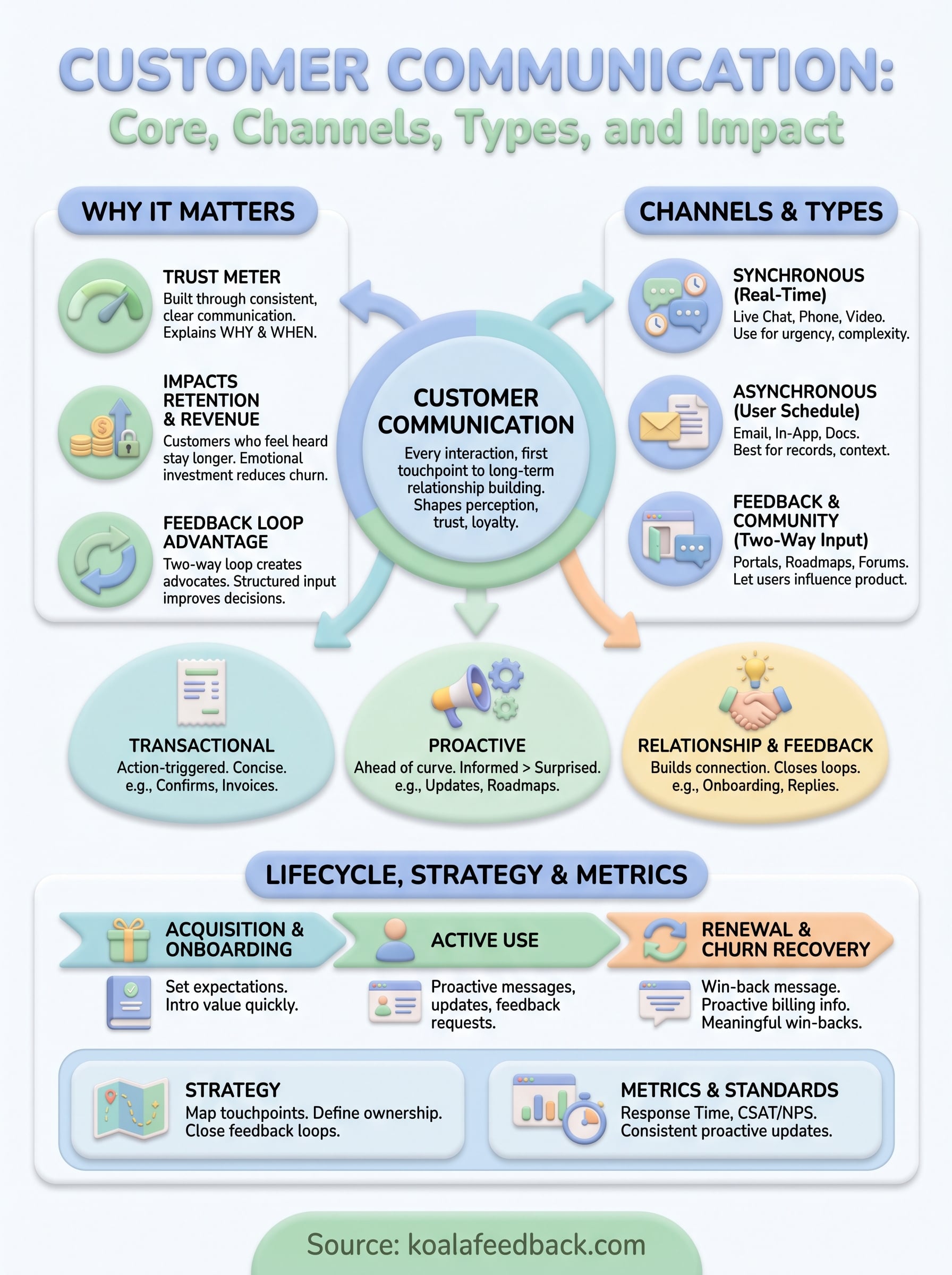
You now have a complete picture of what is customer communication, from the channels and types that structure it to the lifecycle stages and metrics that reveal how well it works. The core principle running through every section is the same: users who feel heard and informed stay longer, engage more deeply, and become the kind of advocates no marketing budget can manufacture.
The next step is practical. Pick one gap from your current communication map, whether that is a missing onboarding sequence, an unacknowledged backlog of feature requests, or a roadmap users cannot see, and fix it before moving to the next. Small, consistent improvements compound quickly once you build the habit of closing every loop.
If your team needs a structured way to collect user feedback, prioritize requests, and share your roadmap transparently, Koala Feedback gives you the tools to do exactly that.

Start today and have your feedback portal up and running in minutes.