Every product decision you make either moves your customers closer to loyalty or pushes them toward the exit. What is customer satisfaction? At its core, it's a measure of how well your product or service meets, or exceeds, the expectations your customers had when they signed up, bought in, or clicked "subscribe." It sounds straightforward, but getting it right is one of the hardest challenges in business.
Customer satisfaction isn't just a feel-good metric. It directly impacts retention, revenue, and word-of-mouth growth. Companies that track and act on satisfaction data consistently outperform those that guess what their users want. The difference often comes down to whether you're listening to your customers or just assuming you know what they need. That's exactly why we built Koala Feedback, to give teams a structured way to collect, organize, and prioritize real user feedback so product decisions are grounded in actual customer input.
In this guide, you'll learn what customer satisfaction really means, which metrics matter most for measuring it, and practical tips you can apply right away. We'll also walk through real-world examples that show how feedback-driven companies turn satisfaction scores into better products and stronger customer relationships.
Customer satisfaction isn't a vanity metric you track to feel good about your product. Understanding what is customer satisfaction and why it drives business outcomes gives you a real competitive edge. When customers are satisfied, they stay longer, spend more, and bring others with them. When they're not, they leave quietly, and often tell others why.
Keeping a customer is significantly cheaper than acquiring a new one. Satisfied customers renew subscriptions, upgrade plans, and resist competitors' pitches because they already trust your product. Microsoft's research on customer experience consistently shows that customers who have a positive experience are more likely to purchase again and spend more over time. For SaaS companies in particular, where growth depends on monthly recurring revenue, even a small improvement in satisfaction can produce a measurable lift in retention rates.
A 5% increase in customer retention can increase profits by 25% to 95%, which means satisfaction isn't just a customer service concern. It's a financial strategy.
Churn is expensive, not just in lost revenue but in the cost to replace that customer. When you treat satisfaction as a core business metric rather than a secondary concern, you start making decisions that protect the revenue you already have instead of constantly scrambling to replace it.
Your satisfied customers do marketing work for you. Positive word-of-mouth and referrals are among the most trusted forms of promotion available, and both happen naturally when customers genuinely like what you've built. On the flip side, dissatisfied customers are vocal. They leave reviews, post on forums, and tell colleagues to stay away. You don't control that narrative directly, but the experience you deliver determines what story gets told.
Building a reputation for listening and acting on feedback creates a cycle that works in your favor. New users arrive with higher expectations and a reason to trust you from day one, which makes it easier to satisfy them and keeps that positive cycle going.
When you consistently measure and track satisfaction, you get a clear signal about what's working and what isn't. Instead of guessing which features to build next or which friction points matter most, you can look at satisfaction data and let your users tell you. Teams that build feedback loops into their process make fewer expensive mistakes and ship improvements that actually matter to the people paying for the product.
Satisfaction data also reveals patterns that individual support tickets won't show you. A single complaint might be an edge case, but a cluster of low satisfaction scores around a specific workflow tells you something is broken that needs your attention. That kind of signal is only visible when you systematically collect and review how customers feel across the board, rather than reacting to whoever is loudest on a given day.
Understanding what is customer satisfaction in full means recognizing it isn't a single thing. It's the combined result of every interaction, experience, and outcome your customer has with your product or company. No single touchpoint defines satisfaction, but every touchpoint contributes to it, and weak spots anywhere in the journey pull the overall score down.
The most fundamental component is whether your product does what you promised it would do, consistently and without friction. Customers arrive with expectations shaped by your marketing, your onboarding, and what peers told them. When the product delivers on those expectations, satisfaction stays high. When it falls short, even great support can't fully compensate. Quality means your core features work, your interface doesn't confuse people, and your product holds up under real-world use.
Reliability is especially critical for SaaS products, where customers depend on your platform as part of their daily workflow.
How your team responds when something goes wrong carries enormous weight in how customers rate their overall experience. Fast, helpful, and empathetic support turns a frustrating moment into a trust-building one. Slow or hard-to-reach support turns a minor issue into a reason to cancel. Your customers don't expect perfection, but they do expect to feel heard and helped when they reach out.
Listening actively to feedback also matters here. When customers see that their input shapes future updates, they feel like partners in the product rather than passive users. That shift in relationship changes how they experience even minor friction going forward.
Satisfaction also depends on whether customers feel they're getting fair value for what they pay. This isn't just about price. It's about whether the outcomes your product delivers justify the cost, the time investment, and the switching costs that came with adopting it. Customers who feel they're getting more than they expected tend to score satisfaction higher across every dimension, even when individual experiences are imperfect.
Knowing what is customer satisfaction means nothing without a reliable way to measure it. The right metrics give you a consistent, comparable signal you can track over time and use to pinpoint specific improvements. Three metrics stand out as the most widely used, and each one tells you something different about how your customers feel and why.
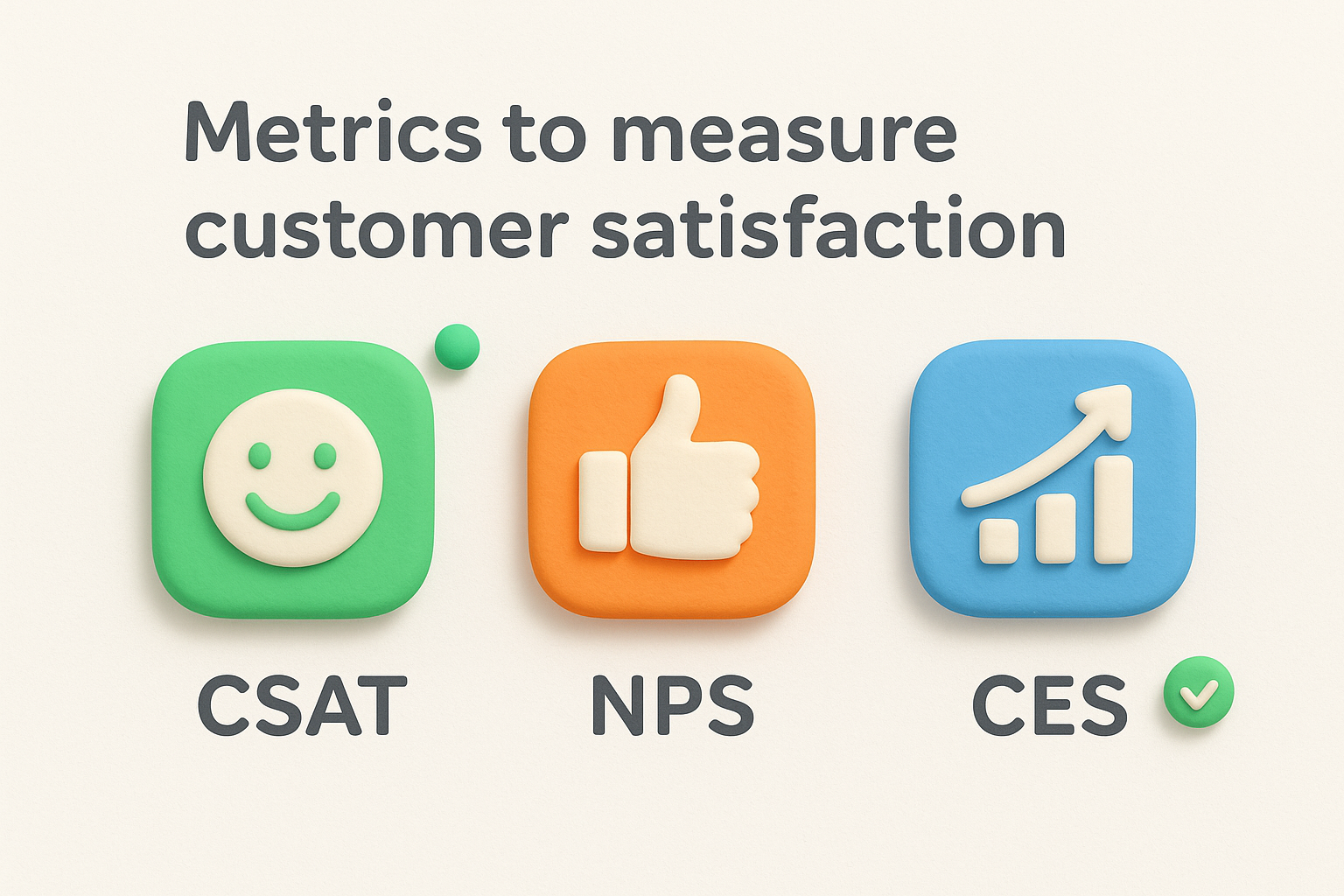
CSAT is the most direct measurement available. You ask customers a simple rating question right after an interaction, such as "How satisfied are you with your experience today?" on a scale of 1 to 5 or 1 to 10. Your score is the percentage of respondents who chose the top ratings. This metric works best when you tie it to specific moments, like after onboarding, a support conversation, or a feature launch.
CSAT captures how customers feel right now, which makes it highly responsive to recent changes in your product or service.
Good moments to send a CSAT survey include:
NPS measures customer loyalty and the likelihood they'll recommend your product. You ask one question: "How likely are you to recommend us to a friend or colleague?" on a 0 to 10 scale. Respondents fall into promoters (9-10), passives (7-8), and detractors (0-6). Subtracting the percentage of detractors from the percentage of promoters gives you your final NPS.
A positive NPS means more people are willing to advocate for you than warn others away, which has a direct impact on word-of-mouth growth and new customer acquisition.
CES measures how much work customers have to do to accomplish something with your product or service. The easier the experience, the higher the score. High-effort interactions, like confusing onboarding flows or hard-to-reach support, correlate strongly with churn even when customers otherwise like the product.
Tracking CES alongside CSAT and NPS gives you a complete picture: emotional response, loyalty signal, and friction level. Together, they replace guesswork with a framework grounded in actual customer experience.
Understanding what is customer satisfaction becomes much clearer when you look at how it plays out in practice. Real examples show you the specific moments where businesses either strengthened customer loyalty or lost it, and they reveal the concrete actions that made the difference.
A SaaS team notices their NPS scores dropping quarter after quarter despite solid support ratings. They dig into the open-ended feedback and find a pattern: users consistently struggle with the same step in the onboarding flow. The team redesigns that specific step, ships the update, and sends a follow-up survey two weeks later. Satisfaction scores climb, and several users specifically mention that the product "finally makes sense." The win here isn't just the fix. It's the fact that the team used structured feedback to identify the real problem instead of guessing.
You don't need a massive change to move satisfaction scores. Fixing one high-friction point your users actually care about often does more than a full feature redesign.
A customer contacts support after a billing error charges them twice in the same month. The support rep responds within an hour, issues a full refund without asking for extensive documentation, and follows up the next day to confirm everything cleared. The customer came in frustrated enough to consider canceling. They leave the interaction more loyal than before because the company handled a mistake quickly and without friction. That response converted a near-churn event into a positive satisfaction data point.
A product team is running behind on a highly requested feature. Instead of going silent, they update their public roadmap to reflect the delay and post a brief explanation of why it's taking longer. Users who voted for that feature receive a notification. Most of them respond positively, not because they're happy about the delay, but because they feel informed and respected. Customers tolerate imperfection far better than they tolerate silence. Keeping them in the loop turns a potential frustration into an opportunity to reinforce trust in your process and your team.
Knowing what is customer satisfaction gives you the foundation. Acting on it is where the real work happens. Most teams that struggle with satisfaction scores aren't short on data; they're short on a consistent process for turning that data into decisions. The tips below give you a practical starting point whether you're just beginning to track satisfaction or trying to push already decent scores higher.
When customers give you feedback, they're watching to see what happens next. Closing the feedback loop means acknowledging what you've heard, acting on it where you can, and communicating the outcome back to the person who shared it. Teams that skip this step lose the trust that makes customers want to share feedback again. Structured feedback tools make this easier by letting you track requests, update statuses, and notify users automatically when something they asked for ships.
Customers who see their feedback result in a real change become your most vocal advocates, and that kind of loyalty is hard to replicate with any other tactic.
Friction rarely stays small. A confusing onboarding step, a slow-loading feature, or an unclear billing process each creates a small amount of dissatisfaction that adds up over time. Regularly reviewing your Customer Effort Score helps you find these pain points early, before they affect retention. Prioritize fixes that affect the highest number of users rather than the loudest individual voices.
Don't wait for customers to discover problems or delays on their own. Proactively sharing updates, even when the news isn't ideal, signals that you respect your customers' time and investment. A brief roadmap update or a short note about a known issue does more for satisfaction than a polished response after the fact. Customers who feel informed trust you more, which gives you more room to recover from mistakes without losing them.
Overpromising is one of the fastest ways to destroy satisfaction before you've had a chance to build it. Clear, honest messaging during onboarding sets expectations your product can actually meet. When customers know what to expect, they measure their experience against a fair standard rather than an inflated one you accidentally created.
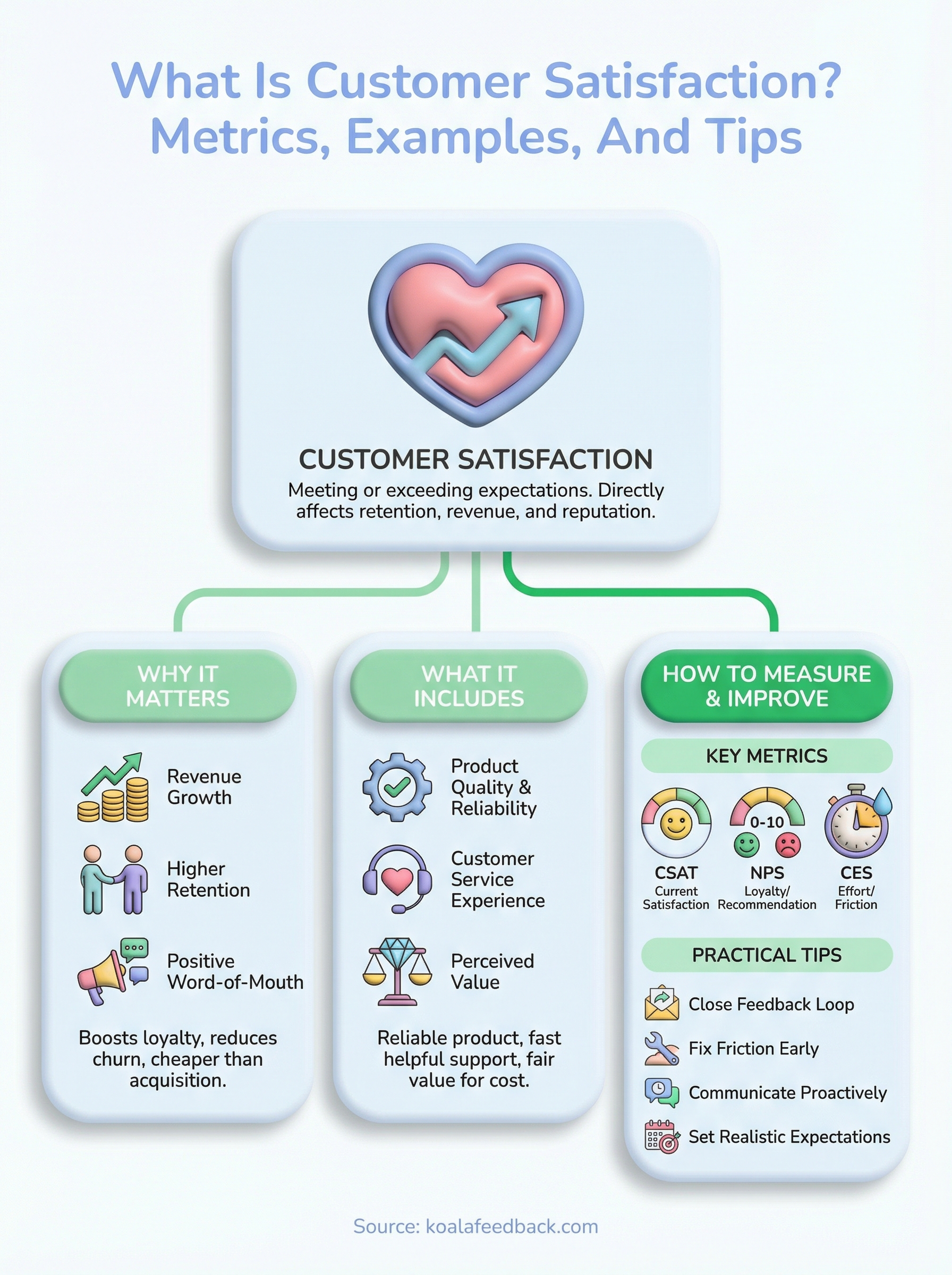
Now you have a complete picture of what is customer satisfaction, how to measure it, and what drives it up or pulls it down. The gap between companies that grow through loyal customers and those that constantly fight churn almost always comes down to whether they have a real system for listening and acting on feedback, or whether they're guessing.
Start with one concrete action. Pick the satisfaction metric that fits your current stage, run your first survey, and review the patterns in what customers tell you. Look for the high-friction point affecting the most users and fix that first before expanding to bigger initiatives.
Building a structured feedback process doesn't require a large team or a complex setup. Koala Feedback gives you a centralized place to collect, organize, and prioritize user feedback so you can make product decisions grounded in what your customers actually need, and keep them informed every step of the way.

Start today and have your feedback portal up and running in minutes.