Acquiring a new customer costs five times more than keeping an existing one. Yet most businesses pour resources into chasing new buyers while their current customers quietly slip away to competitors. This creates an expensive treadmill where you constantly need to replace lost revenue with fresh acquisitions.
Building customer loyalty flips this equation. When customers stick around, they spend more over time, recommend you to others, and provide valuable feedback that helps you improve. You get predictable revenue, lower marketing costs, and a competitive advantage that's hard to copy. The best part is that loyalty isn't about luck or magic. It comes from specific actions you can start taking today.
This guide breaks down 10 practical steps to build customer loyalty, complete with real examples from businesses that got it right. You'll learn how to understand your customers deeply, create experiences worth remembering, reward the behavior you want to see, and use feedback to keep getting better. Whether you're running a SaaS startup or an established business, these strategies will help you turn one time buyers into long term advocates.
Loyal customers drive profitability in ways that new customers can't match. They purchase more frequently, spend more per transaction, and cost less to serve because they already know how your business works. This combination creates a compounding effect on your bottom line that accelerates over time rather than requiring constant reinvestment.
Increasing your customer retention rate by just 5% can boost profits by 25% to 95%, according to research on customer economics. This happens because you eliminate the acquisition cost for repeat purchases while benefiting from higher average order values. Existing customers spend 67% more than new ones on average, and they reach this spending level faster as they become familiar with your full product range.
The math becomes even more compelling when you factor in referrals. Each loyal customer who recommends your business brings in new buyers at zero acquisition cost. These referred customers also tend to stay longer and spend more because they arrive with built in trust from someone they know.
Loyal customers are worth up to 10 times as much as their first purchase.
Learning how to build customer loyalty delivers benefits that extend past direct revenue. Loyal customers provide honest feedback that helps you fix problems before they drive others away. They act as a testing ground for new features or products, giving you validation before major launches.
Your loyal base also insulates you from competitive pressure. When rivals offer discounts or new features, satisfied customers stick around because they value the relationship they've built with you. This stability lets you focus on long term improvements instead of constantly reacting to market threats. Understanding why loyalty matters sets the foundation for the specific tactics that create it.
The foundation of how to build customer loyalty starts with understanding who your customers are and what they experience when interacting with your business. You can't create loyalty without knowing what drives your customers' decisions, where they struggle, and what keeps them coming back. These first three steps focus on gathering and using customer intelligence to inform every decision you make.
Start by categorizing your customers into distinct groups based on behavior, not demographics. Look at purchase frequency, product preferences, support ticket volume, and engagement with your content. A customer who buys monthly and never contacts support has different needs than one who purchases quarterly and regularly asks questions.
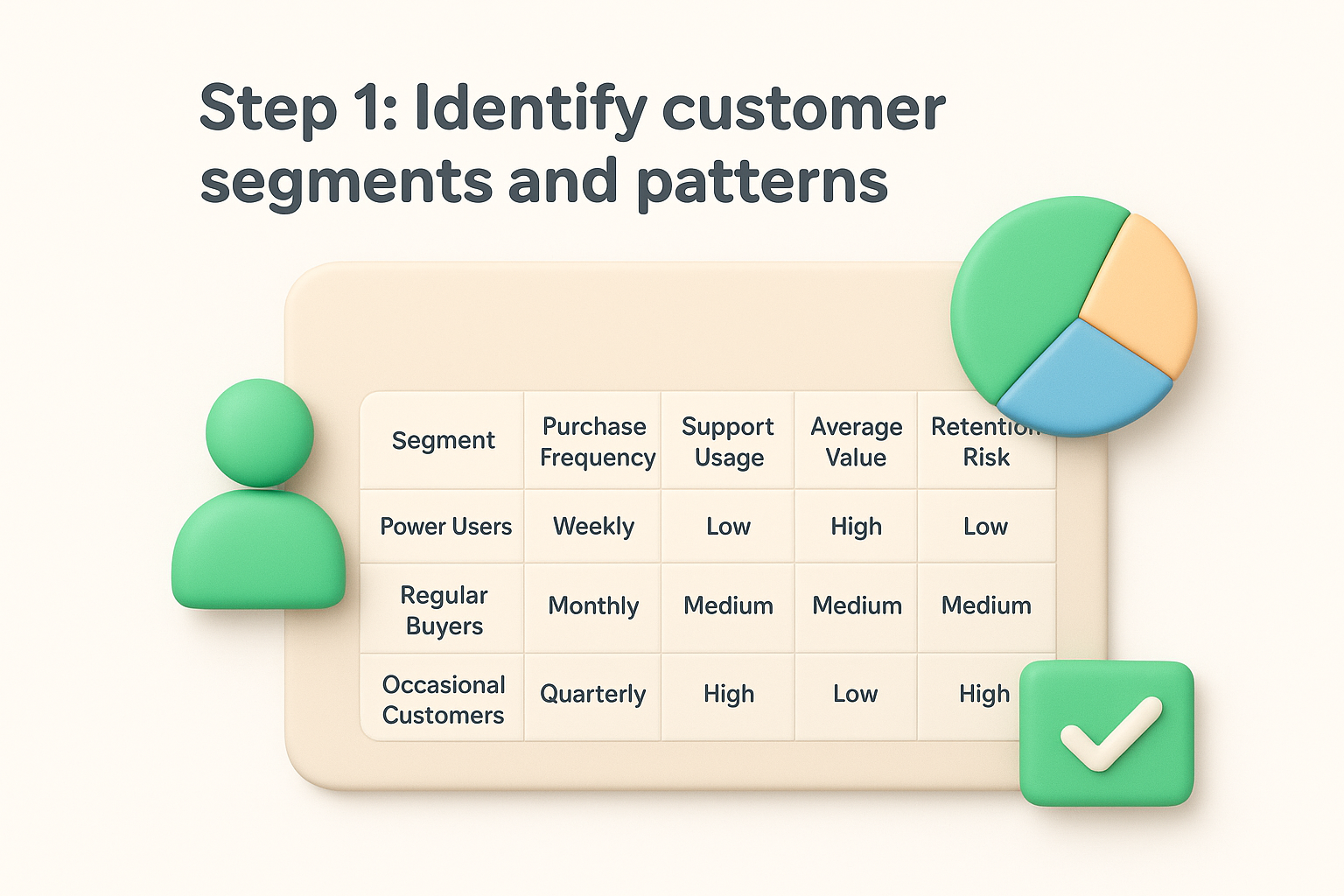
Create a simple segmentation table that captures these behavioral patterns:
| Segment | Purchase Frequency | Support Usage | Average Value | Retention Risk |
|---|---|---|---|---|
| Power Users | Weekly | Low | High | Low |
| Regular Buyers | Monthly | Medium | Medium | Medium |
| Occasional Customers | Quarterly | High | Low | High |
Use this segmentation to personalize your communication and offers for each group. Power users might appreciate early access to new features, while occasional customers may need more education about your product's value. Track which segments generate the most lifetime value so you know where to focus retention efforts.
Document every touchpoint a customer has with your business from first discovery through renewal or repurchase. Include marketing touchpoints, sales interactions, onboarding steps, product usage, support contacts, and billing experiences. Most businesses discover friction points they never knew existed during this exercise.
For each touchpoint, note what customers expect and what you currently deliver. A SaaS company might find that customers expect instant setup but face a three day wait for account approval. An ecommerce business might learn that customers want order updates but only receive generic shipping notifications. These gaps between expectations and reality reveal exactly where loyalty breaks down.
The moments where customer expectations don't match reality are your biggest opportunities to build loyalty.
Set up automated feedback requests at critical moments in the customer journey. Ask for input immediately after support interactions, following purchases, and when customers upgrade or downgrade their plans. Keep surveys short with one or two specific questions rather than lengthy questionnaires that customers ignore.
Pay attention to unsolicited feedback across all channels. Monitor social media mentions, read review sites, and analyze support ticket themes. Customers who take time to share opinions without prompting often highlight issues that silent customers also experience. Create a system to tag and categorize this feedback so patterns become visible over time. Understanding your customers through these three steps gives you the knowledge needed to create experiences that earn loyalty.
Moving beyond understanding your customers, you need to translate that knowledge into experiences that exceed expectations at every interaction. The gap between adequate service and remarkable experiences determines whether customers tolerate your business or actively champion it. These three steps show you how to build customer loyalty through consistently excellent execution that makes competitors irrelevant.
Set internal response targets that beat industry standards by at least 30%. If your industry averages 24 hour email responses, aim for 16 hours or less. Customers notice when you move quickly, and speed signals that you value their time. Track your response and resolution times weekly to catch slowdowns before they become patterns.
Create tiered support channels that match urgency to response speed. Offer live chat for immediate needs, email for standard questions, and self-service resources for common issues. Make sure customers can easily find the right channel without navigating complex menus. A software company might use this structure:
Automate acknowledgment messages that tell customers when they'll hear back and what happens next. Even a simple "We received your message and will respond within 4 hours" reduces anxiety and shows you have a process. Follow through on every timeline you set, treating promised response times as hard deadlines rather than estimates.
Speed doesn't just solve problems faster. It shows customers they matter enough to prioritize.
Give frontline employees the authority to resolve issues without supervisor approval up to a defined threshold. A customer service representative who can issue a refund, send a replacement, or add account credits immediately turns frustrated customers into impressed ones. Zappos famously lets support staff spend up to 10 hours on a single call and send gifts without approval, creating legendary service stories.
Document common problems and their solutions in a decision tree that guides team members through resolution steps. Include the exact compensation or remedy for each scenario so employees don't hesitate or provide inconsistent solutions. Your team should know instantly how to handle a delayed shipment, billing error, or product defect without asking permission.
Ensure every customer facing channel delivers the same quality whether someone contacts you through email, phone, chat, or social media. Train all team members on your complete product range and policies so customers never hear "that's not my department." Nothing erodes trust faster than repeating your issue to multiple people who each provide different answers.
Build standard operating procedures for common interactions that specify response templates, approval processes, and escalation paths. These procedures shouldn't make your team robotic but should guarantee baseline quality regardless of who handles the interaction. Review actual customer conversations monthly to identify where consistency breaks down and update your procedures accordingly.
Understanding how to build customer loyalty requires recognizing and rewarding the behaviors you want to encourage. Customers who feel appreciated for their continued business become more engaged and spend more over time. These two steps show you how to structure rewards that drive retention and activate your best customers as growth engines for your business.
Design a points based system that rewards specific actions beyond purchases. Award points for product reviews, social media shares, referrals, account upgrades, or hitting usage milestones. This approach reinforces behaviors that increase engagement while making customers feel valued for their participation. Make sure your point values align with the effort required and the value you receive from each action.
Structure your program with clear tiers that unlock better benefits as customers progress. A SaaS company might offer:
| Tier | Criteria | Benefits |
|---|---|---|
| Bronze | 0-500 points | Priority email support |
| Silver | 501-1,500 points | Early feature access + 10% renewal discount |
| Gold | 1,501+ points | Dedicated account manager + 20% renewal discount |
Display progress indicators in your customer dashboard that show how close users are to the next tier. This visibility motivates continued engagement because customers can see exactly what they'll gain with a few more actions. Koala Feedback uses this approach to encourage users to submit feedback and vote on feature requests, creating a community driven product roadmap.
Visible progress toward a reward triggers the same anticipation that keeps people engaged with games.
Identify your most enthusiastic customers by tracking engagement metrics like product usage frequency, support interactions with positive sentiment, and unsolicited recommendations. These customers already promote your business informally, so give them tools to do it more effectively. Reach out personally to invite them into an advocate program with exclusive benefits.
Provide referral incentives that reward both parties. Offer the referring customer account credits or extended features while giving new customers a discount on their first purchase. Make sharing simple with one click referral links that track automatically. Test different reward amounts to find the sweet spot where referrals increase without eroding profit margins.
Learning how to build customer loyalty requires treating feedback as a strategic asset rather than a complaint box. Customers who see their input drive real changes develop stronger connections to your business because they feel heard and valued. These final steps show you how to close the feedback loop and demonstrate continuous improvement that keeps customers engaged long term.
Create a public changelog or roadmap that shows customers exactly which features or improvements came from their suggestions. Tag specific updates with phrases like "Based on your feedback" to make the connection explicit. This visibility proves you listen and transforms feedback givers into invested stakeholders who track your progress.
Send personalized updates to customers who requested specific changes when you implement them. A simple email saying "You asked for X feature three months ago and we just launched it" creates a memorable moment that strengthens loyalty. Track which customers submitted feedback in a spreadsheet with these columns:
| Customer | Feedback Date | Request | Status | Notified |
|---|---|---|---|---|
| Company A | 2025-01-15 | Bulk export | Shipped | Yes |
| Company B | 2025-02-03 | API access | Planned | No |
Track your Net Promoter Score (NPS) monthly to spot loyalty trends before they impact revenue. Calculate NPS by surveying customers with one question: "How likely are you to recommend us to a colleague?" Responses of 9-10 are promoters, 7-8 are passive, and 0-6 are detractors. Your NPS equals the percentage of promoters minus the percentage of detractors.
Tracking satisfaction trends reveals problems while you still have time to fix them.
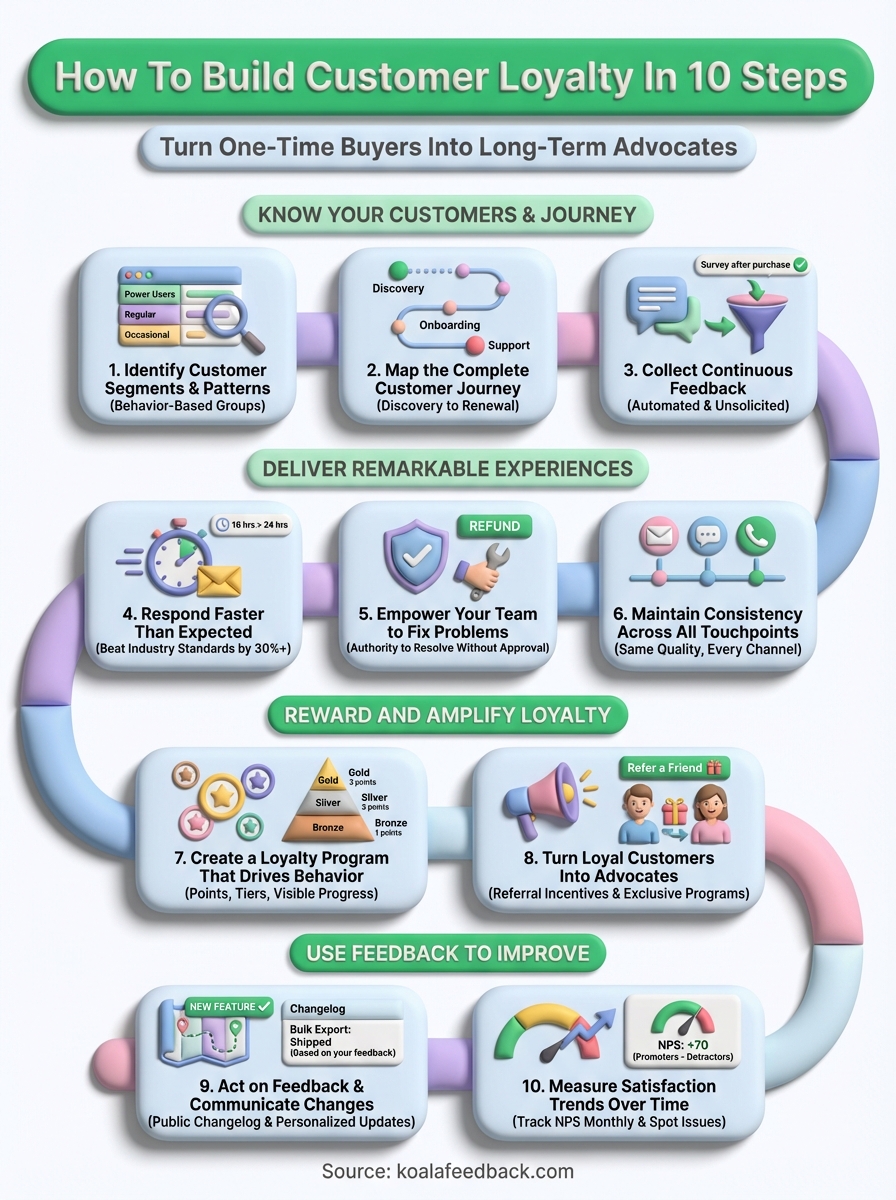
Building customer loyalty becomes manageable when you break it into specific steps you can execute this week. Start by analyzing your current customer segments and identifying the three highest value groups. Then map their journey to find the friction points that cost you repeat business. These initial actions give you clarity on where to focus your energy.
Pick two steps from this guide to implement immediately. You might launch a simple feedback survey after purchases or create response time standards that beat your competitors. Small improvements compound quickly when you track results and adjust based on what works. The businesses that win at retention treat loyalty building as an ongoing process rather than a one time project.
Your feedback system determines how well you execute on these strategies. Koala Feedback helps you collect customer input, prioritize feature requests, and close the loop by showing users exactly which improvements came from their suggestions. When customers see their feedback driving real changes, they become invested in your success and stick around for the long term.

Start today and have your feedback portal up and running in minutes.