You know you need customer feedback flowing into your product decisions, but staring at a blank page trying to design a VoC program from scratch wastes time you don't have. Most teams either skip this step entirely or copy a generic survey template that nobody actually reads. Looking at how real companies structure their programs saves you from that trial and error.
This article rounds up practical voice of the customer examples pulled from companies across SaaS, retail, and B2B services, showing exactly how they collect input, what questions they ask, and how they turn answers into action. Instead of theory, you get concrete VoC program examples you can study and adapt, whether you're running quarterly surveys, in-app prompts, or a dedicated feedback portal.
Below, you'll find nine examples covering different collection methods, from NPS surveys to open feedback boards, along with the specific tactics that made each one work. We'll also point out where a centralized feedback tool fits into the picture, since chasing input across spreadsheets, emails, and support tickets tends to be where most customer feedback strategies quietly fall apart.
AlTing into., ○ votKo. It combinesnes vote counts, comment threads, and effort estimates so a product manager isn't't guessing which loud customer to make happy first. Teams then move validated requests onto a public romap with columns for planned, in progress, and completed work. Customizable statuses let teams signal nuance beyond a simple checklist, marking something as
Spotify built its voice of the customer program around a mix of in-app surveys, a public community forum, and heavy social listening across Twitter and Reddit. The company treats casual mentions and complaints as seriously as formal survey responses, which gives it a much wider net than a typical quarterly NPS email blast.
Users can submit ideas directly through the Spotify Community forum, where other listeners upvote and discuss suggestions before Spotify's product team ever sees them. Inside the app, Spotify also runs targeted micro-surveys tied to specific features, like asking a listener who just used a new playlist tool whether it matched their expectations. This layered approach means Spotify captures both structured data and unprompted, emotional reactions from real usage moments.
Product teams at Spotify tag and cluster forum threads by theme, then cross-reference them against usage analytics before greenlighting a build. A recurring complaint about shuffle play randomness, for example, led engineers to rework the algorithm after thousands of forum posts and social mentions pushed the issue to the top of the backlog. This is a good voice of customer example of pairing qualitative complaints with quantitative usage data instead of acting on volume alone.
The loudest complaint isn't always the most important one, but ignoring patterns across channels means missing real product signals.
Spotify's public acknowledgment of forum-driven changes, including release notes that reference community requests by name, keeps engagement high and gives users a reason to keep posting. Reddit threads dissecting Spotify updates routinely mention features that trace directly back to community requests, which reinforces the feedback loop. Ratings for major releases tend to improve when Spotify explicitly credits user input, a small but telling signal that transparency around feedback pays off in trust, not just feature quality.
LEGO runs one of the most well-known voice of the customer examples in consumer products, built around a platform called LEGO Ideas. Instead of guessing which sets fans want, the company lets its community submit and vote on entire product concepts, turning enthusiasts into an extended design team.
Fans submit build concepts directly to LEGO Ideas, complete with photos, part lists, and a short pitch explaining why the set deserves to exist. Other members vote on submissions, and once a concept crosses 10,000 supporters, LEGO's review board evaluates it for production. Beyond the platform, LEGO also gathers input through customer service interactions and social media, feeding those observations into the same review process so isolated complaints don't get lost.
Submissions that clear the voting threshold go through a formal review board that checks for buildability, licensing conflicts, and market fit before greenlighting production. LEGO doesn't rubber-stamp every popular idea; the board rejects concepts that don't align with brand standards or production costs, which keeps the program credible rather than a popularity contest. This structured filter is what separates a real voice of customer program example from a suggestion box that never gets acted on.
A voting threshold only works if there's a real review process behind it, otherwise popularity replaces judgment entirely.
Dozens of LEGO Ideas sets have shipped as official products, including sets based on NASA's Women in Space, classic video games, and fan-favorite architecture. Each set credits the original submitter by name on the box and in marketing materials, a detail that keeps the community submitting new concepts year after year. Sales data shows these community-sourced sets consistently sell well, proving that fan-validated demand translates into real revenue rather than just goodwill.
Slack treats support tickets as a primary research channel, not just a queue to clear. Every message that comes through Slack's support team gets tagged by topic and sentiment, turning routine troubleshooting into a running dataset of what's confusing or missing in the product. That approach makes this one of the more practical voice of customer examples for B2B software companies, since it doesn't require building a separate survey program from scratch.
Customers reach Slack support through in-app chat, email, and a public feedback form embedded in the help center, and each interaction gets logged with metadata about the account, plan tier, and feature involved. Beyond reactive support, Slack also runs periodic in-product surveys targeting specific workflows, like asking admins how they'd rate the setup process for a new integration. Support agents are trained to flag recurring phrasing or complaints, even when a customer doesn't explicitly request a feature, which surfaces friction that a structured survey would likely miss.
Tagged tickets flow into a shared repository that product managers review weekly, sorted by frequency and account value rather than raw volume alone. A spike in confusion around notification settings, for instance, prompted a redesign of the preferences menu after support data showed the same three questions repeating across hundreds of tickets. Slack's product team treats this recurring-question pattern as a stronger signal than a single detailed feature request, since it points to a usability gap affecting many accounts at once.
A single detailed complaint matters less than the same simple question showing up hundreds of times.
Redesigned settings pages and simplified onboarding flows have measurably cut repeat tickets on the same topics, freeing support staff to handle more complex issues. Enterprise customers in particular cite responsive support as a reason they renew, and Slack's own customer stories highlight faster resolution times as a retention driver. This example shows that a VoC program doesn't always need dedicated tooling to start working; sometimes it just needs better tagging of the feedback you're already collecting.
Marriott built its guest feedback system around a structured survey called Guest Voice, sent after nearly every stay across its full portfolio of brands. Unlike a generic post-purchase email, Marriott ties responses directly to specific properties and even specific departments, which makes this one of the clearer voice of customer program examples for large, multi-location businesses trying to avoid vague, company-wide averages.
Guests receive a Guest Voice survey by email within a day or two of checkout, covering everything from room cleanliness to front desk interactions to food service. Marriott also trains staff to solicit informal feedback during the stay itself, logging comments into the same system that processes survey data, so a complaint mentioned to a bellhop carries the same weight as one typed into a form. Loyalty program members get slightly different prompts tied to their tier, letting Marriott separate expectations of a frequent Bonvoy traveler from a first-time guest.
Each property has a general manager who reviews survey scores weekly, and low scores in a specific category trigger a direct follow-up with the department responsible, whether that's housekeeping or dining. Corporate teams aggregate scores across regions to spot brand-wide patterns, like a consistent complaint about check-in wait times at a particular tier of hotel, then push operational changes down to individual properties. This local-plus-global structure keeps the feedback loop tight enough that a single hotel can fix a problem within days rather than waiting for a quarterly report.
Feedback that reaches the person responsible for fixing it works faster than feedback that only reaches a dashboard.
Properties with consistently high Guest Voice scores see measurably better repeat booking rates, and Marriott ties portions of manager performance reviews to these scores, which keeps attention on the numbers year-round. The system also feeds into public review responses, since staff use survey detail to address specific complaints rather than issuing generic apologies. That specificity, drawn straight from the survey data, is often what turns a frustrated guest into a returning one.
Netflix runs one of the more data-heavy voice of the customer examples on this list, blending viewing behavior with direct surveys instead of leaning on either one alone. The company treats what you watch, pause, and abandon as feedback in its own right, then layers structured surveys on top to fill in the gaps that raw viewing data can't explain.
Subscribers occasionally see short in-app surveys asking about specific titles, recommendation quality, or interface changes, usually triggered right after a relevant viewing session. Netflix also tracks passive signals like rewatches, early exits, and search terms that return no results, treating these behaviors as a form of unspoken feedback. Combining the two means the company doesn't need every user to fill out a survey to understand where a show or feature is falling flat.
Data science teams cross-reference survey responses against viewing patterns before deciding whether a complaint reflects a real trend or a vocal minority. A wave of survey comments about the autoplay preview feature, paired with data showing users muting or skipping past it, pushed engineers to add clearer controls for turning it off. This mix of stated opinion and observed behavior is what separates Netflix's approach from a company that only reacts to written complaints.
What people say they want and what they actually do often disagree, and the gap between the two is where the real insight lives.
Recommendation accuracy has improved steadily as Netflix folds survey feedback into its ranking models, which keeps subscribers watching longer per session. Interface tweaks driven by this feedback loop, like adjustable autoplay settings, show up in App Store and Play Store reviews as specific praise rather than vague satisfaction. That kind of detailed positive response is a strong signal that the underlying feedback loop is catching the right problems.
Honda leans on customer clinics and long-running dealer relationships to shape vehicle design decades before a model reaches production. Unlike a digital-first company, Honda treats in-person observation as a core research method, watching how real drivers interact with a car rather than relying only on written surveys. That hands-on habit makes this one of the more instructive voice of customer program examples for manufacturers building physical products, not just software.
Engineers and product planners run structured customer clinics, inviting groups of current and prospective owners to sit in prototype vehicles and react to seating position, dashboard layout, and controls before any tooling gets locked in. Dealers also feed structured feedback upward through regular reporting on service complaints and trade-in reasons, giving Honda a view into problems owners don't always mention on a formal survey. Telematics data from connected vehicles adds a quieter layer, flagging which features drivers actually use versus ignore.
Design teams weigh clinic reactions alongside dealer service data before finalizing interior layouts, often adjusting details as small as cupholder placement or infotainment button size based on repeated complaints. A pattern of owners struggling with a prior generation's touch-based climate controls, for instance, pushed Honda back toward physical knobs in later redesigns. That reversal shows Honda treating clinic feedback as a real design input, not a formality to check off before launch.
Ignoring repeated complaints about basic controls to chase a modern look is how you lose the customers you already have.
Models that went through heavier clinic testing tend to score better in long-term owner satisfaction studies, and Honda regularly ranks near the top of reliability and loyalty rankings published by independent auto research groups. Owners returning to the brand across multiple vehicle purchases suggest the clinic-and-dealer feedback loop is catching the details that keep people satisfied years after the sale, not just at the moment of purchase.
DHL built its First Choice program around Six Sigma methodology, turning customer complaints into structured data that feeds directly into process improvement projects. Unlike a retail company chasing star ratings, DHL operates in B2B logistics, where a single unhappy account can represent millions in shipping volume, so the program treats every complaint as a potential process defect worth tracing back to its root cause.
Account managers log complaints and satisfaction scores through a centralized system tied to Net Promoter Score surveys sent after major service interactions, like a delayed shipment or a customs issue. Frontline staff, including drivers and warehouse teams, are trained to escalate recurring complaints upward rather than resolving them quietly and moving on, which keeps small operational problems from disappearing before management ever sees a pattern. DHL also holds regular account reviews with large clients, treating those conversations as a structured feedback channel rather than a routine check-in.
Complaints get routed into Six Sigma improvement projects, where teams map out the process behind a recurring issue, like repeated delays at a specific customs checkpoint, and redesign the workflow rather than just apologizing to affected clients. This example of voice of customer examples in a legacy industry shows that a formal quality methodology can work as well as any app-based survey tool when the goal is fixing operational root causes.
A complaint that gets logged but never traced to its root cause will keep coming back under a different name.
DHL credits First Choice with measurable drops in complaint volume across regions where the program has run longest, along with improved on-time delivery rates tracked internally against pre-program baselines. Large enterprise clients cite the structured review process as a reason they renew multi-year contracts, since it gives them a documented path for raising and resolving operational friction instead of just filing a complaint into a void.
Duolingo treats its massive user base as a live testing ground, running constant experiments alongside more traditional feedback channels. Gamification data, in-app prompts, and an active social media presence give the company a steady read on what keeps learners coming back and what makes them quit mid-lesson. This mix of playful branding and rigorous data collection makes it one of the more distinctive voice of customer examples in consumer apps.
Inside the app, Duolingo runs frequent in-app surveys tied to specific moments, like right after a learner fails a lesson three times in a row or completes a new course unit. The company also monitors app store reviews, Reddit threads, and its own Duolingo forums, where users debate lesson structure and report bugs in detail. Its social media team, known for aggressive, meme-driven posts, doubles as an informal listening post, since replies and comments surface complaints that a formal survey would never catch.
Product teams run A/B tests on nearly every change, treating in-app survey responses as one input alongside completion rates, streak data, and drop-off points at specific lesson types. A recurring complaint about repetitive exercises, for instance, led to a broader library of exercise formats so the same grammar point doesn't feel like the same drill every time. This is a clear voice of customer program example of pairing stated frustration with behavioral data before committing engineering time to a fix.
A feature only ships when the data and the complaints point the same direction, not just one or the other.
Retention metrics have improved steadily as Duolingo folds survey feedback into its testing pipeline, and course completion rates rise noticeably after changes tied directly to reported frustration. The company's social media following, now in the millions, doubles as a feedback amplifier, since users tag Duolingo directly with complaints and feature requests that product teams monitor alongside formal channels.
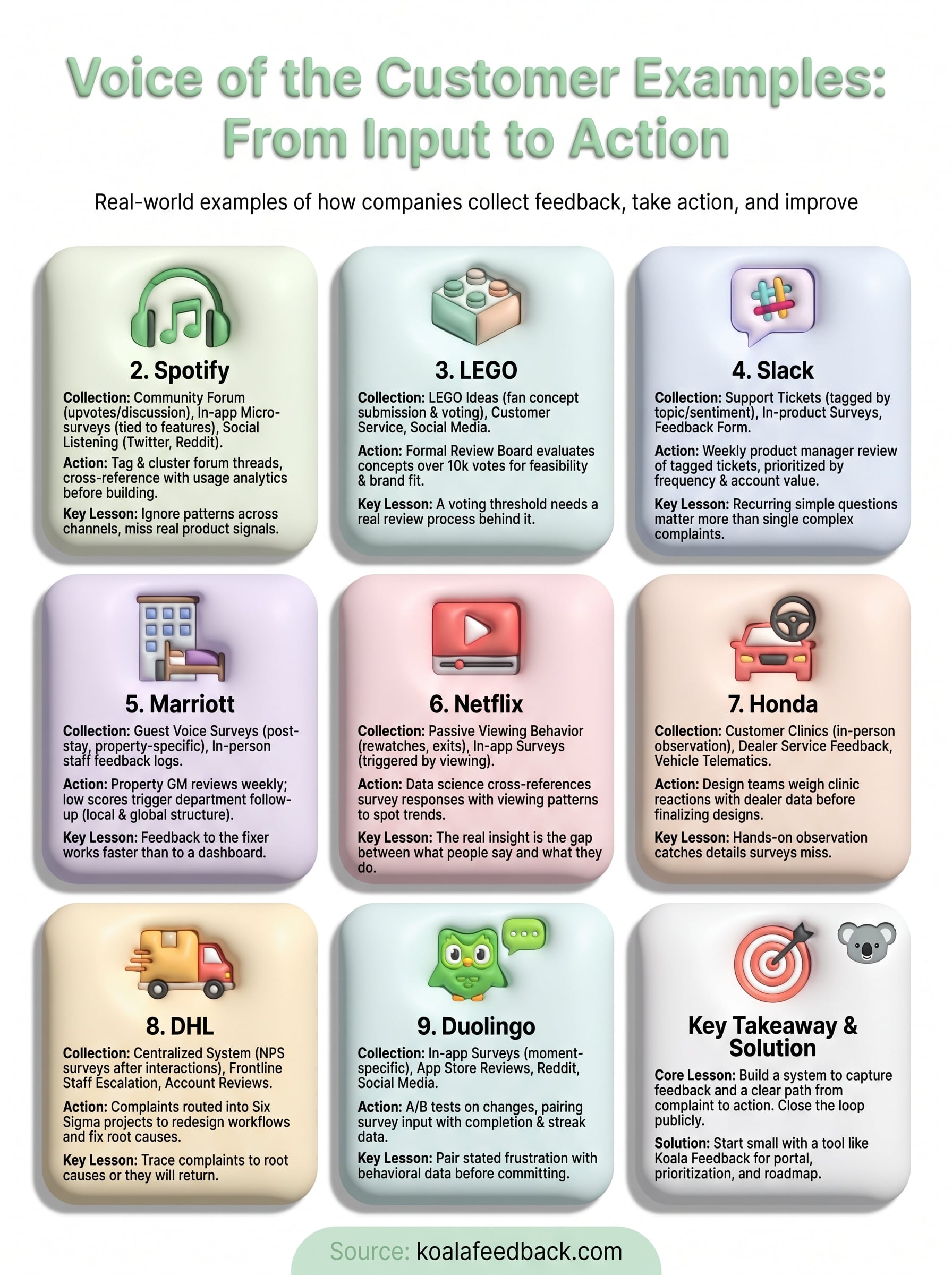
None of these companies got their voice of the customer program right by accident. Spotify tags forum threads, Marriott routes scores to the right department, Duolingo tests every complaint against real usage data. The common thread is a system for capturing feedback and a clear path from complaint to action, not a survey that disappears into a spreadsheet.
Start smaller than DHL or Netflix. Pick one channel, tag what comes in, and close the loop publicly so users see their input matters. That last part is what keeps people submitting feedback instead of giving up on you.
If you want that structure without building it from scratch, Koala Feedback gives you a feedback portal, prioritization boards, and a public roadmap in one place, so your team can focus on acting on feedback instead of chasing it across tools.

Start today and have your feedback portal up and running in minutes.