Most teams collect customer feedback. Few do it with any real structure. Feedback pours in from support tickets, social media, surveys, and sales calls, and without a system to make sense of it all, the most valuable insights get buried. A voice of customer framework gives you that system: a repeatable, organized approach to capturing what your customers actually think, analyzing it, and turning it into product decisions that move the needle.
But "framework" can mean a lot of things. Are we talking about a methodology like Kano or Jobs-to-Be-Done? A step-by-step process for launching a VoC program from scratch? Or a practical template you can adapt to your team's workflow? The answer, honestly, is all of the above, and knowing which model fits your situation is the difference between a feedback program that drives results and one that collects dust in a spreadsheet.
This guide breaks down the most widely used VoC frameworks and models, walks through the concrete steps to build your own program, and includes real examples to make it actionable. Whether you're a product manager at a growing SaaS company or leading a development team that needs to prioritize what to build next, you'll walk away with a clear blueprint for structuring your feedback process. And if you're looking for a tool to centralize that process, collecting feedback, letting users vote on requests, and sharing a public roadmap, that's exactly what we built Koala Feedback to do.
A voice of customer framework is a structured system for collecting, organizing, and acting on what customers say about their experiences, needs, and expectations with your product or service. Unlike random feedback collection, a framework gives you defined processes, consistent data sources, and clear outputs that connect directly to real product and business decisions. Think of it less as a one-time survey and more as a repeatable methodology your entire team operates on a predictable cadence.
A framework turns scattered customer input into a reliable input for your product strategy.
Every VoC framework, regardless of which model you use, shares a few foundational elements. First, there is data collection, which covers the channels and methods you use to hear from customers: surveys, interviews, support tickets, in-app prompts, reviews, and usage analytics. Second, there is analysis, where you identify patterns, priorities, and gaps across that data. Third, there is action, where insights get translated into concrete decisions, whether that means shipping a feature, fixing a friction point, or changing how you communicate a product benefit to a specific segment.
These components do not operate independently. The value of a VoC framework depends on how tightly they connect to each other: if your collection is strong but your analysis is inconsistent, insights get buried. If your analysis is thorough but your team never acts on the findings, the program stalls and trust in the process erodes. A well-designed framework creates a closed feedback loop where each component reinforces the others, and your team builds a habit of listening systematically rather than only reacting to the loudest voices.
Most products already have some version of feedback collection in place. A contact form here, an NPS survey there, maybe a shared inbox where the support team forwards customer complaints. That is not a voice of customer framework. General feedback collection tends to be passive and unstructured, which means you end up with a pile of inputs that have no clear owner, no consistent format, and no agreed-upon process for deciding what to do with them.
A VoC framework adds the structure that raw feedback collection lacks. You define who owns each feedback channel, what questions you are trying to answer, how frequently you gather data, and how findings get shared with decision-makers. It also means deliberately pulling from multiple sources rather than relying on a single signal. One unhappy customer in a support ticket might not mean much on its own, but when that same complaint surfaces across 30 user interviews and shows up in a spike in churn data, your framework helps you connect those dots and prioritize a fix before the problem scales.
It is worth separating VoC from broader user research. User research often focuses on usability and behavior, asking how customers interact with your product. A VoC framework focuses on needs, attitudes, and expectations, asking what customers want, why they want it, and how well your product currently delivers. Both methods complement each other, but VoC is specifically designed to feed prioritization decisions and roadmap planning, not just interface improvements. That distinction matters when you are deciding where to invest your research time and what questions to ask.
Building without structure means building on assumptions. When your team makes product decisions based on whoever spoke up last in a sales call or which feature request landed in the CEO's inbox, you are not working from signal, you are working from noise. A voice of customer framework replaces that guesswork with a consistent, repeatable process that gives everyone on your team the same grounded view of what customers actually need.
When feedback has no structure, prioritization becomes a political exercise rather than a data-driven one. The loudest customer, the most persistent internal stakeholder, or the most recent complaint tends to win the roadmap debate, regardless of whether it reflects a widespread problem. A framework changes that dynamic by giving you a documented, shared source of truth that your team can point to when defending a decision or pushing back on a request.
The teams that build the right things are the ones that listen systematically, not occasionally.
Your product roadmap becomes defensible when it reflects patterns across hundreds of customer inputs rather than a handful of anecdotal conversations. That kind of alignment shortens prioritization debates and helps your development team spend time building features that actually reduce churn, increase activation, or drive expansion revenue.
Customers who submit feedback and never hear back stop submitting feedback. Worse, they stop believing your product will solve their problems and start looking for alternatives. A structured framework closes that loop by creating a clear path from submission to response, whether that means updating a feature status on your public roadmap or simply acknowledging that an idea is under review.
Transparency builds loyalty in a way that occasional product updates never will. When users can see that their input shaped a real shipping decision, they become advocates rather than detractors. That shift has a measurable impact on retention and word-of-mouth growth, two metrics that matter far more than any single feature release. Investing in the framework is, at its core, investing in the relationship you have with the people who use your product every day.
Not every voice of customer framework looks the same. Different models suit different goals, and knowing which one fits your situation helps you avoid building a program that collects the wrong data. The three models below represent the most widely used approaches, each with a distinct focus and a clear use case for product and SaaS teams.
The Kano Model sorts features and customer needs into categories based on how much they affect satisfaction. Developed by Noriaki Kano in the 1980s, it distinguishes between basic needs (things customers expect without asking), performance needs (where more is always better), and delighters (unexpected features that drive strong positive reactions).
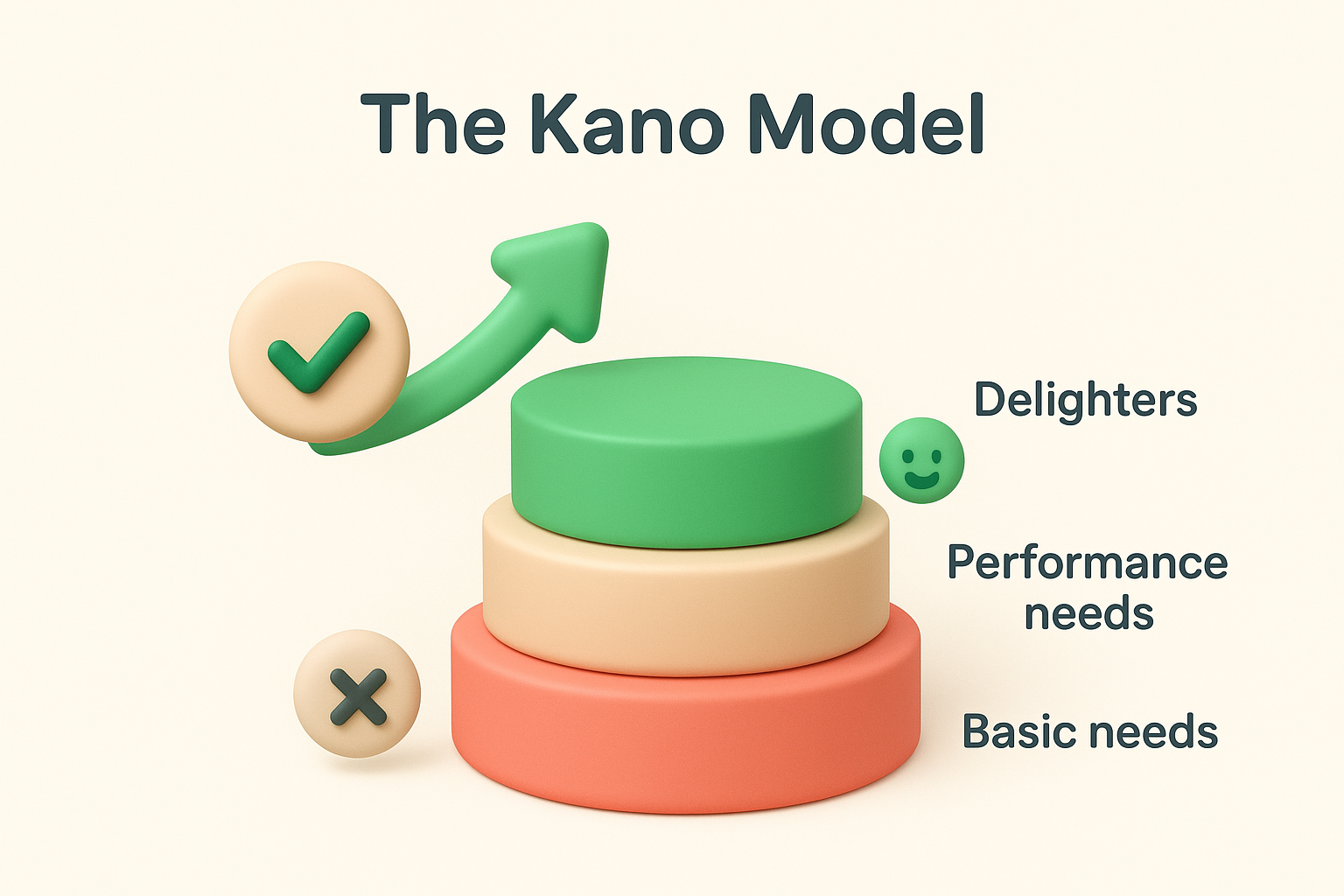
| Category | Definition | Example |
|---|---|---|
| Basic needs | Expected by default | App does not crash |
| Performance needs | More = higher satisfaction | Faster load times |
| Delighters | Unexpected but loved | Proactive usage tips |
This model works especially well for prioritization decisions because it stops your team from over-investing in baseline functionality while ignoring the features that actually differentiate your product in a competitive market.
Jobs-to-Be-Done (JTBD) shifts your focus from what customers say they want to why they need it in the first place. The core idea is that customers "hire" a product to accomplish a specific job in their lives. Understanding the underlying job reveals gaps your product currently fails to fill, even when surface-level feedback sounds positive.
When you understand the job your customers are trying to complete, you stop building features and start solving real problems.
For example, a SaaS user asking for a better export feature is not really asking for a different file format. They are trying to report progress to stakeholders with less friction, and JTBD gives you the framing to address that deeper need directly.
Customer journey mapping organizes feedback by the stages a customer moves through, from first discovery to active use and renewal. It lets you pinpoint exactly where friction appears across the lifecycle so you connect VoC data to specific moments rather than treating all feedback as equally urgent.
Adding this model alongside Kano or JTBD gives you a layered view of your customers, one that captures both what they need and where in the product experience those needs are currently going unmet.
Building a voice of customer framework from scratch feels overwhelming until you break it into focused, sequential steps. Each step produces a concrete output: a defined goal, a consolidated data source, a prioritized list, or a customer-facing update. That structure keeps your team moving forward instead of debating process while valuable feedback sits unread.
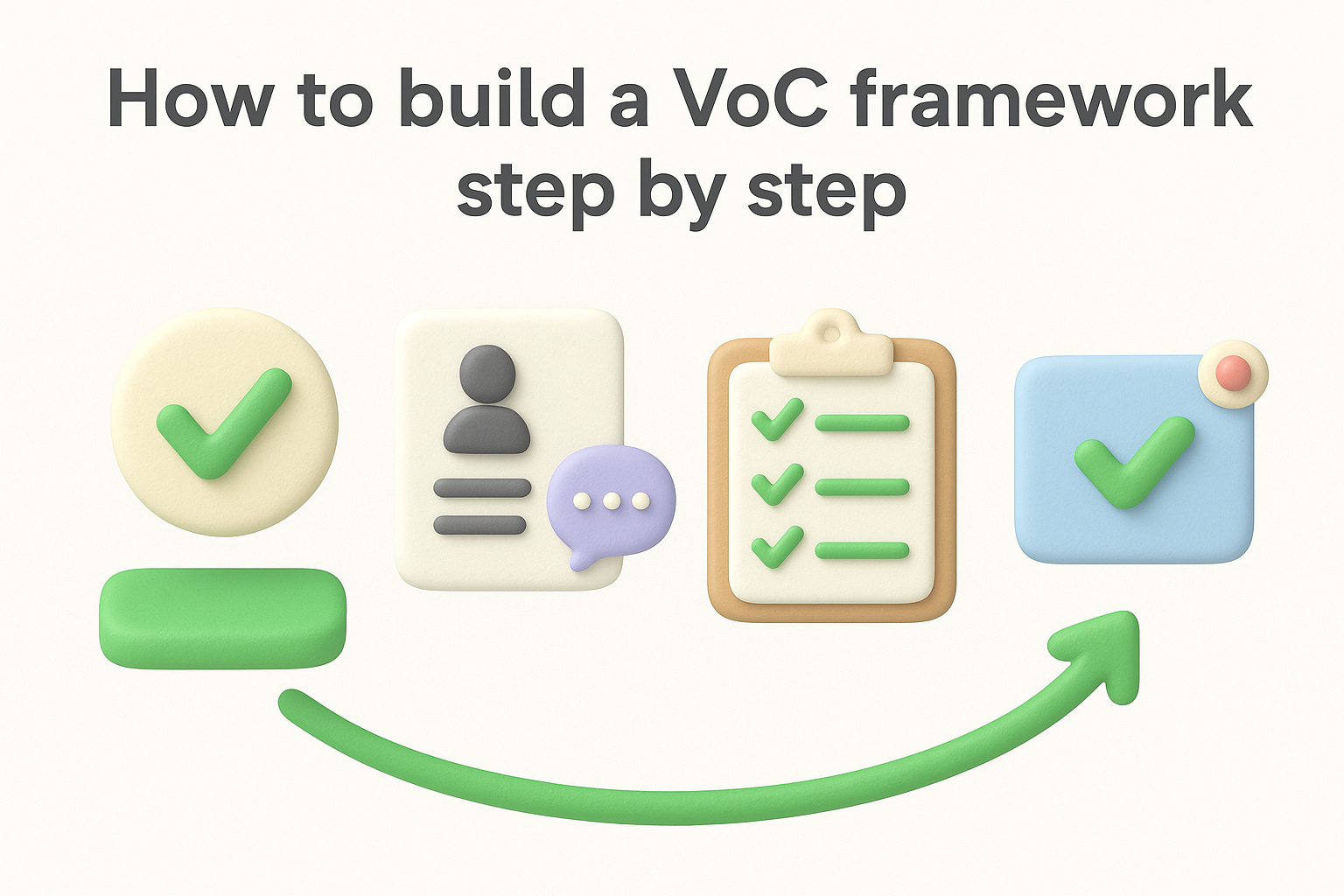
Before you collect a single response, decide what specific question you are trying to answer. Are you trying to reduce churn, prioritize next quarter's roadmap, or improve onboarding completion? Your goal determines which channels belong in your program. A team focused on activation might rely on in-app prompts and user interviews, while a team managing a broad customer base might weight support ticket analysis and NPS surveys more heavily. Documenting your goals upfront keeps the program focused and makes it easier to evaluate whether you are capturing the right signals.
Common feedback channels to consider:
The clearest sign of a poorly structured VoC program is a team that collects everything but acts on nothing.
Once your channels are active, you need one place where all feedback lands. Scattered inputs across email threads, spreadsheets, and Slack channels prevent your team from seeing the full picture. Centralizing feedback lets you spot recurring patterns quickly, assign clear ownership, and check whether a request has already been addressed in a prior release.
Your central system should also make it easy to tag and group related submissions so analysis in the next step does not require starting from scratch every cycle.
Raw feedback alone is not useful. You need to group similar requests into themes and score them against your business priorities. A simple weighting approach considers how frequently a request appears, how much revenue is at risk if it goes unaddressed, and how closely it aligns with your current product strategy.
After prioritizing, assign a clear owner to each action item and set a timeline. Closing the loop means communicating back to customers: updating a roadmap status, sending a changelog, or simply acknowledging that a request is under review. Customers who see their input reflected in a real product decision are significantly more likely to stay engaged with your program over time.
A voice of customer framework only delivers value if you track whether it is actually working. Measuring your program means going beyond counting how many responses you collect and asking whether the data you gather is influencing real decisions and producing outcomes your team can point to. Without that discipline, your program can feel busy while contributing nothing concrete to product direction.
Participation rate tells you whether customers are engaging with your feedback channels at all. If you send an NPS survey and 4% of recipients respond, the data you get back is not a reliable signal. Low participation usually points to a friction problem: the survey is too long, the timing is wrong, or customers do not believe their input will lead to anything. Tracking this metric over time shows whether your collection methods are improving.
| Metric | What it measures |
|---|---|
| Survey response rate | Customer engagement with feedback requests |
| Feature request volume | Depth of user investment in the product |
| Roadmap update frequency | How often insights are turned into visible action |
The true measure of a VoC program is not how much feedback you collect; it is how many decisions that feedback directly shapes.
Decision impact tracks how often your team uses VoC data to justify a product choice. Start by tagging roadmap items with the feedback source that drove them. Over time, you can calculate what percentage of shipped features originated from structured customer input rather than internal assumptions. That number tells you whether your framework is genuinely driving your product or just running in the background while real decisions happen elsewhere.
Your VoC program needs scheduled evaluation points, not just ongoing data collection. Set a quarterly review where your team audits the quality of your current channels, checks whether your original program goals still reflect your business priorities, and identifies any gaps in the feedback you are capturing. Regular reviews prevent the program from drifting out of alignment with what your product actually needs to learn from customers.
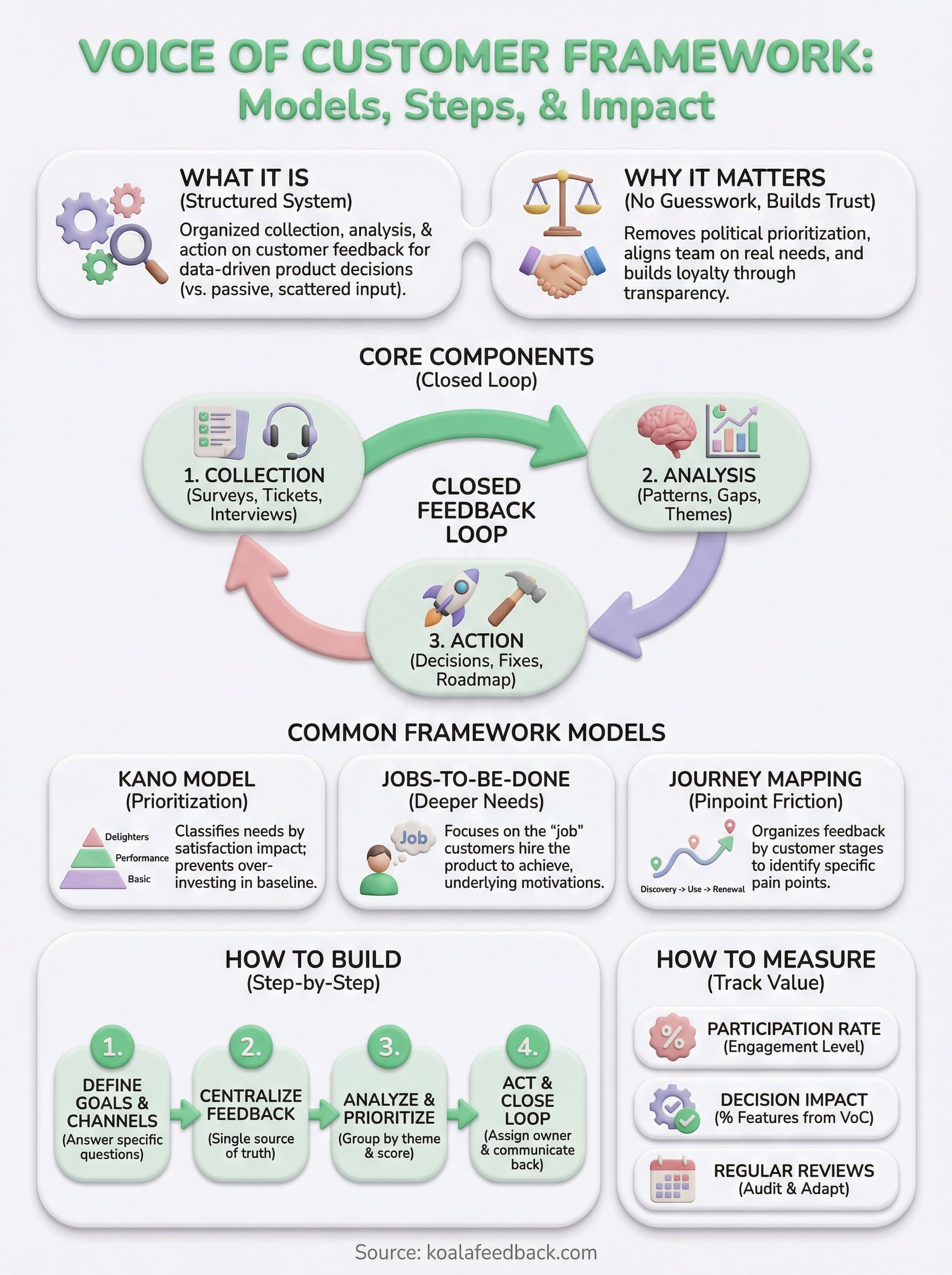
A voice of customer framework is not a project you finish once. It is a discipline you build into how your team operates, and the earlier you start, the faster you create a feedback loop that actually shapes what you ship. Start by picking one collection channel, centralizing the inputs it generates, and running a single prioritization review with your team. That first cycle will surface more useful signal than months of scattered feedback collection.
From there, layer in the models and measurement practices covered in this guide as your program matures. The goal is to move from reacting to individual requests to making decisions grounded in consistent, structured customer input. Every step you take toward that shifts your roadmap from a list of guesses into a reflection of what your users genuinely need.
If you want a tool built to support exactly that process, start centralizing your feedback with Koala Feedback today.

Start today and have your feedback portal up and running in minutes.