Most teams collect feedback reactively, a support ticket here, a churn survey there. But the richest customer insights come from sitting down and asking the right voice of customer interview questions before you build, not after. The difference between a product that resonates and one that misses the mark often comes down to how well you listen during these conversations.
At Koala Feedback, we help product teams centralize and prioritize user feedback so they can build what actually matters. And we've seen firsthand that the quality of your feedback depends entirely on the questions you ask to get it.
Below, you'll find 8 go-to interview questions we recommend asking every time you sit down with a customer, along with why each one works and how to use the answers to drive smarter product decisions.
This is one of the most direct voice of customer interview questions you can ask, and it works precisely because of that directness. You skip the guesswork and let customers tell you exactly where they feel friction or opportunity. Most customers have a mental wishlist ready to share if you just give them the opening.
Ask this question during a mid-cycle check-in or renewal conversation, when the customer has enough experience with your product to have real opinions. You can also drop it into a dedicated discovery interview once the customer has had two or three months of regular use. The more context they have, the more specific and actionable their answer will be.
The answer gives you a direct window into unmet needs and gaps in your current product. You'll often hear themes that no one has bothered to articulate in a support ticket. Customers frequently describe workflow bottlenecks they've silently worked around for months, and those workarounds point directly at your next highest-value feature.
The most useful product ideas rarely come from internal brainstorming. They come from customers describing the step they wish they didn't have to take manually.
A broad answer deserves a sharper follow-up. Try these to move from vague to concrete:
These follow-ups push the customer past surface-level feature requests and into the underlying need, which is what you actually need to build the right solution.
After the interview, log the insight directly into Koala Feedback's centralized feedback portal so it doesn't get buried in meeting notes. Tag it by theme, link it to any existing feature requests, and let your team vote on priority. Over time, repeated patterns across multiple interviews will surface the features worth building first.
This question rewinds the clock to the moment a customer made their buying decision. It uncovers the core pain point that drove them to seek a solution in the first place, which is often more revealing than anything they'll tell you after months of use.
Ask this early in a customer relationship, ideally within the first 60 days of onboarding. At that point, the original problem is still fresh, and the customer can articulate it clearly before daily habits shift their perspective.
You'll learn what your marketing and sales messaging either nailed or missed. Customers describe their problem in their own language, which gives you the exact words to use in positioning. This is one of the most underrated voice of customer interview questions for marketing teams as much as product teams.
The language a customer uses to describe their problem before buying is the same language future customers use when searching for a solution.
Push deeper with these follow-ups:
Log the stated problem verbatim in Koala Feedback and tag it against the relevant product area. When you see the same problem appear across multiple interviews, you have clear evidence to validate or reframe your roadmap priorities.
This question shifts the conversation from opinions to observations. Instead of asking customers what they want, you ask them to narrate real behavior, which gives you far more accurate data than hypotheticals ever will.

Ask this question when a customer mentions a task they do regularly in your product. It works best mid-interview, after they've warmed up and are already talking about their workflow.
You'll uncover exactly where things break down in practice. Customers often describe steps they've normalized but that are actually painful, like exporting data manually, copying information between tools, or waiting on a teammate. These friction points are gold for your product roadmap and represent some of the most actionable voice of customer interview questions you can ask.
Real behavior always tells you more than stated preferences. What customers do reveals the problem; what they say reveals how they feel about it.
Use these to dig into the details:
Log the specific workflow steps the customer described into Koala Feedback as a structured insight. Tag it against the relevant product area and link it to any related feature requests so your team can spot recurring friction patterns across multiple interviews.
This question targets hesitation and doubt, the exact moment a customer almost walked away. The answers expose real objections that your sales process may have never fully resolved, and that your product may still carry as silent risks.
Ask this question during an early customer success conversation, ideally in the first 30 to 60 days. The friction points that nearly blocked the deal are still fresh, and the customer is usually willing to be honest now that they've committed.
You'll surface unresolved concerns around pricing, trust, feature gaps, or competitive doubts. These are often the same objections your next prospects will have, which makes this one of the most strategically valuable voice of customer interview questions you can ask.
What almost stopped a customer from buying is almost always what's stopping your next prospect right now.
Dig past the initial answer with these:
Log the specific objection into Koala Feedback and tag it by category, such as pricing, onboarding, or missing features. When the same concern appears across multiple interviews, your team has clear signal on what to fix or communicate better.
This question forces customers to reconstruct their buying journey, including every competitor or workaround they evaluated before choosing you. The answer tells you exactly who you're up against and what criteria matter most when customers make real comparisons.

Ask this during an early onboarding interview, before the customer's memory of the evaluation process fades. Within the first 30 days, customers can still recall which tools they tested, what they liked, and what fell short.
You'll learn your real competitive landscape, not just the names that show up in analyst reports. Customers often evaluated spreadsheets, internal tools, or products you've never considered direct competitors. This makes it one of the sharpest voice of customer interview questions for shaping both your product positioning and your roadmap.
What customers compared you against tells you more about your market than any competitive analysis you could run internally.
A good first answer usually names a competitor but skips the reasoning behind the comparison. These follow-ups pull out the specific criteria that drove the decision:
Log the competitor names and evaluation criteria directly into Koala Feedback and tag each insight by product area. When the same competitor surfaces repeatedly, your team gets clear signal on where to sharpen the feature set to win more deals.
This question anchors the conversation in near-term outcomes rather than abstract goals. When you ask customers to define success on a short timeline, they give you concrete, measurable answers instead of vague aspirations, and those specifics tell you whether your product is actually solving the right problems right now.
Ask this question at the start of a quarterly business review or a mid-onboarding check-in. The 30-day window is specific enough to prompt realistic, grounded answers rather than long-range wishes that are harder to act on.
You learn what outcomes your customer is actively accountable for right now. Those outcomes reveal whether your product maps to their real priorities or whether there's a gap between what you offer and what they actually need to succeed. This is one of the most forward-looking voice of customer interview questions in your toolkit.
A customer's 30-day success metric is a direct signal of whether your product fits their current reality or just their initial expectation.
Push the answer further with these:
Log the stated success metric into Koala Feedback and tag it by use case or product area. When multiple customers share similar 30-day goals, your team gains clear direction on which features to build or improve first.
This question goes straight to churn risk before it becomes a real problem. Asking customers directly what would drive them away gives you an honest look at the conditions under which your product fails them, and that information is far more valuable when you hear it during a conversation than after they've already left.
Ask this question during a mid-cycle health check, ideally after a customer has been active for three to six months. At that point, they've seen enough of the product to have a grounded answer, and you still have time to act on what they tell you.
Customers will name the scenarios and failure points that genuinely threaten retention. You'll hear about missing features, pricing thresholds, reliability concerns, or shifts in their business that could make your product irrelevant. These answers are among the most candid you'll get from any set of voice of customer interview questions.
What a customer says would make them leave tells you exactly what keeps them staying.
Sharpen the answer with these follow-ups:
Log the specific churn trigger into Koala Feedback and tag it by risk category. When the same trigger appears across multiple interviews, your team has direct evidence of where to focus retention efforts first.
This question gives customers permission to be honest about a specific frustration without feeling like they're attacking your product. The constraint of choosing just one thing forces them to prioritize their complaints, which tells you what actually bothers them most versus what's just background noise.
Ask this near the end of any customer interview, once the conversation has already built rapport. At that point, customers are warmed up and willing to give you a direct, unfiltered answer rather than a polite non-response.
You'll surface the single biggest friction point a customer carries into every session. These answers often expose product issues that never make it into support tickets because the customer has adapted to the inconvenience. This is one of those voice of customer interview questions that cuts through noise fast.
The one thing a customer would change is usually the one thing quietly costing you retention.
Keep the momentum going with these follow-ups:
Log the specific change or removal request in Koala Feedback and tag it by product area. When the same friction point appears across multiple customers, your team has hard evidence to justify prioritizing that fix on the roadmap.
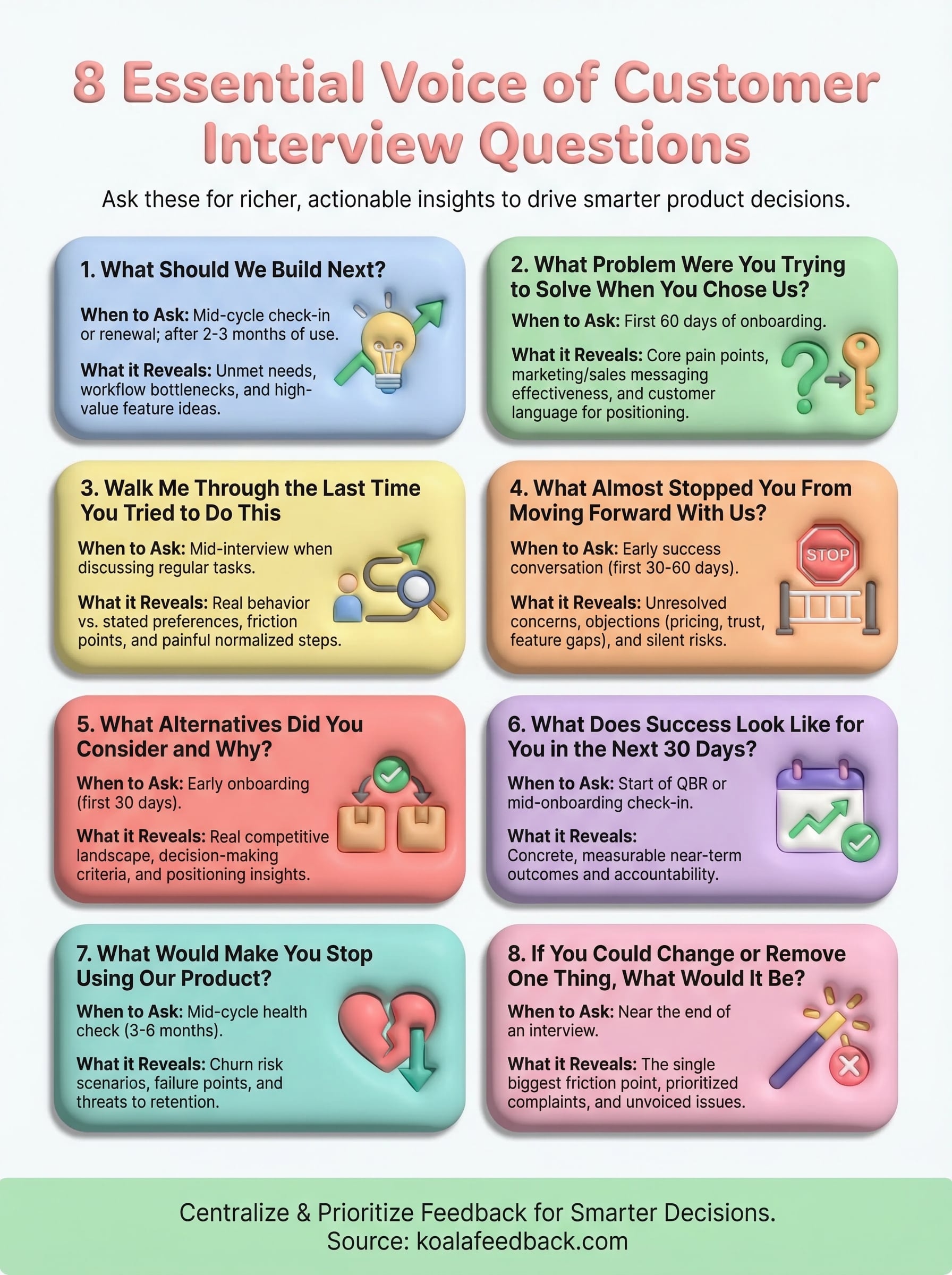
These 8 voice of customer interview questions give you a repeatable framework for extracting real insight from every customer conversation. Each question targets a specific blind spot, whether that's unmet needs, churn risk, or competitive positioning, and the follow-ups ensure you walk away with concrete, actionable data rather than vague impressions.
The hardest part isn't asking the questions. It's making sure the answers actually influence your roadmap instead of sitting in a folder nobody opens. That's where a structured system pays off. When you log insights, track patterns, and let your team vote on priorities, you turn scattered interview notes into a product direction your whole team can act on.
Koala Feedback gives you exactly that, a central place to collect feedback, organize it by theme, and share your roadmap with the users who helped shape it. Start building a product your customers asked for.

Start today and have your feedback portal up and running in minutes.