Your users are already telling you what to build, the question is whether you're actually capturing it. Scattered feedback across emails, support tickets, Slack messages, and social media makes it nearly impossible to spot patterns or prioritize effectively. That's exactly why picking the best voice of customer software has become a critical decision for product teams and SaaS businesses of every size.
VoC platforms pull all that scattered input into one place, helping you understand what users want, what's frustrating them, and where your product should go next. But not every tool approaches this the same way. Some focus on surveys and sentiment analysis, others on feedback collection and feature prioritization, and the right pick depends entirely on how your team operates.
At Koala Feedback, we built our platform around this exact problem: capturing user feedback, organizing it, and turning it into a clear product roadmap. So we know what matters in a VoC tool. In this guide, we break down 11 platforms worth evaluating in 2026, comparing their features, strengths, and trade-offs so you can make a confident choice for your team.
Koala Feedback sits at the intersection of feedback collection, feature prioritization, and roadmap communication. If your goal is to understand what users want and show them you're actually listening, this platform is built specifically around that workflow.
Koala Feedback is a dedicated product feedback platform for SaaS businesses and product teams that need a structured way to collect, organize, and act on user input. It fits into the VoC stack as the bridge between raw user requests and your development backlog. Rather than replacing analytics or support tools, it gives users a direct channel to submit ideas and lets your team manage those ideas without drowning in spreadsheets or scattered email threads.
When users can see their feedback acknowledged and tracked, they trust your product roadmap and stay engaged longer.
Users submit ideas and feedback through a dedicated feedback portal that you can brand with your own domain, colors, and logo. This keeps the experience consistent with your product rather than sending users to a generic third-party page. Once feedback comes in, Koala Feedback automatically deduplicates and categorizes submissions so you're not wading through 50 variations of the same request.
Your team can organize incoming feedback into prioritization boards based on product areas or feature sets, making it straightforward to see which areas generate the most demand. Users can vote on and comment on feature requests, which adds a layer of crowdsourced signal to your prioritization decisions. Instead of guessing what matters most, you get a ranked view of what your actual users care about.
Once you've prioritized what to build, Koala Feedback lets you share a public-facing product roadmap that shows planned, in-progress, and completed features. This is where most feedback tools stop short. Koala Feedback goes further by giving you customizable statuses to manage user expectations at each stage of development. Users who submitted a request can see exactly where it stands without needing to email your support team.
Closing the loop is one of the most underrated parts of any VoC program. When users see their idea move from "planned" to "completed," it reinforces that their input drives real decisions. Koala Feedback makes that visible without any manual effort on your part.
Koala Feedback works best for:
Koala Feedback offers a free plan that covers the core feedback portal and voting functionality, making it accessible for teams that are just getting started. Paid plans unlock features like custom domains, advanced customization, and roadmap sharing, with pricing designed to scale alongside your product. You can check current plan details directly at koalafeedback.com to find the tier that fits your team size and workflow.
Qualtrics is one of the most recognized platforms in experience management, and it sits firmly at the enterprise end of the voice of customer software spectrum. It covers customer, employee, product, and brand experience under one roof, which makes it both capable and relatively complex to implement compared to lighter-weight alternatives.
Qualtrics positions itself as a full experience management platform rather than a survey tool. In a VoC stack, it functions as a centralized system for collecting feedback across every stage of the customer journey, then routing that data to the teams responsible for acting on it. Large organizations use Qualtrics when they need enterprise-grade VoC programs that pull signals from multiple business units and channels into a unified view.
Qualtrics gives you multiple collection methods: web intercepts, email surveys, SMS, QR codes, and in-product feedback widgets. You can trigger surveys based on user behavior or lifecycle stage, which makes it easier to capture input at moments that actually matter rather than just at arbitrary intervals. The platform also integrates with CRM and support systems so you can attach feedback to specific customer records without manual data transfers.
Behavioral triggers let you capture feedback at the exact moment a user completes a task, producing more accurate data than batch email surveys sent weeks later.
Qualtrics includes built-in text analytics that categorizes open-ended responses by topic and sentiment automatically. Its dashboards are highly configurable, letting you build role-specific views so executives see summary metrics while product teams drill into granular feedback trends. You can also set up automated action workflows that alert specific team members when NPS drops below a threshold or when a topic spikes in response volume.
Qualtrics works best for large enterprises and mid-market companies running structured, multi-channel VoC programs that span departments, customer segments, and geographic regions.
Qualtrics does not publish standard pricing. Plans are quote-based and vary significantly depending on the features, seat count, and data volume you need. Expect a meaningful enterprise investment before factoring in implementation costs. You can request a demo directly through their website to get a tailored quote.
Medallia is an enterprise-grade platform that competes directly with Qualtrics for large organizations running complex VoC programs. Where Qualtrics emphasizes survey-driven data collection, Medallia leans heavily into real-time signal capture across every customer touchpoint, making it one of the best voice of customer software options for companies that need continuous feedback rather than periodic survey snapshots.
Medallia functions as a centralized experience intelligence platform built for organizations that interact with customers across multiple channels, products, and service teams. In a VoC stack, it sits at the data aggregation layer, pulling signals from digital, physical, and conversational touchpoints and surfacing them to the teams who can act on them. Companies in retail, financial services, healthcare, and hospitality tend to rely on Medallia when their customer journey spans both online and in-person experiences.
Medallia captures feedback through email and SMS surveys, website intercepts, mobile in-app forms, and point-of-sale terminals. Beyond traditional survey methods, it ingests signals from call center transcripts, chat logs, and third-party review sites, giving you a more complete picture of customer sentiment than surveys alone can provide.
Pulling signals from unsolicited feedback like call transcripts often surfaces issues that customers would never take the time to report through a formal survey.
Your team can connect CRM and ticketing systems so every piece of feedback attaches to a customer record, letting you track sentiment alongside purchase history or support interactions without manual data merging.
Medallia uses AI-driven text analytics to categorize and score open-ended feedback automatically. Role-based dashboards let different teams see the data most relevant to their function, and automated alerts notify frontline managers when a location, product, or team dips below a defined performance threshold. This structure closes the gap between collecting feedback and taking meaningful action on it quickly.
Medallia works best for large enterprises in service-heavy industries that need real-time feedback loops and operational workflows built directly into their VoC program.
Medallia is quote-based with no public pricing. Contracts typically involve significant annual commitments, and implementation costs add to the total. Contact Medallia directly through their website for a custom quote.
Forsta emerged from the merger of Confirmit and FocusVision, bringing together survey research tools and qualitative data capabilities under one platform. It targets research teams and enterprise organizations that need structured, repeatable VoC programs rather than a lightweight feedback widget.
Forsta positions itself as a human experience research platform, covering both quantitative surveys and qualitative methods like video interviews and discussion boards. In a VoC stack, it fills the research layer, helping you design systematic studies and manage data collection over time rather than capturing spontaneous user submissions. Teams running structured, ongoing research programs get more value from Forsta than teams looking for a quick feedback portal.
Forsta gives you a full survey authoring environment with advanced logic, branching, and multi-language support built in. Beyond standard surveys, you can recruit and manage proprietary research panels directly within the platform, which separates it from most of the best voice of customer software tools in this list. Rather than relying on third-party panel vendors, you build and own your research audience, which produces more consistent longitudinal data over time.
Owning your research panel gives you direct access to a known, segmented audience you can survey repeatedly, making trend data far more reliable than ad hoc outreach to your general user base.
Forsta includes built-in data visualization and dashboard tools that let you tailor views for different stakeholders, from executive summaries to detailed research breakdowns. Its text analytics processes open-ended responses to surface themes and sentiment automatically. When your team needs deeper analysis, you can export data to BI tools like Tableau or Power BI for custom reporting. CRM integrations let you tie research findings back to individual customer records without manual data transfers.
Forsta works best for market research teams and enterprise VoC programs that require robust survey authoring, panel management, and qualitative research capabilities in a single platform.
Forsta operates on a custom quote model with no publicly listed pricing. Costs vary by module, panel size, and user count. Reach out directly through the Forsta website for a tailored quote.
Verint takes a different angle than most platforms on this list. Rather than starting with surveys and expanding outward, it roots VoC in contact center operations, making it a strong fit for companies where a significant portion of customer feedback arrives through calls, chats, and support interactions.
Verint is an enterprise customer engagement platform that combines traditional feedback collection with contact center intelligence. In a VoC stack, it occupies the operational layer, connecting feedback from surveys and digital channels with speech and text data from customer service interactions. Organizations in financial services, telecommunications, and retail use Verint when they need feedback tied directly to service performance rather than treated separately from it.
Verint collects feedback through web and email surveys, IVR post-call surveys, and in-app feedback widgets, covering the channels most enterprise teams rely on. What separates it from other best voice of customer software tools is its ability to ingest call recordings and chat transcripts through built-in speech analytics, capturing unsolicited feedback from every customer conversation and not just from users who take the time to complete a formal survey.
Analyzing call transcripts alongside survey data gives you a far more accurate read on what's frustrating customers, since most people express friction directly to a support agent long before they ever open a feedback form.
Verint processes both structured survey responses and unstructured voice data through its analytics layer, surfacing themes, sentiment scores, and emerging issues automatically. Role-specific dashboards push relevant insights to frontline managers, product teams, and executives without requiring anyone to dig through raw data. Automated alerts notify the right person when a metric crosses a defined threshold, which reduces the lag between identifying a problem and acting on it.
Verint works best for large enterprises with significant contact center operations that want to unify survey-based feedback with call, chat, and speech data in a single platform.
Verint uses a custom pricing model with no publicly listed rates. Costs scale with the modules you enable and the data volume you process. Contact Verint directly through their website for a quote tailored to your team's scope.
InMoment is a customer experience intelligence platform that sits between enterprise tools like Qualtrics and Medallia and more focused feedback tools. It targets organizations that need to capture feedback across both digital touchpoints and in-person interactions, then analyze that data to drive specific business outcomes rather than just generate reports.
InMoment positions itself as an XI (Experience Improvement) platform, which means it focuses on turning feedback into action rather than just storing it. In a VoC stack, it functions as a combined collection and analysis layer that connects customer signals to operational teams. Retail, hospitality, and financial services companies tend to rely on InMoment when their customer experience spans both physical locations and digital channels simultaneously.
InMoment collects feedback through web intercepts, email surveys, SMS, and in-app prompts, covering the channels most product and CX teams prioritize. For organizations with physical locations, it also supports point-of-sale and kiosk-based feedback collection, which makes it one of the few tools on this list that handles omnichannel journeys without requiring a separate tool for in-store data.
Capturing feedback immediately after an in-person interaction produces significantly more accurate sentiment data than sending a follow-up survey hours or days later.
InMoment applies AI-powered text analytics to open-ended responses, automatically categorizing themes and scoring sentiment without manual tagging. Role-based dashboards let different teams access the data most relevant to their function, reducing the time your team spends filtering through noise to find actionable insights. It also includes closed-loop alerting workflows that notify the right team member when a customer has a negative experience, enabling a direct follow-up before the issue compounds.
InMoment works best for mid-market and enterprise organizations in retail, hospitality, and financial services that need a single platform to manage feedback across both digital and in-person customer journeys.
InMoment uses a custom quote model with no publicly listed pricing. Costs vary based on the channels you activate, user count, and data volume. You can request a demo through their website to get a quote aligned with your program scope.
Chattermill takes a different approach than most of the best voice of customer software tools in this list. Instead of collecting feedback directly, it focuses on unifying feedback you already have spread across multiple sources and turning it into a structured, searchable view of what customers are actually saying.
Chattermill is an AI-powered customer feedback analytics platform that ingests data from existing tools, such as support tickets, app store reviews, NPS responses, and survey platforms, then analyzes everything in one place. In a VoC stack, it sits at the analysis and synthesis layer rather than the collection layer. Product and CX teams at companies like Uber, Spotify, and Transferwise have used it to make sense of large volumes of existing feedback without manually tagging or sorting through individual responses.
Chattermill connects to a wide range of feedback sources through native integrations, including Zendesk, Intercom, Salesforce, Typeform, and app store reviews. Once you connect your sources, it normalizes and centralizes all that data so your team stops jumping between tools to understand what customers are saying. This matters most when feedback is spread across support, product, and marketing without a shared system tying it together.
When feedback from support tickets and NPS surveys lives in separate tools, you often miss the connection between a recurring complaint and a measurable drop in satisfaction scores.
Chattermill uses deep learning models to detect themes and sentiment in open-ended feedback automatically, going beyond basic keyword matching to understand context and nuance in what customers write. You can track how specific themes shift over time, which helps your team spot emerging issues before they compound or confirm that a product change had the intended effect on customer sentiment.
Chattermill works best for mid-market and enterprise product and CX teams that already collect feedback across multiple tools and need a dedicated layer to consolidate, analyze, and act on that data without rebuilding their collection stack.
Chattermill does not list pricing publicly. Plans are quote-based depending on data volume and the number of integrations you need. You can request a demo through their website to get a tailored estimate.
Brandwatch approaches voice of customer data from a completely different angle than most tools in this list. Instead of asking customers to fill out a form or click through a survey, it monitors public conversations across social media, news sites, forums, and review platforms to capture what people say about your brand organically.
Brandwatch is a social intelligence and consumer research platform that helps businesses understand customer sentiment at scale by tracking public mentions across the web. In a VoC stack, it fills the unsolicited feedback layer, capturing opinions and reactions that customers express publicly without being prompted by your team. Product managers and marketing teams use it to understand how their brand and products are perceived in the real world, separate from what users say when they know they're being surveyed.
Brandwatch connects to an extensive network of social platforms, news outlets, blogs, forums, and review sites, giving you broad coverage across the channels where your customers actually discuss your product. You set up keyword queries, brand mentions, and topic filters to define the data stream you want to monitor. Once your queries are live, the platform continuously pulls in matching content so your team always has an up-to-date view of the conversation happening around your brand.
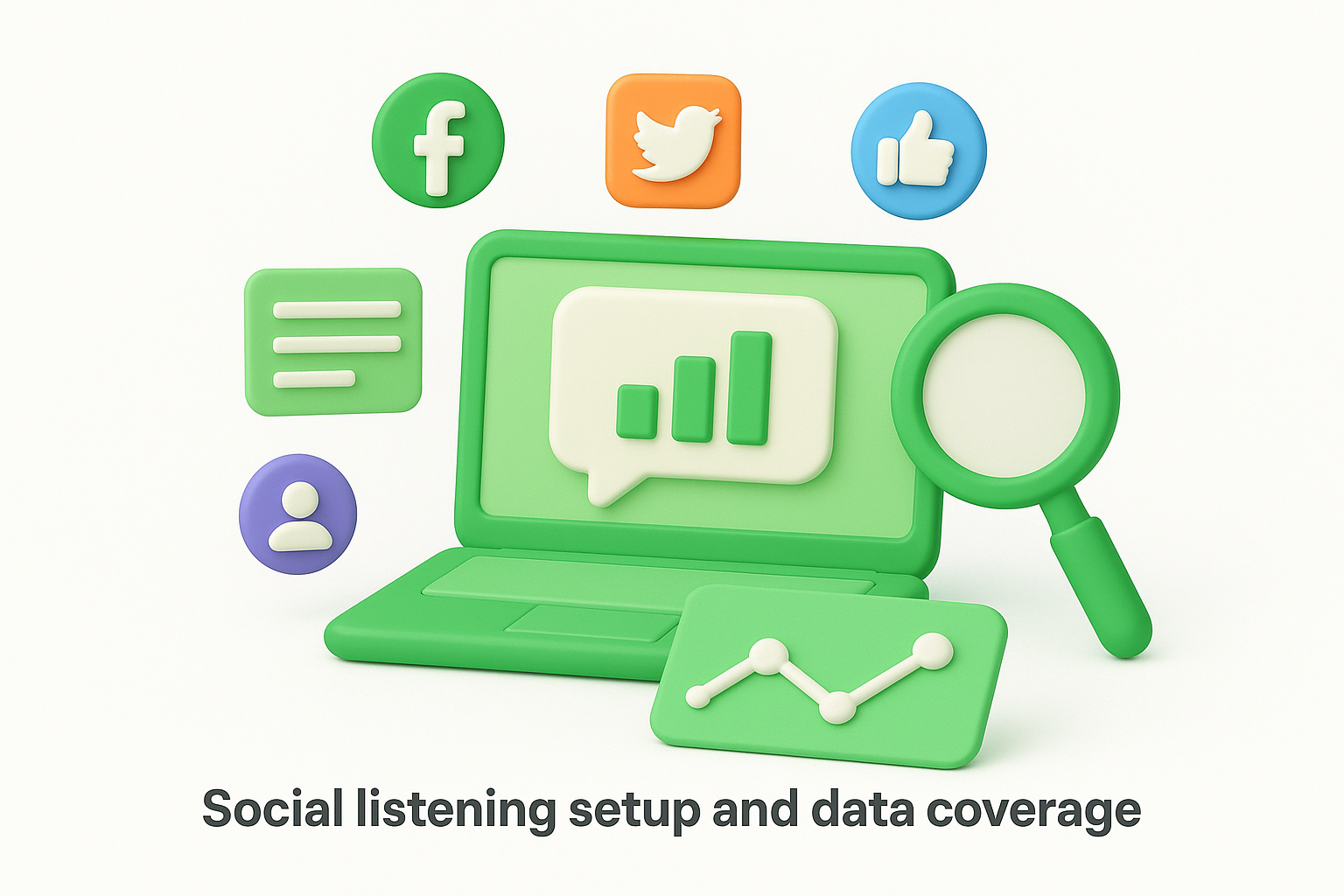
Unsolicited public feedback often surfaces product frustrations and unmet needs that users would never bother submitting through a formal feedback channel, making it one of the most honest VoC data sources available.
Brandwatch applies AI-powered sentiment analysis to categorize mentions as positive, negative, or neutral, and groups them into themes so you can spot trends without reading every post manually. One of its stronger features is competitive benchmarking, which lets you compare your brand's sentiment and share of voice against specific competitors over time. This makes it one of the more distinctive picks among the best voice of customer software options if understanding your market position matters as much as understanding your users.
Brandwatch works best for marketing, brand, and product teams at mid-market and enterprise companies that want to track consumer sentiment across public channels and benchmark against competitors without relying solely on direct user surveys.
Brandwatch uses a custom quote model with no publicly listed pricing tiers. Costs depend on data volume, the number of queries you run, and seat count. You can request a demo through their website to get a scoped estimate.
Talkwalker is a social listening and analytics platform that sits close to Brandwatch in terms of what it does, but takes a stronger focus on media monitoring and earned media analysis. If your VoC program needs to capture what's being said about your brand across news, podcasts, and broadcast media in addition to social channels, Talkwalker covers ground that most survey-focused tools miss entirely.
Talkwalker is a consumer intelligence and social listening platform used by brand, marketing, and research teams to track public sentiment across online and offline media. In a VoC stack, it operates in the unsolicited feedback layer, pulling in what people say about your brand publicly rather than through structured feedback forms. It works well as a complement to survey-based tools when you want a fuller picture of customer perception beyond what formal feedback channels capture.
Talkwalker monitors social media platforms, news sites, blogs, forums, review sites, and broadcast media, giving you one of the broader data coverage footprints among the best voice of customer software tools in this list. You set up keyword and brand queries to define your monitoring scope, and the platform continuously updates your data stream as new mentions appear. Its Blue Silk AI layer processes incoming content to surface patterns and themes without requiring manual review of individual posts.
Monitoring broadcast media and podcasts alongside social channels captures brand conversations that purely digital listening tools miss entirely.
Talkwalker gives you customizable dashboards that display sentiment trends, share of voice, and topic clusters in a format you can tailor for different stakeholders. You can configure real-time alerts to notify your team when a specific keyword spikes in volume or when sentiment around your brand shifts, enabling a faster response to emerging issues. Reporting tools let you export data and visualizations for presentations or for sharing findings across teams without rebuilding charts manually every time.
Talkwalker works best for brand, PR, and marketing teams at mid-market and enterprise companies that need broad coverage across:
Talkwalker operates on a custom quote model with no publicly available pricing. Plan costs depend on the data volume and channels you monitor. Contact them directly through their website to get a scoped estimate for your team.
QuestionPro is a survey platform that has grown its feature set to cover a dedicated VoC module, making it one of the more accessible options for mid-market teams that want structured feedback collection without the enterprise pricing that platforms like Qualtrics or Medallia require.
QuestionPro sits in the survey and research layer of a VoC stack, giving product and CX teams a flexible tool for collecting structured feedback from customers at defined points in the journey. Its VoC module adds journey mapping and customer experience scoring on top of the core survey engine, which lets you move beyond one-off surveys toward a more systematic approach to capturing customer sentiment over time. It lands in a practical middle ground among the best voice of customer software options for teams that need more than a basic form builder but don't need a full enterprise platform.
QuestionPro supports multiple survey types, including NPS, CSAT, and CES, with advanced branching logic that adapts questions based on previous answers. You can distribute surveys through email, SMS, QR codes, and embedded website widgets, giving you coverage across the channels your customers actually use. The platform also supports offline data collection, which makes it useful for field research or in-person events where internet access isn't reliable.
Building branching logic into your surveys means customers only answer questions relevant to their experience, which reduces drop-off rates and improves the quality of the data you collect.
QuestionPro generates real-time reports with built-in charts and filters so your team can slice data by respondent segment, time period, or response type without exporting to a separate tool. CRM and helpdesk integrations connect survey responses to existing customer records, letting you attach feedback to specific accounts or support interactions. The platform also exports data to tools like Tableau and SPSS for teams that need deeper statistical analysis beyond what the built-in dashboards provide.
QuestionPro works best for mid-market product and CX teams that need a flexible survey platform with VoC-specific features at a price point that fits a tighter budget than enterprise alternatives.
QuestionPro offers a free plan with basic survey functionality. Paid plans scale up for the VoC module, advanced logic, and integrations, with current pricing listed directly on their website.
SurveyMonkey is one of the most widely recognized survey tools available, and its familiarity works in its favor for teams that need to launch a VoC program quickly without a steep learning curve. It won't replace an enterprise platform, but for teams that need structured customer feedback without complex setup, it covers the core use cases well.
As a tool, SurveyMonkey sits in the survey collection layer of a VoC stack, giving you a fast, accessible way to gather structured customer feedback through purpose-built templates and straightforward distribution options. It works best as a standalone feedback collection tool or as a complement to a product feedback platform like Koala Feedback, where you want to supplement ongoing user input with periodic structured surveys. Teams that are just starting their VoC program often begin here before moving to more purpose-built tools as their needs grow.
SurveyMonkey includes pre-built templates for CSAT, NPS, and CES surveys, which means you can have a customer satisfaction survey live in under an hour without writing questions from scratch. Distribution covers email, web links, and embedded website widgets, giving you enough reach to connect with customers across the channels most teams rely on. You can also apply branching logic so respondents only see follow-up questions relevant to their specific answers, keeping surveys short and completion rates higher.
Shorter, targeted surveys consistently outperform long generic questionnaires on completion rates, which directly affects the quality and volume of data you collect.
Real-time summary reports with built-in charts and filters let you review results as responses arrive without waiting for a manual export. You can pull data into CSV, Excel, or SPSS for deeper analysis in external tools, and integrations with Salesforce, HubSpot, and Slack route responses to the systems your team already uses. Among the best voice of customer software options in this list, SurveyMonkey offers the lowest barrier to getting useful survey data without heavy configuration work upfront.
SurveyMonkey works best for small to mid-market teams that need a fast, low-cost way to collect structured VoC data through surveys without committing to an enterprise platform.
SurveyMonkey offers a free plan with basic survey creation and limited responses per month. Paid plans unlock advanced question types, branching logic, integrations, and higher response limits, with current pricing listed directly on their website.
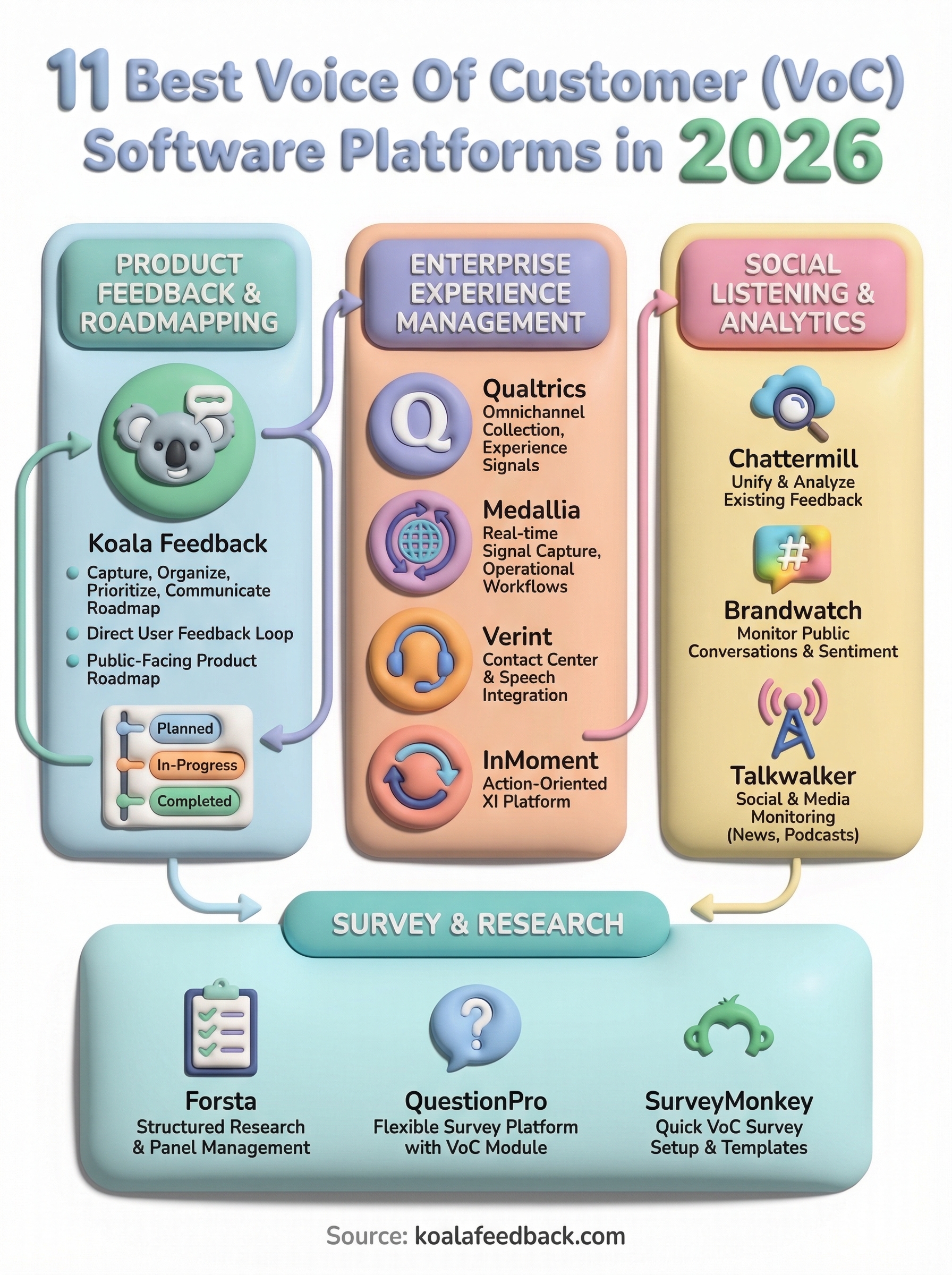
Picking the best voice of customer software comes down to what problem you're actually trying to solve. If you need enterprise-scale survey programs with deep analytics and cross-department workflows, platforms like Qualtrics, Medallia, or Verint are built for that scope. If your team wants to track public sentiment across social and media channels, Brandwatch or Talkwalker cover that layer well. For research-driven teams, Forsta and QuestionPro offer structured survey capabilities at different price points.
For SaaS product teams that need a direct, transparent feedback loop with their users, Koala Feedback handles the full cycle from collecting ideas to sharing a public roadmap. Your users get a clear channel to submit requests, vote on what matters, and see their feedback turn into real product decisions. That visibility builds trust in a way most tools on this list don't address directly.
Start capturing and prioritizing user feedback with Koala Feedback and see how it fits your team.

Start today and have your feedback portal up and running in minutes.