Your users are talking. They submit feature requests through your portal, leave reviews on third-party sites, and send detailed emails to support. The feedback keeps coming from everywhere, but turning those scattered opinions into clear product decisions feels like trying to find patterns in static noise. You know valuable insights are hiding in there, but manual analysis takes hours and still leaves you wondering if you caught everything.
This guide walks you through 16 feedback analysis software options that use AI to make sense of your user feedback. Each tool brings different strengths to the table. Some excel at text analytics and sentiment detection, others shine at organizing feature requests and spotting duplicate ideas. A few specialize in survey analysis, while others connect feedback directly to your product roadmap. You'll see what each platform does best, when it makes sense for your team, and what it costs. By the end, you'll know which tool fits your specific needs, whether you're a startup collecting your first hundred responses or an enterprise processing thousands of feedback entries every month.
Koala Feedback combines feedback collection with basic analysis features to help you organize user requests into a clear product direction. The platform automatically deduplicates submissions and groups similar ideas, so you spend less time sorting through repetitive feedback and more time understanding what your users actually need. You get a centralized view of all feedback alongside voting patterns that reveal which features matter most to your audience.

The platform's analysis tools focus on organization and pattern recognition rather than deep sentiment analysis. When users submit feedback, Koala Feedback automatically identifies duplicate requests and merges them, giving you clean data to work with. The voting system shows you which ideas resonate most with your user base, while comment threads reveal the reasoning behind feature requests. You can categorize feedback into custom boards based on product areas, making it easier to spot trends within specific parts of your product. The system tracks submission volume over time, helping you identify growing concerns or emerging patterns in user needs.
You should consider this feedback analysis software when your primary goal is gathering and prioritizing feature requests rather than analyzing complex sentiment data. Product teams at SaaS companies find it particularly useful because the public roadmap feature keeps users informed about progress on their suggestions. The tool works best when you want to give users a voice in product direction and need a straightforward way to see which ideas have the strongest support.
Koala Feedback shines when transparency and user engagement matter as much as the feedback itself.
Koala Feedback offers a free plan that includes core features for small teams just starting with structured feedback collection. Paid plans provide additional customization options, including custom domains and branding controls, with pricing that scales based on your feature needs and team size.
Thematic specializes in transforming unstructured text feedback into structured insights through AI-powered analysis. The platform processes open-ended survey responses, customer reviews, and support tickets to identify themes and sentiment patterns automatically. You get detailed visualizations that show how customer opinions shift over time, making it easier to spot emerging issues before they become major problems.
The platform uses natural language processing to analyze text feedback at scale, identifying recurring themes across thousands of responses without manual coding. Thematic's AI engine learns from your data, adapting to your specific industry terminology and customer language patterns. You can track sentiment changes over time, compare feedback across different customer segments, and drill down into specific themes to see representative quotes. The system highlights statistically significant changes in feedback patterns, alerting you when new themes emerge or existing ones spike in volume.
Thematic turns thousands of text responses into clear, actionable themes that your team can act on immediately.
This feedback analysis software fits best when you collect large volumes of open-ended feedback that would take days to analyze manually. Companies with mature customer experience programs use it to process survey comments, social media mentions, and review site feedback in one place. You should consider Thematic when understanding the "why" behind customer behavior matters as much as tracking satisfaction scores. The platform delivers the most value when you need theme-level insights rather than just sentiment classification, particularly if you want to connect feedback themes to business metrics like retention or revenue.
Thematic follows a custom pricing model based on feedback volume and feature requirements. You'll need to contact their sales team for a quote tailored to your organization's needs and data sources.
Qualtrics operates as an enterprise-grade experience management platform that combines feedback collection with powerful predictive analytics. The system processes feedback from multiple touchpoints including surveys, social media, and customer support interactions, giving you a complete view of customer sentiment across your entire organization. You get AI-driven insights that not only tell you what customers think today but predict how they'll behave tomorrow.
The platform delivers advanced text and statistical analysis through machine learning algorithms that identify patterns in both structured and unstructured feedback. Qualtrics automatically scores sentiment, detects emerging themes, and flags significant changes in customer opinion before they impact your business metrics. You can segment responses by any attribute, compare feedback across different customer groups, and track satisfaction trends in real time. The system integrates with your CRM and other business tools, allowing you to connect feedback data with customer behavior metrics like purchase history or support tickets. Cross-tab analysis lets you uncover relationships between different variables in your feedback data, revealing insights that simple reporting would miss.
Qualtrics transforms feedback into forecasts, helping you prevent problems instead of just documenting them.
This feedback analysis software makes sense when you run large-scale feedback programs across multiple departments or regions. Enterprise teams choose it when they need sophisticated analytics capabilities and predictive modeling that goes beyond basic sentiment scoring. You should consider Qualtrics when your organization collects feedback from diverse sources and needs a single platform to analyze everything together. The investment pays off when statistical rigor matters and you need defensible insights for executive-level decisions.
Qualtrics uses a custom quote pricing model based on your organization's size, feature requirements, and data volume. Contact their sales team directly to discuss enterprise licensing options.
InMoment combines AI-powered text analytics with human expertise to help you understand feedback across every customer touchpoint. The platform captures data from surveys, social channels, reviews, and support interactions, connecting these sources into a unified view of your customer experience. You get predictive insights that identify issues before they escalate and recommendations that tell you exactly what actions will improve satisfaction scores.
The platform processes feedback through sophisticated text analytics that categorize responses, identify sentiment, and detect emerging themes automatically. InMoment's AI engine analyzes language patterns to predict customer intent, helping you understand not just what customers say but what they'll do next. You can track feedback trends across different channels and segments, comparing satisfaction levels between product lines, regions, or customer types. The system connects feedback patterns to business outcomes like revenue and retention, showing you which improvements deliver the strongest ROI. Real-time dashboards surface actionable insights as feedback arrives, letting your team respond to problems immediately rather than waiting for monthly reports.
InMoment bridges the gap between what customers tell you and what your business should do about it.
This feedback analysis software works best when you operate across multiple channels and need enterprise-grade analytics to make sense of complex feedback streams. Organizations choose it when they want predictive capabilities that go beyond reporting what happened to forecasting what's coming. You should consider InMoment when connecting customer feedback directly to business metrics matters and you need robust security for sensitive data. The platform delivers maximum value when your team needs both automated insights and access to human analysts who can interpret nuanced feedback patterns.
InMoment follows a custom pricing model tailored to your organization's feedback volume, data sources, and feature requirements. Contact their sales team for an enterprise quote based on your specific needs.
Lumoa uses Generative AI to transform customer feedback from multiple channels into real-time insights that your team can act on immediately. The platform pulls data from surveys, reviews, emails, and chat interactions, combining everything into a single analytics dashboard. You get automated analysis that identifies themes and sentiment patterns as feedback arrives, letting you respond to customer concerns before they turn into larger problems.

The platform analyzes feedback through AI-powered text analytics that automatically categorize responses and detect sentiment across different feedback sources. Lumoa's system identifies recurring themes in customer comments, flags significant changes in sentiment trends, and generates GPT-powered summaries that give you quick overviews of what customers think. You can track satisfaction metrics over time, compare feedback across different customer segments, and drill into specific themes to understand the details behind each insight. The dashboard visualizes trends through charts and graphs that make complex feedback patterns easy to understand at a glance.
This feedback analysis software works best when you collect feedback from multiple channels simultaneously and need real-time analysis to keep pace with incoming data. Teams choose it when they want AI assistance that goes beyond basic sentiment scoring to provide actionable theme identification and trend detection. You should consider Lumoa when quick insights matter more than deep statistical analysis and when your feedback volume would overwhelm manual review processes.
Lumoa turns scattered feedback streams into coherent insights that your team can understand and use immediately.
Lumoa offers a custom quote pricing model based on your feedback volume and required features, with published starting rates at $555 per month when billed annually.
Qualaroo delivers real-time feedback collection through targeted surveys that appear at strategic moments during the user journey. The platform captures responses through behavior-triggered nudges, website surveys, and mobile in-app prompts, giving you immediate insights into what users think while they're actively engaged with your product. You get AI-powered analysis that processes feedback as it arrives, helping you understand customer sentiment without waiting for batch reports.
The platform processes feedback through IBM Watson-powered analytics that automatically detect sentiment and categorize responses by theme. Qualaroo's AI engine analyzes text responses to identify emotional tone, flagging positive, negative, and neutral feedback patterns across your surveys. You can segment responses based on user behavior, demographics, or custom properties, letting you compare feedback from different audience groups. The system tracks sentiment trends over time and highlights statistically significant changes in customer opinion. Advanced targeting lets you trigger specific surveys based on user actions, ensuring you capture feedback at the exact moments that matter most for your analysis.
This feedback analysis software works best when you need contextual feedback collected at specific touchpoints in the user experience. Teams choose it when understanding the "why" behind user behavior matters and when you want to capture opinions in the moment rather than through retrospective surveys. You should consider Qualaroo when mobile app feedback collection matters and when you need dynamic survey flows that adapt based on user responses.
Qualaroo captures customer thoughts at decision points, giving you insights tied to actual user behavior.
Qualaroo offers a free plan with basic features for small teams. Paid plans start at $19.99 per month when billed annually, with additional features and survey volume available at higher tiers.
Hotjar combines behavioral analytics with feedback collection, giving you both quantitative data about user actions and qualitative insights about their thoughts. The platform captures heatmaps, session recordings, and survey responses in one place, letting you see what users do alongside what they say. You get context around feedback that standalone survey tools miss, because you can watch actual user behavior that led to their comments.
The platform processes feedback through AI-assisted surveys that you can trigger based on user behavior or page visits. Hotjar analyzes survey responses to identify trends and patterns, though its analysis features focus more on combining feedback with behavioral data than deep text analytics. You can segment feedback by user attributes, compare responses across different page types, and connect survey answers to session recordings of those same users. The system tracks response rates and completion patterns, helping you understand which survey approaches work best. When you review feedback, you see it alongside heatmap data and recordings that show exactly what users experienced before they responded.
This feedback analysis software works best when you need context around user opinions rather than just the opinions themselves. Teams choose it when understanding the full user experience matters and when you want to validate feedback claims by watching actual user sessions. You should consider Hotjar when your feedback strategy combines surveys with behavioral analysis and when you need visual proof of friction points users mention in their responses.
Hotjar shows you the complete story by pairing what users say with recordings of what they actually did.
Hotjar offers a free plan with limited features for small sites. Paid plans start at $39 per month when billed annually, with pricing tiers based on traffic volume and feature access.
Usersnap specializes in visual feedback capture, letting users submit bug reports and feature requests with annotated screenshots and screen recordings. The platform collects contextual data automatically with each submission, including browser details, console logs, and user environment information. You get feedback that shows exactly what users see and experience, eliminating the back-and-forth that comes with vague text descriptions.
The platform processes visual feedback through context-enriched submissions that include metadata about user sessions, making it easier to understand and prioritize issues. Usersnap's analysis tools let you categorize feedback by theme, track submission trends over time, and segment responses by user groups or product areas. You can filter feedback based on browser type, device, or custom properties, helping you identify patterns in how different user segments interact with your product. The customer portal feature centralizes all feedback in one place, letting your team review screenshots alongside text descriptions to understand the full context of each report.
This feedback analysis software works best when visual context matters and when text descriptions alone don't capture the complexity of user issues. Product teams choose it when collecting bug reports and usability feedback where seeing the actual problem makes all the difference. You should consider Usersnap when your product has complex interfaces and when users struggle to describe what they're experiencing in words alone.
Usersnap turns vague descriptions into clear visual evidence that your team can reproduce and fix immediately.
Usersnap offers paid plans starting at €39 per month when billed annually, with pricing tiers based on project volume and team size.
Sogolytics delivers survey-based feedback collection with advanced branching logic that adapts questions based on previous responses. The platform handles multi-channel distribution across email, web, SMS, and mobile devices, capturing feedback wherever your customers prefer to respond. You get flexible survey design tools combined with real-time analysis features that turn responses into actionable insights.

The platform processes feedback through advanced data analysis tools that track response patterns and identify trends across your survey data. Sogolytics offers real-time reporting dashboards that update as responses arrive, letting you monitor sentiment shifts and completion rates without waiting for manual reports. You can segment responses by custom attributes or demographics, comparing feedback across different user groups to spot patterns. The system supports text analytics for open-ended responses, automatically categorizing comments by theme and detecting sentiment polarity. Conditional logic in surveys means you collect more relevant feedback because questions adapt based on how users respond, giving you deeper insights from each submission.
This feedback analysis software works best when you need complex survey flows with sophisticated branching that guides respondents down different paths. Research teams choose it when collecting feedback that requires adaptive questioning and when you want mobile-responsive surveys that work across devices. You should consider Sogolytics when advanced survey logic matters more than basic feedback forms and when you need real-time visibility into response trends.
Sogolytics excels at creating intelligent surveys that adapt to each respondent's answers, capturing richer feedback data.
Sogolytics offers a 10-day free trial plus a free plan for basic use. Paid plans start at $25 per month when billed annually, with higher tiers providing additional response capacity and advanced features.
SurveySparrow takes a conversational approach to survey design, creating feedback experiences that feel more like natural dialogues than traditional questionnaires. The platform supports omni-channel distribution across email, web, social media, and mobile apps, capturing responses wherever your customers engage. You get real-time analytics that process feedback as it arrives, combined with conditional logic that adapts surveys based on how people respond.
The platform processes feedback through real-time analytics dashboards that update instantly as responses come in, letting you track sentiment trends and completion patterns without delays. SurveySparrow's analysis tools segment responses by custom attributes, compare feedback across different user groups, and identify patterns in how various demographics interact with your surveys. You can monitor NPS, CSAT, and CES scores alongside qualitative feedback, connecting satisfaction metrics with the reasoning behind them. The social feedback listening feature extends analysis beyond traditional surveys by monitoring and collecting feedback directly from social media platforms, giving you a complete view of customer sentiment across all channels.
SurveySparrow combines conversational survey design with comprehensive analysis to capture and understand feedback across every customer touchpoint.
This feedback analysis software works best when you want engaging survey experiences that boost completion rates through conversational flows. Teams choose it when collecting feedback across multiple channels matters and when you need automated workflows that trigger actions based on survey responses. You should consider SurveySparrow when traditional surveys feel too rigid and when you want to monitor social sentiment alongside direct feedback.
SurveySparrow offers paid plans starting at $19 per month when billed annually, with pricing tiers based on features and response volume.
ProProfs Survey Maker focuses on comprehensive survey creation with built-in analysis tools that help you understand customer feedback patterns. The platform offers 100+ professionally designed templates and a library of ready-made questions that speed up survey creation while ensuring you ask the right things. You get customization options for branding alongside reporting features that turn responses into visual insights your team can act on quickly.
The platform processes feedback through advanced reporting dashboards that track response patterns, completion rates, and answer distributions across your surveys. ProProfs analyzes data in real time, letting you monitor feedback trends as responses arrive rather than waiting for manual compilation. You can segment responses by custom attributes, compare feedback across different survey types, and export data for deeper analysis in external tools. The system generates visual reports with charts and graphs that make complex feedback patterns easier to understand at a glance. Smart triggers let you capture feedback at strategic moments, ensuring you collect responses when they're most relevant and accurate.
This feedback analysis software works best when you need quick survey deployment without sacrificing analytical depth. Teams choose it when they want pre-built templates that accelerate survey creation and when integration with CRM systems matters for following up on responses. You should consider ProProfs Survey Maker when your focus is comprehensive feedback collection paired with straightforward analysis rather than advanced text analytics.
ProProfs combines ease of use with solid reporting capabilities, making it ideal for teams that need reliable feedback insights without complexity.
ProProfs offers a forever free plan that includes up to 50 responses per survey. Paid plans start at $9.99 per month for 100 responses, with pricing scaling based on response volume and feature requirements.
Canny specializes in feature request management through public feedback boards where users vote on ideas and track progress. The platform captures feedback through branded portals that let customers submit requests, upvote existing ideas, and comment on proposals from other users. You get automated duplicate detection that identifies similar requests and merges them together, keeping your feedback organized without manual sorting.
The platform processes feedback through AI-powered duplicate detection that automatically identifies and groups similar feature requests, preventing your board from filling with repetitive submissions. Canny's analysis tools track voting patterns to show which features have the strongest user support, helping you prioritize based on actual demand rather than gut feeling. You can segment feedback by user attributes or custom properties, comparing what different customer groups request and identifying patterns in feature demand. The system monitors submission trends over time, flagging when specific themes gain momentum or when new types of requests emerge. Integration with project management tools like Jira and Linear lets you connect feedback directly to development workflows.
This feedback analysis software works best when you want transparent feature prioritization where customers see what others request and add their support through voting. Product teams choose it when public roadmaps matter and when showing users that their feedback influences product direction builds trust. You should consider Canny when organizing feature requests takes priority over analyzing sentiment in support tickets or survey responses.
Canny turns feature request chaos into clear priorities by letting your users tell you what matters most through their votes.
Canny offers a free plan with core feedback features for small teams. Paid plans start at $19 per month with additional customization options and administrative controls.
Pendo operates as a product experience platform that captures feedback alongside detailed usage analytics, giving you a complete picture of how users interact with your product. The system collects in-app feedback, NPS surveys, and feature requests while tracking which parts of your product users engage with most. You get analysis that connects user opinions to actual behavior patterns, helping you understand not just what users say but what they do.

The platform processes feedback through in-app surveys and polls that appear during the user journey, capturing opinions at moments when they're most relevant and fresh. Pendo's analysis tools segment responses by user attributes, letting you compare feedback from different customer types or usage levels. You can track NPS trends over time, identify which features drive satisfaction scores, and connect feedback themes to product adoption metrics. The session replay feature lets you watch how users interact with your product before they submit feedback, giving you context around their comments. Integration with project management tools like Jira means you can link feedback directly to development tasks, closing the loop between user requests and product improvements.
Pendo bridges the gap between what users say and how they behave, giving you insights grounded in actual product usage.
This feedback analysis software works best when you need product analytics alongside feedback collection and when understanding feature adoption matters as much as satisfaction scores. Teams choose it when they want to prioritize features based on both user demand and usage data. You should consider Pendo when your product requires in-app guidance and when connecting feedback to behavioral patterns helps you make better product decisions.
Pendo offers a 14-day free trial with access to core features. Pricing follows a custom quote model based on your monthly active users and required features, so you'll need to contact their sales team for specific rates.
Gainsight serves as a customer success platform that combines feedback collection with product usage analytics to give you a complete view of customer health. The system captures feedback through in-app engagements, surveys, and automated workflows while simultaneously tracking how customers use your product. You get insights that connect what customers say to how they behave, helping you predict churn risks and identify expansion opportunities before they become obvious.
The platform processes feedback through machine learning algorithms that analyze both structured survey data and unstructured text from support tickets or comments. Gainsight's AI engine identifies sentiment patterns, detects emerging themes in customer feedback, and flags significant changes in opinion that might signal problems. You can segment responses by customer health scores, product usage levels, or account attributes, comparing feedback from different customer tiers to understand how satisfaction varies. The system integrates feedback with behavioral data from your product, letting you see which features drive positive sentiment and which correlate with negative feedback. Real-time dashboards track satisfaction trends alongside usage metrics, giving you early warning signals when customer sentiment shifts.
This feedback analysis software works best when you manage large customer success operations and need to combine feedback insights with health scoring and usage analytics. Teams choose it when understanding customer health matters as much as collecting opinions and when you want predictive capabilities that identify at-risk accounts. You should consider Gainsight when your customer success team needs automated workflows triggered by feedback patterns and when connecting sentiment to retention metrics drives your strategy.
Gainsight connects customer feedback to health metrics, helping you prevent churn instead of just measuring satisfaction.
Gainsight follows a custom quote pricing model based on your customer volume, feature requirements, and integration needs. Contact their sales team directly for enterprise pricing tailored to your organization.
SmartSurvey provides survey-based feedback collection with analysis features designed specifically for teams that need strong reporting without overwhelming complexity. The platform handles multi-channel distribution across web, email, and mobile devices while tracking responses in real-time dashboards. You get conditional logic that adapts surveys based on previous answers alongside AI-powered analysis that detects sentiment patterns and identifies recurring themes in open-text responses.
The platform processes feedback through real-time dashboards that update instantly as responses arrive, giving you immediate visibility into completion rates and answer patterns. SmartSurvey's AI tools analyze open-ended responses to detect sentiment polarity and automatically categorize comments by theme, saving you hours of manual review. You can segment responses by custom attributes, compare feedback across different respondent groups, and track how satisfaction scores change over time. The system supports closed-loop tracking that monitors follow-up actions on feedback, ensuring no customer concern gets lost in the workflow. Export options let you pull data for deeper analysis in external tools when you need statistical validation beyond the built-in reports.
This feedback analysis software works best when you need reliable survey analytics without enterprise-level complexity or cost. Teams choose it when they want straightforward reporting paired with AI assistance for text analysis and when multi-language support matters for reaching global audiences. You should consider SmartSurvey when your feedback strategy centers on surveys rather than feature request management.
SmartSurvey balances analytical power with usability, making sophisticated feedback analysis accessible to teams of any size.
SmartSurvey offers a free plan for basic surveys with limited features. Paid plans provide advanced analysis capabilities with pricing based on response volume and feature requirements.
Featurebase combines feedback collection with support capabilities through a unified platform that manages feature requests, customer questions, and product updates in one place. The system captures feedback through branded boards, in-app widgets, and customizable forms, letting users share ideas and vote on suggestions from other customers. You get AI-powered tools that automatically detect duplicate submissions and organize feedback into clean, actionable insights your team can prioritize with confidence.
The platform processes feedback through AI duplicate detection that automatically identifies similar requests and groups them together, preventing your feedback board from becoming cluttered with repetitive submissions. Featurebase's analysis tools track voting patterns to reveal which features users want most, helping you make prioritization decisions based on actual demand signals. You can segment feedback by custom tags or user attributes, comparing what different customer groups request and spotting patterns in feature demand across segments. The unified inbox centralizes all customer communications alongside feedback submissions, giving your team complete context when analyzing user needs. AI-assisted replies help you respond faster to common feedback patterns while maintaining personalized communication with each user.
Featurebase connects feedback directly to support and product updates, giving you a complete loop from collection to action.
This feedback analysis software works best when you want transparent feature voting combined with customer support capabilities in a single platform. Teams choose it when they need roadmaps and changelogs that keep users informed about progress on their suggestions. You should consider Featurebase when integration with tools like Intercom or HubSpot matters and when you want feedback boards that build community engagement through visible voting patterns.
Featurebase offers a free plan with core feedback features for small teams starting out. Paid plans begin at $49 per month, with additional features and customization options available at higher pricing tiers.
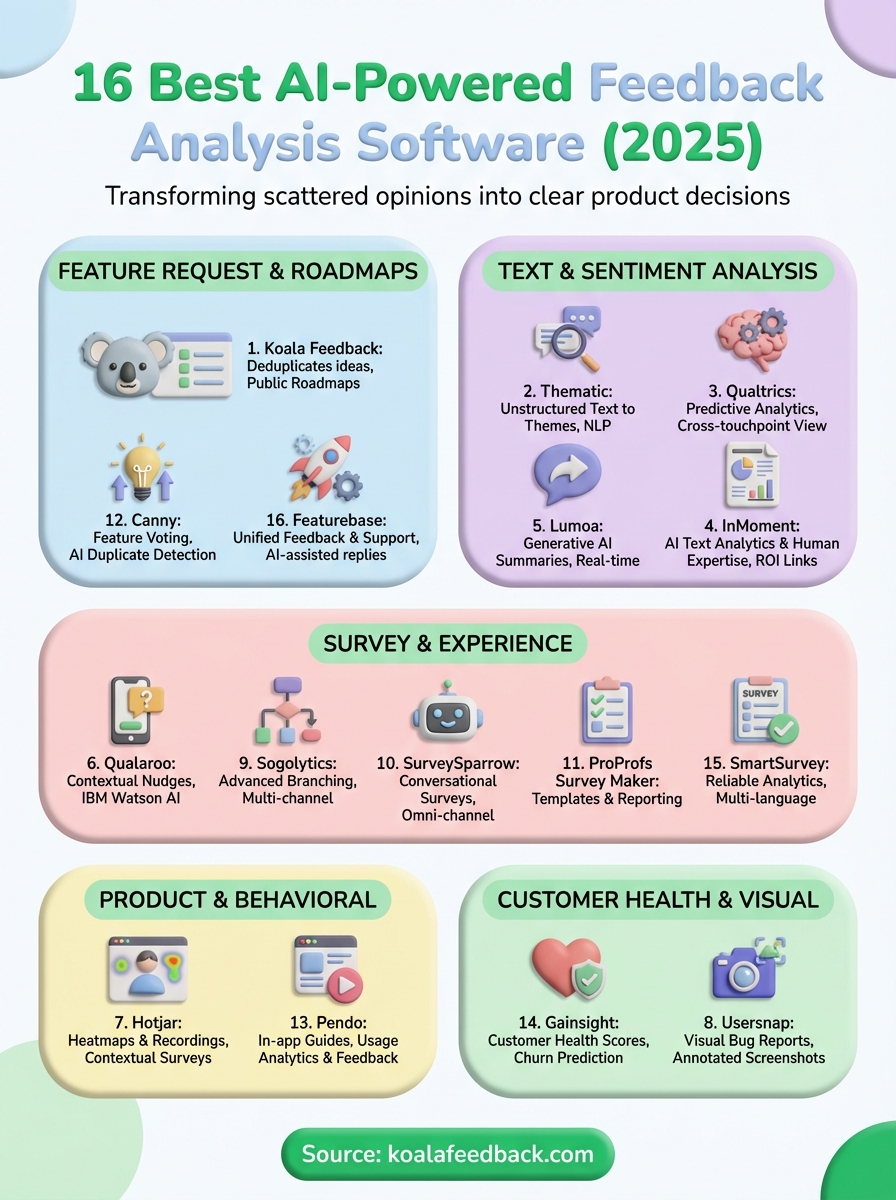
You now have a clear view of 16 feedback analysis software options, each with distinct strengths that match different team needs and feedback workflows. Your next move depends on what matters most: deep text analytics, visual feedback capture, feature request voting, or behavioral data integration. Start by identifying your primary feedback sources and the specific insights you need to extract from them.
Most platforms offer free trials or freemium plans that let you test their analysis capabilities with your actual feedback data before committing. Pick two or three tools that align with your requirements and run them side by side for a week to see which interface and insights work best for your team. If you need a straightforward platform that helps you organize feature requests while keeping users informed about product progress, try Koala Feedback to see how automated categorization and public roadmaps turn scattered opinions into clear product direction.

Start today and have your feedback portal up and running in minutes.