The Six Sigma Voice of Customer (VOC) process gives teams a structured way to capture what customers actually need, not what internal stakeholders assume they need. It's a core element of the DMAIC "Define" phase, and when done right, it prevents teams from burning resources on features and fixes that don't move the needle.
But collecting customer input is only half the battle. The real work is turning raw feedback into Critical-to-Quality requirements (CTQs) that engineering and product teams can act on. That means having the right tools, the right framework, and a system to organize and prioritize what you hear. This is exactly the problem we built Koala Feedback to solve, giving product teams a centralized place to collect, categorize, and rank user feedback so nothing valuable slips through the cracks.
This guide breaks down VOC within the Six Sigma framework: what it is, how it fits into DMAIC, the tools used to gather and analyze customer data, and how to translate feedback into measurable quality drivers that shape better products. Whether you're running a formal Six Sigma program or simply looking to make your feedback process more rigorous, you'll find a practical blueprint here.
Most process improvement failures don't happen because teams lack technical skill. They happen because teams solve the wrong problem. Six Sigma without a structured VOC process is like optimizing a factory line to produce a product nobody asked for. You reduce variation, tighten tolerances, and hit your internal targets, yet customers still complain. That gap between internal assumptions and actual customer requirements is exactly what the voice of the customer is designed to close.
When a Six Sigma team skips or shortcuts the VOC work, the Define phase becomes a guessing game. The team picks metrics that feel important to leadership but may have nothing to do with what drives customer satisfaction or long-term retention. This is one of the most common reasons projects deliver statistically significant process improvements that don't translate into measurable business results. The improvement was real, but the team aimed it at the wrong target.
The biggest risk in Six Sigma is not a flawed measurement system. It's a well-executed project solving a problem customers don't care about.
Every DMAIC project starts with a problem statement, and that statement needs to be grounded in customer language, not internal jargon. When you anchor your project scope in what customers actually experience and report, your team stays focused on what creates value rather than what's convenient to measure.
The core idea behind six sigma voice of customer work is that quality is not defined by your internal specifications. Quality is defined by whether your product or service consistently meets what the customer expects, values, and is willing to pay for. This is a meaningful shift in perspective. A process can be technically in-spec and still produce outcomes that customers find unacceptable, because your specs were built around internal convenience rather than external need.
When you treat customer requirements as the foundation for all quality decisions, you stop over-engineering things customers don't notice and start fixing things they do. This alignment between process performance and customer expectations is what separates effective Six Sigma programs from compliance-driven ones that generate reports without business impact. The difference shows up in project selection, in how teams frame problems, and in how they measure success at project close.
Skipping VOC doesn't just risk project failure. It costs money directly and in ways that are harder to see. When teams improve the wrong process variables, they invest in changes that require rework later. Redesigning a solution after implementation is significantly more expensive than getting the requirements right upfront. Research in product development consistently shows that the cost to fix a requirement error grows sharply the later in the development cycle it's caught.
Beyond direct rework costs, misaligned improvements damage team credibility with leadership. When a project closes with a strong sigma score but customers see no difference in their experience, stakeholders start questioning the methodology itself. Over time, that skepticism makes it harder to secure resources and sponsorship for future improvement work. Starting with clear, validated customer input protects both the individual project outcome and the broader Six Sigma program's standing inside your organization. You build a track record of improvements that customers actually notice, and that reputation is worth protecting from the very first project step.
VOC in Six Sigma is the systematic process of gathering, translating, and prioritizing what customers need from your product or service. It's not a one-time survey or a casual collection of complaints. In a Six Sigma context, VOC is a structured input mechanism that feeds directly into how you define problems, set measurement targets, and decide what success looks like at project close.
Many teams confuse VOC with satisfaction metrics like NPS scores or post-purchase ratings. Those metrics tell you how customers feel after an experience, but they don't explain what specific requirements are driving those feelings. The six sigma voice of customer process goes deeper. It captures the underlying needs, expectations, and pain points that customers themselves may not always articulate clearly. Your job is to surface and translate those inputs into something your process improvement team can actually work with, not just report upward as a number on a dashboard.
VOC is the bridge between what customers experience and what your team actually measures and improves.
Satisfaction scores give you a signal. VOC gives you a direction.
Customer input in Six Sigma typically falls into three layers that you need to work through in sequence:
Understanding all three layers prevents your team from building requirements that only satisfy surface-level requests while missing the deeper drivers of satisfaction or frustration. Most teams that skip latent needs end up shipping improvements that customers acknowledge but don't value enough to change their behavior. When you dig into all three layers, you start building a requirements set that reflects the full customer experience, not just the loudest or most recent complaints your support queue captured last quarter.
DMAIC stands for Define, Measure, Analyze, Improve, and Control. Each phase has a specific job, and VOC is the foundational input that makes the first phase, Define, meaningful. Without it, everything downstream, from how you measure to how you frame root causes, is built on assumptions rather than verified customer requirements. The six sigma voice of customer process doesn't just belong in Define; it sets the direction for the entire project.
The Define phase requires you to do three things well: write a clear problem statement, identify who the customer is, and establish what success looks like in customer terms. VOC data feeds all three. When you walk into the Define phase with structured customer input already collected and organized, your problem statement reflects a real gap between what customers need and what your process currently delivers, not a gap between your last quarter's internal targets.
The project charter only carries weight when the problem statement is grounded in what customers actually report experiencing.
Teams that start Define without VOC tend to write problem statements around operational symptoms: cycle time is too long, defect rates are too high, costs are above budget. Those symptoms matter, but they only connect to improvement value when you can trace them back to a specific customer impact. VOC gives you that connection explicitly.
VOC doesn't stop being relevant after Define closes. The outputs you produce in Define, particularly the Critical-to-Quality requirements (CTQs) derived from customer input, become the measurement targets in the Measure phase. You're not just picking metrics that are convenient to collect; you're selecting metrics that represent what customers said matters most. That discipline keeps the project focused on variables that actually drive satisfaction.
In the Analyze phase, you use those same CTQs to evaluate whether the root causes you've identified explain the customer-visible gap in process performance. In Improve, your solution criteria come directly from the CTQs. In Control, you monitor the process metrics that correspond to what customers care about, not just the ones that are easy to track on a dashboard. Each phase builds on the customer requirements that VOC established at the start. Skipping or shortchanging VOC in Define creates a compounding gap that grows harder to correct as you move deeper into the project cycle.
The biggest threat to useful VOC data is not a lack of responses; it's confirmation bias built into how you collect them. When teams design surveys around what they already believe is true, or only interview customers who are already satisfied, they get data that confirms their assumptions rather than challenges them. In six sigma voice of customer work, the collection method itself has to be treated as a process variable that you design and control carefully.
Biased input at the collection stage produces confident-sounding requirements that still miss what customers actually need.
No single method captures the full picture of what customers need. Interviews give you depth but can be skewed by who you choose to talk to. Surveys give you volume but flatten nuance into multiple-choice responses. Observation eliminates self-reporting bias but takes time and access. The right approach combines at least two methods so the gaps in one are filled by the other. Here is a practical breakdown of the three most effective VOC collection methods and what each one is best suited for:
| Method | Best use | Key limitation |
|---|---|---|
| Customer interviews | Surfacing unstated and latent needs | Sample size is small |
| Structured surveys | Validating patterns across large groups | Misses context and nuance |
| Behavioral observation | Capturing what customers do vs. what they say | Requires direct access |
Question design is where most teams introduce bias without realizing it. Leading questions, like "How much did our new feature help you?" assume a positive outcome before the customer responds. Neutral phrasing, such as "How did the new feature affect your workflow?" gives customers space to report both positive and negative experiences. This distinction matters more than most teams expect, because even small shifts in phrasing change how respondents interpret and answer questions.
You also need to control for sampling bias by deliberately including customers across different usage levels, segments, and satisfaction levels. Interviewing only your most engaged users or your loudest complainers produces a skewed data set that doesn't represent the full customer base. A structured recruitment approach, where you define the customer segments you want to hear from before you start collecting, keeps your VOC data representative enough to build solid requirements on with confidence.
Raw VOC data is valuable, but it can't drive improvement work until you translate it into specific, measurable requirements. Customer statements like "the process takes too long" or "the output is inconsistent" are directionally useful but not actionable in their current form. The translation step, converting voice of the customer inputs into Critical-to-Quality requirements (CTQs), is where Six Sigma separates itself from generic feedback collection processes that gather input but never close the loop with real project outcomes.
The standard tool for this translation is the CTQ tree, a visual breakdown that starts with a broad customer need and progressively drills it down into measurable performance requirements. You start with the general need the customer expressed, identify the quality drivers that make that need tangible, and then define specific, measurable CTQs for each driver. This three-level structure forces your team to stop treating vague input as a finished requirement and instead build a traceable chain from customer language to process metrics.
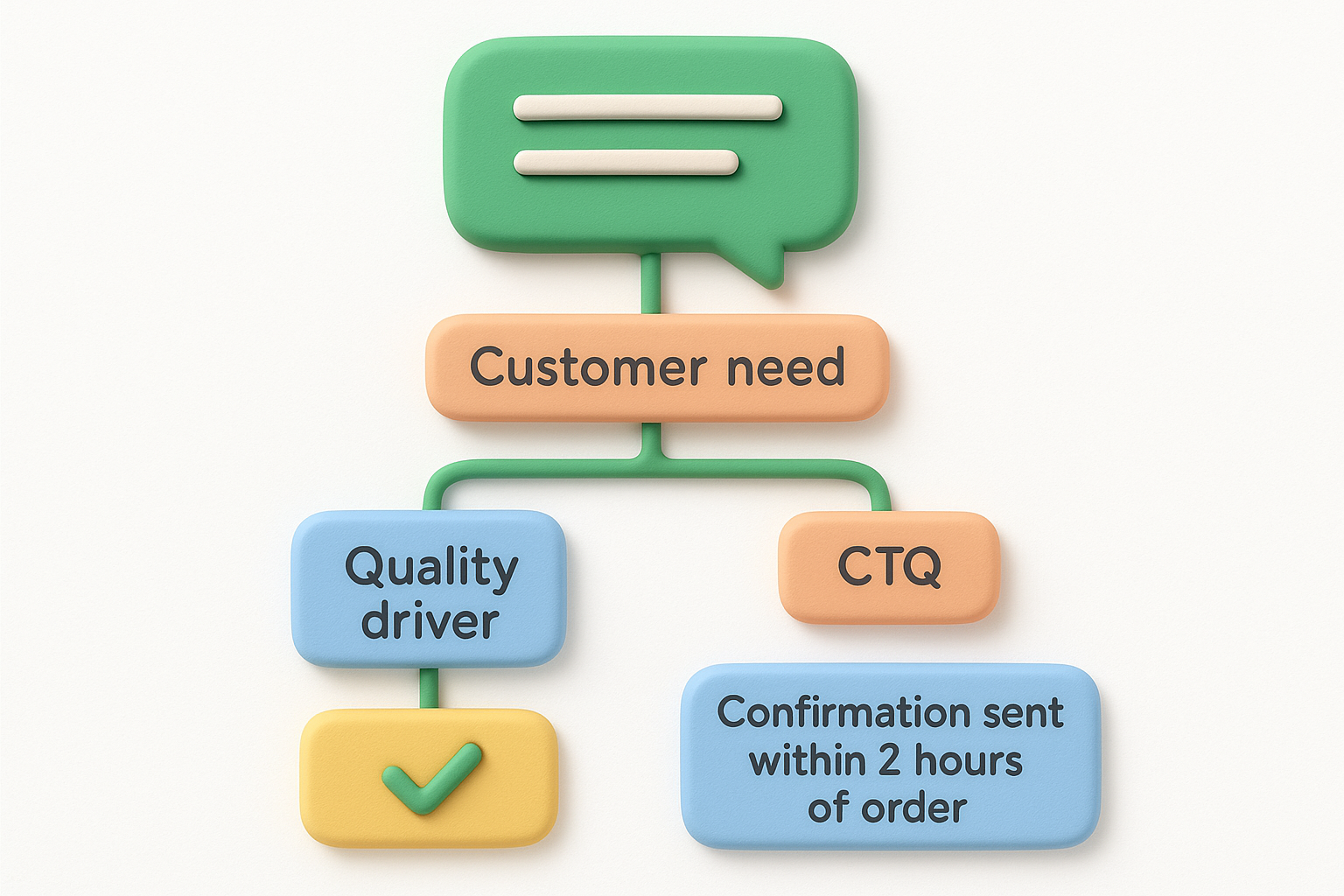
Translating customer language into CTQs is not interpretation work; it is a structured process with defined outputs that your team can measure and verify.
Here is how the three levels of a CTQ tree typically work in practice:
| Level | Label | Example |
|---|---|---|
| 1 | Customer need | Fast order processing |
| 2 | Quality driver | Order confirmation speed |
| 3 | CTQ | Confirmation sent within 2 hours of order |
Each CTQ at level three needs a specific metric and a defined target value before you carry it into the Measure phase. Without a target, you have a direction, not a requirement.
Once you draft your CTQs, take them back to a sample of customers for validation. This step is one that most teams skip, and skipping it introduces significant risk that your team will spend the rest of the project measuring and optimizing for something that doesn't reflect actual customer priorities. In six sigma voice of customer practice, validation closes the loop between what you heard and what you interpreted.
Ask customers to review your CTQ statements and confirm that the metric and target you selected reflect what they actually care about. You will often find that customers confirm the metric but push back on the target value, either because your threshold is too conservative or because it optimizes a variable they weigh less heavily than your team assumed. Catching that misalignment before Measure saves you significant rework downstream and keeps your project aimed at outcomes customers will recognize and value.
Once you have collected and validated your customer inputs, you face a new challenge: raw VOC data is rarely organized in a way that reveals clear priorities. Customers use different language to describe the same problem, and unrelated issues often get grouped together in a single interview response. Before you can prioritize anything, you need to sort and structure your data so that patterns become visible rather than buried in a stack of notes and survey exports.
The goal of VOC analysis is not to count how many times customers mentioned something. It is to understand which themes connect most directly to customer-defined quality.
Affinity mapping is the most practical tool for this grouping step. You place each individual customer statement on its own card, physical or digital, and then cluster cards that represent the same underlying need or frustration regardless of the specific words used. This process surfaces the real themes in your data rather than the ones that happen to use the most consistent language. In six sigma voice of customer practice, this step often reveals that what looked like five separate complaints is actually one core process failure showing up in different contexts.
A basic theme grouping structure looks like this:
| Raw customer statement | Grouped theme | Frequency |
|---|---|---|
| "Takes too long to get a response" | Response time | High |
| "Never sure if my request was received" | Confirmation process | Medium |
| "Had to follow up three times" | Response time | High |
| "No update after I submitted" | Confirmation process | Medium |
Grouping your themes tells you what customers are talking about. Prioritizing those themes tells you where to aim your improvement energy first. The two variables that matter most are frequency, how often a theme appears across your data set, and impact, how significantly the theme affects overall customer satisfaction or retention. A theme that appears frequently but carries low impact deserves less attention than one that appears moderately but consistently links to customer churn or dissatisfaction.
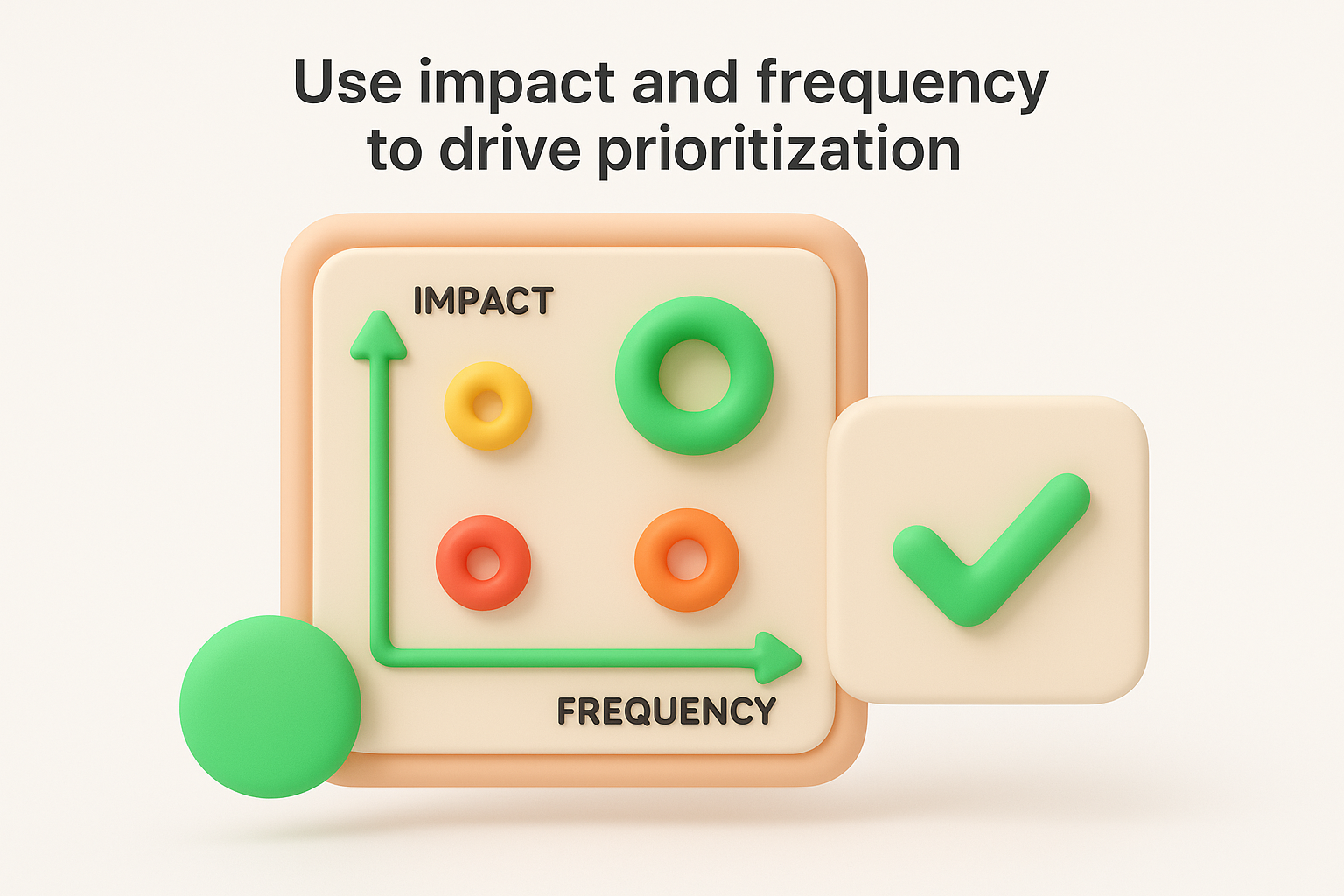
You can plot these two variables on a simple impact-frequency matrix to make prioritization decisions visible to your whole team. This approach keeps the conversation grounded in customer data rather than internal opinions about what matters most, and it gives your project sponsor a clear rationale for why your team chose the CTQs it did when you present the Define phase outputs.
Most Six Sigma teams treat VOC as a project kick-off activity. They collect customer input during Define, build their CTQs, and then stop listening until the next project starts. That approach turns customer understanding into a static snapshot rather than a continuous signal your team can act on. The problem is that customers change, markets shift, and a requirement that was accurate at project start may no longer reflect what your customers actually need six months later.
VOC is not a one-time deliverable; it is a discipline that requires regular maintenance to stay useful.
Structured, ongoing feedback collection keeps your customer requirements current without requiring a full VOC study every quarter. The simplest version is a dedicated channel where customers can submit issues, requests, and observations as they arise. What it needs to be is visible, accessible, and consistently monitored so that new input reaches the people responsible for product and process decisions. A platform like Koala Feedback gives your team a centralized place to capture and categorize that ongoing input without letting it pile up unread in an inbox.
When you combine a live feedback channel with a regular review cadence, such as a monthly theme analysis, you convert one-time VOC data into a living requirements baseline that your team can maintain and update without launching a new project from scratch every time customer needs shift.
Closing the feedback loop means telling customers what happened after they submitted input. This step is easy to skip under workload pressure, but skipping it has a direct cost: customers stop submitting feedback when they believe nothing will come of it. In six sigma voice of customer practice, loop closure also gives you a built-in validation mechanism. When you share how their input shaped a decision or process change, customers confirm whether your interpretation was accurate and whether the improvement addressed what they actually needed.
A basic loop closure process looks like this:
| Input stage | Action | Outcome |
|---|---|---|
| Customer submits feedback | Acknowledge receipt | Customer knows input was captured |
| Team reviews and acts | Notify customer of decision | Customer sees their input used |
| Improvement deployed | Share outcome | Customer validates the result |
This cycle doesn't require heavy infrastructure. It requires a consistent communication habit and a reliable system for tracking who gave input and what your team did with it.
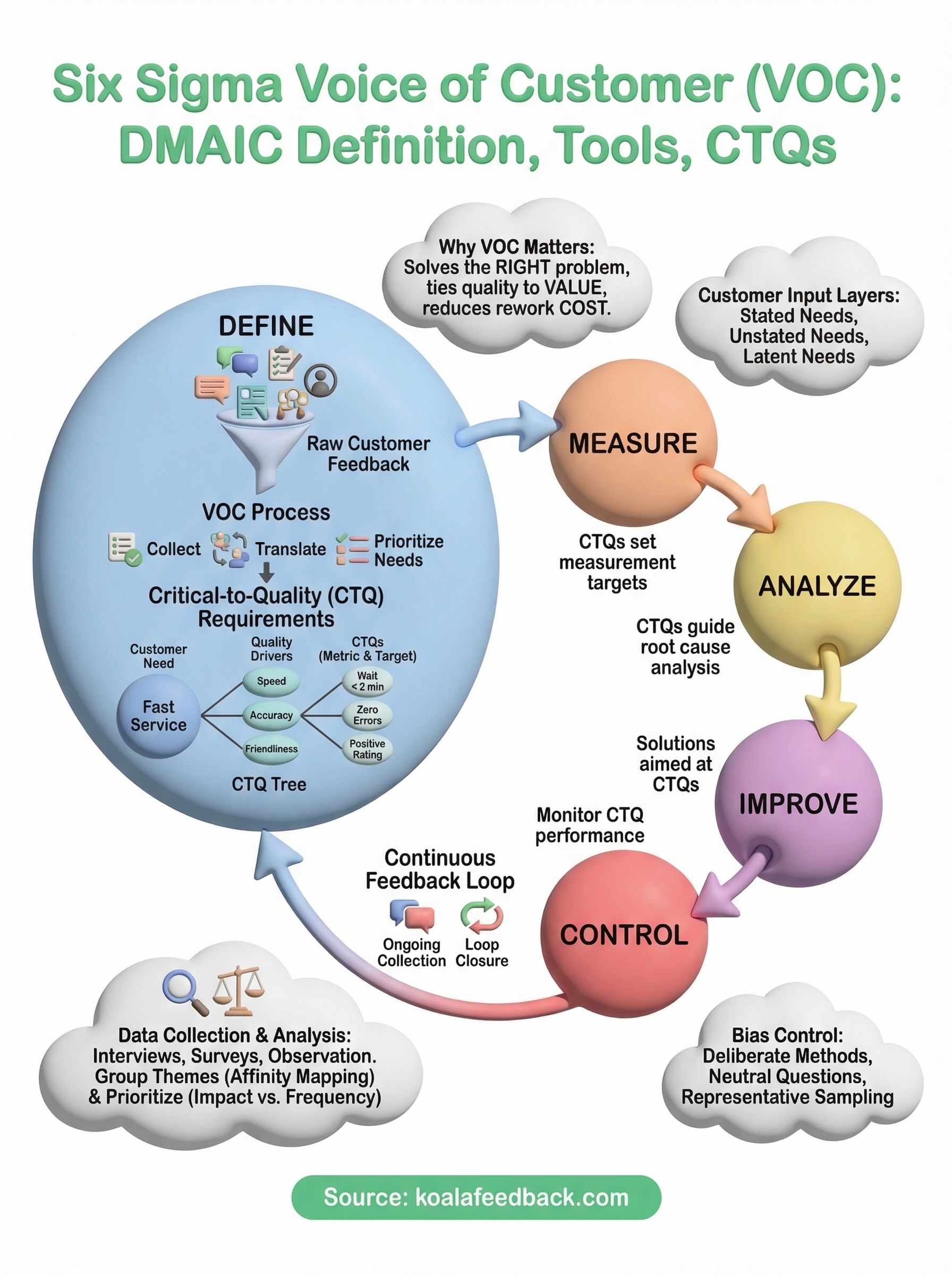
The six sigma voice of customer process works when you treat it as a discipline, not a checklist item. Every step covered in this guide, from unbiased collection to CTQ translation to ongoing feedback loops, builds toward one outcome: improvement work aimed at what customers actually value rather than what your team assumes they want. Projects that start with strong VOC data stay focused, deliver measurable results, and earn the credibility needed to run more improvement work in the future.
Your project quality improves consistently when you anchor every DMAIC phase in verified customer requirements rather than internal targets. The teams that sustain results over time are the ones that keep listening after Define closes, not just when a new project kicks off.
If you want a structured way to collect, categorize, and act on customer input continuously, start with Koala Feedback and give your team the infrastructure to keep VOC data current and organized across every project you run.

Start today and have your feedback portal up and running in minutes.