If you run product or IT operations on ServiceNow, you have probably bumped into its Idea Management module while trying to figure out how to formally capture requests from employees or customers. ServiceNow idea management is the piece of the platform that lets users submit ideas, routes them through review, and tracks them from a rough suggestion to a shipped change. It sits inside the broader Innovation Management application, which is why the naming can feel confusing if you're new to it.
This article breaks down exactly what the module does and how it fits together. You'll see the core roles involved (idea submitters, reviewers, and stakeholders), the idea lifecycle stages from submission through evaluation to implementation, and how prioritization and scoring actually work behind the scenes.
We'll also walk through the practical side: how to submit an idea, how teams evaluate and score submissions, and where this setup tends to fall short for companies that need a simpler, more customer-facing way to collect and act on feedback. By the end, you'll know how ServiceNow handles ideas internally and have a clear picture of when a dedicated feedback tool might serve your product team better.
Most IT and product teams don't lack ideas. They lack a system for catching them before they disappear into inboxes, Slack threads, or someone's notebook. ServiceNow idea management exists because large organizations generate hundreds of small suggestions every month, and without a formal intake process, the good ones get lost right alongside the bad ones. Once you have a structured way to log, score, and track submissions, you stop relying on memory and office politics to decide what gets built next.
Anyone who has managed a backlog knows the problem: a request comes in during a meeting, gets mentioned again in an email three weeks later, and shows up a third time as a support ticket, each version worded differently and tracked nowhere. ServiceNow's module forces every submission into a standard record with a category, description, and owner attached from the start. That structure matters more than it sounds. It means you can pull a report six months later and see exactly how many people asked for the same thing, instead of guessing based on who complained loudest.
A good idea management process turns anecdotes into evidence you can actually act on.
Because ServiceNow already manages incidents, changes, and demand across IT, plugging idea intake into that same platform lets teams connect a raw suggestion to actual project funding and resource planning without switching systems. A department head submits an idea for a new automated approval workflow, and that idea can flow into the same governance process that already handles budget requests and change approvals. This is the real reason large enterprises stick with ServiceNow for this instead of a lightweight form: the idea doesn't live in isolation, it becomes part of the same operational record as everything else IT touches.
Submitting an idea and hearing nothing back is worse than not having a submission process at all. It signals to employees or customers that their input goes nowhere, and they stop bothering. A working idea management setup closes that loop by giving every submitter visibility into where their idea stands, whether it's under review, approved, or rejected with a reason attached. That visibility is what keeps people submitting in the first place. Without it, you get a slow decline in participation until the intake form basically stops getting used.
Teams that try to run this informally usually hit the same wall: duplicate work, decisions made without data, and stakeholders who feel ignored. Here's a quick comparison of what tends to happen with and without a structured process:
| Without idea management | With idea management |
|---|---|
| Requests tracked in emails, chats, spreadsheets | Requests logged in one searchable system |
| Duplicate ideas submitted repeatedly | Similar ideas grouped and counted automatically |
| Prioritization based on who asks loudest | Prioritization based on votes, impact, and cost |
| No feedback loop to submitters | Status updates visible to everyone involved |
| Hard to prove ROI on completed work | Clear record linking ideas to delivered outcomes |
That table isn't hypothetical. It reflects the pattern almost every organization goes through before adopting some form of structured intake, whether that's ServiceNow or another tool entirely.
Even though ServiceNow started as an IT service management platform, the logic behind idea management applies just as well to product teams building customer-facing software. The same principles, centralized intake and visible follow-through, are what make a feedback program worth running at all. If people can't see that their input leads somewhere, they stop giving it, and you lose the single best source of information about what to build next: the people actually using your product.
Understanding why this matters sets up the rest of the article well, because the mechanics only make sense once you see the problem they're solving. Next, we'll walk through exactly how a submission moves through the system, from the moment someone types it into a form to the point where a reviewer decides what happens to it.
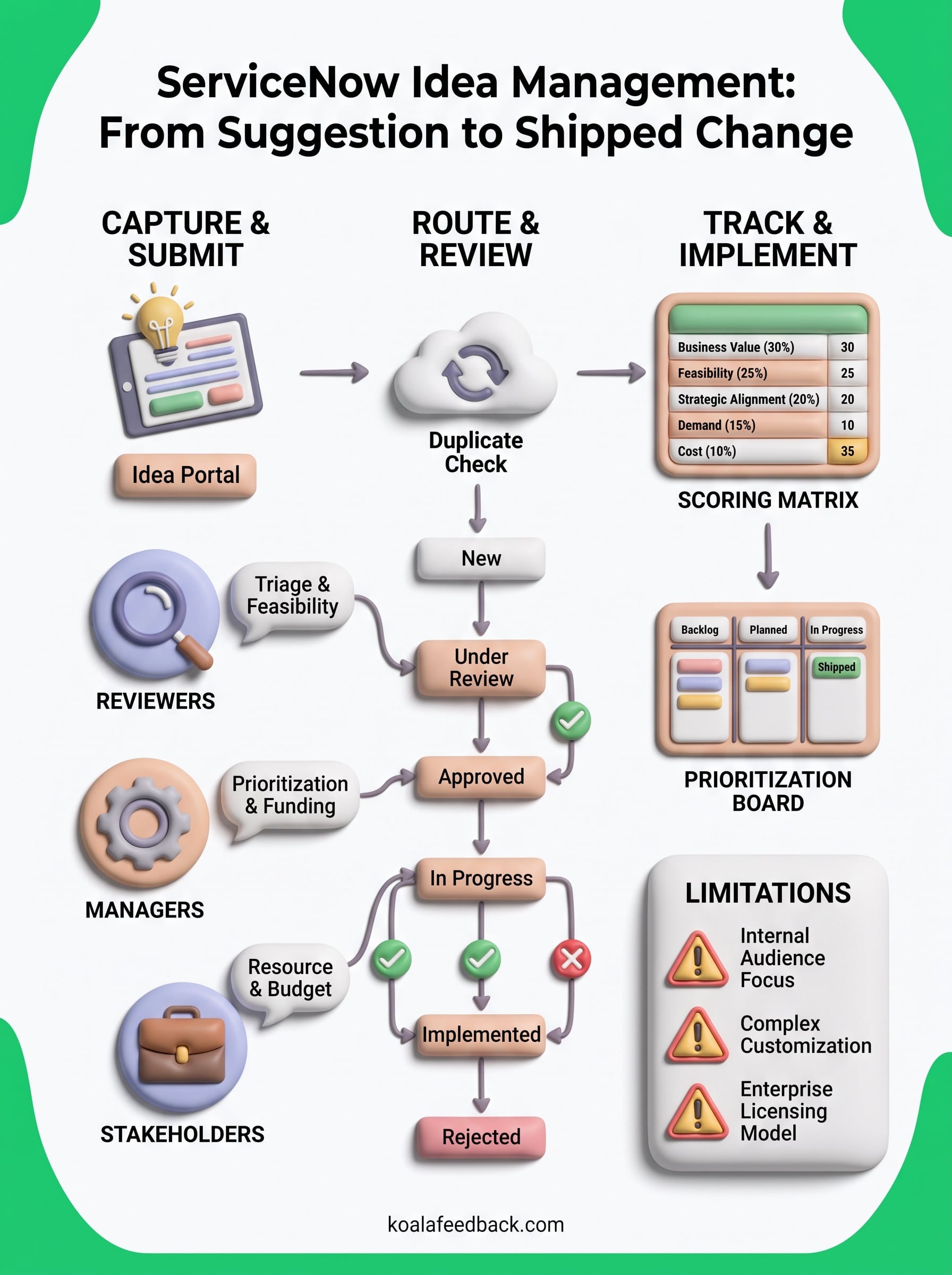
Submitting an idea in ServiceNow starts with the Idea Management portal, a form-based intake screen that sits inside Innovation Management. Once someone logs in with their ServiceNow credentials, they pick a category, write a title and description, and hit submit. From there, the record moves through a defined workflow that an admin configures ahead of time. Getting this right matters because a sloppy intake form produces sloppy data, and sloppy data makes prioritization nearly impossible later.
A typical submission follows a short, predictable sequence:
That duplicate check in step four is worth calling out on its own, because it's one of the more useful pieces of automation in the module. Without it, popular requests get submitted five or six times under slightly different wording, and someone has to manually merge them later.
The value of a submission form isn't the form itself, it's whether the data behind it stays clean enough to act on.
Once an idea exists as a record, managing it is mostly a matter of moving it through states: New, Under Review, Approved, In Progress, Implemented, or Rejected. Admins configure which states exist and who has permission to move an idea between them. This is done through standard ServiceNow list views and workflow configuration, not a separate app, so anyone comfortable with the platform's core admin tools can set it up without custom scripting.
Here's what typically happens at each stage:
| State | What happens |
|---|---|
| New | Idea is logged and visible to reviewers |
| Under Review | Reviewer evaluates feasibility, cost, and demand |
| Approved | Idea is greenlit and queued for planning |
| In Progress | Work has started, often linked to a project record |
| Implemented | Change is live, submitter is notified |
| Rejected | Idea is closed with a reason visible to the submitter |
Managing ideas well also depends on notifications firing correctly at each state change. ServiceNow lets admins configure automatic emails or portal alerts so submitters know when their idea moves from Under Review to Approved, rather than finding out by chance. Skipping this step is the single most common reason idea management programs fail inside large companies, because employees stop checking a portal that never tells them anything. If you're setting this up for the first time, treat notification rules as a required step, not an optional polish item, since the whole point of the module is keeping people informed while their idea works its way through the pipeline.
A submission form doesn't evaluate itself. ServiceNow idea management relies on a handful of defined roles, each with a specific job in moving an idea from raw text to a shipped feature. Skip defining these roles clearly, and you end up with ideas stuck in "Under Review" for months because nobody actually owns the decision to move them forward.
Every idea starts with a submitter, usually an employee, customer, or partner who has permission to access the portal. Submitters write the initial description, but in most setups they don't get to vote on their own idea's priority beyond the initial submission. Larger organizations often add a champion role too, someone senior enough to advocate for an idea once it's submitted, especially when the original submitter has no direct line to the reviewers deciding its fate. Champions matter because good ideas from junior staff sometimes need someone with more organizational weight to push them past the first filter.
Given that submitters can generate dozens of ideas a week, reviewers exist to triage that volume before it reaches anyone with budget authority. A reviewer checks feasibility, flags duplicates the automated matching missed, and either advances the idea to the next stage or rejects it with a documented reason. Some deployments add a coordinator role above individual reviewers, someone who assigns incoming ideas to the right reviewer based on category, similar to how a support queue gets routed by topic.
The reviewer's job isn't to say yes to good ideas, it's to say no to the wrong ones quickly enough that the good ones don't get buried.
Higher up the chain sits the idea manager, the person (or small group) who owns the final prioritization call once an idea clears review. Idea managers weigh cost, demand, and strategic fit, then decide whether something moves into Approved or stays parked. Alongside them, stakeholders such as department heads or product owners often get pulled in specifically because their budget or team will absorb the work if the idea gets approved. Leaving stakeholders out of this step is a common mistake; it produces approved ideas that nobody actually has the resources to build.
Behind all of this sits the system administrator, the person configuring states, notification rules, and permissions inside the platform itself. Administrators don't judge the ideas, but their setup work determines whether the whole process actually functions day to day.
| Role | Primary responsibility |
|---|---|
| Submitter | Writes and submits the initial idea |
| Champion | Advocates for an idea after submission |
| Reviewer | Triages, checks feasibility, flags duplicates |
| Coordinator | Routes ideas to the correct reviewer |
| Idea manager | Makes the final prioritization decision |
| Stakeholder | Confirms budget and resource availability |
| Administrator | Configures states, permissions, and notifications |
Together these roles form a chain of custody for every idea in the system, and gaps anywhere in that chain are usually where good submissions quietly stall.
Once an idea clears initial review, someone has to decide whether it's actually worth building. ServiceNow idea management handles this through a mix of manual scoring and configurable criteria, letting reviewers rank submissions on more than just gut feeling. Getting this step right is what separates a backlog that reflects real demand from one that reflects whoever pitched loudest in the last planning meeting.
Admins typically set up a scoring matrix with a handful of weighted fields, and reviewers fill in a value for each field when they evaluate an idea. A common setup looks like this:
| Criterion | Weight | What it measures |
|---|---|---|
| Business value | 30% | Revenue impact, cost savings, risk reduction |
| Feasibility | 25% | Technical effort and existing capacity |
| Strategic alignment | 20% | Fit with current roadmap or company goals |
| Demand | 15% | Number of votes or duplicate submissions |
| Cost | 10% | Estimated budget or resource draw |
The platform calculates a composite score from these weighted values, and that score becomes the default sort order on the idea list. Reviewers can still override it, but having a number attached gives everyone a shared starting point instead of an open-ended argument.
A scoring matrix doesn't remove judgment from prioritization, it just makes that judgment visible and consistent.
Beyond formal scoring, ServiceNow lets submitters and other users vote on ideas they support, and that vote count feeds into the demand criterion above. This is useful for surfacing ideas that individually seem minor but collectively represent a real pattern, like a dozen employees independently asking for the same report field. Votes alone shouldn't drive the final decision, since a popular idea with no feasibility isn't automatically worth building, but ignoring vote counts entirely risks missing genuine demand hiding in the noise.
Most teams manage the ranked output through a prioritization board, a kanban-style view where ideas sit in columns by state and get dragged between them as decisions get made. This view is where idea managers spend most of their time, since it turns a flat list of scored records into something closer to a visual backlog they can reorder as budget or capacity shifts. It's worth noting that ServiceNow's board here is functional but fairly basic compared to dedicated roadmap tools; it handles ranking fine but wasn't built primarily as a way to communicate priority back to the people who submitted the idea in the first place.
Scores aren't fixed once an idea gets evaluated. Reviewers or idea managers typically revisit stale ideas every quarter or so, since business priorities shift and an idea that scored low six months ago might score much higher now that a related project has already laid the groundwork for it. Building this reassessment step into the process matters because ideas that sit untouched for a year tend to get rejected by default, not because they're bad, but because nobody remembered to look at them again.
People throw around "idea management," "innovation management," and "demand management" like they're interchangeable inside ServiceNow, and that mix-up causes real confusion when you're setting up permissions or trying to explain the process to a new hire. Idea management is actually a module that lives inside the broader Innovation Management application, and both of those are distinct from Demand Management, which is an older, separate application that handles formal project requests once budget is already involved. Knowing where one ends and the other begins matters if you're trying to configure workflows correctly or explain to stakeholders why their approved idea suddenly shows up in a different queue.
Think of Innovation Management as the container and Idea Management as one tool inside it. Innovation Management adds structure around portfolios, funding decisions, and strategic themes, letting an organization group related ideas under a bigger initiative before deciding what gets funded. Idea Management, by contrast, is purely about capturing individual submissions, scoring them, and moving them through review states. You could technically use Idea Management on its own for basic intake, but without Innovation Management wrapped around it, you lose the ability to tie a batch of related ideas to a single funded initiative or executive sponsor.
Idea management captures the raw input, innovation management decides what to do with it at a portfolio level.
Demand Management predates the newer innovation tools and was built specifically for formal project intake, the kind of request that already has a budget line and a business case attached. Ideas that survive scoring and prioritization inside Idea Management often graduate into Demand Management once someone decides to actually fund the work. That handoff is where a lot of teams get tripped up, because the two applications use different terminology and different record types, so an "idea" doesn't automatically become a "demand" without someone manually creating that link or configuring a flow to do it.
| Application | Primary purpose | Typical user |
|---|---|---|
| Idea Management | Capture and score raw submissions | Employees, customers, reviewers |
| Innovation Management | Group ideas into funded portfolios | Idea managers, executives |
| Demand Management | Formalize approved work into projects | Project managers, PMO staff |
Getting this wrong usually shows up as a broken handoff: an idea gets approved, everyone assumes it's now "in progress," but no project record ever gets created in Demand Management because nobody set up the connection between the two applications. That gap is where approved ideas quietly die, not from rejection but from administrative neglect. If you're rolling this out for the first time, map the handoff between Idea Management and Demand Management explicitly during setup rather than assuming ServiceNow links them automatically out of the box, because in most configurations it doesn't. Treating these as three separate but connected layers, rather than one big blob called "idea stuff," is what keeps ideas from stalling right at the finish line.
Despite everything covered so far, ServiceNow idea management was never designed as a customer-facing feedback tool, and that shows the moment you try to stretch it beyond internal IT requests. It works well when the audience is employees who already have platform logins and understand enterprise workflows. It struggles the second you need something a paying customer can use without training, a support ticket, or a login they'll forget in a week.
Getting a customer onto the Idea Management portal usually means provisioning an external user account, configuring guest access rules, and hoping the experience doesn't feel like a corporate intranet. Most product teams don't want that friction between a customer and a simple "here's what I'd like to see next" submission. The module assumes an internal audience with existing platform access, and retrofitting it for the public web is a project on its own, not a checkbox.
A tool built to route internal requests through IT governance isn't automatically a good fit for collecting public product feedback.
Customizing the look of the Idea Management portal takes real configuration work, often involving UI Builder or theme overrides that only an experienced ServiceNow admin can pull off cleanly. There's no simple way to drop in your own domain, match your brand colors, or give customers a portal that feels like part of your product rather than a ticket queue. Compare that to purpose-built feedback tools, where custom domains and branded portals are a settings toggle, not a development task.
ServiceNow's licensing model assumes you're already running the platform for IT service management, and Innovation Management typically gets bundled in as an add-on rather than sold as a standalone product. That structure makes sense for a 2,000-person enterprise already paying for ServiceNow across departments. It makes far less sense for a 15-person SaaS company that just wants a place for users to submit and vote on feature requests.
| Concern | ServiceNow Idea Management | Dedicated feedback tool |
|---|---|---|
| Setup time | Weeks, requires admin configuration | Hours, guided setup |
| Public-facing portal | Requires custom development | Built-in, brandable |
| Pricing model | Bundled with broader platform | Standalone, per-team pricing |
| Learning curve | Steep for non-admins | Minimal, self-serve |
Even when an idea clears review and moves to Implemented, ServiceNow's own product documentation makes clear the prioritization board was built as an internal planning view, not a public roadmap. There's no clean, shareable page showing customers what's planned, in progress, or shipped. Teams end up building that visibility manually or skipping it entirely, which quietly undoes the transparency benefit that made idea management worth setting up in the first place.
ServiceNow idea management gives large IT organizations a solid way to capture, score, and route internal requests through governance they already trust. You've seen how submissions move through states, who owns each decision, and how scoring turns opinions into something closer to data. That structure works well when your audience already logs into ServiceNow every day.
But product teams selling to actual customers usually need something lighter: a branded portal, public voting, and a roadmap people outside your company can actually see. Building that on top of ServiceNow means custom development most teams don't have time for.
If you want that transparency without the enterprise overhead, Koala Feedback gives you a customer-facing feedback portal, prioritization boards, and a public roadmap out of the box, ready in hours instead of weeks.

Start today and have your feedback portal up and running in minutes.