Every product team has experienced it: feature requests scattered across email threads, Slack messages, support tickets, and sticky notes. Without a structured approach, valuable user insights get lost, priorities become unclear, and your team ends up building features nobody asked for while ignoring the ones users actually need.
A well-designed feature request workflow transforms this chaos into a systematic process that captures, evaluates, and acts on user feedback. When done right, it aligns your product roadmap with real customer needs and helps your team ship features that actually matter.
This guide walks you through building a feature request workflow from the ground up. You'll learn how to collect requests effectively, create clear evaluation criteria, prioritize what to build next, and communicate decisions back to your users. Whether you're managing feedback manually or using a dedicated platform like Koala Feedback to centralize and prioritize requests, the principles here will help you turn scattered input into focused product improvements.
A complete feature request workflow acts as a systematic pipeline that moves ideas from initial submission to final delivery. You need clear stages that define how requests progress, decision criteria that determine what gets built, and communication channels that keep everyone informed throughout the process.
Your feature request workflow should move requests through five distinct stages that create structure without adding unnecessary complexity. Each stage has specific responsibilities and outputs that prevent requests from stalling or getting lost in the system.
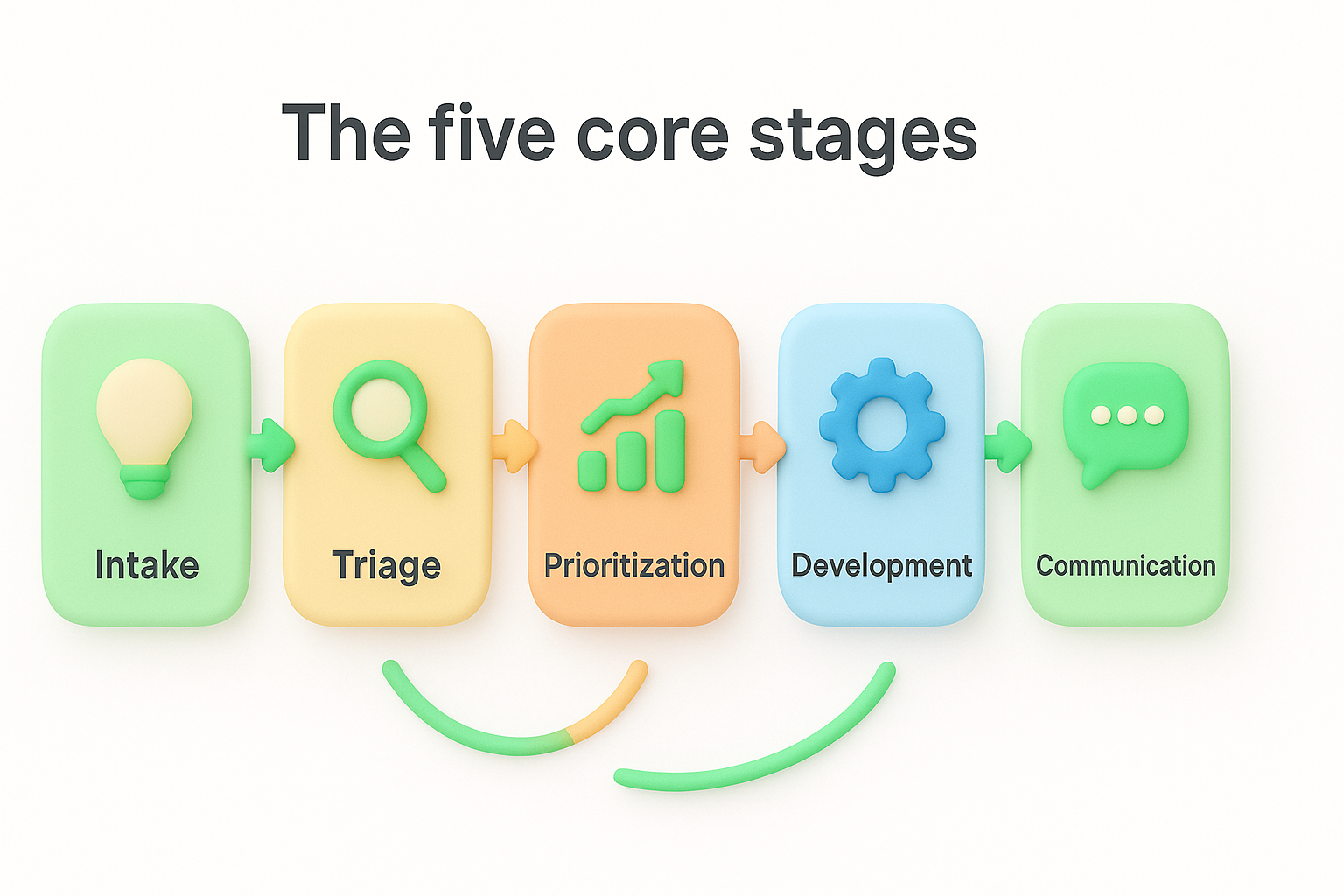
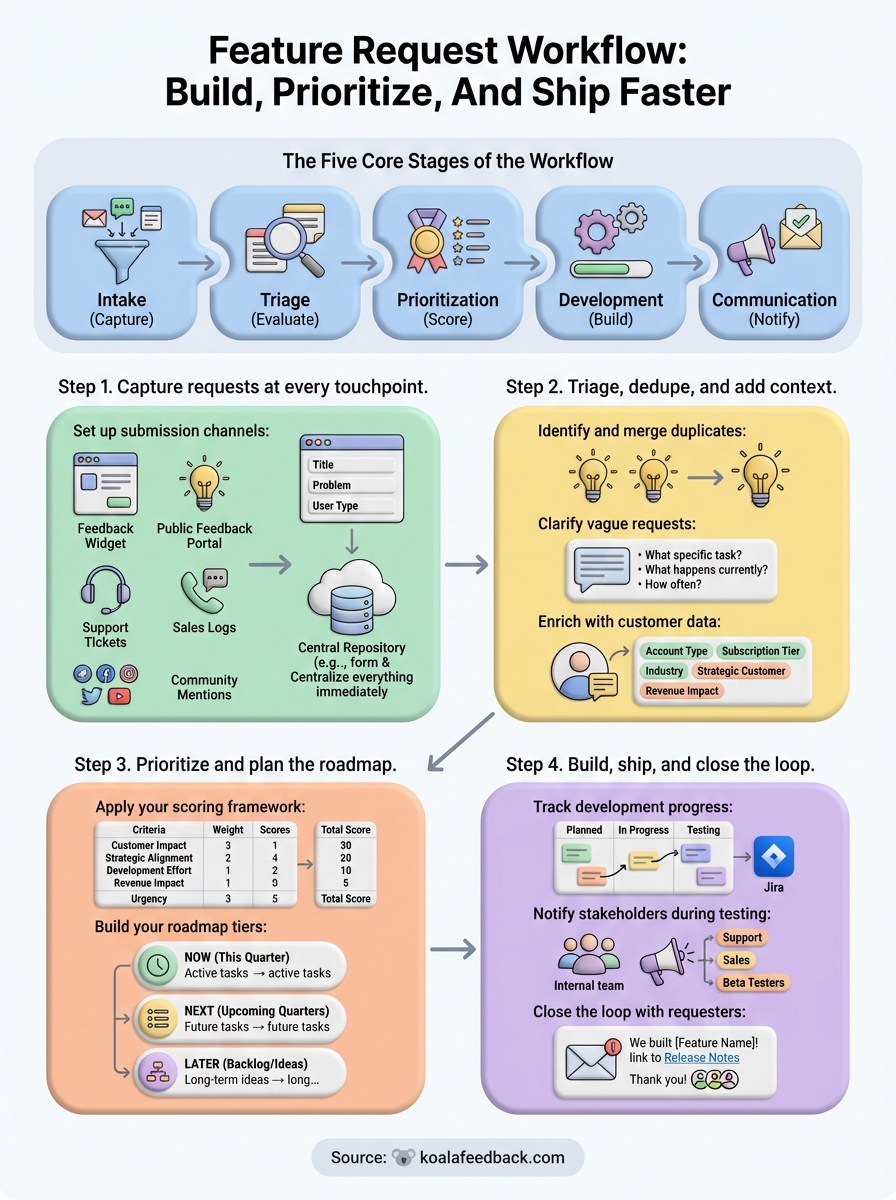
The intake stage captures requests from multiple sources and consolidates them into a single system. Your triage stage evaluates each submission for clarity, removes duplicates, and adds context from your product and customer data. During prioritization, you score requests against your evaluation criteria and decide what makes the roadmap. The development stage tracks progress as your team builds the feature. Finally, the communication stage closes the loop by notifying requesters when their feature ships.
A structured workflow ensures every request receives consistent evaluation, regardless of who submitted it or which channel they used.
Beyond the stages themselves, your workflow needs supporting infrastructure that makes execution possible. You require a centralized database where all requests live, whether that's a spreadsheet, project management tool, or dedicated feedback platform. This single source of truth prevents duplicate work and ensures nothing slips through the cracks.
Your evaluation framework defines how you make decisions about what to build. This includes scoring criteria like customer impact, strategic alignment, development effort, and revenue potential. Role assignments clarify who triages requests, who makes prioritization decisions, and who communicates outcomes back to users.
Communication templates standardize how you respond to feature requests at different stages. When you receive a request, you acknowledge it. When you prioritize it, you explain the decision. When you ship it, you notify everyone who asked. These templates save time and maintain consistency across hundreds of interactions.
Here's a basic framework for scoring requests:
| Criteria | Weight | Score (1-5) | Notes |
|---|---|---|---|
| Customer impact | 30% | How many users need this? | |
| Strategic alignment | 25% | Does it support key business goals? | |
| Development effort | 20% | How complex is the build? | |
| Revenue impact | 15% | Will it drive growth or retention? | |
| Urgency | 10% | Is there a deadline or critical need? |
Documentation requirements round out your workflow components. You need clear records of why you made specific decisions, what assumptions you based them on, and what feedback informed the choice. This documentation helps you defend prioritization decisions when stakeholders question why certain features didn't make the cut.
The workflow also requires regular review cycles where you revisit older requests that didn't initially make priority. User needs change, your product evolves, and competitive pressure shifts. What wasn't important six months ago might become critical today.
Schedule monthly or quarterly reviews to reevaluate your backlog with fresh eyes. During these sessions, you'll archive outdated requests, reprioritize based on new market conditions, and identify patterns in the types of features users keep requesting. This rhythm keeps your workflow current and prevents your backlog from becoming a graveyard of forgotten ideas.
Your team needs defined response times for each stage. Set expectations that new requests get acknowledged within 24 hours, triage happens within one week, and prioritization decisions arrive within two weeks. These timeframes show users you value their input while giving your team realistic deadlines to work within.
Your users submit feature requests wherever they interact with your product. They mention ideas during sales calls, report bugs that turn into feature suggestions, and share thoughts in community forums. If you only collect feedback through a single channel, you miss the majority of valuable input that could shape your roadmap.
You need to create dedicated pathways for feedback across every customer interaction point. Install a feedback widget directly in your product interface where users can submit ideas without leaving their workflow. Add a public feedback portal where users browse existing requests and vote on priorities before submitting duplicates.
Train your support team to recognize feature requests hidden within support tickets and tag them appropriately. Your sales team hears requests during demos and customer calls that never reach product management. Create a simple form or Slack channel where they can quickly log these conversations with context about the customer and their specific use case.
Monitor social media mentions, review sites, and community forums where users discuss your product. Set up alerts for keywords related to feature requests and regularly scan these channels for actionable feedback. Even if users don't submit formal requests, their discussions reveal what they need.
Your intake form standardizes how you collect information regardless of submission channel. Every request should capture the same core details that help you evaluate and prioritize later. Ask for the feature description, the problem it solves, and who needs it.
Here's a template for your intake form:
| Field | Purpose | Example |
|---|---|---|
| Feature title | Quick identification | "Bulk user import" |
| Problem statement | Why it's needed | "Takes 2 hours to manually add 100 users" |
| Current workaround | Understand pain level | "Export/import via CSV manually" |
| User type | Prioritization context | "Enterprise admin" |
| Contact info | Follow-up questions | [email protected] |
Keep your form short enough that users actually complete it. You can gather additional context during the triage stage if needed.
The easier you make submission, the more quality feedback you'll receive from users who would otherwise stay silent.
Route all submissions from different channels into your central repository within 24 hours. Whether you use Koala Feedback, a spreadsheet, or project management software, every request needs to land in the same system where your team can find and evaluate it. Create automated workflows that push form submissions, tagged support tickets, and sales team logs directly into your feature request workflow without manual copying.
Once requests land in your central system, you need to clean and enrich them before your team can evaluate priorities. Raw submissions often lack critical details, duplicate existing requests, or describe symptoms instead of actual problems. This triage stage transforms messy input into actionable information your product team can work with.
Scan new submissions against your existing backlog to find duplicate requests. Users describe the same need in different ways, so look beyond matching titles. Read the problem statement and use case to identify when two requests solve identical pain points even if the proposed solutions differ.
When you find duplicates, merge them into a single request that captures all variations and supporting details. Combine vote counts, link related submissions in your notes, and notify all requesters that their feedback joined a larger conversation. This consolidation gives you accurate data on how many users actually need a specific capability.
Merging duplicates early prevents your backlog from inflating with redundant requests and helps you measure true demand for each feature.
Many submissions lack the specific details you need to evaluate them properly. Reach out to requesters within 48 hours when their submission doesn't clearly explain the problem or expected outcome. Ask targeted questions that fill information gaps without requiring them to write extensive explanations.
Use this template to gather missing context:
Hi [Name],

Thanks for submitting "[Feature Title]". To help our team evaluate this properly, could you clarify:

1. What specific task or goal are you trying to accomplish?
2. What happens currently when you try to do this?
3. How often does this issue come up in your workflow?

Your answers will help us understand the full impact and prioritize accordingly.
Document their responses directly in the request record so future evaluators have complete information without hunting through email threads.
Add contextual information that helps your team understand the business impact of each request. Pull data about the requester's account type, subscription tier, contract value, and industry. Check if they represent a strategic customer or emerging segment you're targeting.
Link requests to related support tickets, churn surveys, or sales conversations that provide additional perspective on why users need this capability. Note whether multiple customers from the same industry or use case submitted similar requests, as patterns indicate broader market needs rather than one-off asks.
Tag each request with relevant product areas, technical complexity estimates, and potential dependencies on other roadmap items. These tags help your team filter and sort during prioritization without rereading every submission from scratch.
You can't build everything users request, so you need clear criteria that determine which features deserve development resources. Prioritization separates requests that align with your product strategy from nice-to-have additions that would dilute your focus. This stage transforms your enriched backlog into a ranked list that guides development decisions for the next quarter or year.
Score each triaged request against the evaluation criteria you established in your feature request workflow. Rate factors like customer impact, strategic alignment, development effort, revenue potential, and competitive pressure on a consistent scale. Multiply each score by its weight to calculate a total priority score that makes comparisons objective.
Use this scoring template for each request:
Feature: [Feature Name]
Customer Impact (30%): 4/5 = 1.2
Strategic Alignment (25%): 5/5 = 1.25
Development Effort (20%): 2/5 = 0.4 (inverse: easier = higher)
Revenue Impact (15%): 3/5 = 0.45
Urgency (10%): 3/5 = 0.3
---
Total Score: 3.6/5.0
Involve cross-functional perspectives when scoring complex features. Your engineering team estimates technical effort more accurately than product managers, while sales understands revenue impact better than developers. Schedule a weekly prioritization session where stakeholders review new requests and align on scores before you finalize rankings.
Objective scoring removes personal bias and helps you defend prioritization decisions when stakeholders question why their request didn't make the roadmap.
Group prioritized requests into roadmap tiers that reflect commitment levels. Your "Now" tier contains features you're actively building this quarter. The "Next" tier holds high-priority items scheduled for upcoming quarters. Your "Later" tier captures requests that scored well but lack capacity or dependencies aren't ready yet.
Place lower-scoring requests in a backlog category separate from your roadmap. These ideas stay in your system for periodic review but don't clutter your planning. Communicate clearly that backlog items might never ship unless business conditions change significantly.
Balance your roadmap across different improvement types. Allocate capacity to new capabilities, existing feature enhancements, technical debt reduction, and performance improvements. This distribution prevents your roadmap from becoming feature-bloated while neglecting quality and maintenance work that keeps your product healthy.
Share your roadmap publicly through a dedicated portal where users see what you're building and why. Link each roadmap item to the original requests that informed the decision, showing users their feedback directly influences your product direction.
Your feature moves from prioritized idea to actual product update during this stage. You need to track development progress, coordinate with stakeholders, and most importantly, notify everyone who requested the capability when you ship. This final step in your feature request workflow transforms planning into tangible value that users can experience.
Update the request status as your team begins development work. Change it from "Planned" to "In Progress" so users checking your roadmap know you're actively building their requested feature. Add estimated completion dates and link to related tickets in your project management system so anyone can follow detailed progress without interrupting your developers.
Schedule regular check-ins with your engineering team to catch scope changes or technical blockers early. Document these updates in the request record and adjust timeline estimates as needed. Users appreciate realistic expectations more than missed deadlines, so update your public roadmap when completion dates shift by more than a week.
Alert internal stakeholders when the feature enters testing phases. Your support team needs time to prepare documentation and train on new capabilities before users start asking questions. Sales teams want advance notice so they can inform prospects about upcoming features that address their requirements.
Create a staging environment where beta testers or power users can preview the feature and provide feedback before general release. Select requesters who submitted detailed use cases and offered to help validate the solution. Their input helps you catch usability issues that your internal team might miss.
Involving original requesters in testing turns them into advocates who promote your feature to other users when it launches.
Send personalized notifications to every user who submitted or voted on the request when you ship the feature. Explain what you built, link to documentation or a demo video, and thank them for their input. This communication demonstrates that their feedback directly influenced your product decisions.
Use this template to announce shipped features:
Subject: We built [Feature Name] based on your feedback

Hi [Name],

Great news! We just shipped [Feature Name], which you requested [timeframe] ago.

What we built:
[Brief description of the feature and its key benefits]

How to use it:
[Link to documentation or quick start guide]

Your feedback shaped this feature, and we'd love to hear what you think now that it's live.

Thanks for helping us build a better product.
Update the request status to "Completed" and link to the release notes or changelog entry. Archive or lock the request to prevent further voting while keeping it visible in your feedback portal as proof you deliver on user requests.
Your feature request workflow only works when you follow it consistently. Schedule weekly triage sessions where you process new submissions, update statuses, and communicate decisions. Block time on your calendar for quarterly roadmap reviews where you reevaluate priorities based on changing business needs and market conditions. Treat these sessions as non-negotiable commitments rather than optional meetings that get pushed when developers face deadlines.
Document your workflow steps in a shared playbook that new team members can reference when they join. Assign clear ownership for each stage so nothing stalls because everyone assumed someone else would handle it. Train your support, sales, and customer success teams on how to submit requests properly so you receive consistent, actionable information from every channel.
Ready to streamline how you collect and prioritize user feedback? Koala Feedback centralizes your feature request workflow, automatically deduplicates submissions, and helps you share progress through public roadmaps that keep users engaged in your product development.

Start today and have your feedback portal up and running in minutes.