Feature requests pile up fast. Your users email them. Your sales team mentions them in calls. Support tickets overflow with them. You find them scattered across Slack channels, spreadsheets, and sticky notes. Without a proper system, valuable feedback gets lost, duplicate requests go unnoticed, and you have no clear way to prioritize what matters most. You end up building features based on whoever shouted loudest, not what your users actually need.
This guide walks you through 13 feature request tracking software options for 2025. We cover tools for every budget and team size, from free open source solutions to enterprise platforms. You'll see how each tool handles feedback collection, what makes it stand out, and who it works best for. By the end, you'll know exactly which tool fits your needs so you can stop losing track of great ideas and start building what your users want.
Koala Feedback gives you a centralized platform to collect, organize, and act on user feedback. The tool automatically deduplicates similar requests so you don't waste time sorting through repetitive suggestions. You get a public feedback portal where users submit ideas, vote on requests, and track what you're building. This feature request tracking software connects your entire feedback loop in one place, from initial submission to shipping the feature.

Your users submit feedback through a branded portal that matches your company's look and feel. Koala Feedback sorts incoming requests into customizable boards based on product areas or feature types. Users can vote and comment on existing requests, which helps you spot patterns and gauge demand. The platform automatically groups similar ideas together, saving you from manually merging duplicates. You can then promote prioritized requests to your public roadmap, where users see what's planned, in progress, or completed.
You'll find Koala Feedback valuable if you run a SaaS product or manage features for a software team. Product managers who want to build transparency with users benefit from the public roadmap feature. Small to mid-sized teams that need a straightforward solution without enterprise complexity get the most value. The tool works well when you want users actively involved in shaping your product direction.
"Koala Feedback allows businesses to build what matters most to their users by giving them a voice and keeping them informed."
The platform offers custom domains so your feedback portal lives on your own subdomain. You customize colors, logos, and branding to match your product. Status management lets you set custom labels like "Under Review" or "Shipped" to manage user expectations. The voting system surfaces the most requested features naturally. Your roadmap updates in real time as you move requests through different stages.
Koala Feedback provides transparent pricing designed for teams of various sizes. You can start with a plan that fits your current needs and scale as your user base grows.
Canny combines a public voting board with product roadmap visualization to help you manage feature requests from collection to completion. Your users submit ideas through a customizable feedback portal, vote on suggestions they care about, and track progress through your public roadmap. The platform automatically updates customers when you change the status of their requests, keeping everyone informed without manual work on your end. This feature request tracking software brings structure to the chaos of scattered feedback.
You collect requests through customizable boards that you can make public or keep private for internal use. Users vote on existing ideas instead of submitting duplicates, which naturally surfaces your most popular requests. Canny lets you filter feedback by segment so you can see what different user groups want. The built-in changelog sits alongside your roadmap, showing what you've shipped and closing the feedback loop. Status updates go out automatically when you move a request from "under review" to "planned" or "complete."
Teams that want a public-facing voting system get the most from Canny. You'll find value here if transparency matters to your product strategy and you want users actively participating in prioritization. Companies that already use tools like Zendesk, Intercom, Jira, or GitHub can connect Canny to their existing workflow. The platform works well when you need both internal feature tracking and external community engagement in one tool.
"Public voting boards and customer-facing roadmaps help teams build what users actually want while keeping everyone informed."
Canny connects with Zendesk, Intercom, Jira, and GitHub to pull feedback from your existing tools. The voting system prevents duplicate requests and shows you which features have real demand. You get a customer-facing roadmap that updates automatically as you progress features. The changelog feature documents everything you ship. Automatic status notifications keep users informed without requiring manual outreach from your team.
Canny starts at $400 per month for 5 team seats, with additional seats at $40 monthly. A limited free plan exists for smaller teams testing the waters. Enterprise features like SFDC and HubSpot integrations require custom pricing conversations.
Frill delivers a user-friendly platform for managing product feedback with an interface that balances simplicity and power. You get three core modules: Ideas for capturing requests, Roadmap for showcasing accepted features, and Announcements for sharing updates. This feature request tracking software works across web, embedded widgets, or directly within your app. The platform gives you everything needed to collect feedback, organize it effectively, and keep users informed about what you're building.
Your users submit ideas through customizable widgets that you embed on your site or app. Frill's prioritization matrix automatically spots common requests by analyzing terms and concepts across all feedback. Users upvote ideas they care about and add comments to provide deeper context beyond simple votes. You can add requests on behalf of users when feedback comes through sales calls or social media. The public roadmap displays your accepted ideas with custom status tags, and the changelog keeps everyone updated when you ship new features.
Small to medium teams looking for affordable yet powerful feedback management get the most value from Frill. You'll appreciate this tool if you need essential features without the enterprise price tag. The platform works well when you want all integrations available from day one instead of locked behind expensive tiers. Teams that already have separate tools for onboarding or help docs find Frill fills the feedback gap perfectly.
"You can track up to 50 ideas at a time for just $25 per month with access to all core features."
Frill includes 10 platform integrations on every plan, connecting to your existing workflow tools. The multilingual interface supports global teams and users. Single sign-on (SSO) comes standard, removing friction for users who want to submit ideas. Custom branding and domain names let you maintain your brand identity across all pricing tiers, not just premium plans.
The Startup plan costs $25 monthly and includes Ideas, Roadmap, and Announcements with tracking for up to 50 ideas. The Business plan runs $49 per month and removes the idea limit, giving you unlimited tracking capacity.
Savio brings powerful segmentation capabilities to feature request tracking, letting you drill down into feedback by customer attributes like MRR, plan type, or lifecycle stage. This feature request tracking software goes beyond simple voting boards by connecting requests to actual customer data. You can see not just how many users want a feature, but which of your high-value customers are asking for it. The platform pulls feedback from tools your team already uses, creating a central knowledge base of user needs and pain points.
You collect feedback through native integrations with Intercom, Zendesk, HubSpot, Help Scout, and Slack, plus an API for custom connections. Savio centralizes everything in one place where you can tag, categorize, and link requests to specific customers. The public voting board lets users submit ideas and vote on requests from others. You segment feedback by any customer attribute you track, making it easy to see what your enterprise clients want versus freemium users. When you're ready to build a feature, you close the loop with just a few clicks by notifying everyone who requested it.
Teams that need to prioritize by customer value rather than vote count alone benefit most from Savio. You'll find this tool valuable when you want to understand which segment of users wants each feature. Product managers who need to justify roadmap decisions to stakeholders appreciate the built-in context showing MRR impact and customer details alongside each request.
"Savio helps you build product roadmaps with context included so you can easily justify your roadmap decisions to stakeholders."
The platform connects with Intercom, Zendesk, HubSpot, Help Scout, Slack, and Zapier to capture feedback wherever it happens. Customer attribute segmentation lets you filter by revenue, plan type, or custom fields. The API supports additional integrations beyond the native connections. Triage features help you organize feedback before prioritizing, ensuring quality data.
The Essentials plan starts at $39 monthly for the first admin with additional admins at $23 each. The Professional plan costs $79 per month for the first admin and $39 for extras. A Business plan with advanced features uses custom pricing for larger teams.
Sleekplan takes you through the complete feedback lifecycle, from initial collection on feedback boards to displaying completed features in a changelog. This feature request tracking software includes satisfaction surveys so you can measure user sentiment alongside feature requests. You get widgets that sit inside your app, customizable layouts that match your brand, and an impact calculator that estimates how each feature might affect your bottom line. The platform covers the full loop of gathering feedback, organizing your roadmap, and announcing what you've shipped.
Your users submit ideas through in-app widgets or your public feedback board. Sleekplan lets you segment feedback by customer status and custom attributes so you can see what different user groups want. You estimate the profitability impact of each requested feature using the built-in calculator, which helps justify prioritization decisions. Users can subscribe to your changelog to receive automatic updates when you ship new features they care about.
You'll find Sleekplan valuable if you run a large SaaS team with an extensive customer base. The tool works best when you primarily need voting boards and want to maintain a public roadmap. Teams that value NPS surveys alongside feature tracking benefit from the combined functionality. The robust free plan makes it accessible for teams testing feedback management tools.
"Sleekplan combines feedback boards, roadmaps, changelogs, and NPS surveys in a single platform for comprehensive user engagement."
The platform offers Chrome and WordPress integrations but has limited connections compared to other tools. You customize your feedback portal's layout and content to match your brand. The impact weight calculator helps you estimate feature profitability. All plans include feedback boards, changelogs, roadmaps, and NPS functionality.
Sleekplan starts with a free Indie plan that includes unlimited feedback and users. The Starter plan costs $13 monthly and supports 3 team seats. The Business plan runs $38 per month for 10 seats. Enterprise plans offer custom pricing with unlimited team members.
Feature Upvote simplifies feedback collection by bringing all your customer requests into a single online board. This feature request tracking software lets users submit ideas and upvote existing suggestions, which naturally surfaces your most demanded features. You get both private and public board options, allowing you to choose whether feedback stays internal or becomes a community-driven priority list. The platform supports unlimited contributors, meaning your entire user base can participate without hitting account limits.
Your users submit requests through dedicated feedback boards that you control and customize. The upvoting system prevents duplicate submissions while showing you which features have genuine demand from your community. You can create multiple boards to organize feedback by product line, feature category, or development phase. Feature Upvote supports multiple languages, making it accessible for global teams and international users. The SSO capability removes friction by letting users sign in with credentials they already have.
You'll benefit from Feature Upvote when you need essential voting functionality without complex feature sets. Teams that want to understand general popularity of requests across their user base find this tool effective. The platform works well if you value multilingual support for international customers. Companies comfortable with per-board pricing models that scale with product complexity get the most value here.
"Feature Upvote provides unlimited contributors and team members, removing barriers to widespread feedback participation."
The platform connects with Slack, Microsoft Teams, Jira, and Zapier to fit into your existing workflow. You get both private and public board options for different feedback scenarios. SSO for users comes standard across all plans, not locked behind enterprise tiers. The multilingual interface supports customer bases spanning different countries and languages.
The Bootstrapper plan costs $49 per board monthly and includes unlimited contributors, SSO, integrations, and private boards. The Standard plan runs $99 per board monthly with priority support added. Enterprise pricing offers custom terms for larger teams needing bulk board pricing or additional features.
UserVoice delivers enterprise-level feedback management built specifically for B2B and SaaS companies that need robust customer insights at scale. This feature request tracking software lets you collect requests through multiple channels and shows you how customers react to your responses. You get customer satisfaction tracking alongside feature requests, giving you a fuller picture of user sentiment. The platform focuses on large organizations that need advanced segmentation and detailed analytics to inform product decisions.
Your users submit feedback through an in-app widget that captures requests without interrupting their workflow. UserVoice segments customers by attributes you define, letting you filter requests by company size, plan type, or custom fields. The platform tracks customer reactions to your responses on feature requests, showing whether users agree with your prioritization decisions or timeline estimates. You send updates through feature announcements that keep stakeholders informed. Integration with Salesforce, Slack, and Zendesk pulls feedback from your existing customer touchpoints.
You'll find UserVoice valuable if you run a large enterprise with budget for premium tooling and complex segmentation needs. Companies that want to measure both feature demand and customer satisfaction in one platform benefit from the combined functionality. The tool works best when you need advanced user segmentation and detailed analytics to justify product investments to stakeholders.
"UserVoice provides the insights needed to deliver the products and features users desire most while tracking their satisfaction throughout the process."
The platform connects with Salesforce, Slack, and Zendesk for enterprise workflow integration. You get built-in NPS and CSAT surveys alongside feature tracking. Customer segmentation capabilities let you analyze requests by any attribute. Feature announcement tools keep users informed of progress and decisions.
UserVoice starts at $499 monthly for the Starter plan with one user seat. The Premium plan costs $999 per month and includes five users. Both plans target enterprise budgets rather than small or mid-sized teams.
Productboard combines powerful roadmapping with feature request management, creating visual roadmaps you can customize for different audiences. This feature request tracking software excels at roadmap creation rather than deep feedback analysis. You get tools to rank features by customer importance, tag requests for organization, and share product plans with stakeholders. The Chrome Extension pulls requests from various sources like Google Docs and SurveyMonkey, centralizing scattered feedback into one workspace.
Your users submit ideas through public or private voting portals where they can upvote requests and engage with other submissions. You categorize incoming feedback with custom tags that help organize requests by theme, product area, or priority level. Productboard calculates a user impact score by letting you rank how important each feature is to the customers requesting it. The platform focuses more on roadmap visualization than detailed customer segmentation, making it better suited for planning and communication than deep analysis.
You'll benefit from Productboard if your team needs sophisticated roadmapping capabilities alongside basic feedback collection. Larger product management teams that regularly share plans with executives, developers, and customers find value in the customizable roadmap views. The tool works best when your primary need is visual planning tools rather than detailed customer data analysis or segmentation by revenue.
"Productboard creates roadmaps you can personalize for different audiences while collecting and organizing user feedback."
The Chrome Extension captures requests from multiple web-based tools you already use. You create roadmaps with different views tailored to specific stakeholders. Tags help you organize feedback into logical categories. The user impact scoring system ranks features based on customer importance ratings.
Productboard starts at $20 monthly per user for basic features. The full-feature plan costs $100 per user monthly. An Enterprise plan with custom pricing serves larger organizations needing advanced capabilities.
Featurebase uses AI-powered duplicate detection to automatically merge similar feedback submissions, saving you from manually sorting through repetitive requests. This feature request tracking software includes revenue-based prioritization that shows the total revenue associated with users who upvoted each request. You collect feedback through customizable forums where users submit ideas, vote on features, and discuss suggestions with your team and other users. The platform connects feedback directly to user profiles through SDK integration, giving you context about who wants what.
Your users submit feedback through a public forum or in-app widgets that you embed directly in your product. Featurebase's AI scans incoming requests and automatically groups similar ideas together, preventing duplicate entries from cluttering your board. You see the combined revenue of all users who upvoted a request, making prioritization decisions clearer when you need to balance user demand with business impact. Automatic email updates notify users when their requested features move through your development pipeline from planned to in progress to shipped.
You'll benefit from Featurebase if you want AI to handle organization while you focus on decisions. Teams that prioritize features based on revenue impact rather than vote count alone find the financial data valuable. The tool works well when you need feedback collection tightly coupled with user authentication and profile data.
"Revenue-based sorting helps you focus on features that matter most to your business by showing the financial weight behind each request."
The platform connects with Slack, Intercom, Jira, and GitHub to fit into your development workflow. AI duplicate detection merges similar submissions automatically. SSO and SDK integration links feedback to specific user accounts. The roadmap feature shows what's upcoming and in progress.
Featurebase offers a Free plan for indie developers and small teams. The Starter plan costs $49 monthly with added features and customization. Growth runs $99 per month for full branding and major tools. Business pricing starts at $207 monthly for advanced capabilities supporting larger product teams.
Nolt provides private and public feedback boards that work together to gather insights from your team and users. This feature request tracking software emphasizes simplicity with a clean interface that focuses on core functionality. You get idea upvoting, custom branding, and roadmap features without overwhelming complexity. The platform supports anonymous voting, which lowers the barrier for users who want to participate but prefer not to create accounts. Single sign-on comes standard across all plans, making it easy for your authenticated users to submit and vote on requests.
Your users submit ideas through feedback boards that you configure as public or private depending on your needs. The upvoting system surfaces popular requests naturally as users vote on submissions they care about. You can enable anonymous voting to increase participation from users who might otherwise skip the feedback process. Nolt lets you create custom status tags for your roadmap, showing users what's under consideration, in development, or shipped. The platform keeps the focus on collecting votes and organizing requests rather than adding layers of analytics or segmentation.
You'll benefit from Nolt if you want straightforward feedback collection without paying for features you won't use. Teams that value single sign-on access across all pricing tiers find this tool accommodating. The lack of a changelog feature means you'll need another tool for announcing updates, which works fine if you already have that covered. Small to medium teams that prioritize voting boards over detailed analytics get solid value here.
"SSO comes standard on every Nolt plan, removing authentication barriers that might prevent users from participating in feedback."
Nolt includes SSO for users across all pricing tiers instead of locking it behind enterprise plans. You customize your feedback portal with your brand colors and logo. The roadmap feature displays your development progress with custom status labels that match your workflow. Advanced moderation tools help you manage incoming feedback and maintain board quality.
Nolt starts at $29 monthly for one board with core features like SSO and integrations. The Pro plan costs $69 per month and adds up to five boards plus advanced moderation. Enterprise plans include unlimited boards and enhanced security features with custom pricing.
Upvoty offers customizable feedback portals and boards where your users submit feature requests, report bugs, and suggest improvements. This feature request tracking software allows users to provide feedback anonymously or without signing up, lowering barriers to participation. You can embed feedback boards directly on your website or within your app using widgets, keeping users in your product environment while they share ideas. The platform includes both a product roadmap and changelog to maintain transparency about what you're building and what you've shipped.
Your users submit requests through customizable feedback portals that match your brand identity. The voting system surfaces popular ideas as users upvote submissions they care about. You organize feedback across unlimited boards included on all plans, letting you separate requests by product line, feature category, or priority level. Upvoty provides widgets you embed on your website or in your app, capturing feedback where users naturally spend time. The roadmap feature shows users what's planned and in progress, while the changelog documents completed features.
You'll find value in Upvoty if you want affordable pricing with unlimited boards from the start. Teams that recently switched to per-user instead of per-board pricing benefit from the cost structure. The tool works well when you need basic voting boards and roadmaps without complex segmentation or analytics. Small to medium teams that prioritize accessibility through anonymous submissions get solid results here.
"Unlimited boards and users on the $15 monthly plan make Upvoty accessible for growing teams managing multiple products."
The platform includes unlimited boards across all pricing tiers, not just premium plans. You customize your feedback portal to match your brand. Product roadmap and custom domain support come with the entry-level plan. Integration options expand on higher tiers but SSO requires the top Hyper plan.
Upvoty starts at $15 monthly for one project with roadmap and custom domain features. The Super plan costs $49 per month and adds integrations. The Hyper plan runs $99 monthly for up to three projects with custom SSO included.
UseResponse delivers a flexible customer feedback platform that combines feature request tracking with help desk and knowledge base functionality. This feature request tracking software offers both public and private feedback portals where users submit requests, vote on ideas, and track progress through your roadmap. You get smart moderation tools that let you review submissions before they go live, plus automation features that process requests based on rules you define. The platform supports multiple boards so you can organize feedback across different products or language groups.
Your users submit feedback through a customizable portal you control with voting limits and automated prioritization rules. UseResponse provides internal notes and discussions for team collaboration on feature ideas without exposing conversations publicly. You set deadlines for feature development and track progress through the built-in analytics dashboard. The platform includes triggers and automations that route requests to appropriate team members based on criteria you establish. Smart moderation reviews submissions before publication, helping you maintain quality standards.
You'll benefit from UseResponse if you need combined support and feedback tools in a single platform. Teams that want automation capabilities for processing high volumes of requests find the workflow rules valuable. The tool works well when you need both public community feedback and internal team discussions about feature priorities.
"UseResponse combines feedback management with help desk and knowledge base features for teams wanting unified customer engagement tools."
The platform offers multiple board support for organizing feedback across products or languages. You get smart moderation and automation tools for processing requests efficiently. SSO capabilities provide secure authentication. Analytics and trend tracking help you measure feedback patterns and team performance.
The Enterprise Cloud Support Suite costs $49 per agent monthly and includes the feedback system, help desk with live chat, and knowledge base. The On-Premise Support Solution runs $120 per agent monthly (billed annually with a five-agent minimum) and provides full control on your own servers.
Fider stands out as a free, open source solution for teams that want complete control over their feedback infrastructure. This feature request tracking software runs on your own servers, giving you full ownership of data and the ability to customize every aspect of the platform. You get the core voting board functionality without monthly subscription fees, making it attractive for teams with technical resources and tight budgets. The platform is written in Go and provides the standard features you need: user submission forms, voting capabilities, and status tracking.
Your users submit ideas through a public or private feedback board that you host and maintain. Fider includes voting functionality so users can upvote requests they want to see built. You organize submissions with status tags that indicate whether ideas are under review, planned, or completed. The platform provides basic moderation tools to manage incoming feedback and remove spam or inappropriate submissions. Since you control the hosting, you can modify the source code to add custom features or integrate with your existing systems.
You'll benefit from Fider if your team has technical expertise to handle self-hosting and maintenance. Companies that need data to stay on their own infrastructure for security or compliance reasons find this tool valuable. The open source model works well when you want to avoid recurring subscription costs and have developers who can customize the platform.
"Fider gives you complete control over your feedback infrastructure without monthly fees, ideal for teams with technical resources."
The platform provides open source code you can modify to fit your needs. You maintain complete data ownership since everything runs on your servers. Basic voting and status tracking come built in. The self-hosted nature means integration options depend on your development team rather than pre-built connectors.
Fider is completely free as an open source project. You cover only hosting costs for running the platform on your own infrastructure.
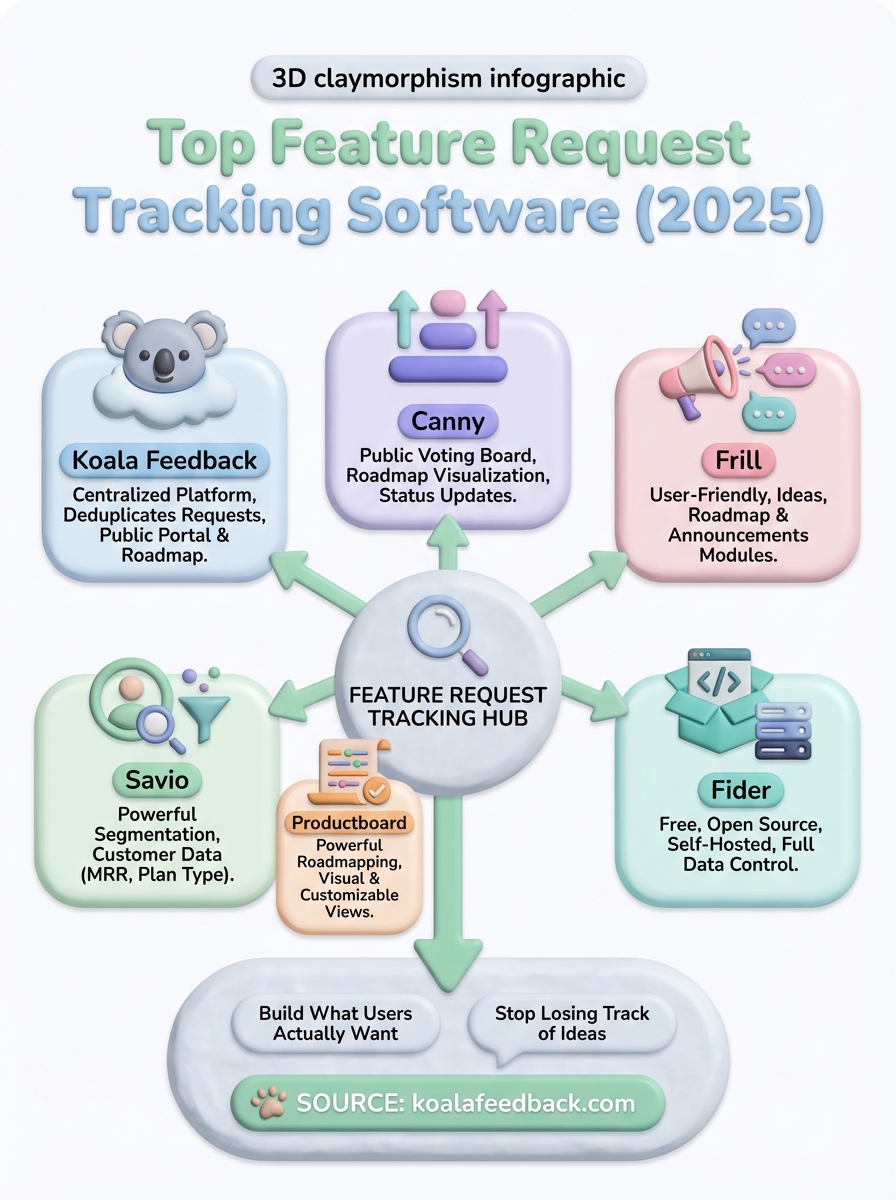
You now have 13 solid options for feature request tracking software, each with distinct strengths. The right choice depends on your team size, budget, and technical requirements. Some teams need enterprise features and complex segmentation, while others want straightforward voting boards that work immediately. Free and open source options like Fider give you complete control, while paid platforms like Canny and UserVoice offer ready-to-use solutions with support included.
Your feedback system shapes how you build your product. Centralized tracking prevents lost ideas and helps you spot patterns in user requests. Transparent roadmaps build trust with users who want to know their voice matters. Try Koala Feedback if you want a platform that combines customization, voting, and roadmaps without enterprise complexity or pricing. Start collecting feedback that actually drives your product decisions instead of letting valuable insights slip through the cracks.

Start today and have your feedback portal up and running in minutes.