Feature requests flood product teams daily. Some get built, most get ignored. The difference often isn't the idea itself, it's how the request is written and presented.
Knowing how to write a feature request that actually moves up the priority list requires more than describing what you want. It demands clear problem framing, solid reasoning, and structure that makes it easy for product teams to evaluate.
At Koala Feedback, we've processed thousands of feature requests through our platform. The ones that get prioritized share common traits: they're specific, they explain the "why," and they make the business case obvious.
This guide breaks down exactly how to write feature requests that get noticed, with templates and examples you can use right away. Whether you're a user submitting feedback or a team member documenting internal requests, you'll learn how to structure your ideas for maximum impact.
Product teams evaluate hundreds of feature requests against limited resources and competing priorities. Understanding what separates prioritized requests from the backlog helps you write more effective submissions. The deciding factors aren't subjective, they're based on measurable criteria that product managers use to justify development time and resource allocation.
Your feature request needs to demonstrate clear business value or solve problems affecting multiple users. Product teams prioritize features that move key metrics: revenue growth, user retention, churn reduction, or efficiency gains. A request affecting 500 users carries more weight than one affecting 5, unless those 5 represent significant revenue or strategic accounts.
The features that get built first solve problems for the most users or deliver the highest business impact per development hour invested.
Quantify your impact whenever possible. Instead of saying "many users need this," provide specifics: "23 enterprise customers have requested this feature" or "this affects 40% of our daily active users." Numbers transform vague requests into concrete business cases that product managers can evaluate objectively.
Requests that clearly articulate the problem and provide sufficient context get prioritized because they require less discovery work. Product teams need to understand the current workflow, the pain point, and the desired outcome. Vague requests create friction: they demand clarification meetings, back-and-forth messages, and additional research before development can even be scoped.
Complete feature requests include user stories, acceptance criteria, and examples of how the solution would work. When you demonstrate that you've thought through edge cases and potential challenges, product teams can assess feasibility faster and provide more accurate timelines.
Features that align with current roadmap priorities or strategic initiatives move faster through the queue. Product teams often batch related features together for efficiency, so requests complementing in-progress work have natural advantages. Understanding how to write a feature request that connects to broader company goals increases your chances significantly.
Technical feasibility matters too. Requests requiring minimal changes to existing systems or leveraging current infrastructure face fewer obstacles than those demanding complete architectural overhauls. Product teams balance impact against implementation complexity when making priority decisions.
Every effective feature request begins with problem definition, not solution proposals. Product teams need to understand the current workflow pain before evaluating any suggested fix. When you start with "we need X feature," you skip the most important context that helps teams explore multiple solutions.
Describe what users do now and where the process breaks down. Explain the specific task causing friction and the consequences of the current limitation. Your problem statement should answer: what are users trying to accomplish, what stops them from succeeding, and what happens as a result?
Avoid vague descriptions like "the system is confusing." Instead, write: "Users attempting to filter search results by date range must enter dates manually in MM/DD/YYYY format. This causes 22% of searches to fail due to format errors, forcing users to retry their searches."
The clearer your problem definition, the easier it becomes for product teams to identify the right solution rather than just building what you asked for.
Structure your request using the standard user story format that product teams recognize. This format forces you to identify the actor, action, and benefit, which surfaces whether the feature delivers real value.
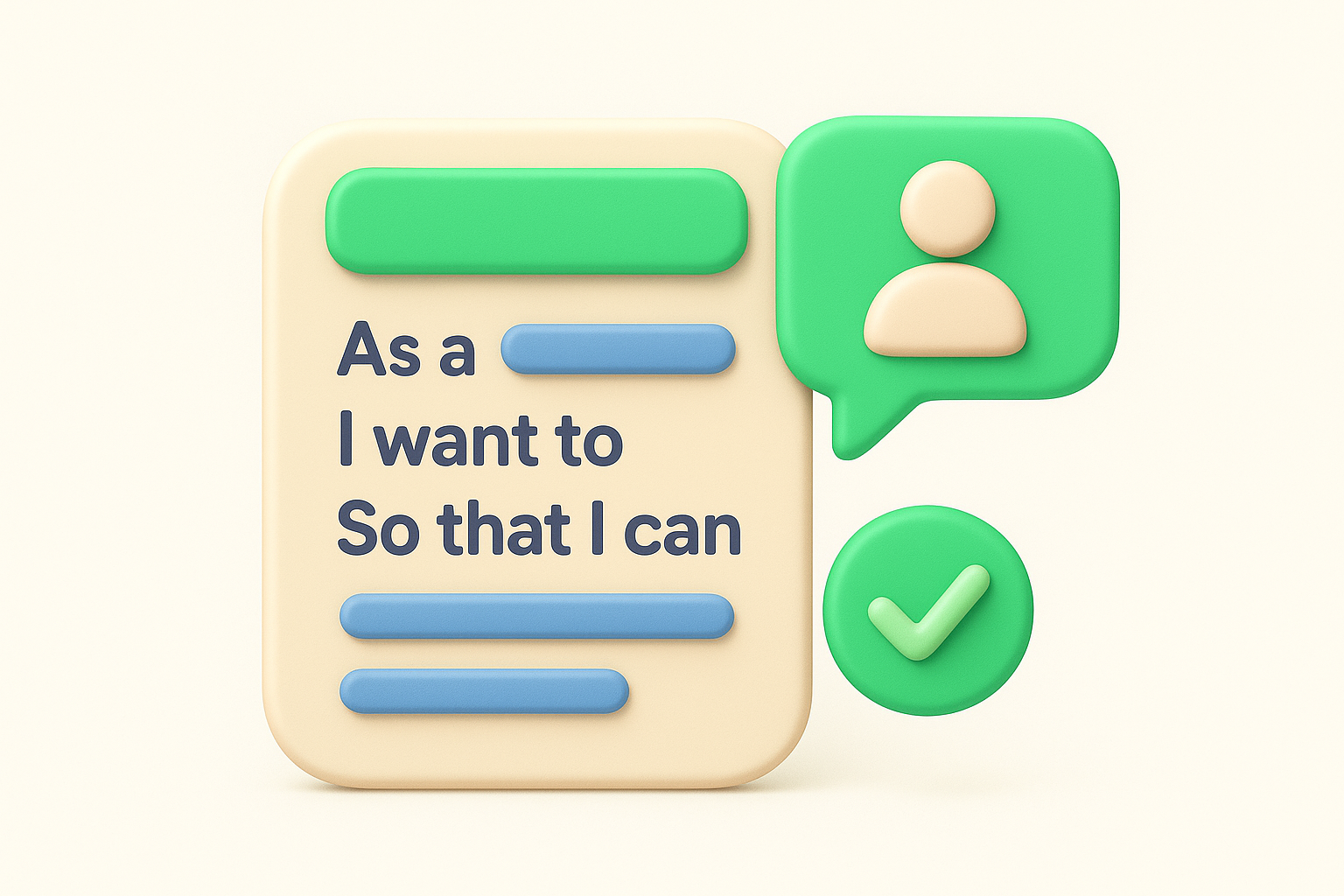
Use this template when learning how to write a feature request:
As a [type of user],
I want to [perform this action],
So that I can [achieve this goal/benefit].

Current behavior: [What happens now]
Expected behavior: [What should happen instead]
Here's a complete example:
As a customer success manager,
I want to export filtered user feedback to CSV,
So that I can share specific feature requests with executive stakeholders in monthly reports.

Current behavior: I must manually copy/paste each request into spreadsheets
Expected behavior: Single-click export of filtered results with all metadata included
Product teams make priority decisions based on data, not assumptions. Your feature request needs concrete evidence showing how many users face this problem and what the business consequences are. Without quantifiable impact, even well-written requests get deprioritized against features with measurable value.
Specify exactly how many users experience this problem and how often. Product managers weigh development costs against impact, so vague statements like "lots of users struggle" don't provide the data they need. Include numbers from support tickets, user interviews, analytics, or direct observations.
Your evidence should answer these questions:
Example: "47 support tickets in the last quarter mention this workflow issue. Our analytics show 312 users encounter this error state weekly, with 18% abandoning the process entirely."
Data-backed requests demonstrate you understand the problem's magnitude and give product teams the metrics they need to justify development resources.
Clarify which user segments need this feature and which scenarios it must address. Learning how to write a feature request includes setting clear boundaries so product teams can estimate effort accurately. Specify whether this affects all users or specific roles, plan types, or use cases.
Include constraints that shape the solution. Does this need to work on mobile devices? Must it integrate with existing systems? Are there compliance or security requirements? Clear scope prevents scope creep during development and ensures the delivered feature actually solves your problem.
After establishing the problem and impact, you can propose your recommended solution. This step shows product teams you've thought through the implementation rather than just complaining about limitations. Your proposal should describe the desired functionality with enough detail for developers to estimate effort, while remaining flexible enough for teams to explore alternative approaches.
Outline what the feature should do in specific terms. Explain the user workflow step by step, including inputs, actions, and outputs. Product teams need to visualize how users interact with the solution, so describe the experience from start to finish.
Your solution description template:
Proposed solution: [One sentence overview]

User workflow:
1. User performs [action]
2. System displays/does [response]
3. User can then [next action]
4. Final result: [outcome]

Key functionality required:
- [Feature element 1]
- [Feature element 2]
- [Feature element 3]
Example: "Add a date range picker to the search filters. Users click the date field, select start and end dates from a calendar widget, then apply filters. The system validates dates are in sequence and returns filtered results automatically."
Clear solution proposals give product teams a starting point for technical planning while leaving room for them to improve your idea during implementation.
List the specific conditions that must be true for this feature to be complete. Acceptance criteria prevent scope ambiguity and help everyone agree when the work is finished. When mastering how to write a feature request, these criteria become your success checklist.

Format criteria as testable statements: "User can select dates using keyboard input OR calendar picker," "System displays error message when end date precedes start date," "Filtered results update within 2 seconds of applying date range."
Knowing how to write a feature request includes understanding where and how to submit it for maximum visibility. Even perfectly structured requests get lost when submitted through wrong channels or buried in cluttered formats. Product teams work with specific tools and workflows, so matching their submission process increases your chances of getting reviewed quickly.
Submit your request through your company's official feedback channel if one exists. Many organizations use dedicated platforms like feedback portals, project management tools, or specialized submission forms. These systems categorize and track requests automatically, ensuring nothing gets lost in email threads or chat messages.
Format your submission according to the platform's structure. If the system has fields for problem description, impact data, and proposed solution, fill each section completely. When submitting via email or ticket, use clear subject lines that include the feature type: "Feature Request: CSV Export for Filtered Feedback."
Using the designated submission channel ensures your request enters the product team's workflow correctly and gets evaluated alongside other priorities.
Wait at least two weeks before following up on your initial submission. Product teams need time to review, discuss, and evaluate against existing priorities. Your follow-up should reference your original request ID or submission date and ask about timeline or next steps.
Keep follow-ups brief and professional:
Subject: Follow-up: Feature Request #1234 (CSV Export)

I submitted a feature request for CSV export functionality on [date].
Has the team had a chance to review this request?
I'm happy to provide additional information if needed.
Avoid demanding immediate action or repeatedly escalating. Multiple follow-ups within short timeframes create noise that actually delays decisions.
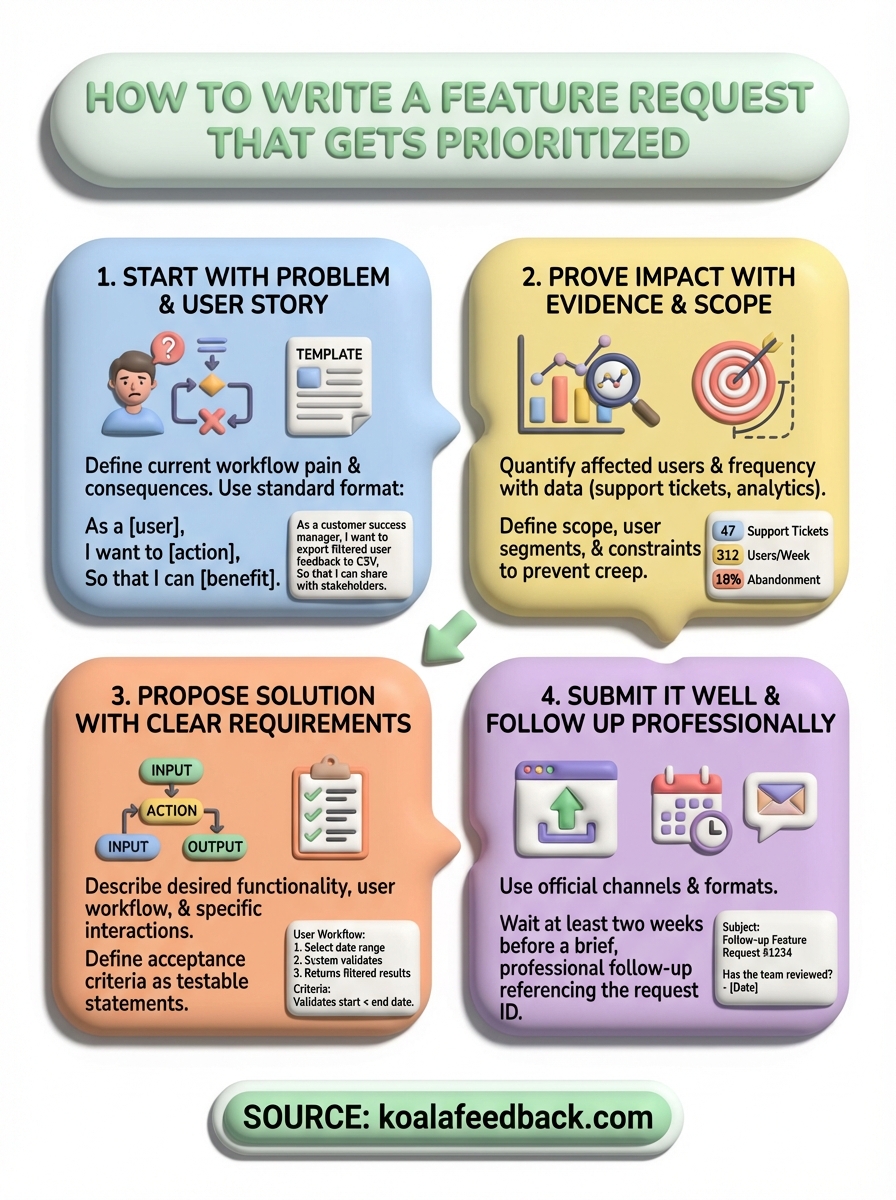
You now know how to write a feature request that product teams actually prioritize. The difference between requests that get built and those that languish in backlogs comes down to structure, evidence, and clarity. Start with the problem and user story, prove the impact with quantifiable data, propose a solution with clear requirements, and submit through the right channels with professional follow-up.
Your feature requests should answer three fundamental questions: what problem exists, how many users does it affect, and what specific functionality would solve it. When you provide this comprehensive information upfront, product teams can evaluate and scope your request without time-consuming back-and-forth delays or unnecessary clarification meetings.
The next step is implementing a system that captures, organizes, and prioritizes all incoming feature requests efficiently. Koala Feedback centralizes user feedback, automatically deduplicates submissions, and helps you identify what matters most through voting and prioritization tools. Your users stay informed about your product roadmap while you build features that drive real business value.

Start today and have your feedback portal up and running in minutes.