Feature requests arrive from everywhere. Support tickets, emails, Twitter DMs, sales calls, Slack messages. Your team scrambles to track them in spreadsheets or scattered Notion pages. Meanwhile, users wonder if you heard them at all. When you finally ship something, half your customers miss the announcement. This chaos wastes time and kills trust with the people who matter most.
A feature request portal solves this mess. It gives users one place to submit ideas, vote on what matters, and see what you're building. You get organized feedback instead of noise, clear priorities instead of guesswork, and a way to show users you're listening. This guide walks you through nine feature request portal tools, what makes each one different, who they work best for, and how to set them up. You'll find pricing breakdowns, real setup tips, and example workflows so you can pick the right portal for your team and get it running fast.
Koala Feedback gives you a centralized platform to capture user feedback, prioritize feature requests, and share your product roadmap with customers. The tool automatically deduplicates and categorizes incoming feedback, so you spend less time sorting through submissions and more time building what matters. Your users submit ideas through a branded portal, vote on what they want most, and track progress as you ship features.
Your feature request portal with Koala Feedback includes voting and commenting on submitted ideas, customizable prioritization boards organized by product area, and a public roadmap that shows users what you're planning, building, and shipping. You can brand the portal with your own domain, colors, and logo to match your product experience. The platform uses customizable status tags to manage expectations, letting users see if their request is under review, in progress, or completed.
"Build what matters most to your users by giving them a voice and keeping them informed."
Product managers and SaaS business owners get the most value from Koala Feedback when they need to organize scattered feedback and make data-driven decisions about feature development. Development teams use it to reduce noise from multiple channels and focus on high-impact work that users actually want.
Koala Feedback offers transparent pricing that scales with your needs. You'll find plans designed for startups through established companies, with custom domain support and unlimited users across all tiers.
Start by creating logical boards for different product areas or feature sets, then share your portal link in your app, support documentation, and email communications. Connect your feedback portal to your existing workflow by reviewing weekly vote counts to spot trending requests, then move prioritized items to your roadmap with clear status updates that keep users in the loop.
Canny helps you manage feature requests through a comprehensive platform that combines user feedback collection with automated organization tools. The platform handles both manual and automated feature request management, giving you flexibility in how you process incoming ideas. Users submit feedback through your branded portal while your team gains insights into customer needs and priorities.
Canny centralizes your feature request management by providing dedicated feedback boards where users submit ideas and vote on what they want most. The platform segments users based on their feedback patterns and engagement, so you can identify which customer groups care about specific features. You track customer reactions to your responses, helping you measure whether your decisions resonate with users.
Your feature request portal with Canny includes in-app widgets that capture feedback without users leaving your product, plus public and private boards to separate internal discussions from customer-facing ideas. The platform offers Salesforce, Slack, and Zendesk integrations to pull feedback from multiple sources. You get a public roadmap, changelog for feature announcements, and customer satisfaction surveys including Net Promoter Score tracking.
"Track customer reactions to your response and measure whether your decisions resonate with users."
Established SaaS companies with larger budgets benefit most from Canny when they need advanced user segmentation and deep integration with enterprise tools. Teams that want automated feedback management and detailed analytics find value in the platform's comprehensive approach.
Canny offers a free plan with two idea boards, one roadmap, and one integration. Paid plans jump to $79 per month for the Starter tier with custom domains and prioritization tools, $359 per month for Growth with advanced AI and segmentation, and custom pricing for Business plans with enterprise permissions.
Configure your feedback boards by product area or user segment first, then embed the widget in your app where users naturally encounter friction points. Review your impact-effort matrix weekly to identify quick wins, move prioritized items to your roadmap with clear status updates, and use automated notifications to keep users informed when their requests progress.
Frill delivers a user-friendly interface for managing feature requests through a platform you can embed directly in your website or app. The tool focuses on visual simplicity and straightforward workflows that get your feedback portal running quickly without extensive configuration.

Frill captures product ideas and requests from users through dedicated Ideas boards while automatically organizing submissions into categories. The platform deduplicates similar requests so you see actual demand instead of repeated variations of the same suggestion. Your users see a clean interface where they submit feedback, vote on features, and track what you're shipping through your public roadmap.
Your feature request portal with Frill includes multilingual support for international users, customizable widgets that match your brand, and a prioritization matrix that spots common requests across submissions. You get SSO for easy user access, a changelog to announce shipped features, and the ability to add requests on behalf of users during support calls. The platform offers 10 integrations starting on the base plan, connecting feedback sources like Slack and Intercom.
Small to mid-sized SaaS teams benefit most from Frill when they need essential feature request tools without paying for extras they won't use. Product managers appreciate the straightforward prioritization that highlights trending requests without complex scoring systems.
Frill starts at $25 per month for the Startup plan with 50 tracked ideas, full access to Ideas, Roadmap, and Announcements features. The Business plan costs $49 per month and removes idea limits while keeping all core features accessible.
Configure your prioritization matrix to match your product strategy, then embed feedback widgets at key friction points where users naturally encounter limitations. Review your matrix weekly for patterns in similar requests, promote high-demand items to your roadmap, and publish changelog updates that link back to original feature requests so users see their impact.
Upvoty simplifies feature request management through feedback portals and boards that collect user input from your website or app. The platform lets users submit requests anonymously or without creating accounts, reducing friction in your feedback collection process while maintaining organized channels for product ideas.
Upvoty captures feature requests, bug reports, and improvement suggestions through embeddable widgets that sit directly in your product. Users access your branded portal to submit ideas, vote on existing requests, and track which features move into development. The platform organizes submissions into boards you customize for different product areas or request types.
Your feature request portal with Upvoty includes a customizable interface that matches your brand colors and domain, plus widgets you embed in websites and apps for instant feedback capture. You get a product roadmap that displays planned and in-progress work, a changelog for announcing shipped features, and voting tools that surface popular requests.
Startups and small SaaS teams benefit most from Upvoty when they need affordable feedback management with unlimited boards from day one. Teams that want low-barrier submission through anonymous voting find value in removing signup friction.
Upvoty starts at $15 per month for one project with unlimited boards, roadmap access, and custom domain support. The Super plan costs $49 per month and adds integrations, while the Hyper plan at $99 per month includes three projects and SSO authentication.
Create separate boards for feature requests, bug reports, and general feedback to keep submissions organized from the start. Embed widgets on pages where users hit limitations, review vote counts biweekly to spot demand patterns, and promote top-voted items to your roadmap with status updates that close the feedback loop.
Featurebase combines AI-powered organization with revenue-based prioritization to help you manage feature requests from collection through shipping. The platform automatically detects and merges duplicate submissions, saving your team hours of manual cleanup while giving you accurate demand signals for each feature request.

Featurebase captures user feedback through a dedicated forum where customers submit ideas, vote on existing requests, and comment on features they care about. The platform connects feedback to revenue by showing you the total customer value behind each upvoted request, helping you prioritize based on business impact instead of just vote counts. Your users receive automatic email updates when their requested features move through your development stages.
Your feature request portal with Featurebase includes in-app widgets for collecting feedback without disrupting user workflows, plus AI duplicate detection that groups similar submissions automatically. You get roadmap management tools that display what's planned and in progress, user authentication through SSO and SDK that links feedback to profiles, and integrations with Slack, Intercom, Jira, and GitHub that sync data across your workflow.
"Connect feedback to revenue by showing the total customer value behind each upvoted request."
SaaS teams that make decisions based on revenue impact benefit most from Featurebase when they need to balance user demand with business value. Product managers appreciate the AI-powered deduplication that keeps feedback organized without manual intervention.
Featurebase offers a free plan for indie hackers with limited features. Paid plans start at $49 per month for Starter with added customization, $99 per month for Growth with full branding, and $207 per month for Business with advanced tools for larger product teams.
Configure your revenue tracking by connecting user profiles to your billing system, then set up AI duplicate detection rules that match your product terminology. Review your prioritization dashboard weekly by revenue impact, promote high-value requests to your roadmap, and use automated email notifications to update users when their features ship.
UserVoice targets B2B and SaaS companies that need enterprise-grade feedback management with deep customer insights. The platform helps you understand which features your users want most while tracking their reactions to your decisions, giving you a feedback loop that extends beyond simple vote counting.
UserVoice collects feature requests through a structured submission system that captures both the request itself and the business context behind it. The platform shows you customer reactions to your responses on feature requests, helping you measure whether your prioritization decisions align with user expectations. You gain insights into which customer segments care about specific features and how satisfied they are with your product direction.
Your feature request portal with UserVoice includes in-app widgets for seamless feedback collection, feature announcements that keep users informed of shipped work, and integrations with Salesforce, Slack, and Zendesk that pull feedback from multiple channels. The platform offers customer satisfaction surveys including Net Promoter Score tracking and user segmentation tools that group feedback by customer attributes.
"Track customer reactions to your decisions and measure whether your prioritization aligns with user expectations."
Enterprise SaaS companies with substantial budgets benefit most from UserVoice when they need advanced segmentation and detailed customer insights. Large product teams appreciate the comprehensive integration options with enterprise tools they already use.
UserVoice offers a Starter plan at $499 per month for one user and a Premium plan at $999 per month for five users, making it accessible only to well-funded teams with enterprise needs.
Connect your Salesforce instance first to link feedback with customer data, then configure user segments based on plan type or company size. Review customer reactions monthly to spot disconnect between your decisions and user expectations, adjust your roadmap based on segment-specific feedback, and use automated satisfaction surveys to measure impact after shipping requested features.
Sleekplan provides user feedback management through a platform that combines feature request boards with satisfaction surveys. The tool gives you multiple ways to capture feedback while maintaining a clean interface that keeps users engaged with your product development process.
Sleekplan collects product feedback through dedicated feedback boards where users submit ideas, vote on features, and track your progress on requested improvements. The platform includes satisfaction survey tools that measure customer sentiment alongside feature requests, giving you both qualitative and quantitative insights into user needs. You capture feedback through widgets, boards, and direct submissions that flow into a single organized system.
Your feature request portal with Sleekplan includes roadmap and changelog tools that display planned and shipped features to users, plus feedback widgets and custom domains that match your brand identity. The platform offers Chrome and WordPress integrations to connect feedback sources, though integration options remain limited compared to other tools. You get voting systems, commenting features, and status tracking that keeps users informed.
"Capture both qualitative and quantitative insights through combined feedback boards and satisfaction surveys."
Budget-conscious teams benefit most from Sleekplan when they need core feedback management features without monthly costs. Small SaaS companies appreciate the unlimited feedback capacity on the free tier when they're starting their feedback collection process.
Sleekplan offers a free Indie plan with unlimited feedback and users. Paid plans start at $13 per month for Starter with three team seats and $38 per month for Business with 10 seats, including feedback boards, changelogs, roadmaps, and NPS tools across all tiers.
Start with the free plan to test whether limited integrations work for your workflow, then create separate boards for features, bugs, and general feedback. Review satisfaction scores monthly alongside feature votes to identify patterns between user sentiment and requested features, promote high-demand items to your roadmap, and publish changelog updates that reference original feedback submissions.
Beamer combines customer communication tools with feature request management to help you engage users throughout the product development cycle. The platform focuses on announcement delivery alongside feedback collection, giving you a complete system for gathering input and communicating progress back to users who submitted requests.

Beamer captures feature requests through a dedicated feedback system where users submit ideas, vote on features, and participate in discussions about product direction. The platform measures customer satisfaction through NPS surveys that run alongside your feedback boards, helping you understand sentiment while collecting feature requests. You track feature status automatically and keep users informed as their requests move through development stages.
Your feature request portal with Beamer includes a changelog that showcases updates to users, in-app notifications for targeted messaging about new features, and feedback boards with voting and prioritization tools. The platform offers segmentation capabilities that let you target specific user groups with personalized announcements, plus integrations with Slack, Zapier, and other platforms through API and webhooks. You get both public and private roadmap views that control what information different audiences see.
SaaS companies focused on user engagement benefit most from Beamer when they need to combine feedback collection with feature announcement capabilities. Product teams appreciate the integrated communication tools that reduce context switching between feedback and updates.
Beamer starts at $49 per month for the Starter plan with 5,000 monthly active users, changelog, and customization options. The Pro plan costs $99 per month with 10,000 MAUs and adds segmentation, while the Scale plan at $249 per month includes 50,000 MAUs with advanced tracking.
Configure user segments based on plan type or usage patterns before launching your feedback board, then embed notification widgets where users naturally encounter product limitations. Review feedback and NPS scores together each week to spot connections between feature gaps and satisfaction drops, promote high-impact requests to your roadmap, and use targeted announcements to notify specific user segments when their requested features ship.
Nolt delivers feedback management through both private and public boards that give you flexibility in how you collect user input. The platform keeps your feature request portal simple with flat-rate pricing and core features available from the entry-level tier, making it accessible for teams that need straightforward feedback collection without complex workflows.
Nolt captures feature requests through dedicated boards where users submit ideas, upvote submissions they support, and track which features move into development. The platform offers anonymous voting that removes barriers to participation while maintaining organized channels for product feedback. Your team accesses private boards for internal discussions while users engage with public boards to influence your product direction.
Your feature request portal with Nolt includes idea upvoting that surfaces popular requests, Single Sign-On across all pricing tiers for easy access, and custom branding that matches your product identity. The platform provides a roadmap view that displays planned features, though it lacks changelog functionality for announcing shipped work.
"SSO available on all plans removes authentication barriers and increases user participation in feedback collection."
Small SaaS teams benefit most from Nolt when they need affordable feedback boards with SSO included at every pricing level. Teams that already use separate changelog tools appreciate the focused feature set that keeps costs predictable.
Nolt starts at $29 per month for one board with SSO and core integrations included. The Pro plan costs $69 per month with five boards and advanced moderation, while Enterprise plans offer unlimited boards with enhanced security.
Create separate public and private boards to distinguish customer feedback from internal product discussions, then share your public board link in product documentation and support channels. Review upvotes weekly to identify trending requests, move high-demand items to your roadmap with clear status indicators, and use a separate changelog tool to announce shipped features that originated from user feedback.
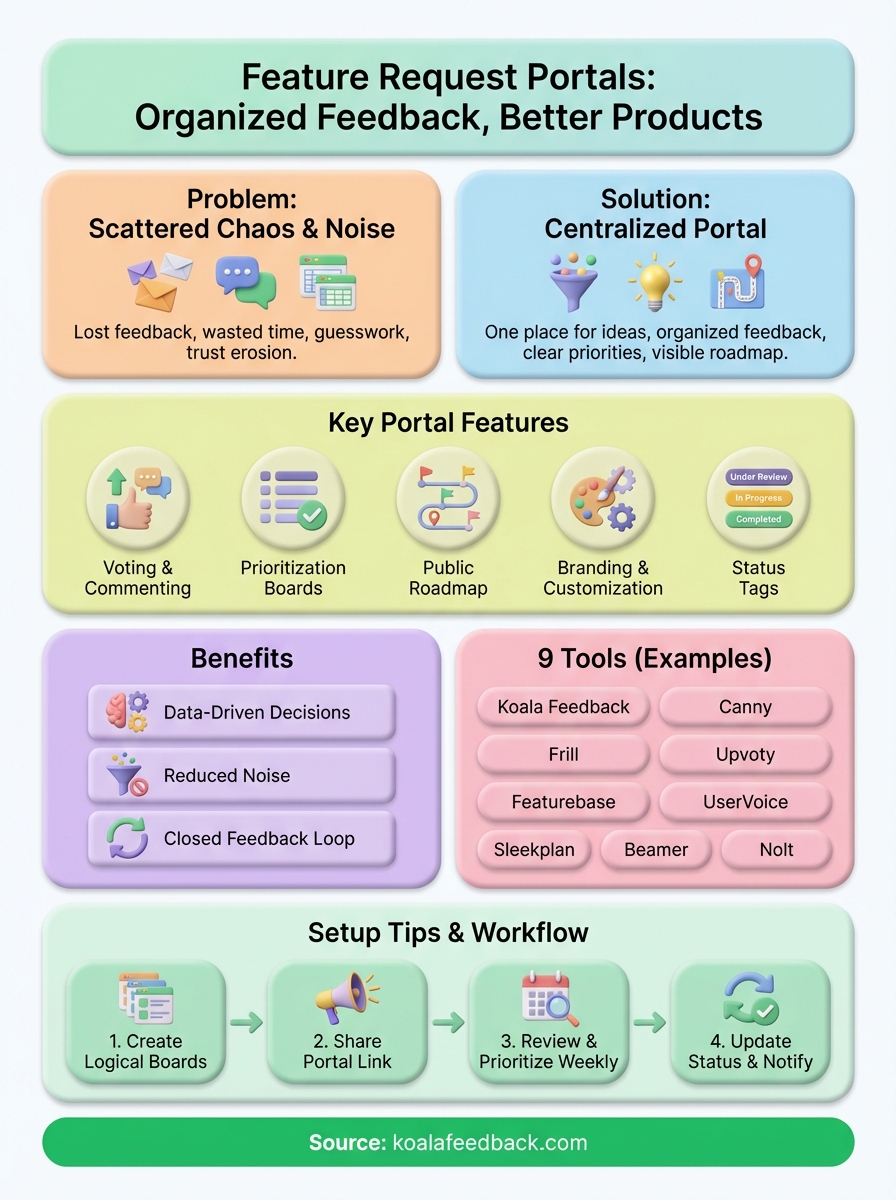
You now have nine feature request portal options with clear pricing, features, and setup guidance to evaluate against your team's specific needs. Your next move depends on your budget and requirements. Start by identifying your must-have features like SSO, integrations, or revenue-based prioritization, then narrow your list to tools that offer those capabilities at your price point. Most platforms offer free trials or free tiers, so test your top two or three choices with real users before committing.
Your feature request portal becomes valuable only when users actually engage with it. Share your portal link in your product, documentation, support emails, and anywhere users currently send feedback scattered across channels. Review submissions weekly to spot patterns, promote high-demand requests to your roadmap, and close the feedback loop by notifying users when you ship their ideas. Try Koala Feedback to centralize your feature requests, prioritize with confidence, and keep users informed throughout your development process.

Start today and have your feedback portal up and running in minutes.