Most teams don't have a shortage of ideas. They have a shortage of structure around those ideas. Feature requests pile up in spreadsheets, Slack threads, and support tickets, and without a clear system, the best ones get buried under the loudest ones. That's exactly the problem that idea management best practices solve: they give you a repeatable process to capture, evaluate, and act on ideas before momentum fades or context disappears.
Good idea management isn't about collecting more input. It's about building a decision-making framework that connects raw feedback to real product outcomes. When done right, it shortens the gap between what users ask for and what your team actually ships, and it gives you the data to explain why.
At Koala Feedback, we built our platform around this exact workflow: centralized feedback collection, voting, prioritization boards, and public roadmaps that keep users in the loop. We've seen firsthand how the right process, paired with the right tool, turns scattered suggestions into a clear product direction.
This guide breaks down the core components of an effective idea management process, the metrics that tell you it's working, and the tools that make it practical. Whether you're a product manager at a startup or leading development at a scaling SaaS company, you'll walk away with a system you can implement immediately.
Idea management is the structured process of capturing, organizing, evaluating, and acting on ideas from any source, whether that's customers, employees, or internal teams. It's not a single meeting or a suggestion box. It's a repeatable system that moves ideas through a defined pipeline so the best ones reach decision-makers and the rest get explained, not just quietly dropped.
A well-built idea management system doesn't just collect input. It creates a clear path from raw suggestion to deliberate decision.
At its core, idea management connects three things: input sources (where ideas come from), evaluation criteria (how you assess them), and action workflows (what happens next). When you follow idea management best practices, you create a system where every idea gets acknowledged, categorized, and reviewed against the same standards. That consistency prevents personal bias or organizational politics from deciding which features get built.
Structured idea management also creates institutional memory. When you document why an idea was accepted or rejected, future team members don't re-litigate the same decisions. You build a searchable record of what your users asked for, what your team considered, and what choices you made, along with the reasoning that supported each one.
Here's what a functioning idea management process typically includes:
Idea management is not a democratic voting system where the most popular request automatically wins. Votes signal demand, but they don't account for strategic fit, technical feasibility, or business value. Treating your idea pipeline as a popularity contest leads to a roadmap that satisfies the loudest segment of users while missing the needs of your most valuable ones.
It's also not a one-time initiative or a workshop exercise. Teams often run a brainstorming session, fill a whiteboard, and call it idea management. That produces a list, not a system. Without an ongoing process to capture new ideas, re-evaluate old ones, and communicate decisions, the effort stalls within weeks. Real idea management is an operational discipline, not an event you schedule once a quarter.
Finally, idea management is not the same as project management. Project management takes an approved idea and executes it. Idea management happens before that: it's the filter that decides which ideas deserve to become projects in the first place. Confusing the two means you skip the evaluation step entirely and end up building things that seemed urgent in the moment but don't move the needle for your users or your business.
Without a formal system, ideas decay. A feature request submitted in January might resurface in a Slack message in March, but by then the context is gone and the user who asked for it has moved on. Idea management best practices give your team a structured way to prevent that decay, turning scattered input into reliable product intelligence you can act on with confidence.
The cost of a missing process isn't just lost ideas. It's lost trust from the users who submitted them.
When your team lacks a clear intake and evaluation system, decisions default to whoever talks loudest in the room. That might be the most persistent customer, the most senior engineer, or the last person who had a call with sales. The result is a product roadmap driven by proximity, not evidence. Over time, that misalignment compounds: you build things users didn't prioritize, miss the ones they actually needed, and spend development cycles on work that doesn't move your key metrics.
Teams also waste significant time re-evaluating the same ideas. Without documentation of past decisions, you revisit the same feature debate every few months and reach the same conclusion each time, just without noticing.
A well-run idea management process does something beyond helping you pick better features: it signals to users that their input matters. When someone submits a request and receives a status update, even a "not now," they're more likely to stay engaged and submit future feedback. That feedback loop is a direct driver of long-term retention for product-led businesses.
Internally, a clear process removes ambiguity from prioritization conversations. Your product, engineering, and business teams align around the same evaluation criteria instead of advocating for competing priorities in every planning session. That efficiency compounds over time as your team builds faster and with more confidence in the decisions behind each item on the roadmap.
A process that works for a five-person team breaks down fast when your user base grows. If you rely on a shared inbox or a sticky note system at the start, you'll hit a wall the moment feedback volume increases and more stakeholders need visibility. Building your idea management process with scalability in mind from day one means you won't have to rebuild it entirely six months later.
Before you organize ideas, you need to control where they enter your system. Most teams collect feedback from multiple touchpoints: in-app prompts, support conversations, sales calls, and user interviews. The problem isn't the number of sources. It's that each one feeds a different place. Pick a single centralized destination where all inputs land, whether that's a dedicated feedback portal, a structured form, or a tool built for this workflow. If ideas arrive through other channels, route them to that central location immediately rather than triaging them separately.
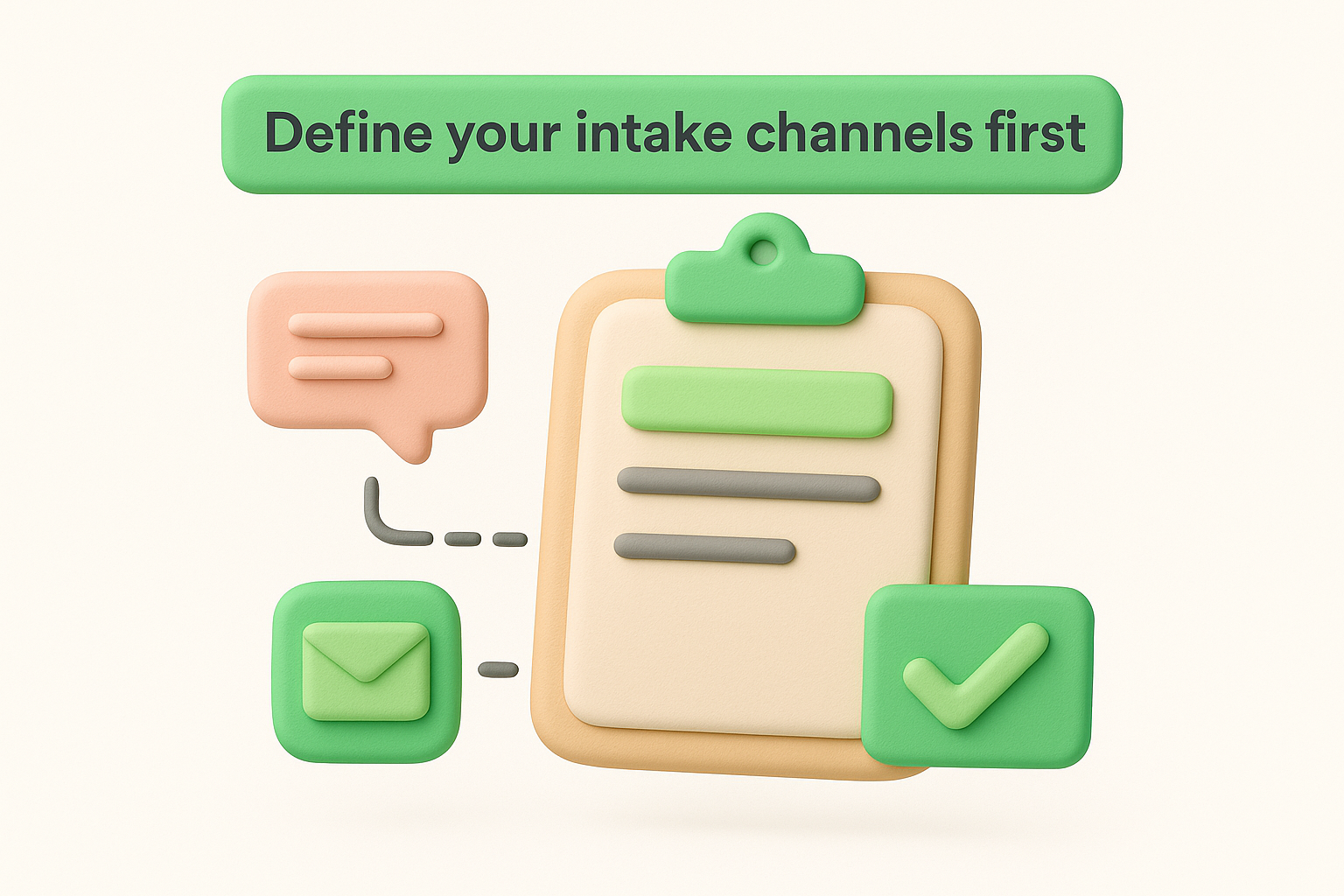
Here are the intake rules that keep the pipeline clean as you scale:
Capturing ideas without a review schedule creates a backlog that no one trusts. You need a fixed cadence where your team moves ideas through defined stages: new, under review, accepted, declined, or deferred. Without that rhythm, ideas sit in a queue indefinitely and lose the context that made them useful.
A predictable review cycle is what separates a functioning idea management process from a graveyard of feature requests.
Following idea management best practices means treating your review cadence like a standing meeting with a clear agenda, not an optional cleanup task. Set a weekly or biweekly session, assign an owner, and document the outcome of every idea reviewed so your team builds a record they can reference when similar requests resurface.
Capturing ideas is the easy part. Deciding which ones to pursue is where most teams struggle without a defined framework. When your evaluation process relies on opinions and instincts, the same debates repeat themselves every planning cycle. Following idea management best practices means replacing that guesswork with a consistent set of criteria that every idea moves through before anyone commits resources to it.
A scoring framework forces your team to evaluate every idea against the same dimensions, regardless of who submitted it or how loudly they advocated for it. Without one, your highest-voted request might be a poor strategic fit, and your most impactful opportunity might be sitting at the bottom of a long backlog.
Applying a consistent framework removes politics from prioritization and replaces them with evidence.
A simple scoring model covers four dimensions that matter most to product decisions:
Rate each idea on a fixed scale (1 to 5 works well) across these dimensions, then calculate a weighted score to rank your pipeline objectively.
Not every dimension carries equal importance at every stage of your product's growth. An early-stage team might weight effort heavily to avoid overcommitting, while a mature product team might prioritize strategic fit above all else. Define your weights before you score any ideas, not after, so the output reflects your actual priorities rather than the result you were hoping to justify.
Revisit your weighting model at least once per quarter. As your product strategy shifts, your scoring criteria should shift with it. A framework that stays static becomes just as unreliable as the gut-instinct approach you replaced.
After you evaluate and score ideas, what you communicate back to contributors matters just as much as the decision itself. Users who submit feedback and never hear back stop submitting entirely, and your idea pipeline dries up along with your most direct source of product intelligence. Closing the loop is not a courtesy. It's a core part of any idea management best practices framework.
Every idea that moves through your review cycle deserves a status update, whether you accept it, defer it, or decline it. A clear status message tells contributors that their input entered the process and received real consideration. When you share the reasoning behind the outcome, you build the kind of transparency that keeps users engaged long after their specific request is resolved.
The teams that communicate decisions consistently are the ones that generate the most useful feedback over time.
Use consistent status labels across your pipeline: planned, in progress, completed, under review, and not planned. Each label signals something specific. "Not planned" with a one-line explanation is far more useful than silence because it sets clear expectations and prevents the same request from resurfacing repeatedly without context.
Declining an idea well is a skill worth developing. When you tell a user their request is not on your current roadmap, the way you frame that response determines whether they submit the next piece of valuable feedback or disengage entirely. Acknowledge the underlying need, explain the strategic reason behind the decision, and where possible, point to something you are building that addresses a related problem.
You don't need a long explanation for every declined request. A brief, honest response that covers what you decided and why you went that direction is enough. The goal is to make contributors feel heard rather than processed, so they stay invested in your product's direction and continue sending you the raw input your team depends on to make better decisions.
A process without measurement is just activity. When you follow idea management best practices, you track specific numbers that tell you whether your pipeline is functioning or quietly breaking down. The right metrics show you where ideas stall, which contributors stay engaged, and whether the ideas you act on actually drive the outcomes you planned for.
Without metrics, you're managing ideas by feel. With them, you're managing them by evidence.
Throughput tells you how many ideas move through each stage of your pipeline within a given period. If you're capturing 50 ideas a month but only reviewing 10, you have a bottleneck at the evaluation stage. If you review all 50 but act on none, your criteria are either too strict or misaligned with your strategy. Track the number of ideas that move from submitted to reviewed, from reviewed to accepted, and from accepted to shipped. Those conversion rates reveal exactly where your process breaks down.

Here are the core throughput metrics worth tracking each month:
Engagement metrics tell you whether users trust your system enough to keep contributing. Track the number of unique contributors per month and watch for changes over time. A drop in submissions often means contributors stopped believing their input leads anywhere. That's a signal to revisit your communication process before your feedback pipeline runs dry.
Quality matters as much as volume. Score a sample of submitted ideas each quarter for completeness and specificity: does the submission describe a real problem, include a use case, and provide enough context to evaluate? If average quality drops, your intake form needs tighter required fields. High-quality input leads directly to higher-confidence decisions, which is the output a well-maintained idea management process is designed to deliver.
The tool you choose won't fix a broken process, but the right one will make a working process significantly easier to maintain at scale. When you apply idea management best practices, your toolset should match your workflow rather than force you to adapt your workflow to fit the tool. Before evaluating any platform, map out what your team actually needs: centralized intake, status tracking, contributor communication, and roadmap visibility. A tool that covers all four reduces the friction that causes teams to abandon their process when feedback volume increases.
Every stage in your idea pipeline requires specific functionality. Your intake stage needs a structured submission form with required fields that prevent vague requests from entering the system. Your evaluation stage needs scoring or voting mechanisms that surface demand without letting volume override strategic judgment. Your communication stage needs status labels and update tools that reach contributors automatically when a decision is made. Before committing to any tool, verify it supports all three stages, because a gap at any point forces your team to patch the process with manual workarounds that won't hold as you scale.
The tools that generate the most useful long-term feedback are the ones contributors actually trust.
Your users need to see what happened to their ideas after submission. That means your tool should support a public-facing roadmap or status board where contributors can check progress without contacting your team directly. Koala Feedback gives you a customizable feedback portal, a public roadmap with configurable statuses, and automatic contributor updates built into the same workflow. That combination reduces the manual communication overhead that slows most teams down and keeps your contributor engagement metrics healthy over time. When your users can see their ideas move from submitted to shipped, they stay invested, and that ongoing investment is what keeps your idea pipeline producing the quality input your team depends on to make confident product decisions.
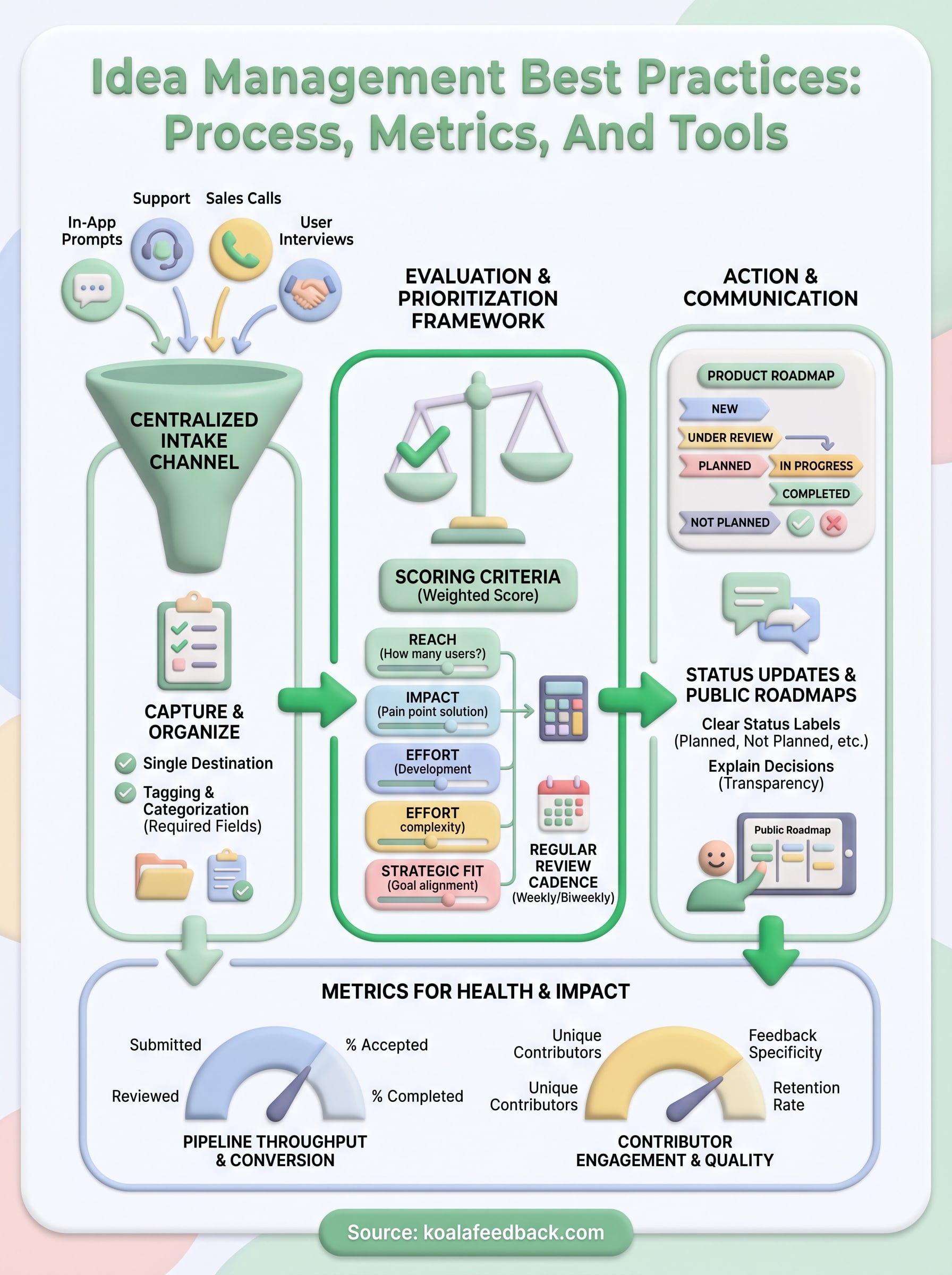
You now have a complete picture of what idea management best practices require: structured intake, consistent evaluation criteria, clear communication, and metrics that tell you whether your process is working. The gap between knowing this and doing it comes down to one decision: start with the simplest version of the system you can run today, then build from there. Pick one intake channel, set a biweekly review meeting, and establish two or three scoring criteria before you add anything else.
Your process will improve faster once real ideas are moving through it than it ever will in planning. Complexity scales naturally when the foundation is solid. Once your team reviews ideas consistently and communicates decisions back to contributors, engagement grows and your feedback quality rises with it. If you want a tool built for exactly this workflow, start your free trial with Koala Feedback and get your first feedback portal live today.

Start today and have your feedback portal up and running in minutes.