A solid product roadmap planning template gives your team a shared reference point, something everyone can look at and immediately understand what's being built, why, and when. Without one, roadmap conversations tend to spiral into scattered docs, conflicting priorities, and stakeholders who feel left out of the loop. Templates fix that by providing structure from the start.
But not every template works the same way. Some are built for executive-level presentations, others for sprint-level planning. Some live in spreadsheets, others inside dedicated tools. The right pick depends on your team size, your planning style, and how closely you want to tie your roadmap back to actual user feedback. That last part matters more than most teams realize, a roadmap disconnected from what users are asking for is just a wish list with deadlines.
That's exactly why we built Koala Feedback: to help product teams collect, prioritize, and act on user feedback, then reflect those decisions in a public roadmap users can actually follow. We've seen firsthand how the right planning framework changes the way teams ship.
Below, you'll find 16 product roadmap planning templates worth considering, spanning spreadsheets, slide decks, and software-based options. Each one includes what it's best suited for so you can skip the trial-and-error and start planning with something that fits.
Most product roadmap planning templates start with the team deciding what to build. This one starts with your users telling you. The Koala Feedback workflow connects raw user input directly to your roadmap, so every item on it traces back to something a real user actually asked for, not something someone assumed they wanted.
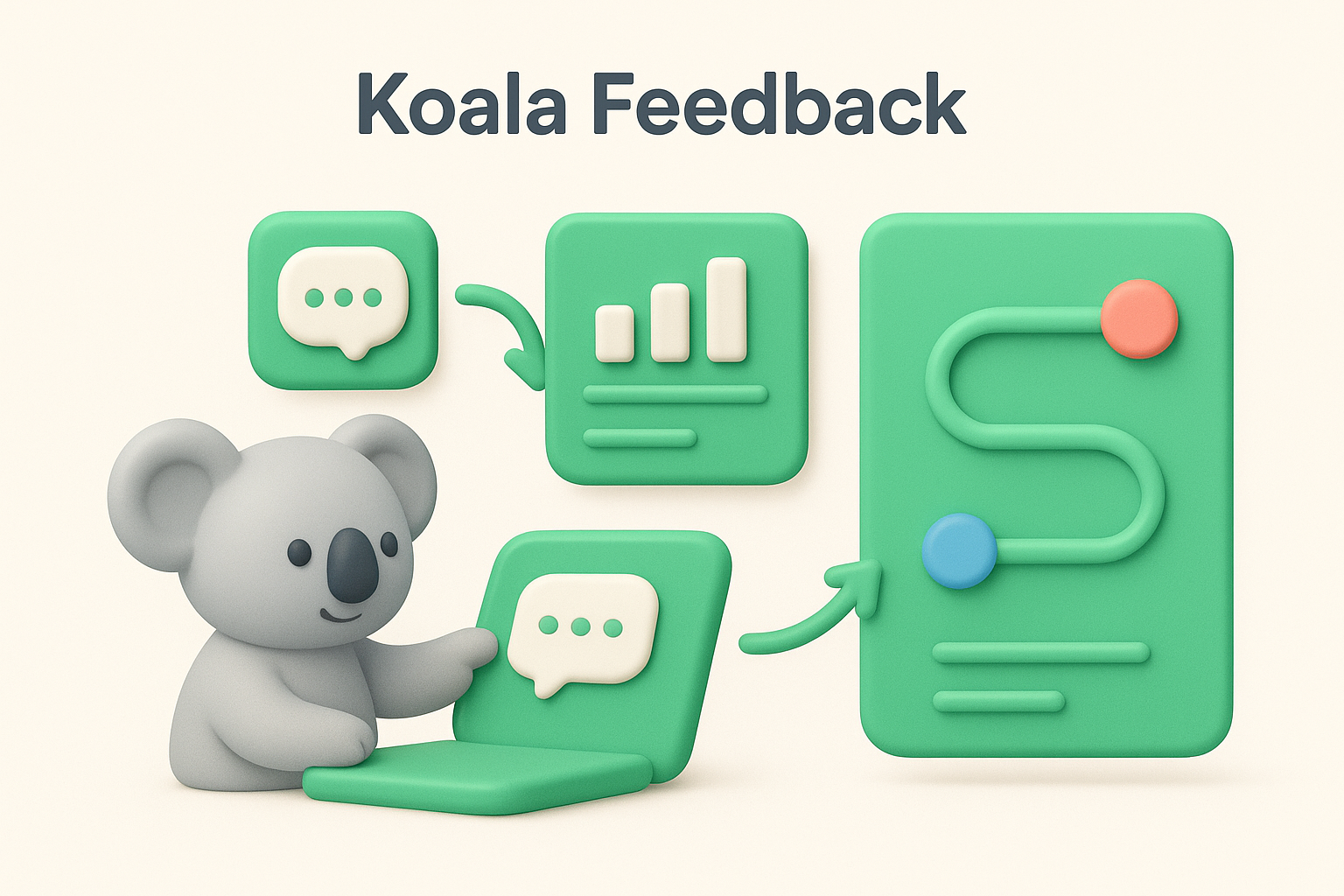
The Koala Feedback feedback-to-roadmap workflow is a structured process that captures user submissions, organizes them by theme or priority, and surfaces them in a public roadmap. Instead of building in a vacuum, you collect requests through a dedicated portal, let users vote on what matters most, and then reflect your decisions in a roadmap your users can follow in real time.
This template fits SaaS teams and product managers who want their roadmap driven by demand rather than internal guesswork. It works especially well when you have an active user base with strong opinions and a team willing to communicate their decisions back to users.
If your roadmap currently lives in a spreadsheet nobody checks, this workflow gives it a home users will actually visit.
A complete feedback-to-roadmap setup in Koala Feedback includes:
Start by creating a feedback portal and setting up boards that match your main product areas. Then invite your users to submit and vote on feature ideas. As requests come in, Koala Feedback automatically deduplicates and categorizes them so you are not sorting through redundant submissions by hand. Once you identify what to build next, move items to your roadmap and update their status as work progresses. Users who voted get visibility into what is happening without you needing to write individual update emails.
The biggest mistake teams make here is collecting feedback and never updating the roadmap to reflect their decisions. If users submit ideas and see no movement, they stop contributing. Keep your statuses current and respond to high-vote items with a clear explanation of whether or not you will build them.
The now next later roadmap is one of the most approachable product roadmap planning template formats available because it removes dates entirely and focuses on sequence and priority instead. You communicate direction without locking yourself into a delivery calendar you cannot guarantee.
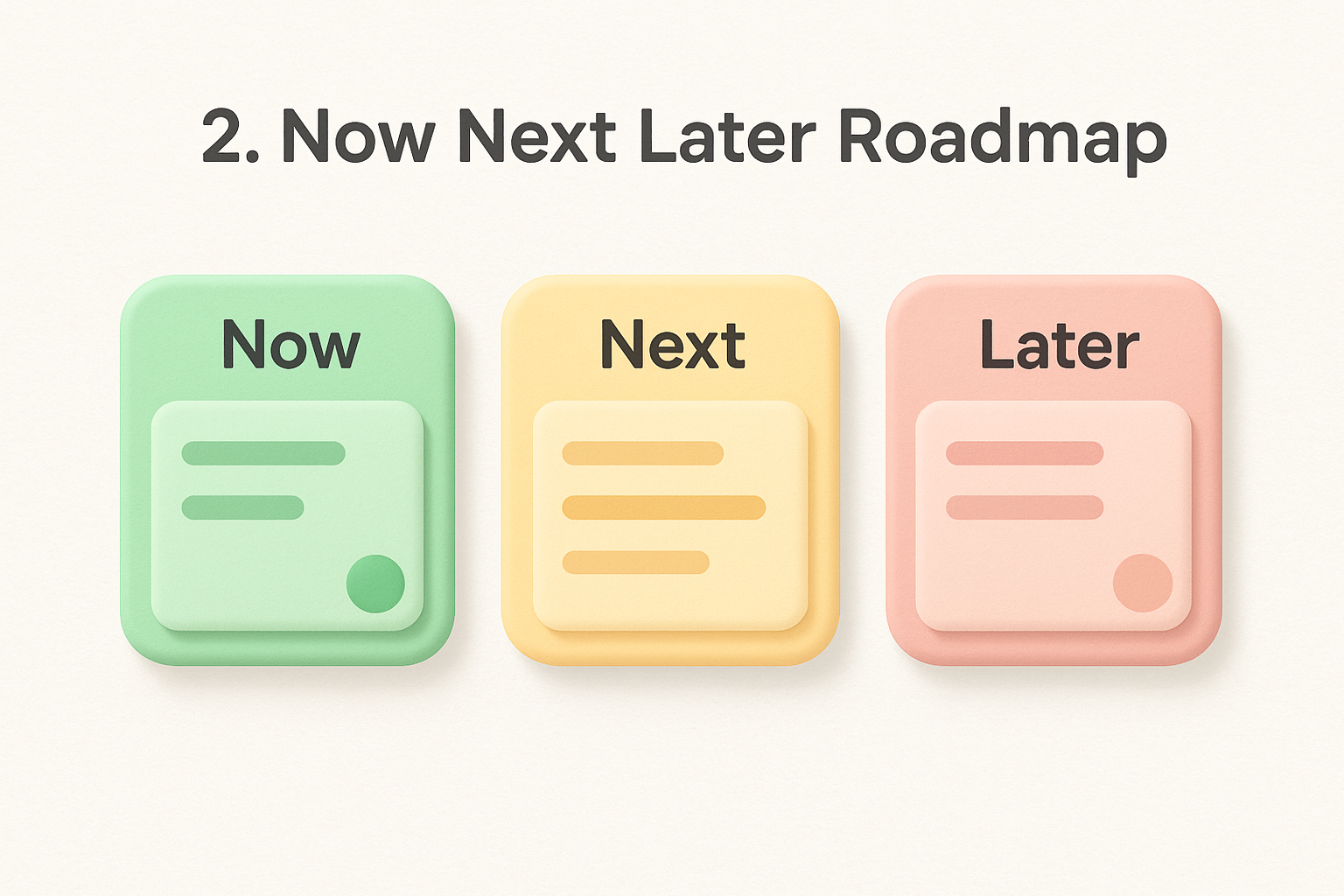
This template organizes work into three horizontal columns: Now (what the team is actively building), Next (what comes after the current work), and Later (items the team intends to address but has not committed to yet). It is a lightweight, direction-focused framework that works just as well in a spreadsheet as it does in a dedicated tool.
This format suits early-stage teams and fast-moving startups where committing to specific dates creates more problems than it solves. It also works well for teams that present roadmaps frequently to external stakeholders and need a format that clearly communicates priorities without triggering debates about missed ship dates.
If stakeholders keep asking why things are late, switching to a now-next-later format often stops that conversation before it starts.
Each column should hold feature or initiative names, a brief description of the user problem being solved, and an optional status indicator. Keep the Now column short, ideally three to five items, so it stays honest.
Run a review session every four to six weeks. Pull items from Next into Now as capacity opens, and promote Later items into Next based on updated priorities from user feedback or business goals.
Avoid letting the Later column become a graveyard for ideas nobody ever revisits. If an item sits in Later through three consecutive reviews, either schedule it or remove it.
An outcome-based roadmap shifts focus from features shipped to results delivered. Instead of listing what you are building, it lists what you are trying to change, whether that is reducing churn, increasing activation, or improving retention, and then connects planned work back to those specific targets.
This product roadmap planning template organizes work around measurable business outcomes rather than feature names. Each roadmap item sits under a defined goal with a metric attached, so everyone on the team can see how a piece of work connects to a real number the company cares about moving.
This format works well for product teams reporting to executives or investors who care more about business results than feature counts. It is also a strong fit for teams running OKR cycles who want their roadmap anchored to measurable goals rather than drifting toward an unchecked feature backlog.
If you cannot draw a line from a roadmap item to a metric that matters, that is a signal the item may not belong on the roadmap yet.
Each row in this template should carry:
Before adding any item, write down the metric it is meant to move and by how much. Review that connection every sprint to check whether the work is tracking as expected and adjust scope if the numbers are not responding.
The most common error is attaching metrics after the fact to justify work the team already committed to. Set your outcome targets before scoping any feature, not after, so the metric shapes the solution rather than rubber-stamps it.
A theme-based quarterly roadmap groups work around strategic focuses rather than individual features, giving your team and stakeholders a clear sense of direction each quarter without over-committing to a specific delivery schedule.
This product roadmap planning template organizes your quarter around two to four named themes, such as "improve onboarding" or "expand integrations," and slots initiatives under each theme rather than listing every feature independently. It keeps the roadmap readable at a glance and helps everyone understand the strategic reasoning behind the work being prioritized.
This format works well for mid-size product teams presenting quarterly plans to leadership, sales, or customer success teams who need to understand direction without drowning in feature-level details. It also suits teams that align planning cycles to quarters and want a consistent rhythm for reviewing and resetting priorities.
Themes give non-technical stakeholders a narrative to follow, which makes roadmap conversations far more productive.
Each theme should carry a brief one-sentence goal, a list of supporting initiatives underneath, and an ownership assignment. Add a confidence indicator to signal how certain you are that each theme stays in scope for the quarter.
Start each quarter by identifying your top themes based on current user feedback, business goals, and team capacity. Assign initiatives to themes during a planning session, then review theme progress at a mid-quarter check-in to catch scope creep early before it derails your commitments.
Avoid defining so many themes that the quarter loses focus. If you carry more than four active themes, you are likely spreading your team too thin across competing priorities with no clear way to make meaningful progress on any of them.
A feature timeline roadmap maps individual features to specific delivery windows on a calendar, giving your team and stakeholders a concrete schedule to plan against. Unlike theme-based or now-next-later formats, this one commits to real dates, which makes it useful when external parties need to know exactly when something ships.
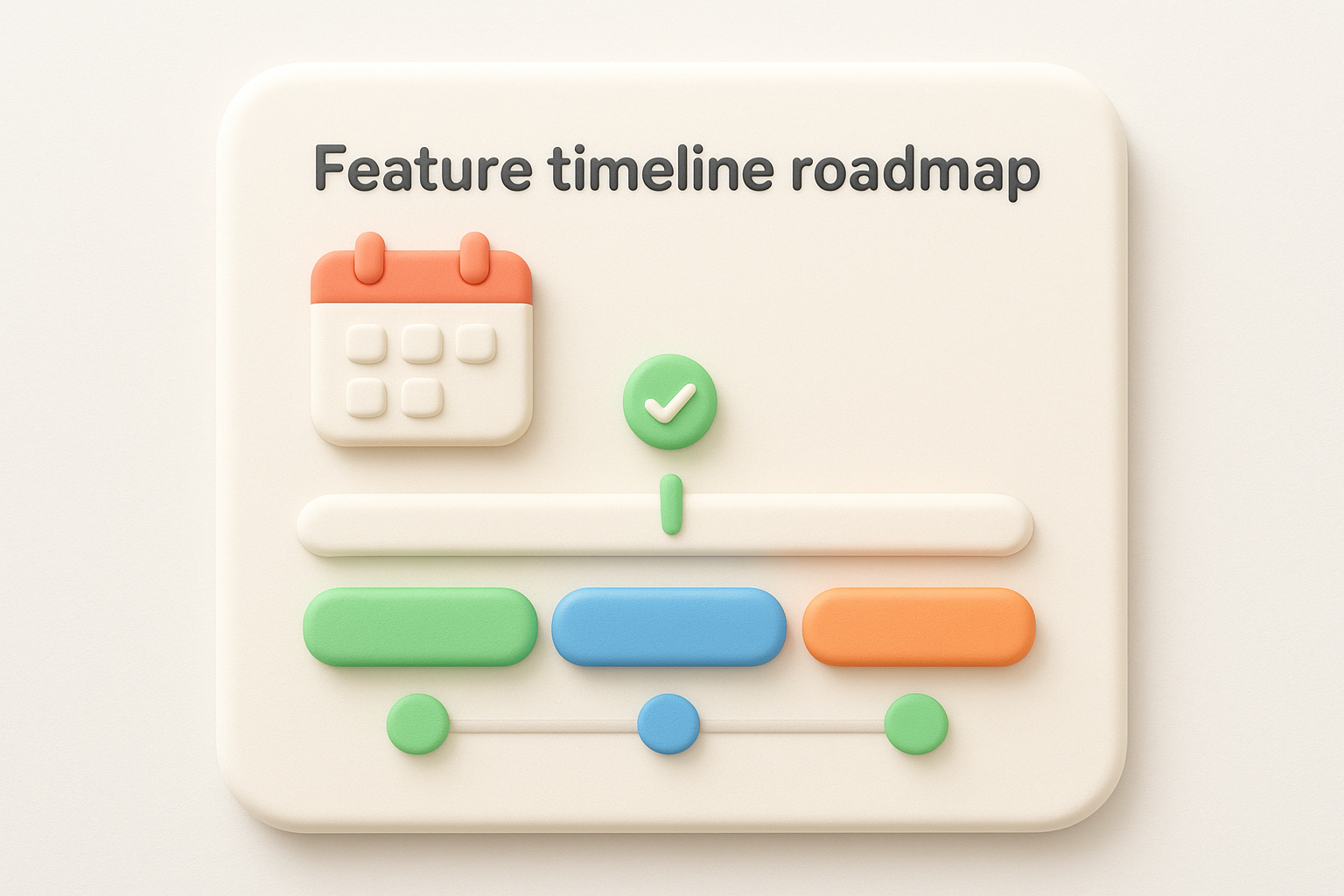
This product roadmap planning template displays features or releases plotted across a horizontal timeline, typically organized by month or quarter. Each item shows a start and end date, making it easy to spot overlapping work and capacity constraints before they create problems during delivery.
This format fits teams with external commitments, such as enterprise sales contracts, partner integrations, or marketing launches tied to specific dates. It works well when stakeholders need a concrete delivery schedule rather than a directional view.
If you are working toward a hard deadline like a conference launch or a contractual milestone, a timeline roadmap keeps everyone aligned on exactly what ships when.
Each feature entry should carry a feature name, owner, start date, and target completion date. Adding a confidence level column helps communicate how firm each date actually is so stakeholders do not treat estimates as guarantees.
Review your timeline every two weeks and update dates the moment scope or capacity changes. Holding stale dates in place only builds false expectations that lead to harder conversations later.
The most common error is padding every estimate with so much buffer that the timeline loses its usefulness as a planning tool. Set realistic dates, communicate risks early, and adjust openly when circumstances change.
A release plan roadmap zooms in on a specific launch, mapping out everything that needs to happen before a feature or version ships. Where a feature timeline shows you the broad calendar, this product roadmap planning template focuses on the coordination layer between product, engineering, QA, and go-to-market teams.
This template tracks all the work tied to a single release, from development tasks and QA checkpoints to marketing prep and documentation. It gives every team involved a single view of what is ready, what is blocked, and what still needs to happen before the release date.
This format suits teams shipping versioned releases rather than continuous deployment cycles. It works especially well when multiple teams need to coordinate their work around a shared launch date.
When a release involves more than two teams, a dedicated release plan prevents miscommunication from quietly delaying the whole launch.
Your release plan should carry release version or name, target ship date, and a checklist of dependencies broken down by team. Add a risk column to flag items that could block the release if they slip.
Map dependencies before the release cycle starts, not midway through it. If engineering finishes early but documentation is behind, you need to know that in week one, not the week before launch. Scope freezes two weeks before the target date help protect the release from last-minute additions.
Avoid letting scope grow after the freeze point without formally adjusting the release date. Quietly adding features to an in-flight release is one of the fastest ways to push a launch past its deadline.
An agile epics and sprints roadmap bridges the gap between high-level planning and day-to-day execution. It lets your team see both the big picture (epics) and the near-term delivery schedule (sprints) in one connected view, so nothing gets lost between quarterly planning and weekly standups.
This product roadmap planning template organizes work into named epics, which are large chunks of related functionality, and then breaks those epics down into sprint-sized deliverables that map to your actual development cycles. The result is a roadmap that doubles as an execution guide.
This format works well for engineering-led teams running Scrum or similar agile workflows who need their roadmap to stay in sync with their sprint cadence. It suits teams where the product manager and engineering lead plan together and need a shared artifact that both sides can read.
When your roadmap and your sprint board reflect the same priorities, you spend far less time re-explaining decisions to your team.
Each epic should carry a goal statement, estimated sprint count, and a list of component stories or tasks. Attach an owner to every epic and mark each sprint with a target completion date so the timeline stays visible.
Review your epics at the start of every sprint planning session and confirm the backlog items pulled into the sprint still match the epic's stated goal. If stories drift from the original scope, flag them immediately rather than letting misaligned work quietly accumulate.
Avoid defining epics so broadly that a single one spans an entire quarter with no meaningful milestones inside it. Break large epics into smaller segments so your team can track real progress at a granular level.
A kanban roadmap view adapts the familiar column-based kanban format to roadmap planning, giving your team and stakeholders a visual snapshot of where every initiative stands without requiring anyone to read a wall of text or decode a Gantt chart.
This product roadmap planning template organizes initiatives into status-based columns, typically something like Backlog, Planned, In Progress, and Shipped. Cards move across the board as work progresses, making the current state of the roadmap visible to anyone who glances at it.
This format suits teams that ship continuously rather than in fixed release cycles. It works especially well for product managers who need to run regular stakeholder reviews without rebuilding a presentation from scratch each time.
When your roadmap updates itself as work moves forward, stakeholder meetings become check-ins instead of catch-up sessions.
Each card on your kanban roadmap should carry an initiative name, owner, and a brief description of the problem it solves. Adding a priority label and a rough effort estimate helps reviewers quickly judge what is moving and why.
Pull up the board at the start of each stakeholder meeting and walk columns left to right. Focus conversation on anything stuck in In Progress longer than expected. This format naturally surfaces blockers without requiring you to prepare a separate status report ahead of each session.
Avoid letting your Backlog column grow unchecked. A backlog with fifty items tells stakeholders nothing meaningful about your actual priorities, so trim it regularly to items your team genuinely intends to pursue.
An OKR-aligned roadmap connects your product roadmap planning template directly to the Objectives and Key Results your company sets each quarter or year. Every item on the roadmap links to a specific objective, so your team always knows why a piece of work is being prioritized over everything else sitting in the backlog.
This format organizes roadmap initiatives under named OKRs rather than product areas or themes. Each initiative sits below the objective it supports, and the key result it moves is clearly labeled alongside it. The structure forces your team to justify every item against a business goal before it earns a spot on the roadmap.
This template works well for product teams operating inside companies that run formal OKR cycles. It suits organizations where leadership wants roadmap decisions tied visibly to company strategy, rather than just trusting the product team to figure out what matters.
When every roadmap item traces back to a key result, you spend far less time defending prioritization decisions in review meetings.
Each initiative should carry the parent objective, the specific key result it targets, the owner, and current status. Adding a confidence score next to each key result helps surface which objectives are on track versus falling behind mid-cycle.
Before adding any item, rate its expected impact on the attached key result on a simple one-to-three scale. Items with a low score need a stronger justification or should move to a future cycle.
Avoid mapping every roadmap item to the same one or two objectives just because they are the most visible. If multiple objectives are never represented, your roadmap is not actually aligned to your full strategy.
A customer-facing public roadmap shares your product direction directly with users, giving them visibility into what is planned, what is being built, and what has already shipped. This product roadmap planning template sits at the intersection of product management and customer communication.
This format is a publicly accessible view of your roadmap, typically organized by status columns like Planned, In Progress, and Completed. Users visit it on their own time to track progress without needing to email your support team or hunt through release notes.
This template works best for SaaS teams with an engaged user base that actively wants to see where the product is heading. It suits companies that use transparency as a trust-building tool with both existing customers and potential buyers evaluating the product.
A public roadmap signals that you are building with your users, not just for them.
Your public roadmap should carry initiative names, clear status labels, and brief descriptions of what each item solves for the user. Avoid internal jargon and skip technical implementation details that would confuse non-technical visitors.
Use status language that signals confidence levels rather than committing to dates you cannot guarantee. Labels like "exploring," "planned," and "in progress" tell users where something stands without locking you into a delivery promise. When plans change, update the roadmap promptly rather than leaving outdated items visible.
Avoid publishing a roadmap and then leaving it unchanged for months. A stale public roadmap damages trust faster than having no roadmap at all, so assign someone to own regular updates.
An internal stakeholder roadmap is built for the people inside your organization who need to understand product direction but do not need every technical detail. This audience-aware format prioritizes clarity and relevance over completeness, giving each stakeholder group exactly the information they need to do their job.
This product roadmap planning template presents your plan in a format tuned for internal audiences like sales, marketing, customer success, and leadership. It filters out implementation noise and focuses on timelines, business impact, and cross-team dependencies that affect people outside the engineering team.
This format works well for product managers at companies where multiple departments rely on product decisions to plan their own work. It suits organizations where sales needs to know what to promise, customer success needs to set expectations, and leadership needs to see strategic progress at a glance.
When each stakeholder group sees information relevant to their role, your roadmap conversations stay focused instead of derailing into unrelated debates.
Your internal roadmap should carry initiative names, target timeframes, business rationale, and a clear owner for each item. Adding a column that labels which teams are affected helps stakeholders quickly spot what involves them without reading every row.
Present the same underlying roadmap in filtered views depending on who is in the room. Leadership gets a summary view showing themes and business outcomes. Sales gets a timeline showing what features are coming and when. Customer success gets status updates on items tied to active customer requests.
Avoid sharing one identical version with every team. A roadmap that tries to serve every audience at once serves none of them well, and you will spend more time answering confused questions than you saved by skipping the extra preparation.
A portfolio roadmap gives teams managing multiple products or product lines a single view that shows how all of them connect to shared company goals. Without it, each product team operates in isolation and leadership loses visibility into how resources are spread across the entire portfolio.
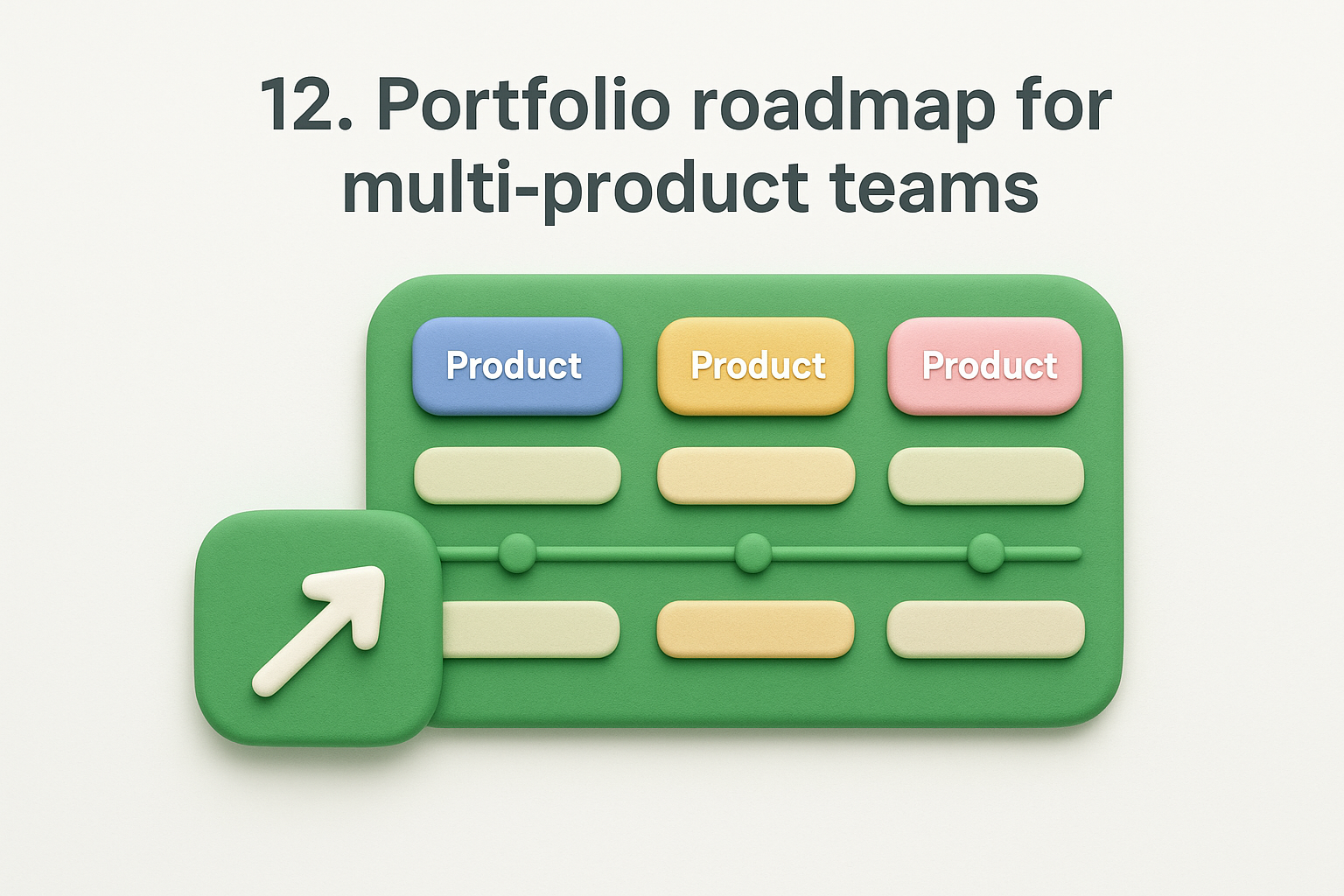
This product roadmap planning template organizes work across multiple products simultaneously, displaying each product's key initiatives side by side on a shared timeline or board. It lets executives and product leaders see the full picture of what is being built across the organization without opening five separate documents.
This format suits product leaders or heads of product who oversee several distinct products and need to communicate portfolio-level strategy to executives or boards. It works well when resource allocation decisions involve tradeoffs between competing products rather than features within a single one.
When you manage more than one product, a portfolio view is the only format that makes cross-product tradeoffs visible before they become conflicts.
Your portfolio roadmap should carry each product name, its top two or three active initiatives, target timeframes, and shared team dependencies. A column flagging which initiatives compete for the same engineering or design resources helps leadership make faster allocation decisions.
Review the portfolio roadmap before each planning cycle and identify where shared teams are double-booked. Resolve conflicts at the portfolio level rather than letting individual product teams negotiate directly, which typically delays both products without producing a fair outcome.
Avoid treating the portfolio roadmap as a simple merge of individual product roadmaps. Each product's roadmap shows what that team wants. The portfolio roadmap shows what the organization can actually deliver given shared constraints, and those two things are rarely identical.
A platform and API roadmap tracks the work your infrastructure and developer-facing teams are building, separating it from the feature roadmap your end users follow. When your product powers third-party integrations or exposes an API to external developers, you need a dedicated product roadmap planning template to manage that surface separately.
This format organizes planned work around your platform capabilities and API endpoints, including new integrations, deprecations, versioning changes, and developer tooling improvements. It serves two distinct audiences: internal engineers who depend on the platform to build product features, and external developers who build on top of your API.
This template works best for developer-focused SaaS products that expose public APIs or maintain shared infrastructure layers used by multiple internal teams. It suits companies where breaking changes to platform behavior ripple outward and affect customers directly.
When your API has external consumers, every change you make without warning is a potential support incident waiting to happen.
Your platform and API roadmap should carry endpoint names or platform components, planned changes, versioning notes, and deprecation timelines. Add a column that distinguishes internal-only changes from those visible to external developers so reviewers can quickly spot what requires customer communication.
Before scheduling any breaking change or deprecation, confirm your internal teams are unblocked first and external developers have enough notice to adapt. Treat your API consumers as a separate stakeholder group with their own communication cadence, distinct from your regular product updates.
Avoid burying API deprecation notices inside general release notes where external developers are unlikely to find them. Communicate breaking changes through a dedicated channel well in advance so your users have time to update their integrations before the old version disappears.
A technical debt and reliability roadmap makes invisible work visible. Engineering teams carry a constant burden of aging code, fragile infrastructure, and performance issues that never make it onto a feature roadmap because they do not ship anything users can see. Without a dedicated product roadmap planning template for this work, it keeps getting deprioritized until something breaks.
This format tracks infrastructure improvements, code refactors, and reliability work separately from your feature roadmap. It gives engineering teams a dedicated place to plan and communicate the work that keeps the product stable and scalable, rather than treating it as invisible overhead that competes with new features for attention.
Teams that benefit most from this template are engineering-led organizations and CTOs who need to make the case for reliability investment to non-technical stakeholders. It works especially well when your product is growing fast and technical debt is starting to slow down feature delivery in measurable ways.
When reliability work has its own roadmap, it becomes a commitment rather than a suggestion.
Your technical debt roadmap should carry the specific system or component being addressed, the problem it currently causes, and the expected outcome after the work completes. Add a rough effort estimate and a risk rating so reviewers can assess urgency without needing a deep technical briefing first.
Frame each item around its business impact, not its technical complexity. Slower deploy times, increased error rates, and rising infrastructure costs all translate to numbers leadership understands. Track your baseline metrics before the work starts so you can demonstrate real improvement once the work ships.
Avoid bundling reliability work into feature sprints without protecting dedicated capacity for it. When reliability items share a queue with feature requests, they lose every time a deadline approaches and the backlog quietly grows larger.
A discovery and validation roadmap tracks the research and experimentation work your team does before committing to build anything. Most roadmap formats assume you already know what to build. This one acknowledges that figuring out what to build is real work that needs its own planning structure.
This product roadmap planning template organizes user interviews, prototype tests, and assumption validation experiments into a sequenced plan with defined time limits. Each item on the roadmap represents a question your team is trying to answer, not a feature you have already decided to build.
This format works best for product teams running continuous discovery cycles or organizations investing in early-stage problem exploration before committing engineering resources. It suits teams where the cost of building the wrong thing is high enough to justify structured validation before any development begins.
When discovery work lives on its own roadmap, it earns the same respect as feature work instead of getting squeezed out by delivery pressure.
Each discovery item should carry the research question being investigated, the method you are using to answer it, the owner, and a hard deadline for reaching a conclusion. Add a decision column that records what you chose to do after each experiment closes.
Assign a firm end date to every discovery item before it starts. Open-ended research expands to fill whatever time you give it. Set a deadline and force a go, no-go, or revisit decision when that date arrives.
Avoid treating discovery as infinitely extendable whenever the findings are inconclusive. Inconclusive results are still results that tell you the question needs reframing, not more time.
A go-to-market readiness roadmap coordinates product, marketing, and sales work around a shared launch timeline. Without it, teams ship features that sales cannot explain and marketing cannot promote because nobody synchronized the work ahead of time.
This product roadmap planning template tracks the cross-functional tasks that need to happen before a feature or product reaches customers. It sits alongside your delivery roadmap and focuses specifically on launch preparation, from positioning and messaging to sales enablement and support documentation.
This format suits product managers working closely with marketing and sales teams at companies where launches require coordinated effort across multiple departments. It works especially well when a new feature changes how your product is sold or affects pricing and packaging in ways that require sales to update their pitch before the feature ships.
When your go-to-market team learns about a launch from a release note, you have already missed the window to prepare them properly.
Your go-to-market roadmap should carry the feature or release name, target launch date, and a checklist of tasks broken down by team. Include rows for sales training, marketing asset creation, support documentation, and any customer communication needed before or after the launch date.
Bring marketing and sales into planning at least four weeks before any major launch, not after engineering ships. Run a weekly sync to track blockers across teams and confirm that sales messaging and product positioning align before anyone speaks to a customer.
Avoid treating go-to-market preparation as a post-shipping task that starts after the feature is live. Launch readiness work runs in parallel with development, and starting it late forces your team to choose between delaying the launch or releasing something your customers cannot understand.
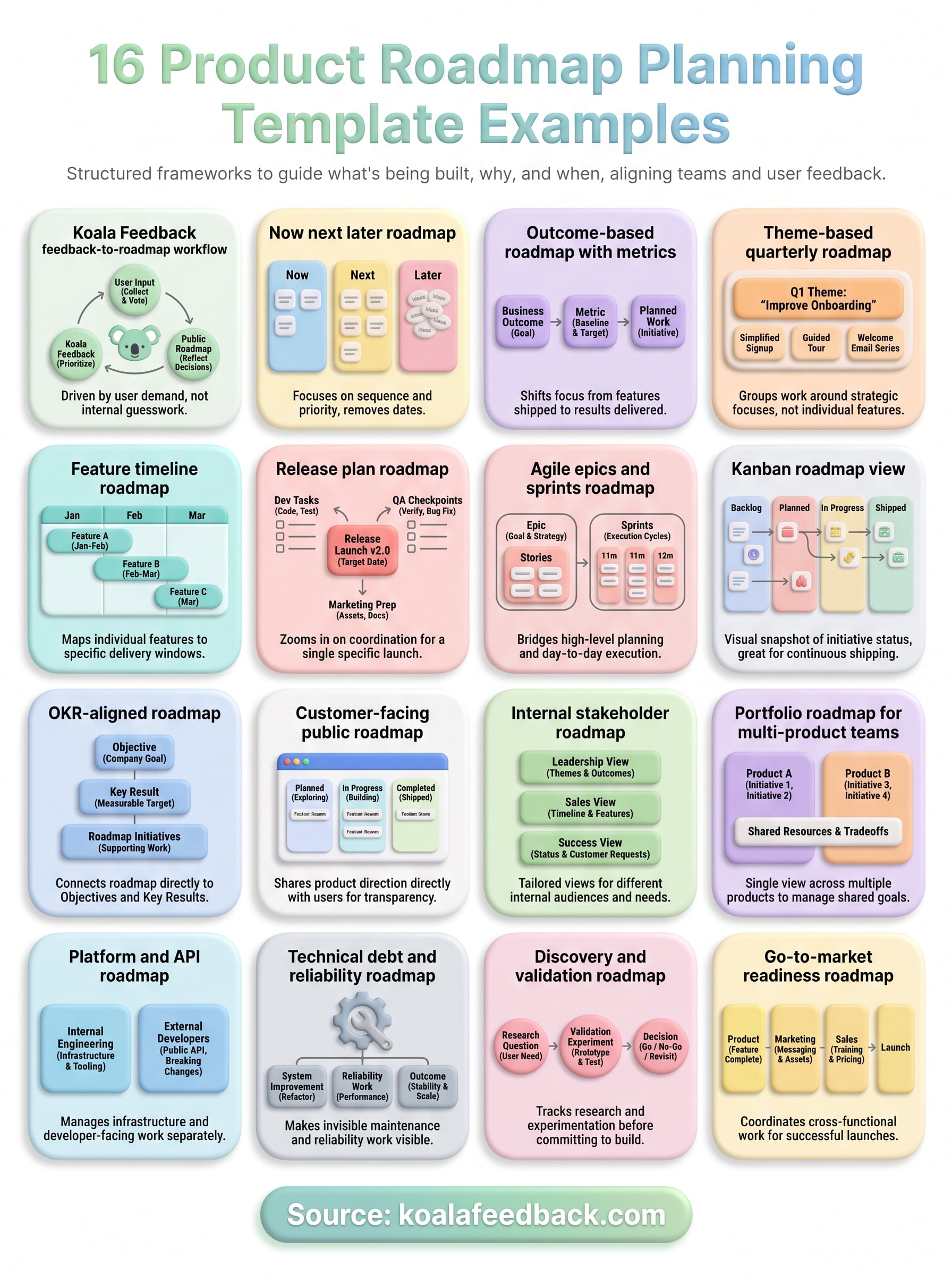
You now have 16 product roadmap planning template formats to choose from, each suited to a different team size, planning style, and audience. The right starting point is the one that matches how your team actually works today, not the most sophisticated format you might eventually need. Pick one, run it for a full planning cycle, and adjust from there based on what your team finds useful.
If you want your roadmap grounded in real user demand rather than internal assumptions, the feedback-to-roadmap workflow covered in template one gives you a direct line from user requests to published roadmap. Koala Feedback handles the collection, deduplication, and status communication so your team spends less time managing spreadsheets and more time making good decisions about what to build next. When your users can see their feedback reflected in your roadmap, they stay engaged and you stay accountable. Start building a user-driven roadmap with Koala Feedback today.

Start today and have your feedback portal up and running in minutes.