Every product team has ideas. Too many, actually. The challenge isn't generating features to build, it's deciding which ones matter most and communicating that direction clearly. That's where having a product roadmap explained and documented becomes essential. A roadmap transforms scattered priorities into a strategic visual plan that aligns your team, stakeholders, and users around what's coming next.
Without a roadmap, teams drift. Engineers build features nobody asked for. Stakeholders lose confidence. Users feel ignored. A well-crafted roadmap prevents this by creating shared understanding across everyone involved in your product's success. It answers the questions your team and customers keep asking: What are we building? Why? When?
This guide covers everything you need to know about product roadmaps, from core concepts to real examples and templates you can start using right away. At Koala Feedback, we help teams collect user feedback, prioritize features, and share public roadmaps that keep customers informed throughout the development process. We've seen firsthand how the right roadmap approach turns product development from guesswork into a user-driven process, and we'll share what actually works.
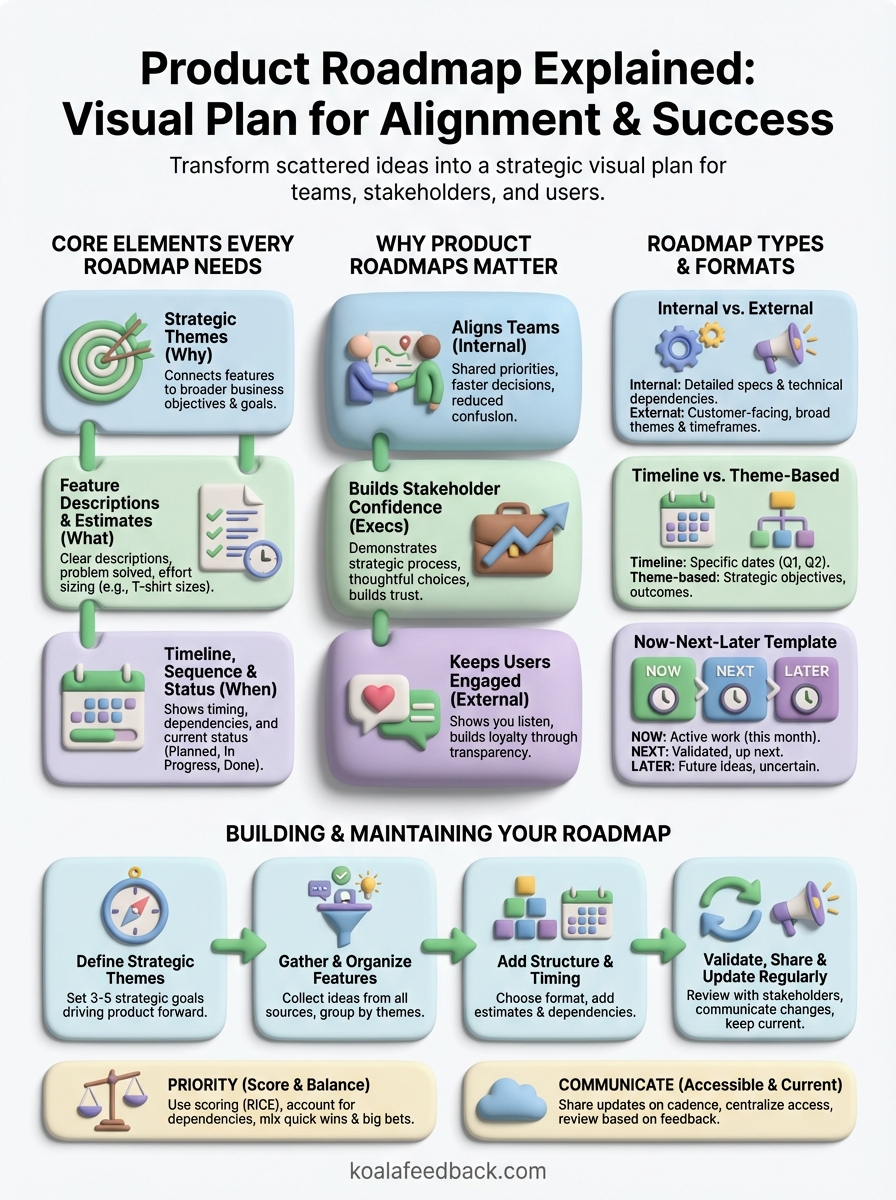
A product roadmap isn't just a list of features. It's a strategic document that connects your product vision to execution by showing what you're building, when you plan to deliver it, and why it matters. Think of it as the bridge between your high-level strategy and the day-to-day work your team does. The best roadmaps include several core components that work together to create clarity for everyone involved.
Your roadmap should start with the strategic themes or goals driving your product forward. These themes explain the "why" behind your feature choices. For example, instead of just listing "payment integration" as a feature, your roadmap might show it under a theme like "Expand revenue channels" or "Remove friction from checkout." This context helps everyone understand how individual features connect to broader business objectives.
Next, you need clear feature descriptions that stakeholders and team members can understand without technical jargon. Each feature should answer what problem it solves and who it serves. Most effective roadmaps also include some form of effort estimation (like T-shirt sizing: small, medium, large) so teams can discuss trade-offs between quick wins and major initiatives. You don't need perfect estimates, but rough sizing helps with realistic planning.
The most useful roadmaps connect individual features to strategic themes, making it clear why each initiative matters to your product's direction.
Roadmaps need to show when work happens, but the level of detail varies based on your audience. For internal teams, you might organize work into specific sprints or months. For external stakeholders and customers, broader timeframes like "Q1 2026" or "Next quarter" work better because they manage expectations without making promises you can't keep. Your roadmap's time horizon typically extends 3 to 12 months, depending on your product's complexity and release cycle.
Sequencing matters as much as timing. Your roadmap should reflect dependencies between features and explain the logical order of development. Building feature B often requires completing feature A first. Making these connections visible helps everyone understand why certain work can't start immediately, even if it's high priority. This sequencing also reveals where your team might face bottlenecks or need additional resources.
Every item on your roadmap needs a clear status that tells people where it stands. Common statuses include "Under consideration," "Planned," "In progress," and "Completed." These labels keep everyone aligned on what's actually happening versus what's still being discussed. When your roadmap shows progress through these stages, it becomes a living communication tool rather than a static document that nobody trusts.
You should also indicate confidence levels for different roadmap items, especially those further out. Work scheduled for next month has high confidence. Items planned for six months away might shift based on customer feedback or market changes. Being honest about uncertainty builds trust with stakeholders and users. They'd rather know that timelines might adjust than feel surprised when plans change without warning.
A product roadmap matters because it prevents chaos in product development. Without one, teams waste time building features that don't serve your strategic goals, stakeholders lose confidence in your direction, and customers feel ignored when they never see the improvements they requested. The roadmap creates shared understanding across everyone who influences or depends on your product's success. It transforms abstract strategy into concrete plans that your team can execute and your users can track.
Your engineering, design, marketing, and sales teams all need to understand what's coming next and why it matters. A roadmap gives everyone visibility into the same plan, reducing confusion about priorities and preventing teams from working at cross purposes. When your sales team promises features that aren't on the roadmap, or when engineers build functionality nobody requested, you've got an alignment problem that roadmaps solve. Having a product roadmap explained clearly to all teams means fewer surprises and better coordination across departments.
Teams that use roadmaps make faster decisions because everyone understands the criteria for what gets built next. Instead of endless debates about which feature to prioritize, you can reference the roadmap's strategic themes and ask whether a new request aligns with those goals. This shared framework speeds up planning meetings and reduces the political friction that often derails product development.
Executives and investors want to know that their product investment is being managed strategically. A roadmap demonstrates that you're making thoughtful choices based on data and strategy, not just reacting to whoever complains the loudest. It shows you have a plan for how the product will evolve and create value over time. Regular roadmap reviews give stakeholders the visibility they need without requiring them to attend every sprint planning session.
A well-maintained roadmap builds trust by showing stakeholders that product decisions follow a strategic process rather than random requests.
Your users want to know that you're listening to their feedback and working on improvements that matter to them. When you share a public roadmap, you transform user feedback from a black hole into a transparent process where customers can see their requests move from "Under consideration" to "In progress" to "Completed." This transparency builds loyalty because users feel heard and valued. At Koala Feedback, we've seen how companies that share their roadmaps publicly experience higher user satisfaction and retention because customers trust that their voice influences product direction.
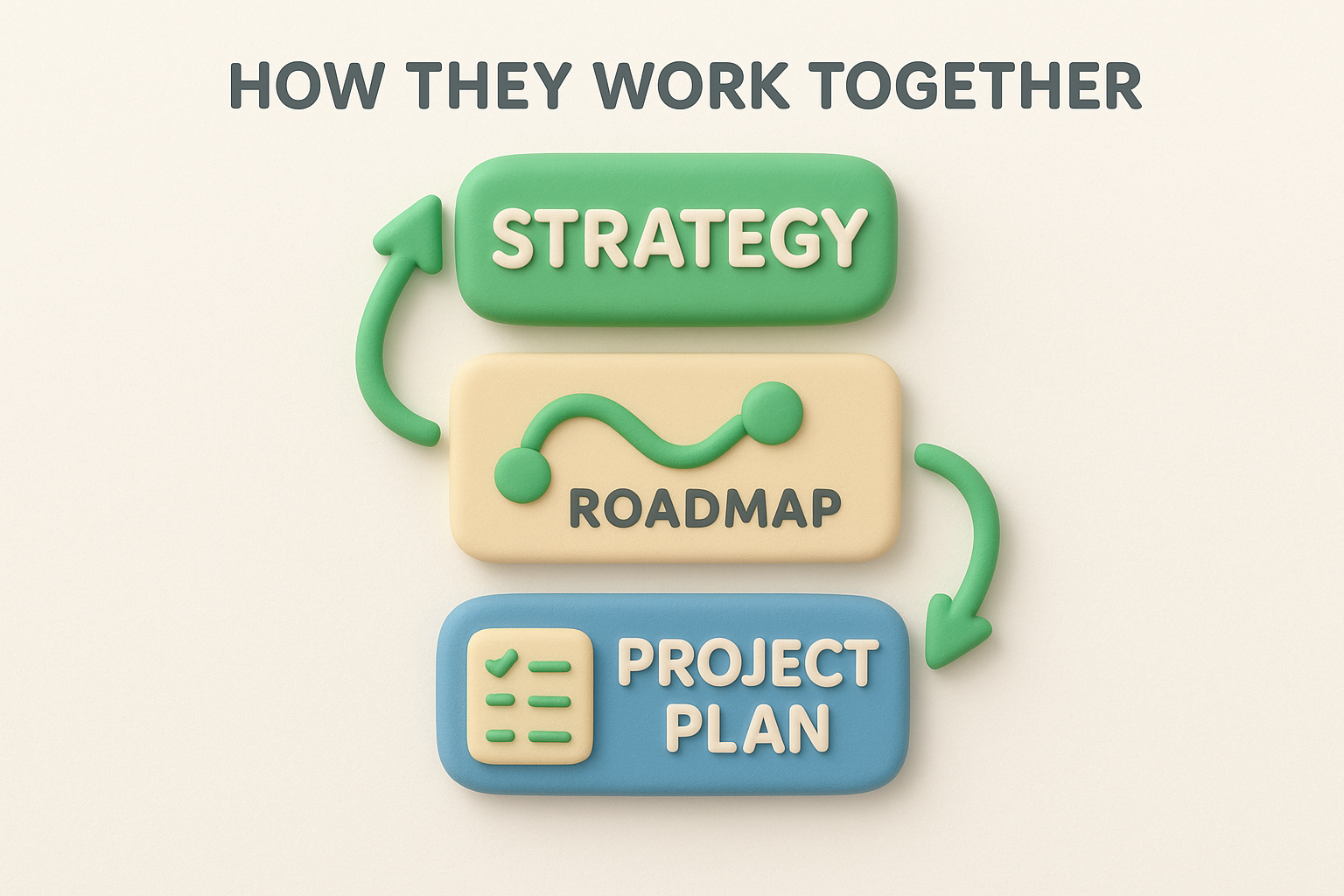
You'll often hear people use "strategy," "roadmap," and "project plan" interchangeably, but they're distinct documents that serve different purposes. Mixing them up creates confusion about what your team should build, when to build it, and how the work gets done. Understanding how these three tools differ and relate to each other helps you communicate more clearly with stakeholders and execute more effectively. Getting a product roadmap explained alongside its strategic and tactical counterparts reveals how each document fits into your product development process.
Your product strategy defines where you're going and why. It articulates your product vision, identifies your target customers, explains your competitive positioning, and establishes the key objectives that measure success. Strategy answers questions like "What market are we serving?" and "How will this product win?" It's your north star that guides all product decisions but doesn't specify which features to build or when to release them.
A strategy document stays relatively stable over long periods, typically a year or more. While your roadmap might change quarterly based on user feedback and market conditions, your strategy shifts only when fundamental business conditions change. Think of strategy as the destination you're traveling toward, while your roadmap shows the specific route you'll take to get there.
Strategy tells you where to go; your roadmap shows the path to get there; project plans break that path into executable steps.
Project plans sit at the opposite end of the spectrum from strategy. While strategy looks months or years ahead and roadmaps span quarters, project plans focus on the immediate work happening in the next few weeks or sprints. They include task assignments, dependencies, technical specifications, acceptance criteria, and daily progress tracking. Project plans answer "Who's doing what by when?" with the granularity your team needs to actually build features.
Your project management tools (like Jira or Asana) hold these execution details. Project plans change constantly as your team completes tasks, discovers technical challenges, and adjusts estimates. Most stakeholders and customers don't need to see this level of detail. They care about what you're building and when (roadmap), not which specific developer is writing which API endpoint (project plan).
These three documents form a planning hierarchy that translates business objectives into shipped features. Your strategy informs which themes appear on your roadmap. Your roadmap determines which features get broken down into project plans. When you update your roadmap, you're not changing your overall strategy or rewriting every project task. You're adjusting the medium-term path between where you are today and where your strategy says you need to be.
Not every roadmap looks the same, and that's intentional. Different audiences need different levels of detail, and different products require different planning approaches. The right roadmap format depends on who you're communicating with and what stage your product is in. Choosing the wrong type creates confusion instead of clarity. When you have a product roadmap explained through the appropriate format for your audience, everyone gets exactly the information they need without being overwhelmed or under-informed.
These two roadmap variations serve fundamentally different audiences with different needs. Your internal roadmap shows detailed feature specifications, technical dependencies, resource allocations, and precise timelines that help your engineering and product teams coordinate their work. It might include API changes, infrastructure upgrades, and technical debt items that customers don't care about but your team needs to plan around.
External roadmaps strip away technical complexity and focus on customer-facing improvements. They use broader timeframes like quarters instead of specific dates, group features into themes that users understand, and exclude internal work that doesn't directly impact the customer experience. You share external roadmaps with customers, prospects, and partners to manage expectations and demonstrate progress on their feedback.
External roadmaps build trust by showing users what's coming without exposing internal technical details that might confuse or overwhelm them.
Timeline-based roadmaps organize work by specific dates or periods, showing what you'll deliver in March, Q2, or the next six months. This format works well when you have stable requirements, predictable release cycles, and stakeholders who need to coordinate around specific launch dates. Marketing teams love timeline roadmaps because they can plan campaigns around feature releases.
Theme-based roadmaps (also called outcome-based roadmaps) organize work around strategic objectives rather than dates. Instead of "Launch payment feature in April," you show themes like "Expand monetization options" with related features beneath. This approach gives you flexibility to adjust sequencing based on changing priorities while maintaining strategic focus. Startups and teams practicing continuous delivery often prefer theme-based roadmaps because they reduce pressure to hit arbitrary dates.
You'll find this format increasingly popular because it balances specificity with flexibility. The "Now" column shows what your team is actively building this month or quarter. "Next" contains validated features you'll tackle once current work completes. "Later" holds ideas you're considering but haven't committed to yet. This structure manages expectations honestly by acknowledging that distant plans remain uncertain while showing clear progress on immediate work.
You don't need fancy software to create your first roadmap. The templates below give you starting frameworks that work for most product teams, whether you're planning your first release or managing an established product. Each template focuses on different organizational approaches, so you can choose the one that matches how your team thinks about product development and what your stakeholders need to see.
This format works perfectly when you need maximum flexibility without sacrificing clarity. Create three columns labeled "Now," "Next," and "Later." Under "Now," list the 3 to 5 features your team is actively building this month. The "Next" column holds validated features you'll tackle once current work completes. "Later" contains ideas you're considering but haven't fully scoped or committed to yet.
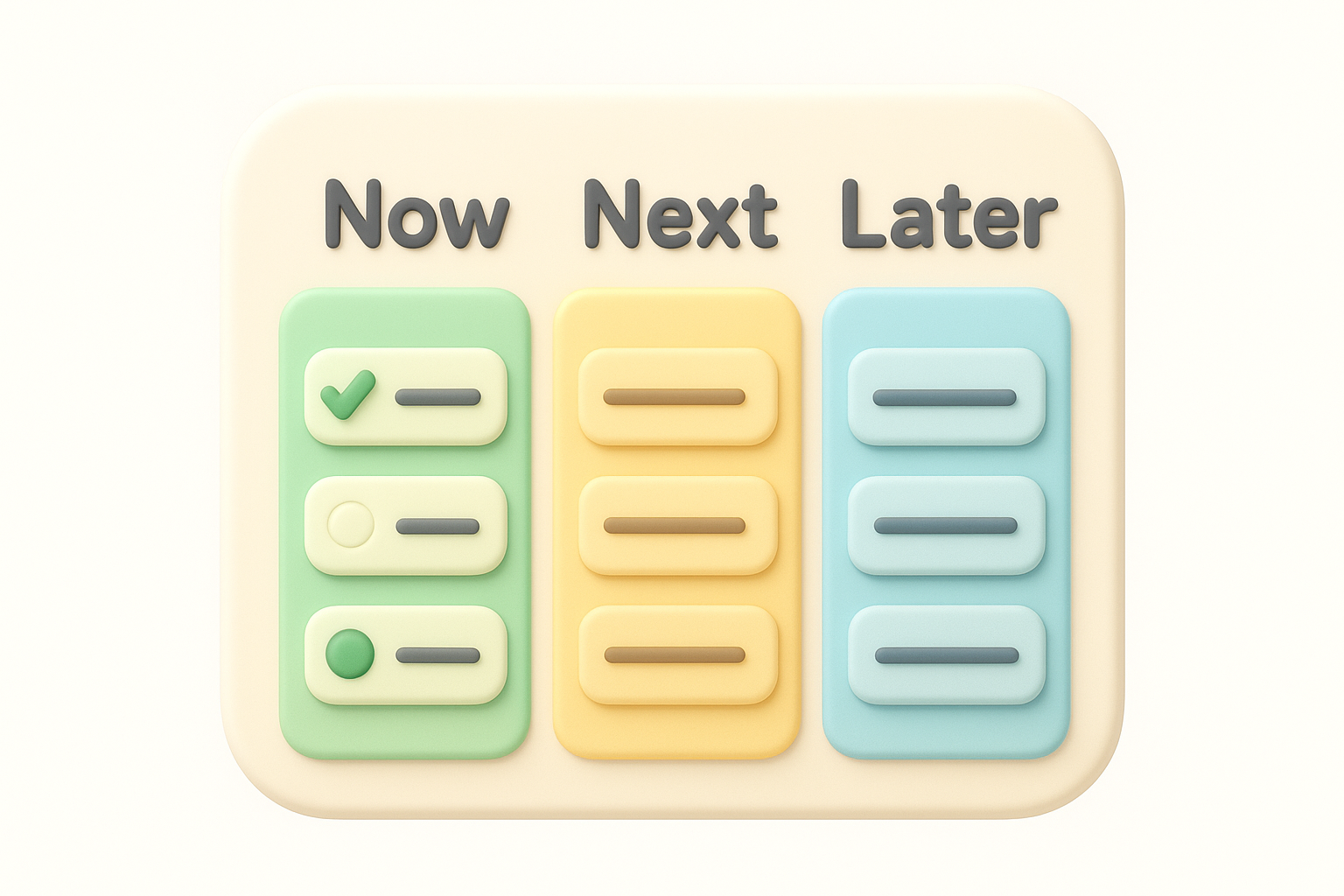
Each item should include a brief description (one sentence explaining what it does) and the problem it solves for users. You can add simple status indicators like checkboxes or color codes to show progress. This template prevents over-commitment while giving stakeholders visibility into your thinking beyond the immediate sprint.
The Now-Next-Later format lets you be honest about uncertainty in distant plans while demonstrating clear progress on immediate work.
When you need to show specific deliverables with timeframes, a feature-based roadmap organized by quarters works well. Create columns for Q1, Q2, Q3, and Q4. List features under each quarter, grouped by the strategic theme they support. For instance, under Q2, you might have "Revenue Growth" as a theme with three features beneath it: payment plan options, annual billing discount, and usage-based pricing.
Include effort estimates (small, medium, large) next to each feature so teams understand the relative complexity involved. This approach helps when sales teams need to know when specific capabilities will be available or when you're coordinating releases with marketing campaigns.
Organize your roadmap by strategic objectives rather than dates when your team practices continuous delivery or when priorities shift frequently. Create a section for each theme like "Improve Onboarding," "Scale Performance," or "Expand Integrations." Under each theme, list the related features you're planning to build, ordered by priority rather than specific dates.
Having a product roadmap explained through themes helps teams stay focused on outcomes instead of arbitrary deadlines. You can still indicate general timing by marking items as "This Quarter" or "Next Quarter" without committing to exact dates that might change as you gather feedback.
Creating your first roadmap feels overwhelming when you stare at a blank document. You have scattered feature requests, conflicting stakeholder opinions, and limited resources to allocate. The good news? Building an effective roadmap follows a repeatable process that takes the guesswork out of where to start. Following these steps helps you create a roadmap that actually guides decisions instead of gathering dust in a forgotten document.
Before listing features, identify the three to five strategic goals driving your product forward over the next 6 to 12 months. These themes might include "Improve user retention," "Expand enterprise capabilities," or "Reduce onboarding friction." Your themes should connect directly to business objectives that leadership cares about, like revenue growth, market expansion, or competitive differentiation. Having a product roadmap explained through clear strategic themes makes it easier for everyone to understand why certain features matter more than others.
Document each theme with a brief explanation of what success looks like and which metrics you'll track. This framework becomes the filter you use to evaluate every feature request that comes your way. When someone suggests a new capability, you can ask whether it advances one of your strategic themes or pulls focus away from what matters most.
Collect feature ideas from multiple sources: customer feedback, sales conversations, support tickets, competitive analysis, and internal team suggestions. At Koala Feedback, we help teams centralize this input so nothing gets lost across scattered tools and email threads. Your goal isn't to build everything on this list but to capture all possibilities before making prioritization decisions.
Group related features together under your strategic themes. You'll quickly notice that some themes have dozens of feature ideas while others have only a few. This distribution reveals where your team and customers are most focused and might indicate themes that need refinement or more discovery work.
The best roadmaps emerge from systematically collecting input across all stakeholders rather than building what the loudest voice requests.
Decide whether you'll organize your roadmap by specific quarters, broader timeframes like "Next 3 months," or a Now-Next-Later approach. Your choice depends on your release cadence and how much flexibility you need. Teams shipping continuously often prefer looser timeframes, while products with coordinated launches need specific dates.
Add effort estimates to each feature using simple sizing like small, medium, or large. These rough estimates help you assess whether you've packed too much into a single period. Mark dependencies between features so everyone understands why certain work must happen in a particular sequence.
Before publishing your roadmap, review it with key stakeholders from engineering, design, and leadership. Ask whether the plan feels achievable given current resources and whether it addresses the most important customer needs. Make adjustments based on their feedback, then share the roadmap widely across your organization and, if appropriate, with your user community through a public roadmap portal.
You've gathered dozens of feature ideas and grouped them by strategic themes. Now comes the hardest part: deciding what to build first and in what order. Poor prioritization leads to teams working on low-impact features while critical improvements sit untouched. The right prioritization framework helps you make defensible decisions that balance user needs, business goals, and technical constraints. When you have a product roadmap explained with clear prioritization criteria, stakeholders understand why certain features come before others.
Apply a consistent scoring method to evaluate every feature candidate objectively. The RICE framework works well for most teams: Reach (how many users benefit), Impact (how much it improves their experience), Confidence (how certain you are about your estimates), and Effort (how much work it requires). Score each feature on these dimensions, then calculate a priority score by multiplying Reach × Impact × Confidence and dividing by Effort.
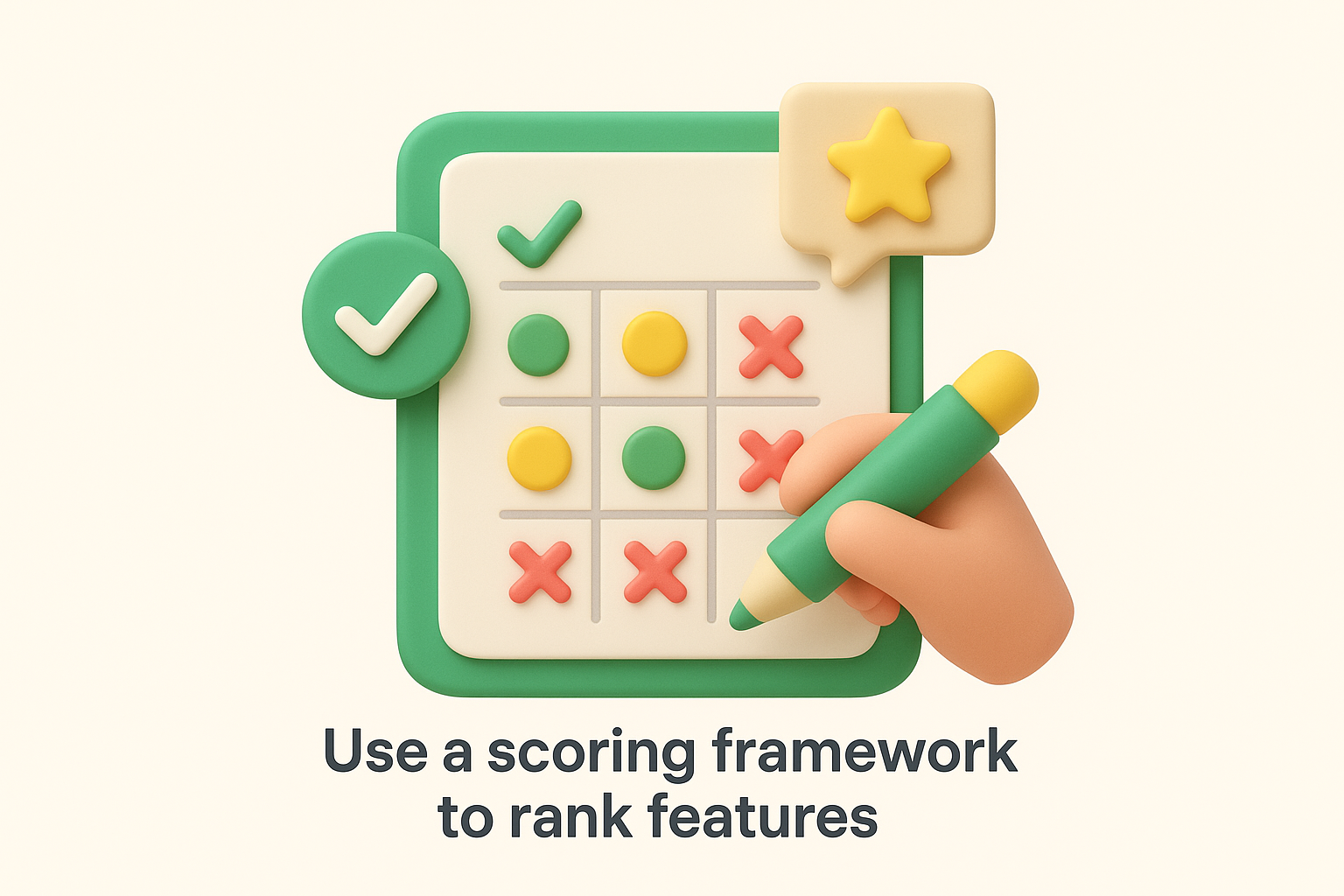
You can also use simpler approaches like value versus effort matrices. Plot features on a grid with business value on one axis and implementation complexity on the other. Features with high value and low effort become obvious quick wins. Those with high value but high effort are strategic bets worth the investment. Low-value, high-effort items rarely make the cut unless they unlock something critical down the road.
Scoring frameworks remove emotion from prioritization by forcing you to evaluate features against consistent criteria rather than whoever advocated loudest.
Some features can't start until others complete because of technical dependencies or resource limitations. Map these relationships before finalizing your sequence. You might need to build API infrastructure before adding integrations, or redesign your data model before enabling advanced filtering. Identifying these blocking relationships early prevents you from committing to impossible timelines.
Consider your team's capacity and skills when sequencing work. If you have one backend engineer and three designers, avoid scheduling multiple backend-heavy features simultaneously. Spread complex work across quarters so you're not overwhelming specific team members while others sit idle waiting for dependencies to clear.
Your roadmap needs both immediate improvements that satisfy users now and substantial features that position you for future growth. Shipping only quick wins makes your product feel stagnant. Building only big bets means users wait months between releases and lose faith in your progress. Aim for a healthy mix in each planning period.
Include at least one or two small improvements in every quarter that you can ship within weeks. These quick wins maintain momentum, demonstrate responsiveness to feedback, and give your team regular confidence boosts from completing work. Reserve remaining capacity for the strategic initiatives that differentiate your product and drive major business outcomes, even if they take multiple sprints to finish.
Building your roadmap is only half the work. The real value comes from keeping it updated and ensuring the right people see changes as they happen. A roadmap that sits untouched for months becomes fiction rather than a useful planning tool. Your team loses trust in the plan, stakeholders stop checking for updates, and users assume you've abandoned the features they care about. Treating your roadmap as a living document that reflects current priorities and progress transforms it into your product team's most effective communication channel.
You need a consistent schedule for roadmap updates that matches your release cycle and planning rhythm. Most teams review and refresh their roadmaps monthly or quarterly, depending on how quickly priorities shift. During these reviews, you move completed features to "Done," promote items from "Next" to "Now," and add newly validated ideas to your future plans. This regular rhythm creates predictable touchpoints where stakeholders know they'll get roadmap updates without needing to ask.
Communicate changes broadly when you update the roadmap. Send a brief email summarizing what moved, what got added, and what shifted timelines. Post updates in your team's communication channels and on your public roadmap if you maintain one. At Koala Feedback, we've seen how teams that share roadmap updates publicly see higher user engagement because customers appreciate the transparency and can track progress on features they voted for. Having a product roadmap explained through regular updates keeps everyone aligned on current direction.
Regular roadmap updates build trust by demonstrating that your planning reflects current reality rather than outdated assumptions.
Your internal teams need constant access to the latest roadmap version, not a copy from last quarter buried in email. Store your roadmap in a central location that everyone can view, whether that's a shared document, dedicated roadmap software, or your product management platform. Make sure new team members learn where to find it during onboarding so checking the roadmap becomes automatic behavior when questions about priorities arise.
Consider maintaining separate roadmap views for different audiences. Your executive dashboard might show high-level themes and business outcomes, while your engineering team sees technical details and dependencies. Sales teams need customer-facing language that helps them discuss upcoming capabilities with prospects. Creating these audience-specific views from the same underlying roadmap ensures everyone gets relevant information without overwhelming them with details they don't need.
Set aside time each month to evaluate whether your roadmap still reflects current priorities and customer needs. Review recent feedback to identify themes that deserve more attention. Check whether assumptions you made last quarter still hold true given market changes or new competitive threats. This systematic review catches outdated plans before they waste development cycles on features that no longer matter.
Be transparent when priorities change. If you need to push a feature back or cancel it entirely, explain why rather than letting it silently disappear. Users and stakeholders understand that circumstances change, but they lose trust when commitments vanish without explanation. Clear communication about why decisions changed maintains credibility even when you deliver news people don't want to hear.
You now understand how effective roadmaps transform scattered priorities into clear direction for your team and users. A product roadmap explained through the right format, updated regularly, and shared with appropriate audiences becomes your most powerful tool for building products people actually want. The difference between successful and struggling product teams often comes down to how well they communicate what's coming and why it matters.
Start building your roadmap today by defining three strategic themes that drive your product forward. Collect feedback from your users, score features against consistent criteria, and map them onto a simple Now-Next-Later structure. Once you've drafted your plan, share it with your team to validate priorities and resource allocation.
Consider using Koala Feedback to centralize user feedback, prioritize features, and maintain a public roadmap that keeps customers engaged throughout your development process. When users see their feedback moving from submitted to planned to completed, they become invested in your product's success and more forgiving when timelines adjust based on new information.

Start today and have your feedback portal up and running in minutes.