You need a clear way to plan your product strategy and share it with your team and users. Spreadsheets get messy fast. Slide decks go out of date the moment you present them. And piecing together multiple tools for planning, feedback, and communication creates more confusion than clarity. The right product roadmap platform can transform how you prioritize features, align stakeholders, and keep everyone informed about what you're building next. But with dozens of options available, each claiming to solve your roadmapping problems, choosing the right one feels overwhelming.
This guide walks you through 10 platforms that help you build, manage, and share roadmaps in 2026. We cover what each tool does best, where it falls short, how it integrates with your existing stack, and what you'll pay. Some platforms excel at public roadmaps and user feedback collection, while others focus on internal planning and enterprise features. By the end, you'll know which platform fits your team's needs, workflow, and budget.
Koala Feedback combines feedback collection and public roadmapping into a single platform designed for teams who want to build what users actually need. Instead of managing separate tools for feature requests and roadmap visualization, you get both capabilities in one place, making it easier to close the loop between what users ask for and what you deliver.
Koala Feedback gives you a feedback portal where users submit ideas, vote on requests, and track progress on features they care about. You organize incoming feedback into customizable boards based on product areas, automatically deduplicate similar requests, and prioritize based on user demand. The platform then connects directly to your public roadmap, where you share planned, in-progress, and completed features with full transparency.
The platform excels at user-facing roadmaps that keep your customers informed without requiring constant manual updates. You customize status labels to match your development process, control what information appears publicly, and maintain your brand identity with custom domains, colors, and logos. Users see exactly what you're working on and can follow specific features to receive updates when statuses change.
Transparency in your roadmap builds trust with users and reduces repetitive "when will this ship?" support tickets.
Koala Feedback focuses primarily on external communication rather than internal planning workflows. If you need deep project management features like Gantt charts, resource allocation, or sprint planning, you'll likely need to supplement it with dedicated project management tools. The platform also works best for SaaS products with active user communities rather than enterprise software with complex stakeholder requirements.
You can connect Koala Feedback to your existing stack through webhooks and native integrations, though the ecosystem is smaller than enterprise-focused alternatives. The platform prioritizes simplicity over extensive integration options, which means you might need to set up custom connections for specific workflows.
Koala Feedback offers straightforward pricing without hidden fees or per-seat charges that balloon as your team grows. Plans scale based on features rather than user count, making it predictable for budget planning. You can test the platform with a free trial before committing to a paid plan.
Productboard positions itself as an enterprise-grade product roadmap platform built for teams that need to connect user research, feature prioritization, and roadmap planning in one system. The platform serves product teams at scale, offering workflows that span from initial feedback collection through strategic planning and stakeholder communication.
You centralize user feedback from multiple sources into a single repository, then use Productboard's scoring frameworks to prioritize features based on business impact. The platform connects this prioritization work directly to visual roadmaps that you can customize for different audiences, whether you're presenting to executives, sharing with customers, or aligning engineering teams.
The platform excels at multi-view roadmaps that let you present the same underlying data differently depending on your audience. You switch between timeline views, release-based layouts, and high-level strategic views without rebuilding your roadmap. Productboard's prioritization matrix helps you score features objectively using customizable criteria.
Different stakeholders need different roadmap views, and rebuilding presentations for each audience wastes valuable time.
Productboard carries enterprise pricing that puts it out of reach for smaller teams and startups. The platform's depth creates a steep learning curve, requiring significant onboarding time before your team can use it effectively. You'll also find that extracting data or migrating away becomes complicated if you decide to switch platforms later.
You connect Productboard to development tools like Jira, Azure DevOps, and GitHub to sync feature status automatically. The platform also integrates with communication tools including Slack, Intercom, and Zendesk to pull in feedback from various channels.
Productboard starts at premium pricing tiers with per-user costs that increase as your team grows. You'll need to contact their sales team for exact pricing, as they don't publish rates publicly.
Aha! Roadmaps delivers a comprehensive product roadmap platform built for teams that need to connect strategy, planning, and execution in a unified system. The platform caters to product leaders who want complete control over their roadmapping process, from initial idea capture through detailed feature specification and cross-functional alignment.
You start by defining your product strategy using goals and initiatives, then link features directly to these strategic objectives. Aha! Roadmaps lets you build detailed feature specifications with custom fields, attach mockups and documents, and estimate effort before work begins. The platform then generates roadmaps automatically based on your priorities and timeline constraints.
The platform stands out with its strategic alignment tools that ensure every feature ties back to business goals. You create multiple roadmap views from the same data, switching between timeline, kanban, and pivot table layouts. Aha! Roadmaps also includes presentation mode for stakeholder meetings and notebook functionality to document product decisions alongside your roadmap.
Disconnecting features from strategy creates roadmaps that look busy but fail to deliver meaningful business outcomes.
Aha! Roadmaps carries complexity that can overwhelm smaller teams who need simpler workflows. The platform's extensive customization options require significant setup time, and the user interface feels dense compared to more visual alternatives. You'll also find the pricing structure expensive for teams just starting with formal roadmapping.
You connect Aha! Roadmaps to development platforms including Jira, Azure DevOps, and Rally to sync features with engineering work. The platform also integrates with collaboration tools like Slack and Microsoft Teams for notifications.
Aha! Roadmaps starts at premium pricing tiers with per-user charges. You can access a free trial, but production use requires paid plans that scale with team size.
ProductPlan delivers a visual-first product roadmap platform designed for teams that prioritize clarity and simplicity over complex planning workflows. The platform focuses on drag-and-drop timeline views that make roadmap building intuitive, serving product teams who need to create professional roadmaps quickly without extensive training.
You build roadmaps by dragging bars across a timeline, organizing features by swim lanes that represent products, teams, or themes. ProductPlan lets you adjust dates by simply dragging elements around the canvas, making it easy to visualize how your product strategy unfolds over quarters or months. The platform emphasizes visual communication, helping you create roadmaps that stakeholders understand immediately.
The platform excels at multiple roadmap views from a single data source, letting you switch between timeline, list, and portfolio views. You can create custom lanes to organize features by team, product area, or any categorization that matches your workflow. ProductPlan also includes presentation mode for stakeholder meetings and export options to share static roadmaps.
Visual roadmaps reduce the time spent explaining your strategy and get teams aligned faster on what matters.
ProductPlan focuses exclusively on roadmap visualization rather than comprehensive product management workflows. You won't find deep prioritization frameworks or feedback collection features, meaning you'll need separate tools for those activities.
You connect ProductPlan to Jira, Azure DevOps, and GitHub to sync feature status. The platform also integrates with Slack for notifications and updates.
ProductPlan offers per-user pricing with monthly and annual options. You can test the platform with a free trial before selecting a paid tier.
airfocus delivers a modular product roadmap platform that adapts to your specific workflow rather than forcing you into predefined processes. The platform serves product teams who need flexibility in how they prioritize features, visualize roadmaps, and collaborate across departments, offering customizable views and scoring frameworks that match your unique decision-making approach.
You start by defining custom priority scores using factors that matter to your business, then apply these frameworks to evaluate features objectively. airfocus lets you build multiple roadmap types from the same underlying data, switching between timeline views, now-next-later formats, and portfolio overviews. The platform adapts to different product management methodologies rather than prescribing a single approach.
The platform excels at priority poker sessions that help teams align on feature importance through collaborative scoring. You create custom fields and filters to view your roadmap from different angles, making it easy to present information relevant to specific stakeholders. airfocus also includes insights dashboards that show how your roadmap aligns with strategic goals.
Flexible prioritization frameworks help teams move beyond gut feelings to data-driven feature decisions.
airfocus requires significant configuration to match your workflow, which can slow initial adoption. The platform's flexibility creates complexity that smaller teams might not need.
You connect airfocus to Jira, Azure DevOps, and Asana to sync work items. The platform also integrates with communication tools for team updates.
airfocus offers tiered pricing based on features and team size. You can start with a free trial before selecting a paid plan.
Jira Product Discovery brings roadmapping capabilities into the Atlassian ecosystem, designed for teams already using Jira Software who want to connect idea collection with development work. The platform serves product teams that need to capture ideas, prioritize features, and create roadmaps that sync directly with engineering sprints and backlogs.
You collect product ideas from multiple sources into a central workspace, then use built-in views to organize and evaluate options. Jira Product Discovery lets you create custom fields to capture information specific to your decision-making process, from customer impact scores to effort estimates. The platform connects directly to Jira Software, allowing you to push prioritized features into your development backlog without manual duplication.
The platform excels at idea matrices that help you visualize features across two dimensions simultaneously, like impact versus effort. You build roadmaps using timeline and list views, then share them with stakeholders through customizable presentations. Jira Product Discovery also includes delivery tracking that automatically updates roadmap status as engineering teams complete work in Jira Software.
Automatic status syncing between roadmap and development tools eliminates the manual updates that make roadmaps outdated.
Jira Product Discovery works best for teams already in the Atlassian ecosystem. If you don't use Jira Software, you lose the platform's primary advantage of tight integration.
You connect natively to Jira Software and other Atlassian products. The platform also integrates with Slack for notifications.
Jira Product Discovery offers per-user pricing tied to your Atlassian subscription. You can start with a free tier for small teams.
Roadmunk delivers a presentation-focused product roadmap platform that helps teams create visually compelling roadmaps for stakeholder communication. The platform serves product managers who need to build multiple roadmap formats quickly, from executive summaries to detailed timeline views, making it easier to share your product strategy with different audiences without rebuilding from scratch.
You build roadmaps using drag-and-drop functionality across multiple view types, then customize colors, labels, and layouts to match your presentation needs. Roadmunk lets you maintain a single source of truth while generating different roadmap formats, including timeline, swimlane, and portfolio views. The platform emphasizes visual polish, helping you create roadmaps that look professional in stakeholder meetings.
The platform excels at roadmap templates that accelerate initial setup and ensure consistency across different product lines. You switch between view types instantly, transforming the same data into timeline, list, or now-next-later formats. Roadmunk also includes scenario planning features that let you model different strategic directions before committing to a final roadmap.
Different stakeholder groups need tailored roadmap views that highlight information relevant to their specific concerns and decisions.
Roadmunk focuses primarily on roadmap visualization rather than comprehensive product management workflows. You won't find built-in feedback collection or deep prioritization frameworks.
You connect Roadmunk to Jira and Azure DevOps to sync feature status. The platform also integrates with collaboration tools for team communication.
Roadmunk offers per-user pricing with different tiers based on features. You can test the platform with a trial period before selecting a paid plan.
Trello brings kanban-style project management to roadmapping through a flexible card and board system that adapts to various workflows. Originally designed as a visual collaboration tool, Trello serves teams who prefer simple, board-based organization over traditional timeline roadmaps, making it accessible for smaller teams or those just starting with structured product planning.
You organize roadmap items as cards across customizable lists, creating visual workflows that represent stages like "Planned," "In Progress," and "Shipped." Trello's drag-and-drop interface lets you move cards between lists as features progress, making status updates intuitive. The platform works best for teams who think in kanban terms rather than timeline views.
The platform excels at simplicity and visual clarity that requires minimal training to understand. You add custom fields to cards for priority scores, target dates, and effort estimates, then use labels and filters to organize features by theme or product area. Trello's power-ups extend functionality with calendar views, voting features, and automated workflows through Butler automation.
Visual board layouts make roadmap status immediately clear to anyone who opens the tool, reducing time spent explaining progress.
Trello lacks purpose-built roadmapping features that dedicated platforms offer. You won't find timeline views, dependency tracking, or strategic planning tools without significant customization through power-ups. The platform also struggles with complex roadmaps that span multiple products or require sophisticated prioritization frameworks.
You connect Trello to thousands of tools through Zapier and native power-ups, including Slack, Jira, and Google Drive. The platform's integration ecosystem ranks among the most extensive available.
Trello offers a free tier with basic features and paid plans that add power-ups and advanced functionality. Pricing remains affordable compared to dedicated product roadmap platforms.
Asana brings project management capabilities to roadmapping through a flexible task organization system that scales from individual features to multi-product portfolios. Originally built as a work management platform, Asana serves teams who want to connect roadmap planning directly with execution tracking, making it easier to maintain alignment between strategic goals and daily development work across your organization.
You organize roadmap items as tasks within projects, using custom fields to track priority, status, and target releases. Asana's timeline view transforms your task lists into visual roadmaps that show how features sequence across weeks, months, or quarters. The platform lets you create dependencies between tasks, ensuring your roadmap reflects realistic delivery constraints based on what needs to happen first.
The platform excels at portfolio tracking that aggregates multiple product roadmaps into executive-level views. You build custom dashboards that show progress across all roadmap initiatives, making it easy to spot bottlenecks or areas falling behind schedule. Asana's goal tracking connects roadmap items to business objectives, helping you ensure every feature contributes to measurable outcomes.
Connecting roadmap features to measurable goals transforms planning from guesswork into strategic execution that drives business results.
Asana lacks purpose-built roadmapping features like public sharing portals or customer-facing roadmap views. You'll need to export roadmaps or grant external access if you want to share plans with users. The platform's flexibility also creates setup complexity that requires investment in templates and workflows before your team can use it effectively for roadmapping.
You connect Asana to development tools including GitHub, GitLab, and Jira to sync engineering work. The platform integrates with communication tools like Slack and Microsoft Teams for updates.
Asana offers a free tier for basic features and paid plans that unlock timeline views and advanced reporting. Pricing scales per user with discounts for annual commitments.
Notion transforms all-in-one workspace functionality into roadmapping through its flexible database and page system that adapts to countless workflows. Originally designed as a documentation and knowledge management tool, Notion serves teams who want complete control over their roadmap structure and presentation, making it ideal for organizations that prefer building custom solutions over adopting pre-built frameworks.
You build roadmap databases from scratch using Notion's table, board, timeline, and gallery views, connecting them to other pages in your workspace. Notion lets you define custom properties for tracking priority, status, team ownership, and release dates, then filter and sort roadmap items across different views. The platform works best when you treat it as a blank canvas rather than a ready-made product roadmap platform.
The platform excels at complete customization that lets you design exactly the roadmap structure your team needs. You embed roadmaps within broader product documentation, link features to strategy pages, and create connected databases that update across multiple views simultaneously. Notion's wiki capabilities let you document decisions alongside your roadmap, keeping context and planning in one location.
Connecting roadmap features directly to supporting documentation eliminates the context switching that slows down product decisions.
Notion requires significant setup effort to build effective roadmapping systems from its building blocks. You won't find ready-made prioritization frameworks or public sharing features designed specifically for product roadmaps.
You connect Notion to Slack, GitHub, and Figma through native integrations, plus thousands of tools through Zapier for workflow automation.
Notion offers a free tier for individuals and small teams, with paid plans adding collaboration features and advanced permissions at affordable per-user rates.
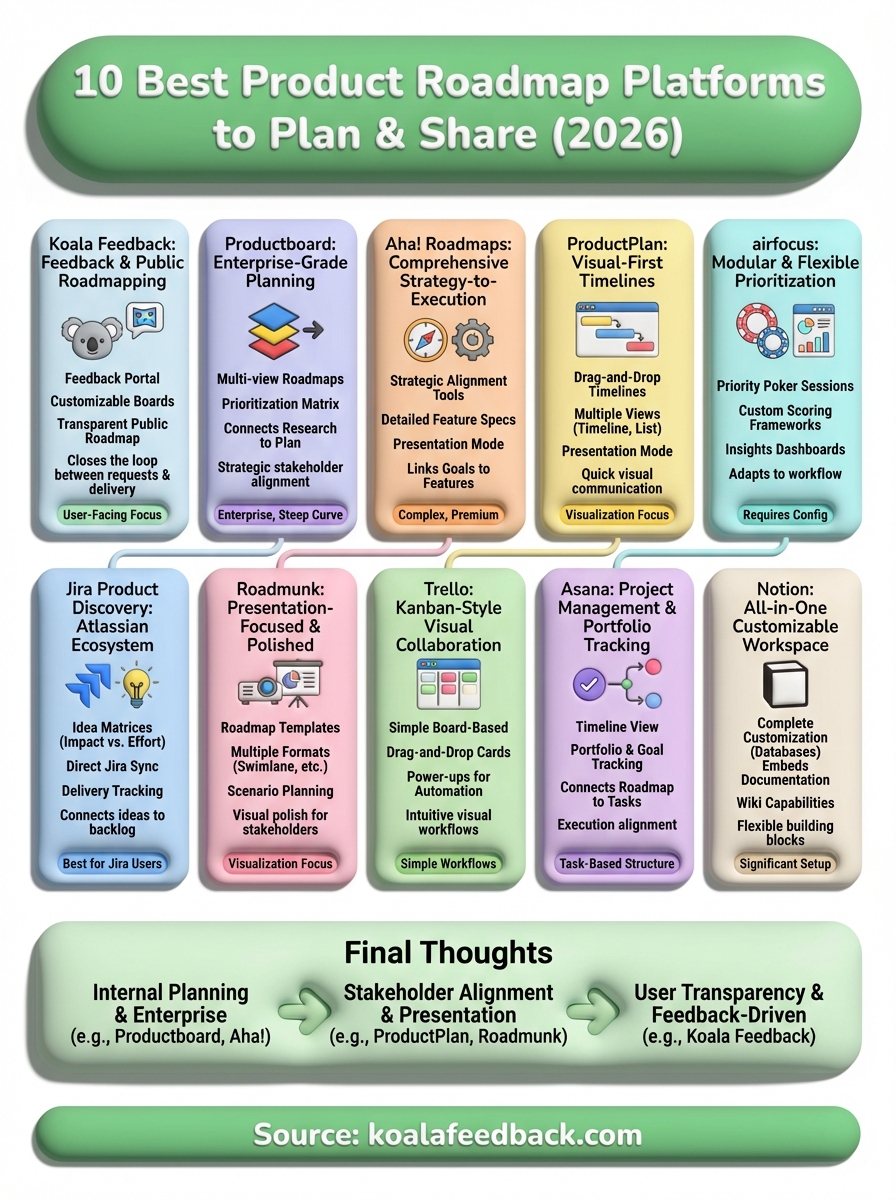
Choosing the right product roadmap platform comes down to how you want to communicate with your users and team. Enterprise platforms like Productboard and Aha! Roadmaps deliver comprehensive features but demand significant investment and learning time. Visual-first tools like ProductPlan and Roadmunk excel at stakeholder presentations. Flexible options like Notion and Trello work when you need customization over ready-made workflows.
For teams prioritizing user transparency and feedback-driven development, Koala Feedback connects what your users request directly to what you build. You capture feature requests, prioritize based on actual demand, and share progress through a public roadmap that keeps everyone informed. The platform eliminates the gap between feedback collection and roadmap communication, making it easier to build products users actually want.
Start by defining your primary goal: internal planning, stakeholder alignment, or public transparency. Your answer will point you toward the platform that fits your workflow best.

Start today and have your feedback portal up and running in minutes.