The difference between product strategy vs product roadmap confuses many teams. A product strategy defines why you're building something and what problems you're solving for users. It sets your direction and priorities. A product roadmap shows how you'll execute that strategy through specific features, timelines, and milestones. Think of strategy as your destination and roadmap as your route to get there.
This article breaks down the core differences between these two planning tools and shows you how they work together. You'll see why you need both to succeed, learn how to translate strategic thinking into actionable plans, and discover what separates high level goals from tactical execution. We'll walk through real examples that clarify the distinction and show you how to incorporate user feedback into your planning process. By the end, you'll know exactly when to focus on strategy versus when to build out your roadmap.
You can't build a successful product with just one of these tools. Your product strategy gives purpose to every decision you make, while your product roadmap turns those decisions into reality. Teams that focus only on strategy end up with beautiful vision statements but no concrete progress. Teams that jump straight to roadmaps build features without understanding whether they actually matter. Both elements work together to create products that users want and businesses can execute.
Building a roadmap without strategy creates a feature factory that churns out updates nobody asked for. You'll respond to every customer request, chase every competitor feature, and watch your product become a bloated mess. Your team wastes time building the wrong things because there's no filter to separate good ideas from distractions. Resources get spread thin across unrelated features instead of focusing on what truly moves the needle. Without strategic direction, you can't say no to requests, and saying yes to everything means saying no to coherence.
Strategy without a roadmap leaves your team stuck in planning mode forever. You'll have endless discussions about vision and direction but never ship anything. Your developers can't start work because they don't know what to build next or when priorities will shift. Stakeholders lose confidence because they see no tangible progress on strategic goals. Teams working on product strategy vs product roadmap implementation need both pieces to move forward. A strategy document sitting in a drawer helps nobody, and your users don't care about your vision if they never see improvements to the product.
A roadmap without strategy is a ship without a destination. A strategy without a roadmap is a destination with no ship.
Strategy and roadmap complement each other by connecting vision to execution. Your strategy defines success metrics, target users, and competitive positioning. Your roadmap breaks those concepts into specific features with delivery dates. When you update your roadmap based on user feedback, your strategy helps you decide which feedback matters most. When market conditions change and you need to adjust strategy, your roadmap shows you exactly what work needs to shift. This partnership keeps your team aligned on both the big picture and the next steps, preventing the disconnect that kills products.
Your product strategy becomes actionable when you convert high-level objectives into specific deliverables on your roadmap. This translation process bridges the gap between product strategy vs product roadmap by taking abstract goals and turning them into concrete features your team can build. You need a systematic approach that maintains strategic alignment while giving your developers clear direction on what to build next.
Identify the top three strategic objectives you want to accomplish in the next quarter or year. Each objective should tie directly to a measurable business outcome like increasing retention, expanding into a new market, or solving a specific user problem. Write these objectives down and share them with your team so everyone understands what success looks like. If your strategy says "become the best solution for small businesses," your roadmap needs to include features that specifically serve small business needs, not enterprise requirements.
Strategic goals without roadmap features are just wishes. Features without strategic goals are just busy work.
Break each strategic objective into tangible features that users will interact with. Ask yourself what capabilities would directly advance each goal. If your objective is reducing churn, your roadmap might include onboarding improvements, help documentation, or customer success tools. List all potential features, then ruthlessly cut anything that doesn't clearly support your strategy. This filtering step prevents feature creep and keeps your roadmap focused on what actually matters.
Assign delivery windows to your features based on team capacity and dependencies between features. Your roadmap needs dates that account for research, design, development, and testing phases. Communicate these timelines as quarters or months rather than specific days to give your team breathing room for unexpected challenges. Update your roadmap regularly as you learn more about technical complexity and user needs, but always trace each adjustment back to your strategic priorities.
The fundamental difference between product strategy vs product roadmap lies in their scope and abstraction level. Your strategy operates at a high altitude, focusing on long-term direction and competitive positioning across years. Your roadmap lives in the weeds, detailing specific features and releases across months or quarters. Understanding this distinction helps you know which document to reference when making different types of decisions.
Your product strategy typically spans two to five years into the future, setting direction without committing to exact features. It answers questions about which markets you'll serve, what problems you'll solve, and how you'll differentiate from competitors. Strategy documents rarely change unless your business model shifts or market conditions dramatically alter. This stability gives your organization consistent direction even as individual features come and go.
Roadmaps work on shorter cycles of three to twelve months, showing what you'll build in the near term. You'll update your roadmap quarterly or monthly as you learn from user testing, technical challenges, and feedback. This flexibility lets you respond to market changes without losing strategic focus. While your strategy might say "dominate the small business market," your roadmap shows exactly which small business features you're shipping this quarter.
Your strategy stays stable while your roadmap adapts to reality.
Strategy describes outcomes and capabilities at a conceptual level. You might say "become the most user-friendly option" without specifying which interface changes will get you there. Your strategy defines success metrics like customer satisfaction scores or market share percentages, but it doesn't detail implementation methods. This abstraction allows multiple valid approaches to achieving the same strategic goal.
Roadmaps demand concrete specificity about features, releases, and timelines. Each roadmap item names an actual capability users will see, like "mobile app notifications" or "export to PDF." You'll assign these items to specific team members and track their progress status from planned to completed.
Understanding the practical difference between product strategy vs product roadmap becomes clearer when you examine real scenarios. These examples show how strategic direction transforms into specific features that users actually experience in their daily workflows.
Consider a project management platform used mainly by solo freelancers. The product strategy states: "Become the collaboration hub for small creative teams by 2027." This strategy identifies the target market (small creative teams), the positioning (collaboration hub), and the timeframe. The strategy document explains why this expansion makes sense based on market research and revenue projections.
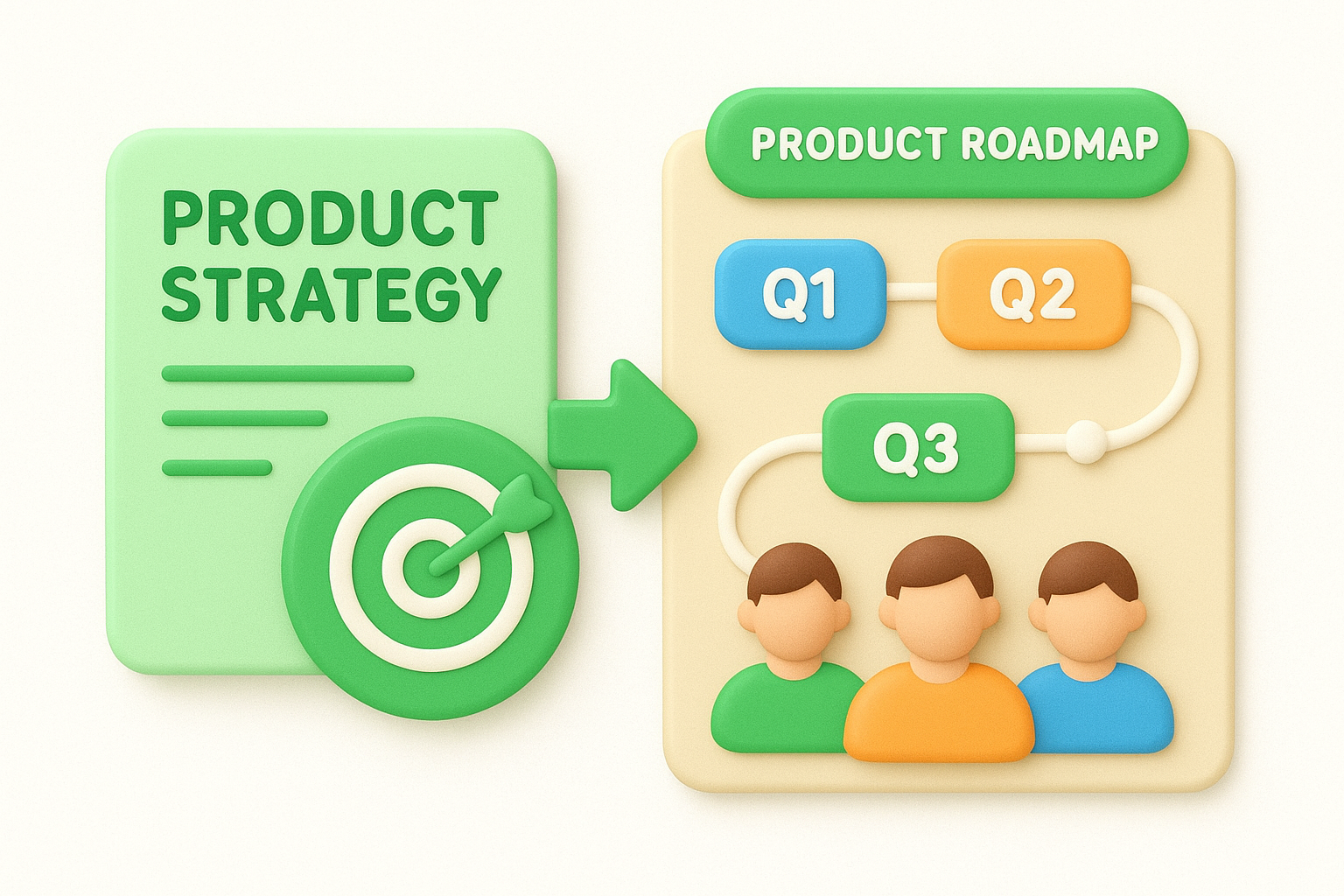
The product roadmap converts this strategy into buildable features. Q1 includes team workspaces and shared project views. Q2 adds real-time commenting and file sharing. Q3 brings team performance dashboards and role-based permissions. Each roadmap item directly supports the strategy by addressing collaboration needs that solo features never covered.
Strategy defines the destination. The roadmap plots every turn you'll take to reach it.
Look at an email platform experiencing high churn among new users. The strategic objective focuses on "Reduce first-month churn by 40% through improved user success." This strategy prioritizes retention over new features, identifies the specific user segment (new users), and sets a measurable goal. The strategy explains that retention drives more value than acquisition at this stage.
The corresponding roadmap breaks this into concrete initiatives. Month one delivers an interactive onboarding tutorial. Month two ships pre-built email templates and a campaign wizard. Month three adds in-app success metrics and automated tips based on user behavior. Your roadmap shows exactly what ships and when, while your strategy explains why retention matters more than adding new sending capabilities.
User feedback shapes both your product strategy vs product roadmap decisions differently based on their scope. Strategic feedback reveals patterns about your market positioning and user needs that might require fundamental direction changes. Roadmap feedback tells you which features to prioritize, which to delay, and which to cut entirely. You need systems that capture both types of input and route them to the right planning document.
Sort incoming feedback into strategic signals versus tactical requests. Strategic signals indicate major shifts in user needs, competitive threats, or market opportunities that might require strategy adjustments. These include repeated requests for capabilities outside your current product vision or feedback that questions your core value proposition. Tactical requests focus on improving existing features, fixing bugs, or adding incremental capabilities that fit your current direction.
Feedback that challenges your assumptions belongs in strategy discussions. Feedback that improves execution belongs on your roadmap.
Build a simple classification system that tags each piece of feedback as either strategic or tactical. Review strategic feedback quarterly when you evaluate your product strategy for necessary adjustments. Process tactical feedback continuously as you update your roadmap and prioritize upcoming releases.
Track which features users request most frequently and tie those requests to your strategic objectives. If your strategy focuses on small business users but enterprise teams dominate your feedback, you've spotted a strategic misalignment. Use voting systems and comment threads to measure demand for specific capabilities before adding them to your roadmap. This data-driven approach prevents building features that only vocal minorities want while the silent majority needs something else entirely.
Your feedback system should show you both the quantity of requests and the revenue potential behind them. This visibility helps you decide whether popular requests deserve roadmap space or whether they distract from higher-value strategic goals.
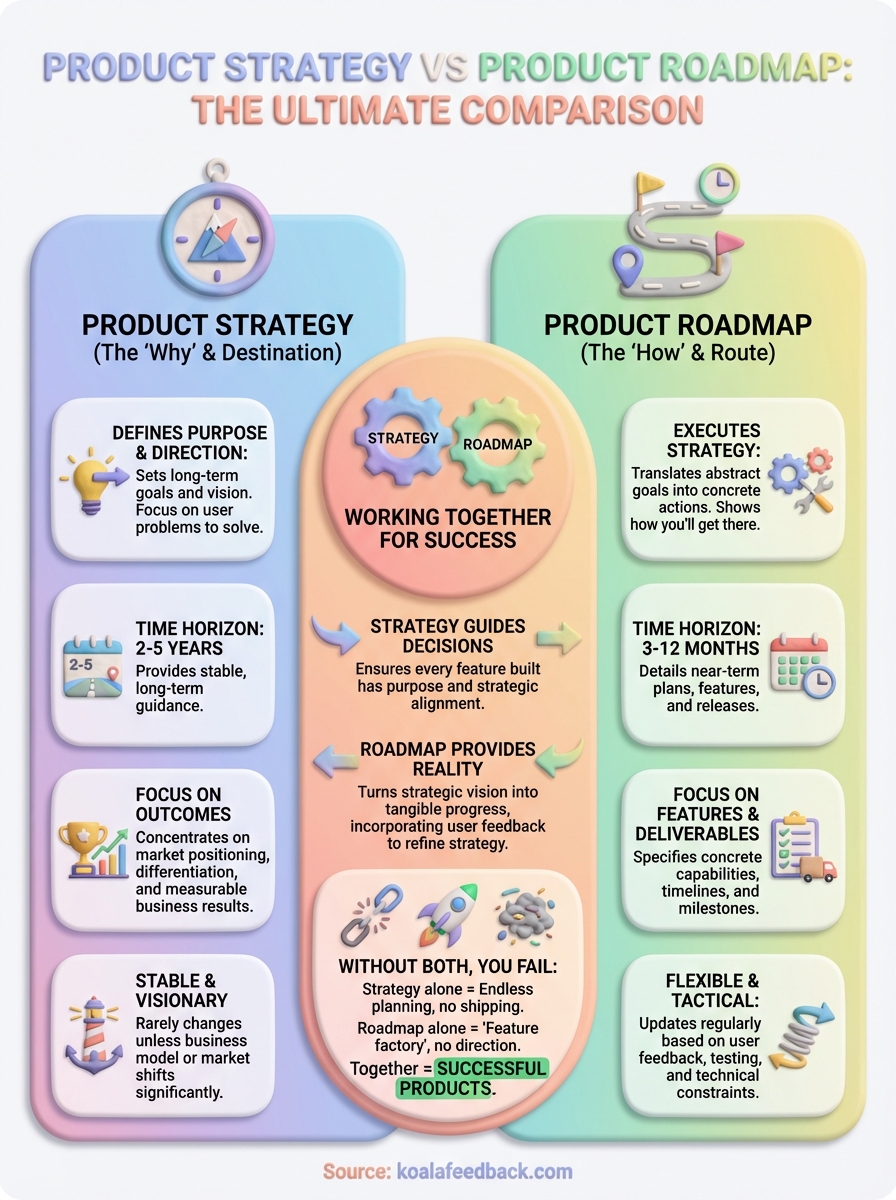
Mastering the relationship between product strategy vs product roadmap transforms how you build products. Your strategy provides the vision and direction that keeps your team focused on meaningful goals. Your roadmap translates that vision into concrete features that users can touch, use, and benefit from. You need both working together to create products that matter.
Success comes from treating these tools as complementary partners rather than competing alternatives. Update your strategy when market conditions shift or user needs fundamentally change. Adjust your roadmap continuously as you learn from user feedback and technical constraints. This flexibility within structure lets you respond to real-world challenges while maintaining strategic focus.
Start capturing user feedback systematically to inform both your strategic decisions and roadmap priorities. Koala Feedback helps you collect, organize, and prioritize user input so you can build what actually matters to your audience. Your users tell you what they need, and your planning documents show how you'll deliver it.

Start today and have your feedback portal up and running in minutes.