You have a backlog full of feature requests. Your team is building things. Users are giving feedback. But when you step back and ask what your product should accomplish over the next year, the answer gets fuzzy. Without a clear product strategy, you end up reacting to whoever shouts loudest or building features that never move your core metrics.
A solid product strategy gives your team direction. It connects what you build to business outcomes. It helps you say no to good ideas so you can focus on great ones. Instead of guessing what matters, you have a framework for making decisions about priorities, resources, and roadmap items.
This guide walks you through product strategy planning from start to finish. You will learn how to tie strategy to business goals, understand customer problems, define measurable bets, and build roadmaps that your team can execute. We have included real examples and templates you can use right away. By the end, you will have a clear path to turn strategic thinking into products that actually deliver results.
Product strategy planning is the process of defining where your product needs to go and how it will get there. You map out the problems you will solve, the customers you will serve, and the outcomes you expect to achieve. This work happens before you build features or commit resources. Think of it as the blueprint that guides your product decisions over months or years, not just the next sprint.
Your strategy needs three essential elements to work. First, you define the market opportunity and customer problems worth solving. Second, you set clear goals with metrics that show progress. Third, you identify the key initiatives or bets that will move those metrics. Each component connects to the others. Your customer insights inform your goals, and your goals determine which initiatives make the cut.
A product strategy without measurable goals is just a wish list.
Many teams confuse strategy with execution. Your strategy tells you what to achieve, while your roadmap shows how and when you will build it. Strategy answers questions like "Which market segment do we target?" or "What competitive advantage do we build?" Execution covers sprint planning, feature specs, and release dates. Product strategy planning happens at a higher altitude. You step back from daily tasks to make choices about direction, not just delivery. This separation keeps your team focused on outcomes instead of just shipping features.
Your product strategy needs to support what the business wants to achieve. Before you define any product goals or initiatives, you must understand the company's objectives for the next year or two. This alignment ensures your product work drives real business value instead of just creating features nobody cares about. Product strategy planning starts here because a strategy disconnected from business goals wastes resources and loses executive support.
Talk to your leadership team and ask direct questions about their priorities. Find out what success looks like for the business this year. Is the company focused on revenue growth, expanding into new markets, improving retention, or reducing costs? Write down the top three to five business objectives in simple language. These might include targets like "grow annual recurring revenue by 40%" or "reduce customer churn from 8% to 5%." You need specific numbers and timeframes, not vague statements about "being the best" or "delighting customers."
Your product strategy should make it obvious how building certain features will move business metrics.
Map each business objective to potential product contributions. If the company needs to grow revenue, your product might drive that through new customer acquisition, upsell opportunities, or pricing changes. If retention matters most, you might focus on improving core workflows or adding features that increase daily usage. Create a simple table that shows this connection:
| Business Goal | Product Contribution | Example Initiative |
|---|---|---|
| Increase ARR by 40% | Enable enterprise sales | Multi-team workspace features |
| Reduce churn to 5% | Improve user engagement | In-app guidance and templates |
| Expand to EU market | Support localization | Multi-language interface |
This exercise forces you to think about outcomes, not outputs. Your job is not just to ship features. Your job is to help the business hit its targets through the product you build.
Write one-sentence statements that tie your product direction to business goals. These statements become your North Star when making trade-off decisions. Use this format: "We will [product action] to help the business [business outcome]." For example: "We will build team collaboration features to help the business capture enterprise accounts and grow revenue by 40%." Keep these statements visible. Share them in planning meetings, roadmap reviews, and stakeholder updates. They remind everyone why certain product bets matter more than others.
Your product strategy planning cannot succeed without deep customer knowledge. You need to understand the problems your customers face, how they currently solve those problems, and what outcomes matter most to them. This step requires direct interaction with users, not just reading survey results or analytics dashboards. Skip this research and you build features based on assumptions, not reality. Your goal is to collect insights that reveal which problems are worth solving and which customers will pay for solutions.
Schedule 15 to 20 customer interviews across different segments. Talk to power users, casual users, and people who churned. Ask open-ended questions about their workflow, pain points, and goals. Avoid leading questions like "Would you use feature X?" Instead, ask "Walk me through how you accomplished [task] last week." Focus on understanding their current behavior and the workarounds they use. Record these conversations (with permission) so you can review exact quotes later. This qualitative data reveals motivations that numbers alone never show.
The best product insights come from watching what users do, not just what they say they want.
Look for patterns across multiple interviews. When three or more customers describe similar frustrations or workarounds, you have found a real problem worth addressing. Create a simple problem statement for each pattern: "Customer segment X struggles to [specific action] because [specific blocker], which prevents them from [desired outcome]." These statements become the foundation for your strategic bets.
Not every customer problem deserves a solution. Prioritize problems based on impact and frequency. Ask yourself: How many customers face this problem? How much does it cost them in time or money? How often does it happen? Would solving this problem drive revenue, reduce churn, or enable expansion into new markets? Create a table that connects problems to business value:
| Problem | Customer Segment | Frequency | Business Impact |
|---|---|---|---|
| Manual data entry takes 2 hours daily | Enterprise teams | Daily | Enables upsell to automation tier |
| Can't collaborate across teams | Mid-market companies | Weekly | Reduces churn, blocks expansion |
| No mobile access to reports | Field workers | Daily | Opens new market segment |
This mapping exercise shows which problems align with your business goals from Step 1. Focus your strategy on problems that matter to both customers and the business.
Write a two-page research summary that captures your key findings. Include direct customer quotes, problem statements, and the business value of solving each problem. Structure this document so anyone on your team can read it in ten minutes and understand what customers need. Share this summary with stakeholders before you start defining goals or building roadmaps. This document becomes your reference point when someone asks "Why are we building this?" during product strategy planning discussions.
Your product strategy planning now shifts to defining specific outcomes you will achieve. You have business goals and customer problems. Now you translate these into product goals, strategic bets, and measurable metrics. This step creates accountability because vague intentions like "improve the product" mean nothing without concrete targets. You need numbers that show progress and bets that connect directly to those numbers.
Write three to five product goals that support your business objectives. Each goal should include a metric, a target number, and a timeframe. Use this format: "Increase [metric] from [current] to [target] by [date]." For example: "Increase feature adoption rate from 35% to 60% by Q3 2026" or "Reduce time to first value from 4 days to 1 day by December 2026." Avoid goals like "improve user experience" because you cannot measure them. Every goal needs a clear finish line that tells you whether you succeeded or failed.
Goals without metrics are just wishes. Metrics without goals are just numbers.
Link each product goal back to a business objective from Step 1. Your stakeholders should see the connection immediately. If a goal does not support revenue growth, retention, or another key business metric, question whether it belongs in your strategy.
Identify two to four strategic bets that will move your product goals. A bet is a hypothesis about what will drive results. Write each bet as: "We believe [action] will [impact] because [reason]." For example: "We believe adding team workspaces will increase enterprise adoption by 40% because our research shows collaboration features are the top request from enterprise buyers." Your bets should come directly from the customer insights you documented in Step 2.
Rank your bets by potential impact and confidence level. Focus on high-impact bets where you have strong evidence from customer research. Use this simple framework:
| Bet | Goal It Supports | Impact | Confidence | Priority |
|---|---|---|---|---|
| Team workspaces | Increase enterprise accounts by 50 | High | High | 1 |
| Mobile app | Increase daily users by 30% | Medium | Medium | 2 |
| Advanced analytics | Reduce churn to 5% | High | Low | 3 |
This table forces you to make hard choices about where to invest limited resources.
Define one primary metric for each goal and two to three supporting metrics that show leading indicators. Your primary metric measures the outcome you want. Supporting metrics help you diagnose problems early. For a goal like "increase feature adoption to 60%," your metrics might look like this:
Track these metrics weekly or monthly depending on your product cycle. Build a simple dashboard that shows current performance versus targets so your team sees progress in real time. This visibility keeps everyone focused on moving numbers, not just shipping features.
Your roadmap translates strategy into execution. It shows what you will build, when you will build it, and why it matters. This document keeps your team aligned and gives stakeholders visibility into your product direction. Build your roadmap after you complete product strategy planning because you need clear goals and strategic bets before you can prioritize initiatives. Your roadmap should focus on outcomes and themes, not just a list of features with dates.
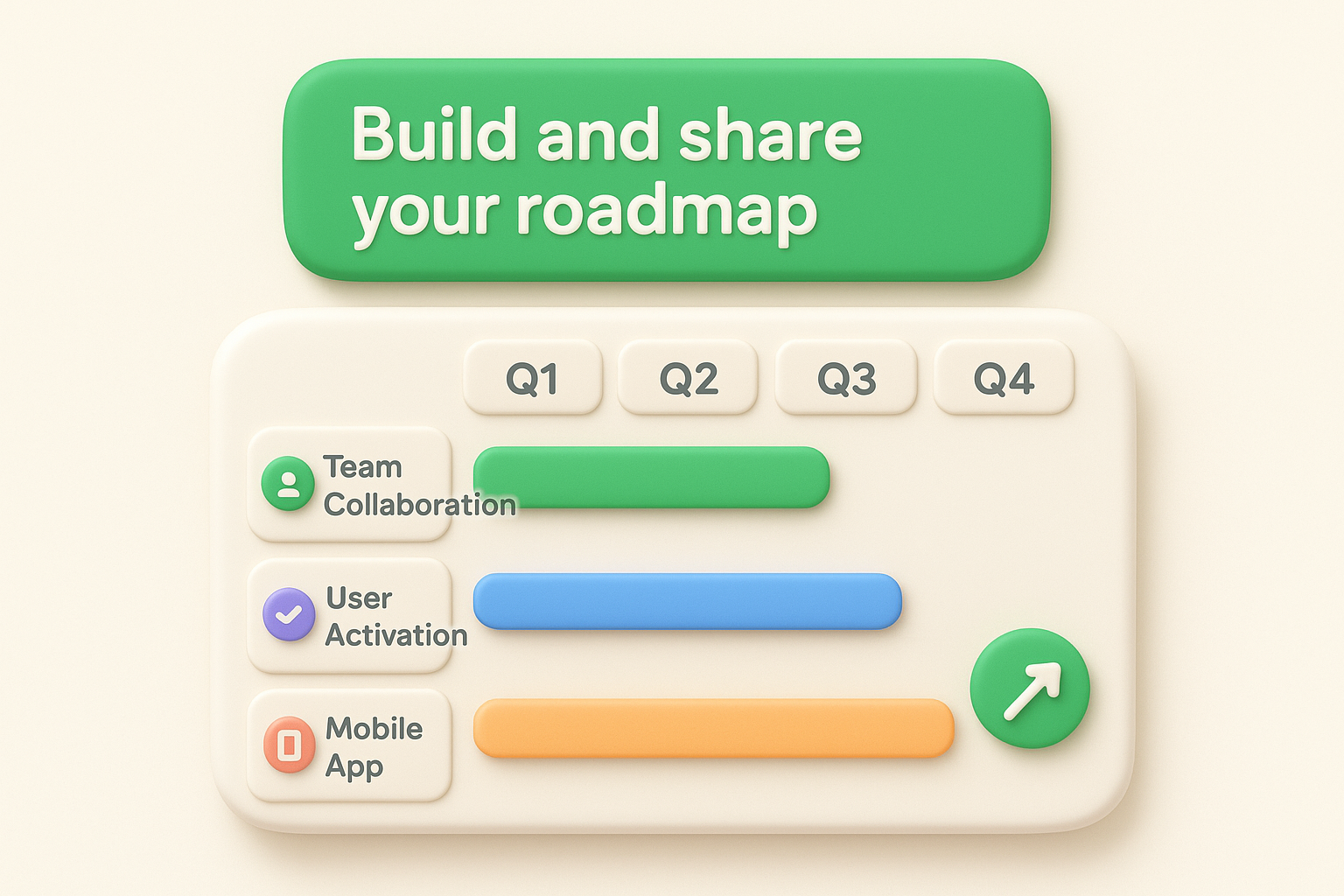
Organize your roadmap by strategic themes that connect to your goals. Each theme represents a group of related initiatives that drive a specific outcome. For example, if your goal is increasing enterprise adoption, your theme might be "Team Collaboration." Under that theme, you list the initiatives like team workspaces, permission controls, and admin dashboards. This approach keeps everyone focused on outcomes instead of individual features. Use this structure for each roadmap item:
| Theme | Goal It Supports | Key Initiatives | Timeframe | Success Metric |
|---|---|---|---|---|
| Team Collaboration | Increase enterprise accounts by 50 | Team workspaces, permissions, admin tools | Q1-Q2 2026 | Enterprise signups per month |
| User Activation | Reduce time to value to 1 day | Onboarding wizard, templates, quick setup | Q1 2026 | Days to first value |
Your roadmap should cover the next three to four quarters with decreasing specificity. Quarter one shows detailed initiatives, while later quarters show themes and strategic bets. This gives you flexibility to adjust based on what you learn.
Your roadmap is a living document, not a contract. Update it as you gather new customer insights and market data.
Create a simple visual version of your roadmap that anyone can understand in two minutes. Use a timeline format that shows themes progressing across quarters. Include the business goal each theme supports so stakeholders see the connection between your work and company objectives. Share this roadmap where your team can access it easily, whether that's in Confluence, Notion, or a dedicated roadmap tool like Koala Feedback. Avoid complex Gantt charts or spreadsheets that only product managers understand.
Review your roadmap every month with your team and quarterly with stakeholders. Update priorities based on what you learned from shipping features and talking to customers. When priorities change, explain why using the goals and metrics you defined in Step 3. For example: "We moved mobile app development to Q2 because our metrics show feature adoption dropped to 30%, and fixing that will have bigger impact on our retention goal." This transparency builds trust and shows you make decisions based on data, not politics. Share roadmap updates through brief written summaries that highlight what changed and why, not hour-long presentation meetings that waste everyone's time.
You can speed up your product strategy planning by starting with proven templates. Real examples show you what works instead of forcing you to build everything from scratch. The templates below give you structure for strategy documents, roadmap presentations, and goal-setting frameworks. Adapt these to your product and business context rather than copying them word for word.
Your strategy document should fit on two pages and cover these essential elements. This template keeps you focused on outcomes instead of filling pages with fluff. Use this structure:
Product Strategy: [Product Name] [Year]
Fill in each section with specific numbers and timeframes. The "Not Doing" section matters as much as your priorities because it prevents scope creep and keeps your team aligned on trade-offs.
The best strategy documents explain what you won't build as clearly as what you will.
Structure your roadmap as a quarterly timeline that shows themes and outcomes. This format works for stakeholder presentations and keeps your team focused on strategic direction:
| Quarter | Theme | Key Initiatives | Goal | Success Metric |
|---|---|---|---|---|
| Q1 2026 | Activation | Onboarding wizard, templates, quick setup | Reduce time to value to 1 day | Days to first value |
| Q1-Q2 | Enterprise Features | Team workspaces, permissions, admin tools | Increase enterprise signups by 50 | Enterprise accounts added |
| Q2-Q3 | Mobile Experience | iOS app, offline mode, push notifications | Increase daily active users by 30% | DAU growth rate |
Each row connects initiatives to specific goals and metrics. Share this format with executives who want to see direction without getting lost in feature details. You can expand each theme into detailed feature specs separately for your development team while keeping the high-level view simple for stakeholders.
A SaaS company targeting enterprise customers might write: "We will build team collaboration features (workspaces, permissions, admin controls) to help the business capture 50 more enterprise accounts by Q2 2026 because our research shows 80% of enterprise buyers require multi-team support before purchase." This statement connects product work directly to business outcomes and includes the customer insight that validates the bet. Copy this format when writing your own strategic bets during product strategy planning sessions.
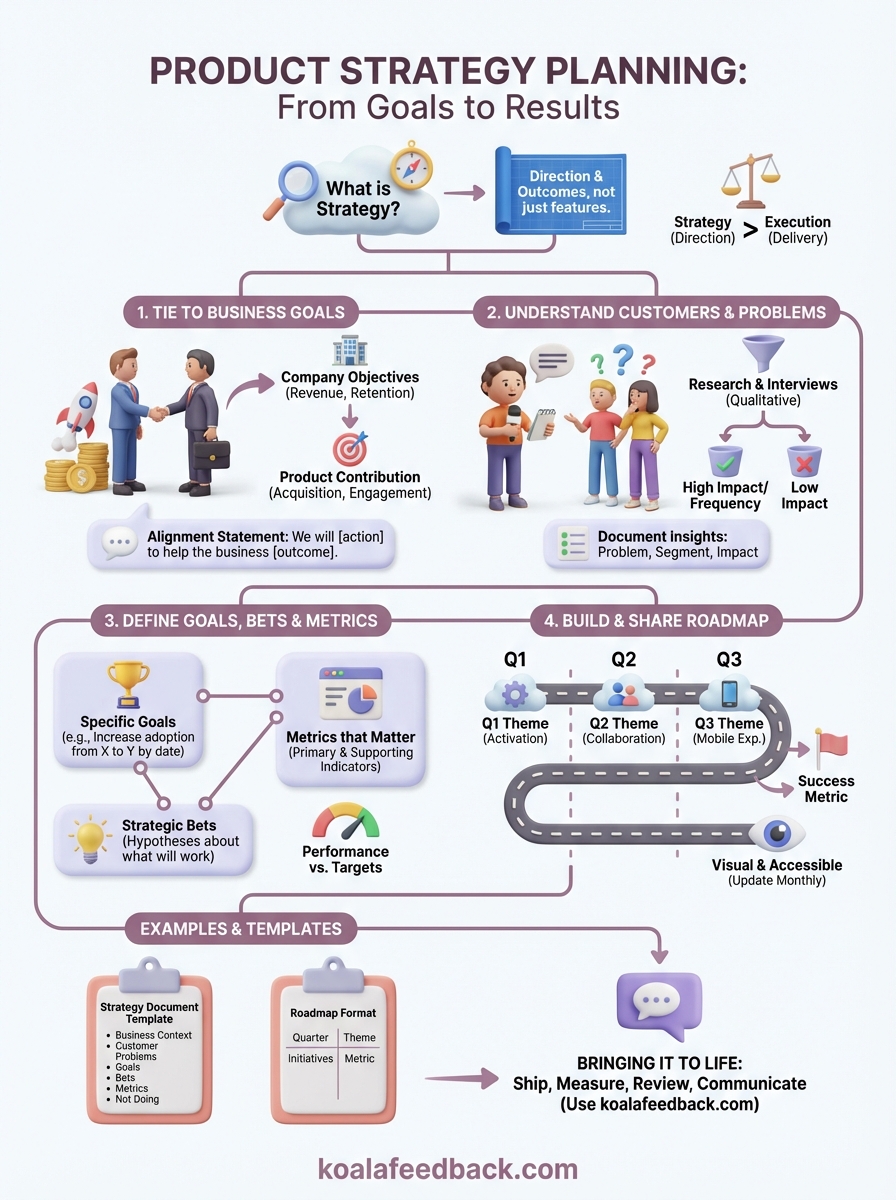
Your product strategy planning work means nothing until you execute it. You now have the framework: business goals that drive product goals, customer insights that inform strategic bets, and a roadmap that guides your team. The next step is shipping features and measuring results against the metrics you defined. Review your progress every month. Update your strategy when data shows you need to change direction.
Communication keeps your strategy alive beyond the initial planning sessions. Share updates with your team weekly and stakeholders monthly. When someone asks why you prioritized feature X over feature Y, point them to your goals and metrics. Use a tool like Koala Feedback to collect user input continuously and validate whether your strategic bets solve real problems. Your strategy evolves as you learn, but the discipline of tying decisions to business outcomes never changes.

Start today and have your feedback portal up and running in minutes.