You've got a backlog full of feature ideas, a team eager to build, and no clear framework for deciding what actually moves the needle. That's the gap a solid product development and strategy fills. It's the difference between shipping whatever's loudest in your inbox and shipping what genuinely grows your product.
At its core, a strategy for product development is a structured plan for how you research, build, launch, and improve products based on real user needs and business goals. It covers everything from initial discovery and prioritization to launch and post-release iteration, giving your team a repeatable process instead of guesswork. Whether you're mapping out a strategy for new product development or refining an existing lineup, the fundamentals stay the same.
In this article, you'll learn what a product strategy actually includes, the key stages behind any workable approach, and practical steps to develop product strategy for your own roadmap. We'll also touch on how a clear product improvement strategy keeps your team focused on what users actually want, not just what feels urgent this week.
Skip the strategy step and you're left prioritizing by volume instead of using a real feature prioritization framework, whoever complains loudest in a support ticket gets built first. That approach burns through engineering hours on features that never move retention or revenue. A documented product development strategy forces you to test assumptions before you commit resources, so your team builds what actually matters instead of what's easiest to greenlight this sprint. Companies that treat the strategy of new product development as an afterthought tend to ship a lot and grow very little, and the pattern shows up across SaaS, hardware, and internal tooling teams alike: without a strategic filter, effort scatters across low-impact work.
A backlog without a strategy is just a to-do list dressed up as a roadmap.
Teams without a clear strategy waste time in predictable ways. Engineers build features nobody asked for, support tickets pile up because the roadmap doesn't reflect real pain points, and leadership loses confidence in the product team's direction. Here's what typically goes wrong when strategy takes a back seat:
| Without a strategy | With a strategy |
|---|---|
| Roadmap driven by whoever asks loudest | Roadmap tied to measurable goals |
| Teams duplicate work unknowingly | Single source of truth for priorities |
| Prioritization by gut feeling | Prioritization backed by user data |
| Support blindsided by scope changes | Support briefed on what's coming and when |
Each of these gaps is expensive to close after the fact. Rebuilding user trust after a string of ignored requests takes far longer than building the right feature the first time.
Once you have a strategy, every department points toward the same goal. Sales stops overpromising features that aren't planned, and support can tell customers when a fix is coming instead of guessing. Engineering stops re-litigating priorities every sprint planning meeting, because the decision was already made against agreed criteria, not whatever came up in yesterday's stand-up.
Growth makes this even more important. A five-person startup can align by chatting in Slack. A fifty-person product org needs a documented plan everyone can reference, one that ties every initiative back to a measurable goal like activation rate, retention, or churn reduction. Without that shared reference point, teams quietly drift toward building whatever's interesting to them rather than what moves the business forward.
Strategy built purely on internal opinions drifts away from what customers actually need within a quarter. A feedback portal where users submit and vote on ideas gives you a live signal of what to prioritize next, instead of relying on the loudest sales rep's anecdote from last week's call. Platforms like Koala Feedback centralize that input so patterns surface automatically instead of getting buried across spreadsheets, support threads, and Slack channels.
When your product improvement process is anchored in actual user votes and comments, you spend less energy defending decisions in planning meetings and more time actually shipping them. That shift, from opinion-driven roadmaps to evidence-driven ones, is usually the single biggest improvement teams report after adopting a formal strategy process.
Learning how to create a product strategy that works doesn't require a 40-page document. It requires a clear sequence: research, prioritize, build, launch, measure. Skip a step and the whole chain weakens, because each stage feeds data into the next one. Teams that develop product strategy successfully treat it as a loop, not a one-time planning exercise that gets filed away after the kickoff meeting.
Gather input from every channel where users already talk about your product: support tickets, sales calls, churn surveys, market research for product development, and a public feedback portal where anyone can submit and vote on ideas. Don't rely on the three loudest customers to represent your whole user base. A structured intake process, where every request lands in one place and gets tagged by theme, catches patterns that individual conversations miss.
Strategy starts with listening at scale, not guessing at scale.
Once requests are collected, score feature requests against consistent criteria instead of instinct. A simple framework keeps this fair and repeatable:
Tools built for this, like Koala Feedback's prioritization boards, let you organize scored requests by product area so the highest-value work rises to the top automatically instead of getting buried in a spreadsheet nobody updates.
Engineering picks up the prioritized items, but communication shouldn't stop once a feature enters development. Customizable statuses on a public roadmap, like "planned," "in progress," and "shipped," keep users informed without requiring a status update from support every time someone asks. This single habit, closing the loop publicly, cuts down repeat questions and rebuilds trust with users who submitted ideas months ago.
After launch, track whether the shipped feature actually moved the metric you predicted. If activation ticked up, you validated the bet. If nothing changed, that's useful information too, feed it back into your next scoring round so estimates get sharper over time. This measurement step is what separates real new product development from a one-off launch calendar, because it turns every release into a data point for the next decision.
Not every product needs the same playbook. The right product development strategy depends on your market position, your resources, and how mature your product already is. Picking the wrong type wastes effort even when execution is flawless, because you're optimizing for the wrong outcome. Below are the five approaches most teams end up choosing from, often blending two depending on the product line.
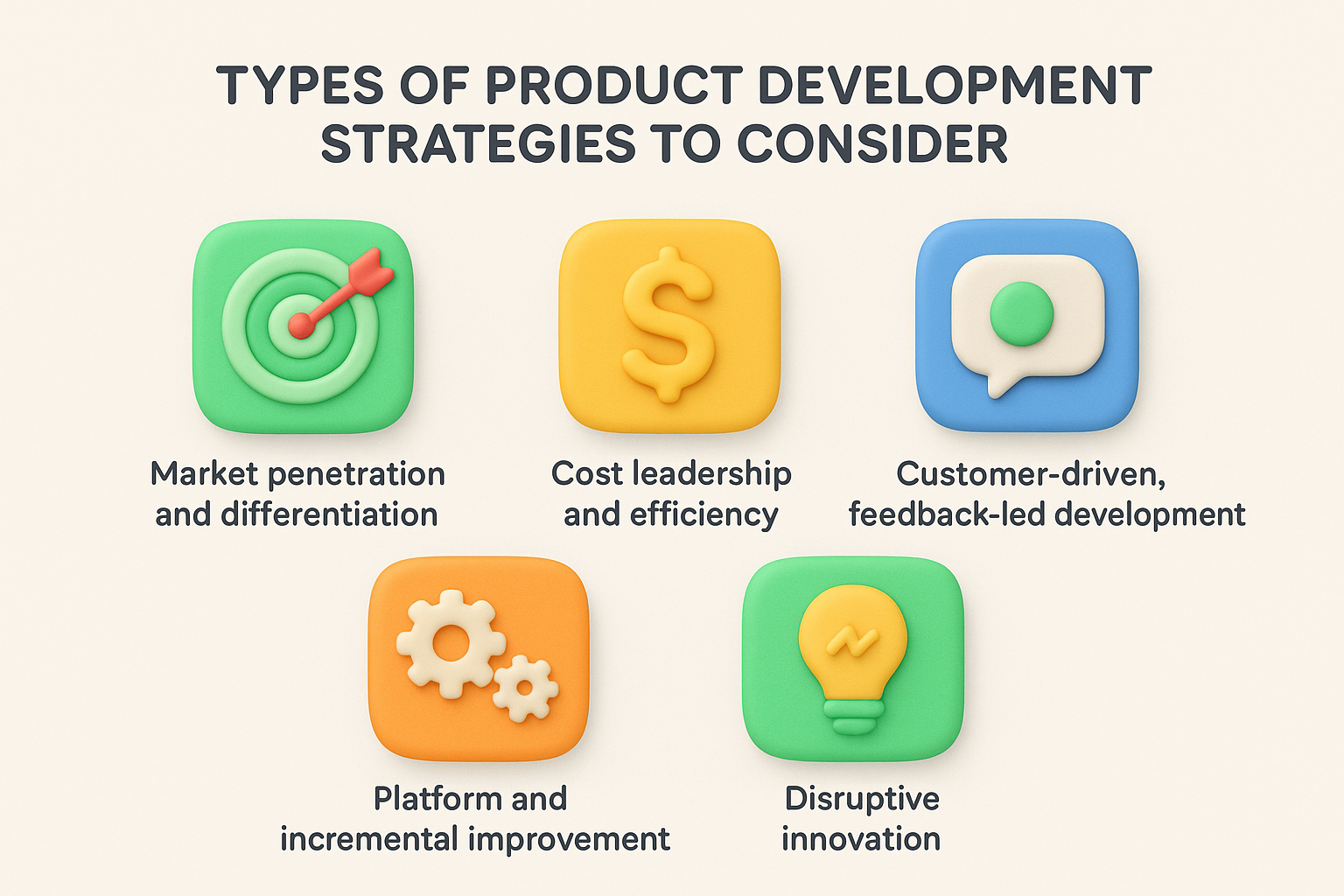
Differentiation strategies focus on making your product distinct enough that users choose you over a crowded field of alternatives. You invest in features competitors haven't shipped yet, betting that uniqueness drives adoption faster than price ever could. This works best when your market already has established players and switching costs are low, so you need a real reason for someone to move, and the four strategies in the product-market growth matrix can help you decide where to place that bet.
Cost leadership strategies prioritize lean, efficient builds that keep your price point below competitors without sacrificing core functionality. Rather than chasing every feature request, teams here ruthlessly cut scope and automate wherever possible. Engineering time goes toward reliability and speed, not novelty, because the pitch to customers is value per dollar, not innovation.
Here, every roadmap decision traces back to user votes, comments, and support patterns rather than internal guesses. Teams running a feedback-led product strategy this way rely on a centralized feedback loop, something a tool like Koala Feedback is built for, so prioritization reflects actual demand instead of whoever pitched loudest in a planning meeting.
The best product strategy is the one your users would recognize in your roadmap.
Instead of chasing new markets, this approach doubles down on strengthening what already works: performance, integrations, and polish. It suits mature products where the core value proposition is proven and churn risk comes from friction, not missing features.
Disruptive strategies aim to create a new category or radically undercut how an existing problem gets solved. High risk, high reward, and rarely the right first move for an early-stage team without runway to absorb failed bets.
| Strategy type | Best for | Primary risk |
|---|---|---|
| Differentiation | Crowded markets | Feature bloat |
| Cost leadership | Price-sensitive segments | Thin margins |
| Feedback-led | Retention-focused SaaS | Slower big-bet innovation |
| Platform improvement | Mature products | Stagnant growth |
| Disruptive innovation | New categories | High failure rate |
Even teams with a documented plan stumble in predictable ways. Most failures trace back to a handful of habits that quietly undo the value of any product development strategy, no matter how carefully it was drafted. Spotting these early saves you from relearning the same lesson a quarter later.
Saying yes to every loud voice is the fastest way to dilute a strategy into a wish list. Teams that skip scoring criteria end up building whatever the last sales call demanded, which quietly reverses the prioritization work you did earlier. A product improvement strategy only holds if you're willing to say no to requests that don't move a core metric, even when the person asking is persistent or important.
A strategy that says yes to everything is really a strategy for nothing.
Building first and asking questions later is expensive. Use product idea validation to confirm demand and rough impact before engineering commits weeks to a feature, otherwise you're gambling with a resource you can't get back. Common validation shortcuts that backfire include:
Once published, a roadmap needs upkeep. Statuses that never move from "planned" to "in progress" erode the trust you built by sharing it publicly in the first place. Customizable statuses only work if someone owns updating them regularly, so build that into your release process rather than treating it as optional cleanup.
Measuring a launch once and moving on skips the most valuable part of the cycle. Results from a shipped feature should feed back into your next scoring round, sharpening future estimates on reach and impact. Without that loop, every strategy for new product development resets to guesswork each cycle instead of getting smarter over time.
Watching for these patterns matters more than getting the initial plan perfect. Strategies rarely fail because the framework was wrong; they fail because a team stopped following it under deadline pressure.
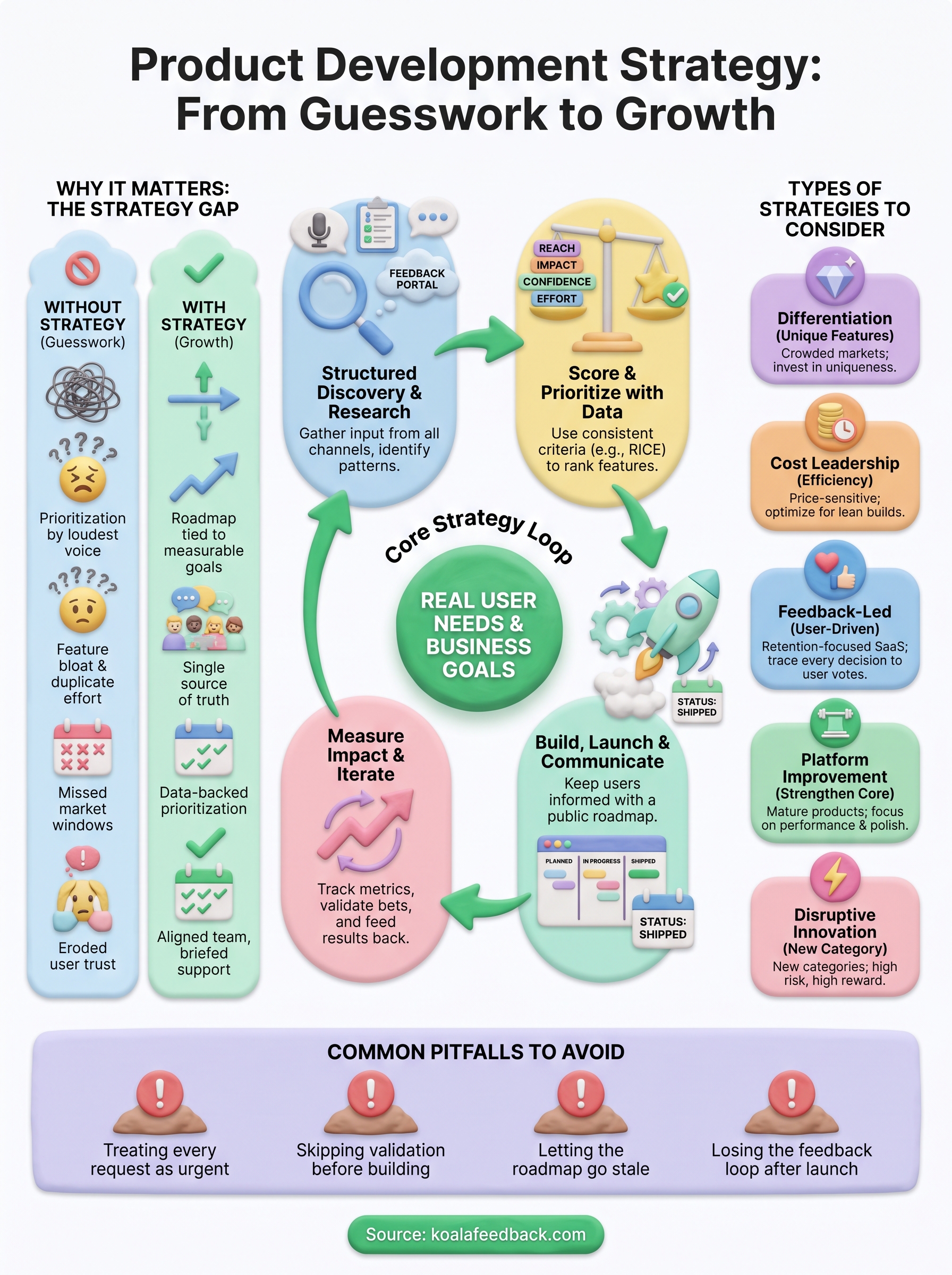
A product development strategy only works when you actually run it, not when it sits in a slide deck from last quarter's planning meeting. Discovery feeds prioritization, prioritization feeds building, and measurement feeds the next round of discovery. Drop any link in that chain and you're back to guessing, no matter how polished your original plan looked on paper.
Start small if you need to. Pick one channel for collecting feedback, score requests against a consistent framework, and publish a roadmap your users can actually see move. That single habit, closing the loop publicly, does more for trust than any strategy document ever will.
You don't need to build this from scratch. Try Koala Feedback free to capture and prioritize user feedback in one portal alongside your public roadmap, so your next roadmap decision comes from real user data instead of whoever emailed you last.

Start today and have your feedback portal up and running in minutes.