Building a product without solid research is a bet, not a strategy. You can spend months on a roadmap only to launch something users shrug at, because the assumptions behind it were never tested. Market research for product development fixes that by grounding your decisions in what people actually want before you write a line of code.
This guide gives you a practical process for market research and product development, not just theory. You'll learn how to define what you need to know, choose the right research methods, talk to real customers and prospects, and turn raw findings into a prioritized feature list you can defend to your team or stakeholders.
We'll walk through each stage in order: setting research goals, picking between qualitative and quantitative methods, analyzing competitors, and validating ideas with your existing user base. Along the way, we'll show how tools like a feedback portal and public roadmap make it easier to collect input continuously and keep users informed as their suggestions move from idea to shipped feature.
Most failed products don't fail because of bad engineering. They fail because nobody validated the idea before building it. Product development market research exists to catch that mistake early, when it costs you a survey instead of six months of wasted sprints. Teams that skip this step tend to rely on internal opinions, the loudest voice in the room, or whatever a competitor shipped last quarter. None of that tells you what your actual customers need.
CB Insights has repeatedly found that "no market need" is one of the top reasons startups fail, ranking above running out of cash or losing to competitors. That's not a funding problem or a talent problem. It's a research problem. When you skip research in the key stages of new product development, you're not avoiding the work, you're just doing it after launch, with real customers as your test subjects and your reputation on the line.
Skipping research doesn't remove risk, it just delays the moment you find out you were wrong.
Here's what tends to happen when teams build without validating assumptions first:
| Without research | With research |
|---|---|
| Features built on guesses | Features built on evidence |
| Roadmap driven by internal opinions | Roadmap driven by customer demand |
| Feedback arrives after launch, often as churn | Feedback arrives before launch, shaping the build |
| Marketing struggles to explain the "why" | Positioning matches a validated pain point |
| Budget spent rebuilding features | Budget spent refining what already works |
Solid market research in product development does three things well. First, it tells you whether a problem is worth solving at all, before you commit engineering time to it. Second, it shows you how people currently solve that problem, including with competitor tools, so you know what you're up against. Third, it gives you language, the actual words customers use to describe their pain, which makes your positioning and onboarding sharper later.
Think of research as insurance against building in a vacuum. Companies that run structured research cycles report faster time-to-value for new features because they're not guessing at scope or priority. They already know which problems matter most, so they can size the work accurately and defend the roadmap to stakeholders with data instead of opinion.
Gathering this kind of insight doesn't have to mean a one-time research sprint before every release. An always-on feedback portal turns research into an ongoing habit rather than a periodic project. When users can submit ideas, vote on existing requests, and comment on what matters to them, you get a live stream of market signal that supplements formal research methods like interviews and surveys. Koala Feedback's feedback management tools are built for exactly this: centralizing input so you're not starting from zero every time you plan a new feature.
Ultimately, research isn't a phase you complete once and move past. It's a discipline you build into how your team operates, from the first customer interview through the fifth version of a feature. The steps that follow walk you through how to set that discipline up, starting with the question most teams skip: what do you actually need to know before you start?
Before you send a single survey or book a single interview, write down exactly what you're trying to learn. Vague goals like "understand our users better" produce vague data that nobody can act on. A tight objective, like "find out whether small agency owners would pay extra for client-facing reporting," gives your user research plan a clear finish line and tells you which method to use later.
Work backward from the decision you need to make. Are you deciding whether to build a feature at all, how to price it, or which of three competing ideas to prioritize? Each of those questions needs different data. A pricing decision needs willingness-to-pay data from prospects, while a prioritization decision needs demand signals from your existing user base. If you can't name the decision your research will inform, you're not ready to start collecting data yet.
If your research objective doesn't point to a decision, it's not an objective, it's curiosity.
A good objective is specific enough that it could turn out to be wrong. "Learn about onboarding" can't fail. "At least 60% of trial users who churn cite setup complexity as the reason" can fail, and that's what makes it useful. Use this template when you draft objectives for your team:
Objective: [What you want to know]
Why it matters: [Which decision this informs]
Success signal: [The data pattern that would confirm it]
Failure signal: [The data pattern that would disprove it]
Deadline: [When you need the answer by]
Run each draft objective through that template before you move to research methods. If you can't fill in "failure signal," rewrite it.
Most teams doing market research for new product development try to answer too many questions in one cycle and end up with data that's broad but shallow. Limit yourself to two or three objectives per research cycle. That constraint forces you to prioritize what you actually need to know now versus what's just interesting to know eventually. A short list also makes it easier to brief your team, write focused survey questions, and keep interviews on topic instead of drifting into a general conversation about the product.
Once your objectives are locked in, they become the filter for everything that follows: which methods you choose, who you talk to, and how you judge whether the research actually answered your question or just generated more noise.
Once your objective is locked, the method almost picks itself. User research methods split into two broad camps: qualitative work that tells you why people behave a certain way, and quantitative work that tells you how many people behave that way. Skipping one in favor of the other is the most common mistake teams make at this stage. Interviews alone give you rich stories but no sense of scale, while surveys alone give you numbers with no context for what's driving them.
Go back to the objective you wrote in step one and ask what kind of evidence would actually satisfy it. A pricing question needs quantitative willingness-to-pay data across a large enough sample to trust the average. A question about why users abandon setup needs qualitative depth, and five or six candid conversations, if you know how to conduct user interviews, will surface more than a thousand survey responses ever will. Trying to answer a
With your objectives set and methods chosen, it's time to actually collect data. Good market research for product development pulls from three separate pools: your existing customers, the broader market, and your direct competitors. Relying on just one gives you a distorted picture. Customers tell you what's broken today, market data tells you where the opportunity is growing, and competitor research tells you what you're up against if you build it.
Your current users are the cheapest and fastest source of signal you have, and most teams under-use them. Pull data from support tickets, churn interviews, and your existing customer feedback collection channels before you ever run a fresh survey. Look for patterns in what people ask for, complain about, or vote on repeatedly. If you're using a tool like Koala Feedback's feature voting boards, you already have a ranked list of demand sitting in your dashboard, no recruiting or incentives required.
The feedback you already have is worth more than the survey you haven't sent yet.
Once you understand customer pain, check whether the market is big enough to justify building for it. Public sources like the U.S. Census Bureau's Business data and industry reports from analyst firms can confirm whether a segment is growing or shrinking. This step matters most when you're considering a new segment, not just a feature for existing users.
Don't just browse competitor sites. Build a simple comparison so patterns jump out:

| What to check | Why it matters |
|---|---|
| Feature set | Shows gaps you could fill |
| Pricing tiers | Reveals what the market will pay |
| Public reviews (G2, Capterra) | Surfaces recurring complaints you can solve |
| Public roadmaps | Tells you what's coming, so you don't duplicate effort |
| Onboarding flow | Shows friction points competitors haven't fixed |
Run through this table for your top three to five competitors, not just the obvious market leader. Smaller players often reveal underserved niches that the leader has ignored.
A single data point from any one pool can mislead you. A vocal customer request might be a one-off, a market trend might not apply to your niche, and a competitor feature might be underused by their own customers. Cross-reference all three before you treat a finding as solid. This kind of market research new product development work is slower than trusting a gut feeling, but it's the difference between a roadmap built on evidence and one built on assumptions.
Data sitting in a spreadsheet doesn't build anything. The point of market research for new product development is to turn what you learned into a ranked list of decisions your team can actually execute. This is where most of the value gets lost, teams run great research and then let it die in a slide deck instead of presenting findings to stakeholders and feeding them into the roadmap.
Go back to the objectives you wrote in step one and check each finding against its success and failure signals. If a finding confirms an objective, it earns a spot on the roadmap. If it contradicts one, don't bury it, that's often the more valuable result because it saves you from building the wrong thing. Sort every finding into one of three buckets before you move further: build now, needs more validation, or shelved for now. This filter keeps enthusiasm for a shiny new idea from overriding what the evidence actually showed.
A finding that never changes a roadmap wasn't research, it was trivia.
Once findings are sorted, score and rank the ideas in the "build now" bucket so you're not just ranking by gut feeling again. A lightweight model works better than a complicated one because your team will actually use it:
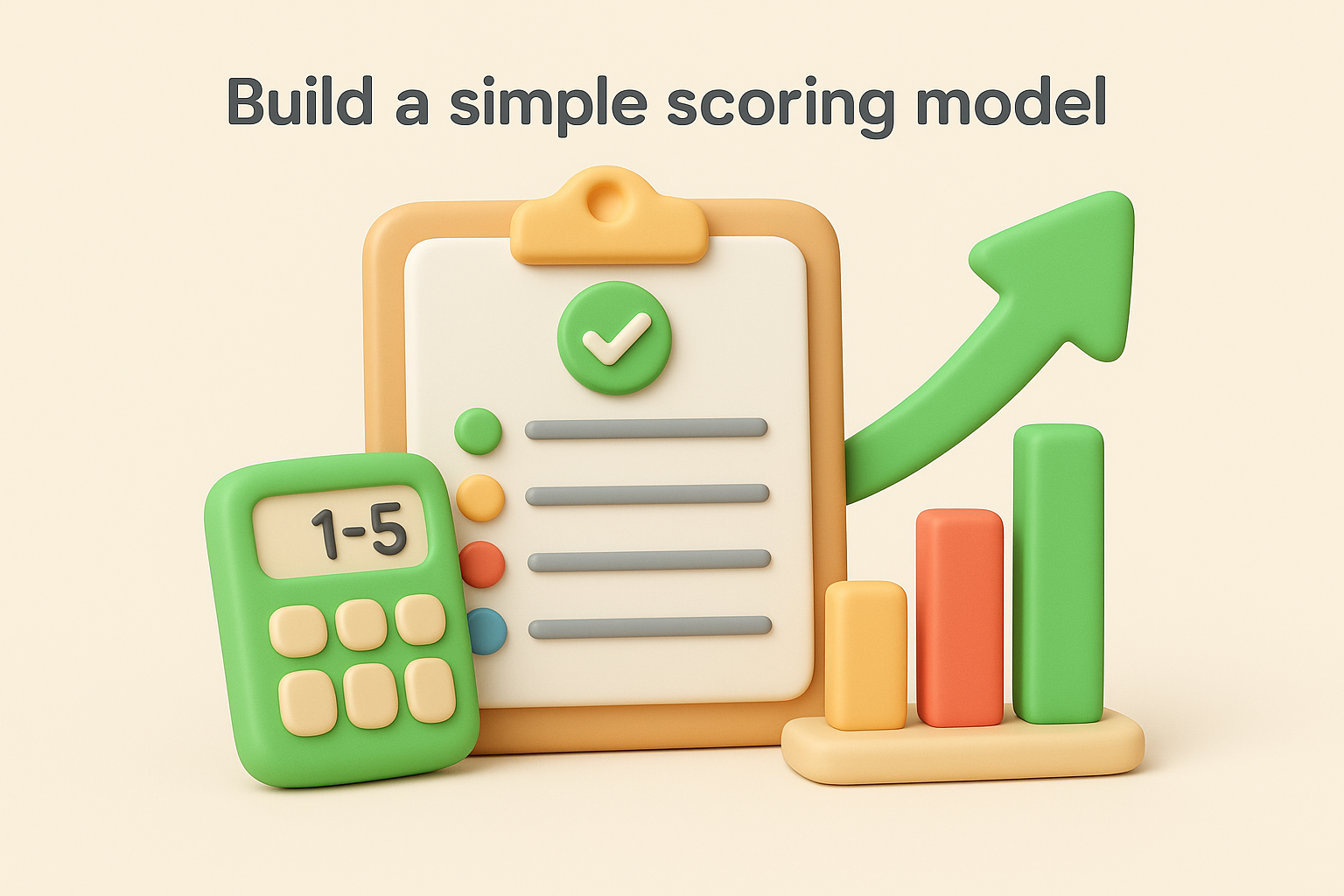
For each candidate feature, score 1-5 on:
- Demand: how many customers/prospects asked for it or voted on it
- Pain: how severe the problem is when it happens
- Effort: rough engineering cost to build
- Confidence: how strong is the underlying data (interview vs survey vs vote count)

Priority score = (Demand + Pain + Confidence) / Effort
Run your top ten candidates through this and sort by score, the same way any roadmap prioritization framework works. It won't replace judgment, but it forces the conversation to center on evidence instead of whoever pitches loudest in the planning meeting.
High scores mean nothing if they stay internal. Move the winning ideas onto a public roadmap so customers see their input shaping what ships next, and use customizable statuses to show what's planned, in progress, and completed. Koala Feedback's roadmap tool exists for exactly this handoff, turning your prioritized research into something transparent rather than a private backlog. Closing that loop matters as much as the research itself: users who see their feedback acted on keep contributing, which means your next research cycle starts with a richer pool of signal than the last one.
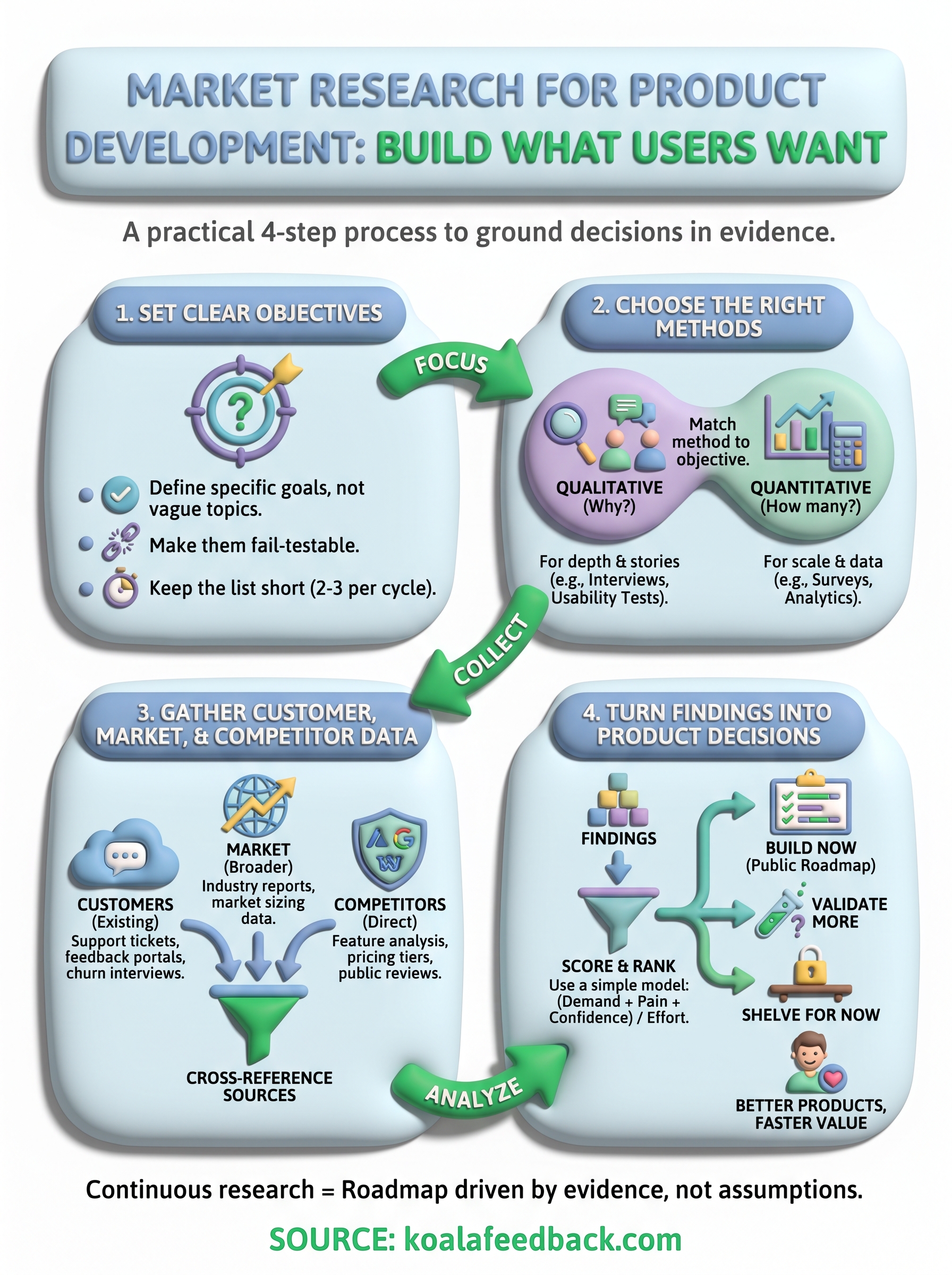
Good research isn't a gate you pass through once before launch. It's the habit that separates teams shipping features nobody asked for from teams whose roadmap reads like a direct response to real demand. Market research for product development works because it replaces internal debate with evidence: clear objectives, the right mix of qualitative and quantitative methods, data pulled from customers and competitors alike, and a scoring process that turns findings into decisions instead of slide decks.
None of this has to slow you down. The fastest teams treat research as continuous, not periodic, feeding customer input straight into their planning instead of waiting for the next big study. That's the whole point of pairing structured research with an always-on feedback loop.
If you're ready to stop guessing and start building from real demand, start capturing feedback with Koala Feedback and give your users a direct line into what you build next.

Start today and have your feedback portal up and running in minutes.