You have an idea for a new product or feature. You can picture it clearly. You know it will solve a real problem. But here's the question that keeps you up at night: will anyone actually pay for it? Too many products get built on assumptions and gut feelings, only to launch to crickets. Teams spend months building something nobody wants, burning through budget and morale in the process.
Product idea validation gives you a way to test demand before you commit serious resources. It means running small experiments, talking to real customers, and collecting evidence that your idea solves a problem people will pay to fix. Validation reduces risk. It helps you spot fatal flaws early when pivoting is still cheap.
This guide walks you through a practical four step process for validating any product idea. You'll learn how to define your concept clearly, research your market, evaluate feasibility, and run experiments that prove or disprove demand. By the end, you'll know whether to move forward, pivot, or kill the idea before you waste time building the wrong thing.
Product idea validation saves you from the most expensive mistake in product development: building something nobody wants. When you skip validation, you make decisions based on your own assumptions rather than market reality. You invest months of development time, hire engineers, design interfaces, and write code for a product that may never find paying customers. The average cost of a failed product launch ranges into six figures when you account for salaries, opportunity cost, and wasted resources.
Validation gives you permission to pivot or kill ideas before they drain your budget. You discover fatal flaws when fixing them costs hours instead of months. A quick customer interview might reveal that your target market already uses a competitor they love, or that the problem you're solving isn't painful enough to justify switching. These insights are gold when you find them early and devastating when you discover them after launch.
Validation reduces the risk of product failure by testing your assumptions against real market demand before you commit to full development.
The process also helps you refine your positioning and messaging before you go to market. When you talk to potential customers during validation, you learn the exact words they use to describe their problems. You discover which features matter most and which are nice to have. This research shapes everything from your pricing strategy to your marketing copy, giving you a head start on companies that launch first and learn later.
Speed matters in competitive markets. Teams that validate ideas quickly can test multiple concepts in the time it takes others to build one unvalidated product. You fail faster, learn more, and ultimately ship products with real market fit.
You can't validate what you can't articulate. The first step in product idea validation requires you to translate your concept into clear, testable statements about the problem you're solving, who experiences that problem, and how your solution creates value. Vague ideas lead to vague validation. When you force yourself to write these elements down, you expose gaps in your thinking and create a foundation for all your future testing.
Your problem statement should describe a specific pain point that your target audience experiences regularly. Avoid solving problems that only exist in your imagination. Focus on situations where people already spend time, money, or effort working around the problem today.
Use this template to structure your problem statement:
[Target audience] struggles with [specific problem] when [situation/context].
This causes them to [negative outcome] and costs them [time/money/opportunity].
Currently, they solve this by [existing workaround], which is [why it's inadequate].
For example: "Marketing managers struggle with organizing customer feedback when it arrives through email, chat, and support tickets. This causes them to miss important feature requests and costs them hours each week manually consolidating data. Currently, they solve this by using spreadsheets, which become outdated quickly and lack voting capabilities."
Start narrow rather than trying to serve everyone. You need to talk to real people during validation, and "anyone who needs better productivity" doesn't help you find interview candidates. Define one specific user segment with clear characteristics you can use to recruit research participants.
The more specific your target audience, the easier it becomes to find them, interview them, and understand their unique needs.
Document these details: job title or role, company size, industry, current tools they use, and how they currently solve the problem. For the example above, you might target "Product managers at B2B SaaS companies with 20 to 200 employees who currently use email and spreadsheets to track feature requests."
Your value proposition explains what your solution does and why it matters to your target user. Write one sentence that completes this formula: "We help [target user] [achieve outcome] by [unique approach]."
Example: "We help product managers prioritize feature development by centralizing all feedback in one place with built in voting and automatic categorization." This statement gives you something concrete to test during validation interviews and experiments.
Market research turns your assumptions into facts. This step in product idea validation requires you to look outward at real market conditions and talk directly to the people who experience the problem you're trying to solve. You need two types of evidence: competitive intelligence that shows what solutions already exist, and customer insights that reveal whether your approach offers meaningful differentiation.
Start by identifying every product or service that currently addresses your target problem. Include direct competitors, indirect alternatives, and manual workarounds people use today. Search Google for keywords your target audience would use. Browse product review sites and check Reddit communities where your audience discusses their challenges.
Document what you find in a simple comparison table:
| Solution | Price | Key Features | User Complaints | Market Gap |
|---|---|---|---|---|
| Competitor A | $49/mo | Feature voting, roadmap | Clunky interface, no integrations | Better UX opportunity |
| Spreadsheets | Free | Flexible | Manual work, no voting | Automation opportunity |
This research reveals which features matter most to users and where existing solutions fall short. Pay special attention to negative reviews and feature requests. These gaps represent opportunities for differentiation.
Customer interviews give you qualitative insights you can't get from surveys or analytics. You need to talk to at least 10 to 15 people who match your target user profile. Reach out through LinkedIn, industry forums, your professional network, or existing customer lists if you have them.
Structure your interviews around open ended questions that explore their current experience:
1. Walk me through how you currently handle [problem area].
2. What frustrates you most about your current approach?
3. How much time do you spend on this per week?
4. What have you tried in the past that didn't work?
5. If you could wave a magic wand, what would change?
The goal is to listen more than you talk. Let customers describe their problems in their own words before you mention your solution.
Take detailed notes on the exact language they use to describe pain points. These phrases become your marketing copy later. Ask about their budget for solving this problem and what outcomes would justify the expense.
Surveys help you test specific hypotheses at scale after interviews give you initial direction. Use tools like Google Forms to reach 50 to 100 potential customers. Keep surveys short with focused questions about problem frequency, current spending, and feature preferences. Include at least one ranking question where respondents prioritize potential features to validate which capabilities matter most for your minimum viable product.
Product idea validation includes a hard look at whether you can actually build and sustain the solution profitably. You've confirmed a market need exists and identified your target customers. Now you need to assess whether the economics make sense and whether your team has the technical capability to deliver. This step prevents you from committing to ideas that will drain resources or require expertise you don't have.
Break down your product idea into specific technical requirements and estimate what each piece will cost to build. Start with the core features you identified from customer interviews. For each feature, estimate engineering hours, design time, and any third party services or infrastructure you'll need.
Create a simple cost breakdown:
| Component | Hours | Rate | External Costs | Total |
|---|---|---|---|---|
| User authentication | 40 | $100/hr | $500 (auth service) | $4,500 |
| Feedback portal | 80 | $100/hr | $0 | $8,000 |
| Voting system | 60 | $100/hr | $0 | $6,000 |
| Admin dashboard | 100 | $100/hr | $0 | $10,000 |
| Minimum viable product | 280 | $500 | $28,500 |
Include ongoing monthly costs like hosting, software subscriptions, support tools, and maintenance hours. Calculate your break even point by dividing total costs by your expected price per customer. If you need 500 customers to break even and your addressable market is only 200 companies, you've found a fatal flaw.
You need to evaluate honestly whether your team can build this product with current skills and resources. List every technical component required: backend infrastructure, frontend framework, integrations with third party tools, data storage, security requirements, and compliance needs.
Technical feasibility isn't just about possibility, it's about whether you can build and maintain the solution within realistic time and budget constraints.
Identify skill gaps that would require hiring or outsourcing. Check if any features depend on technologies you've never used before. Research whether required integrations have stable APIs and documentation. A product that needs machine learning expertise when your team only knows basic web development presents a feasibility risk that could derail the entire project.
Map out business risks that could kill your product even if you build it successfully. Consider regulatory requirements, especially for products handling financial data or health information. Evaluate dependencies on third party platforms that could change their terms or pricing. Look at customer acquisition costs versus lifetime value projections.
Use this risk assessment framework:
Risk: [Specific threat]
Probability: [High/Medium/Low]
Impact: [High/Medium/Low]
Mitigation: [How you'll reduce or eliminate this risk]
Go/No-Go Threshold: [What would make this a deal breaker]
Document competitive timing risks and intellectual property concerns. If a competitor with ten times your resources could copy your idea in three months, you need a different moat. Product idea validation means facing these hard truths early rather than discovering them after you've invested everything.
Product idea validation moves from research to testing in this step. You've talked to customers and confirmed the problem exists. Now you need proof that people will actually use your solution. This means building something tangible that potential customers can interact with, then measuring their response through structured experiments. You're not building the full product yet. You're creating the minimum artifact needed to test whether your core value proposition resonates.
Start with the simplest version that demonstrates your core concept. This could be clickable mockups in Figma, a basic landing page, or interactive wireframes. The prototype only needs to show the key workflow that solves the main problem you identified in customer interviews. Don't waste time on polish or secondary features.
Focus your prototype on these elements: the problem statement in customer language, your solution's main benefit, and one complete user flow from problem to resolution. You can use design tools or even presentation software to create screens that users can click through. The goal is to test comprehension and desirability, not functionality.
Fake door tests give you hard data on demand without building anything functional. Add a button or menu item for your new feature in an existing product, or create a call to action on your website. Track how many people click expecting to access the feature, then show a message explaining you're gauging interest and collect their email for early access.
Fake door tests measure genuine intent by tracking who takes action, giving you stronger evidence than survey responses about hypothetical interest.
Landing page experiments work similarly for brand new products. Create a page describing your solution with a signup form for early access. Drive traffic through social media, paid ads targeting your audience, or posts in relevant communities. A conversion rate above 10 percent suggests real demand worth pursuing.
Set up a consistent process for collecting and organizing responses from every experiment. Use feedback tools that let you tag responses by theme, priority, and user segment. After each prototype test or experiment, ask participants these specific questions: what problem were you hoping to solve, what confused you, what would make this valuable enough to pay for, and how much would you budget for this solution.
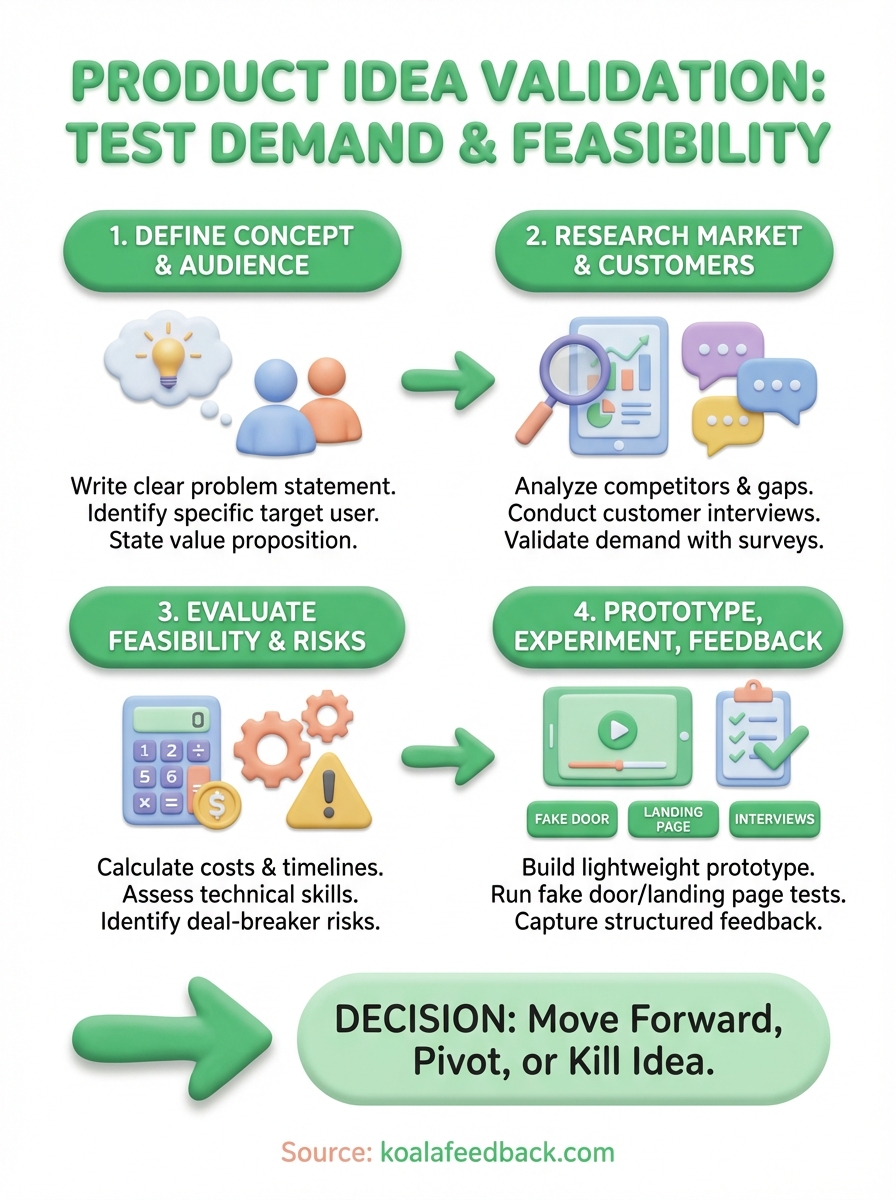
You've worked through the complete product idea validation process. You've defined your problem statement, researched your market, evaluated feasibility, and tested demand through prototypes and experiments. Now you need to make a decision: move forward with development, pivot to a different approach, or stop before investing more resources into an unproven concept.
If your validation showed positive signals (conversion rates above 10 percent, strong user interest in interviews, clear willingness to pay), start building your minimum viable product. Focus on the core features customers ranked highest during research. Track early user behavior closely and continue collecting feedback to guide your roadmap decisions.
Koala Feedback helps you capture and organize feedback throughout development, making it easy to prioritize features based on real demand rather than assumptions. You'll spend less time guessing what to build next.

Start today and have your feedback portal up and running in minutes.