Every product on the market today started as a rough idea that someone had to shape, test, and validate before it ever reached a customer. New product development is the term for that whole journey, and if you're reading this, you're probably trying to figure out how to run it without wasting months on features nobody wants.
At its core, the new product development process is a structured path from spotting an opportunity to launching something people will actually buy. It typically moves through stages of product development like idea generation, screening, concept testing, business analysis, building the product, testing it, and finally launching and reviewing performance. Skip a stage and you usually pay for it later with rework or a flop.
This article breaks down each stage of the NPD process in plain terms, so you know exactly what happens at every step and why it matters. We'll also touch on where user feedback fits into the picture, since the teams that build the right things are the ones who keep listening to their customers instead of guessing what to ship next.
Companies that treat new product development as an afterthought tend to bleed money on features nobody asked for. A disciplined NPD process forces you to validate demand through product research and development before you spend a single engineering hour, which means your roadmap reflects what customers actually want instead of what the loudest voice in a meeting thinks is a good idea. That difference shows up directly in revenue: products built around confirmed demand sell faster and churn less, because you're not asking customers to adapt to your guesswork.
Building the wrong thing is expensive, and the further along you are when you discover the mistake, the more it costs. Research from McKinsey has repeatedly shown that fixing a problem after launch can cost far more than catching it during concept testing or early development. A structured process for new product development puts evidence-based gate checkpoints in place specifically to catch bad ideas before they eat your budget.
Catching a bad idea in the concept stage costs you a afternoon of meetings; catching it after launch costs you a quarter of revenue.
Here's what those checkpoints typically save you from:
Customer expectations don't stay still, and neither do your competitors. A repeatable new-product development process gives your team a reliable way to keep responding to shifting needs instead of reacting in a panic every time a competitor ships something new. Teams that run this process well aren't smarter than everyone else, they're just structured enough to keep testing ideas continuously rather than treating product development as a one-time event. That structure is what lets a company stay ahead for years instead of coasting on a single hit product.
Growth also comes from paying attention to the people already using your product. Companies that understand why collecting feedback matters and build a habit of prioritizing user feedback consistently outperform ones that rely on internal opinions alone, because they're solving real problems instead of imagined ones. This is where the development of new product ideas gets a lot less risky: instead of guessing what your next feature should be, you can look at what customers are actually requesting, how often they're requesting it, and how many people would benefit. Tools like Koala Feedback exist specifically to centralize that input so it doesn't get lost in scattered emails and support tickets, and so your prioritization decisions are backed by actual demand rather than the opinion of whoever spoke last in a planning meeting.
It helps to see the tradeoffs side by side. Companies that skip structured NPD product development and companies that follow it tend to land in very different places:
| Approach | Typical outcome |
|---|---|
| No structured process, feature built on internal opinion | Higher failure rate, wasted development cycles |
| Structured process, no customer input | Fewer wasted cycles, but still misses real demand |
| Structured process with continuous user feedback | Lower failure rate, faster time to product-market fit |
Ultimately, the reason new product development processes matter isn't abstract. It's the difference between a roadmap built on evidence and one built on hope. Businesses that get this right ship fewer duds, retain more customers, and spend their limited engineering resources on work that actually moves the needle. That's the payoff worth chasing, and it's why the rest of this article walks through exactly how to run the process well.
Running the process for new product development isn't complicated once you break it into essential steps in the development process, but skipping one is how most projects go sideways. Each stage has a clear input and a clear output, and moving forward before finishing the previous one just means you're building on assumptions instead of evidence. Below is the sequence most teams follow, plus what actually needs to happen at each step before you move on.
Following this order keeps you from spending real budget on an idea that was never validated in the first place.
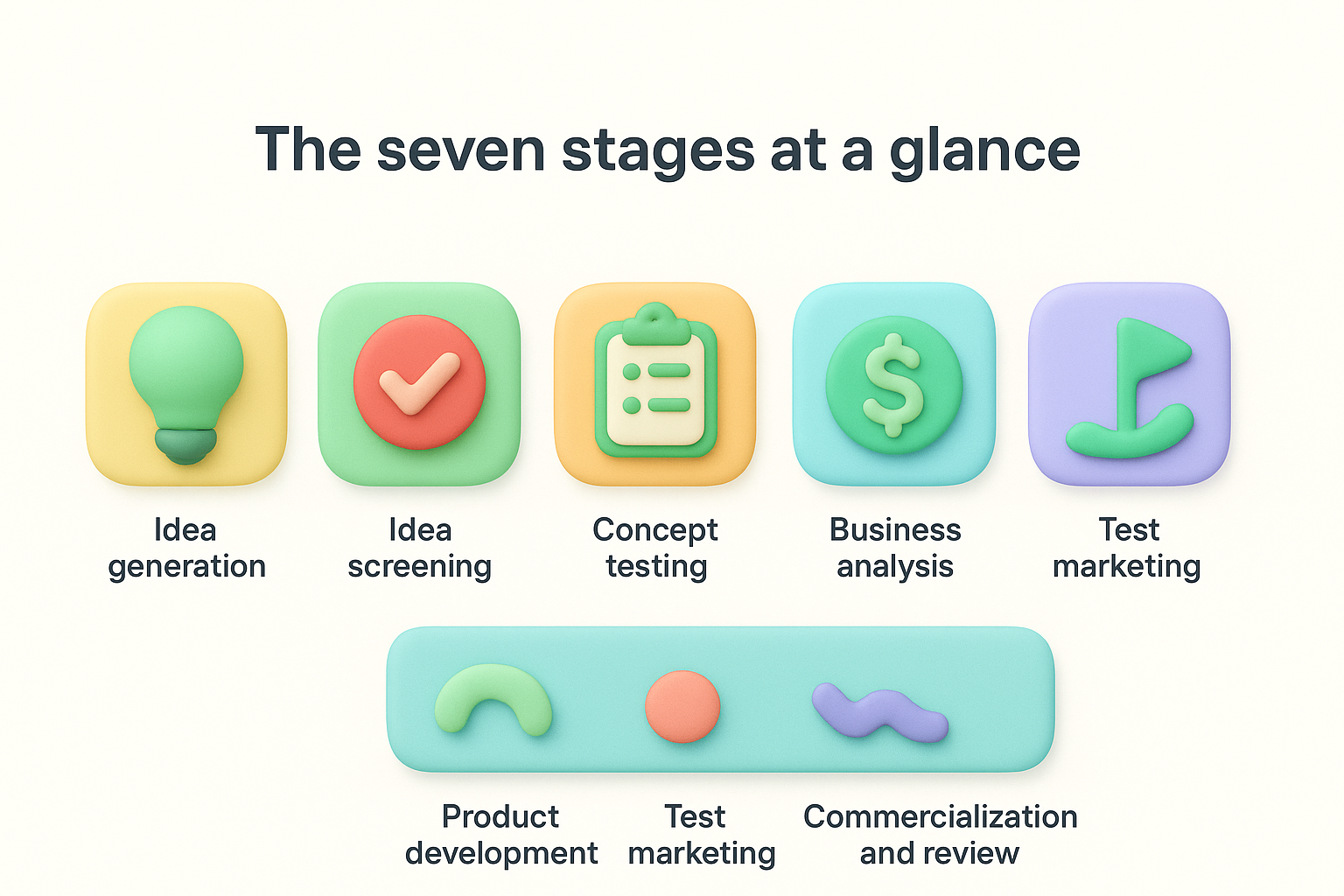
Every stage in the new product development process exists to kill a bad idea cheaply, before it becomes an expensive one.
Most teams don't fail at idea generation, they fail at screening and business analysis, because those stages feel like they slow things down. Skipping them is tempting when a stakeholder is pushing for speed, but that's exactly where unvalidated features sneak into the roadmap. Teams that keep a running, prioritized list of customer requests, the kind you'd manage with a feature request workflow, tend to screen faster because the demand signal is already visible instead of buried in scattered notes.
Getting the sequence right matters more than getting each stage perfect on the first try. Testing concepts with actual users before building anything, then checking real usage data before a full launch, keeps you from betting the whole roadmap on a hunch. Once that rhythm is in place, the process new product development teams follow starts to feel less like a bureaucratic checklist and more like a safety net that catches expensive mistakes early.
Not every new product development effort starts from a blank page. Some projects invent something the market has never seen, while others quietly extend a product line that's already working. Knowing which type you're actually running changes how much risk you take on, how long the process takes, and how much validation you need before launch. Lumping all of these into one generic new product development process is how teams end up over-testing a minor tweak or under-testing a genuinely new category.
Most efforts fall into one of six buckets, and each one carries a different risk profile.
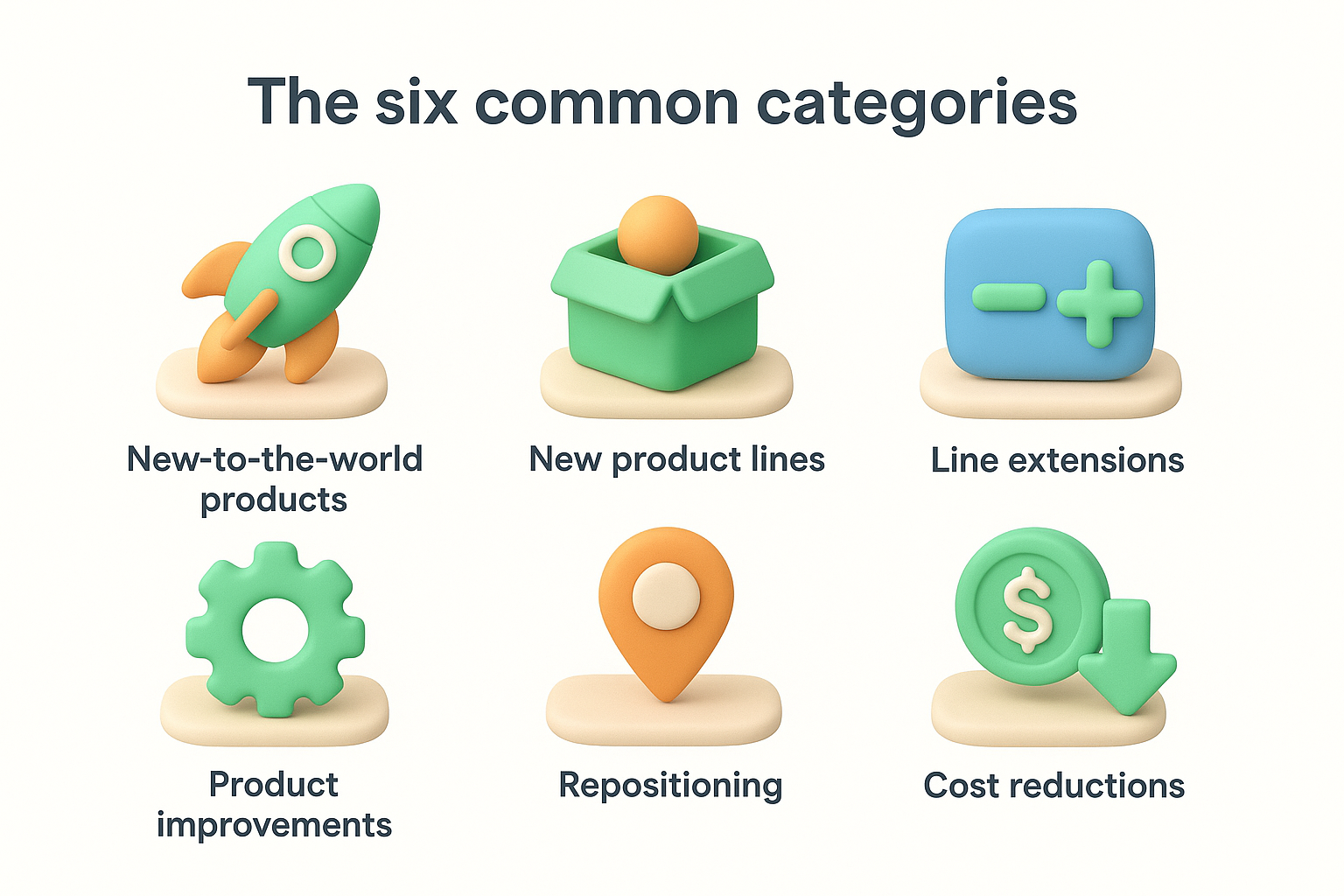
| Type | What it means | Typical risk level |
|---|---|---|
| New-to-the-world products | Something that didn't exist before, creating a new category | Highest |
| New product lines | A product new to your company but already established elsewhere | High |
| Line extensions | Adding variations to an existing product | Low to medium |
| Product improvements | Upgrading features on something you already sell | Low |
| Repositioning | Marketing an existing product to a new audience or use case | Medium |
| Cost reductions | Redesigning a product to deliver similar value at lower cost | Low |
The riskiest type of new product development isn't the one with the biggest budget, it's the one built on the least validated assumption.
Getting this classification wrong is a common reason NPD product development goes over budget. A team building a genuinely new-to-the-world product needs heavy concept testing and a longer business analysis phase, because there's no existing customer behavior to compare against. A team shipping a line extension, on the other hand, already has usage data, support tickets, and feature requests pointing at demand, so the process can move faster without cutting corners. Treating both efforts the same way either slows down a low-risk improvement unnecessarily or rushes a genuinely novel idea through steps it needed.
Sorting incoming requests by type also makes prioritization easier. Requests for small tweaks to an existing feature usually cluster together and point toward a repeatable product improvement process, while a flood of requests describing a problem your product doesn't touch at all often signals demand for a new product line. Watching how feedback clusters over time, rather than reacting to one loud request, is what separates a repeatable process of new product development from one that chases whatever came up in the last customer call. When you're running that process across a product portfolio, shared feedback management makes these patterns visible instead of scattered across inboxes, so you can tell early whether you're looking at a minor upgrade or the start of a whole new product category.
Understanding which type of development you're actually undertaking isn't a bureaucratic exercise. It sets realistic expectations for timeline, budget, and how much validation each stage of the process actually needs before you commit resources.
Abstract stages are easier to understand once you see them play out in products you already know. The three examples below cover different points on the risk spectrum from the table above, and each one shows how the new product development process looks in practice rather than in theory.
Apple's first iPhone is the textbook case of new-to-the-world products, and it shows why that category carries the highest risk. There was no existing market data on how people would use a touchscreen phone without a physical keyboard, so Apple had to lean heavily on internal prototyping, extended concept testing, and a business analysis phase that had to justify a completely unproven category. That's the trade-off with true innovation, as other design product innovation examples show: you get a shot at defining a new market, but you pay for it with a longer, more expensive validation process before launch.
The bigger the leap from what already exists, the more testing you owe yourself before you commit real money.
Consumer brands like Coca-Cola show the opposite end of the spectrum. Launching a new flavor or a smaller can size is a line extension, and it moves fast because the company already has decades of purchase data, distribution relationships, and brand trust to lean on. The procedure for new product development here skips heavy concept testing in favor of smaller regional pilots, because the core product is already proven and the question is narrower: does this specific variation sell.
Software companies run a version of this every sprint, just at a smaller scale. A mid-market SaaS team we've seen through Koala Feedback noticed dozens of separate requests asking for the same missing export option, scattered across support tickets and sales calls until they landed in one feedback portal. Once votes and comments piled up on that single request, prioritizing it was straightforward instead of political. That's new product development npd process thinking applied to something as small as one feature: collect the signal, confirm demand, then build.
What ties these three examples together is discipline, not budget size. Apple validated a category, Coca-Cola validated a variation, and the SaaS team validated a single feature request, but all three skipped straight from evidence to development rather than guessing. That's the pattern worth copying regardless of how big or small your next release is.
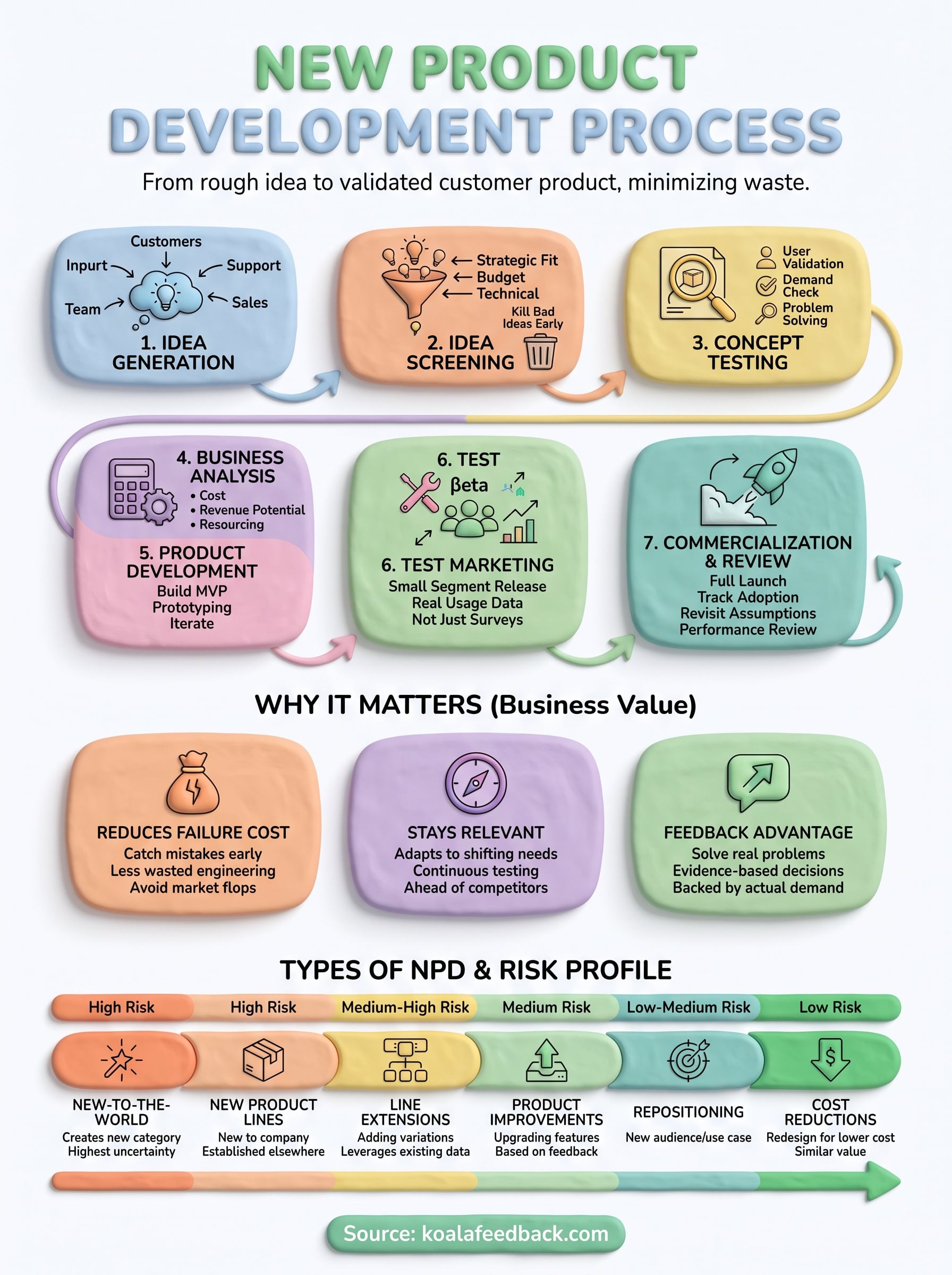
Running a solid new product development process comes down to discipline, not luck. Generate ideas widely, screen them honestly, test concepts before you build, and keep checking real usage data after launch instead of assuming the first version is the last word. Skip a stage and you're gambling engineering time on a hunch instead of evidence.
Every example in this article, from Apple's biggest bets to a single SaaS export feature, worked because someone collected real signal before committing resources. That's the habit worth building into your own team: treat customer input as a steady input to the roadmap, not an occasional nice-to-have.
If you're ready to stop guessing and start prioritizing based on actual demand, see how Koala Feedback can capture and centralize user feedback alongside your roadmap so your next product decision is backed by evidence, not opinion.

Start today and have your feedback portal up and running in minutes.