You know the feeling when a new feature launches to silence, or worse, complaints. Most of that pain traces back to skipping or rushing product research & development, the process of figuring out what to build before you spend months building it. Teams that treat this step as optional end up guessing, and guessing is expensive.
So what does solid product research and development actually look like? It's a structured cycle: gathering input from real users, analyzing market and competitor data, testing concepts, and feeding what you learn into your roadmap. Done right, it connects customer feedback directly to engineering priorities, so you build features people actually asked for instead of ones that sounded good in a meeting.
This article breaks down what product research and development means in practice, why it matters for SaaS teams specifically, and how to run the process step by step. You'll see how feedback collection tools fit into the research phase, how prioritization frameworks turn raw data into a decision, and how sharing a public roadmap keeps users engaged while you act on what you've learned.
Skipping research doesn't save time, it just moves the cost downstream. A feature built on assumptions can take a sprint to code and a quarter to unwind once support tickets pile up. Product development research exists to catch bad ideas before they hit a sprint board, not after they hit production.
Building something nobody wants is the single most expensive mistake a product team can make, and it's almost always avoidable once you separate product discovery from delivery. Talk to ten users before you write a single line of code, and you'll often find the feature they're asking for is smaller and simpler than the one your team imagined. Research on product development turns expensive engineering cycles into cheap conversations, which is a trade every team should want.
The cheapest bug to fix is the feature you never should have built.
Without a research habit, roadmap decisions default to whoever argues loudest in the planning meeting, usually a sales lead chasing one deal or a founder chasing a hunch. A steady stream of customer feedback, support logs, and usage data gives you something more durable to point to. When a stakeholder pushes for a pet feature, you can show them the actual demand, or the lack of it, instead of relitigating opinions every quarter.
Users stick around when they see a product responding to what they actually said, not just what the company assumed they wanted, and that's why user feedback matters so much for retention. A public roadmap built on real requests, paired with a place to vote and comment, tells your users their input goes somewhere. Koala Feedback's feedback portal is built for exactly this, capturing requests directly from users so they feed straight into your research pipeline instead of getting lost in a support inbox.
The difference shows up clearly when you compare how each approach tends to play out over a product cycle.
| Without structured research | With structured research |
|---|---|
| Features guessed from internal opinion | Features validated against real demand |
| Roadmap shifts with the loudest voice | Roadmap backed by data and user votes |
| Churn discovered after the fact | Churn risks flagged early through feedback trends |
| Engineering time spent rebuilding | Engineering time spent shipping what sticks |
Teams in the right column aren't smarter, they're just running product research & development as a habit instead of an afterthought. That habit is what separates products that compound their improvements from ones that keep circling back to fix the same misjudged launch.
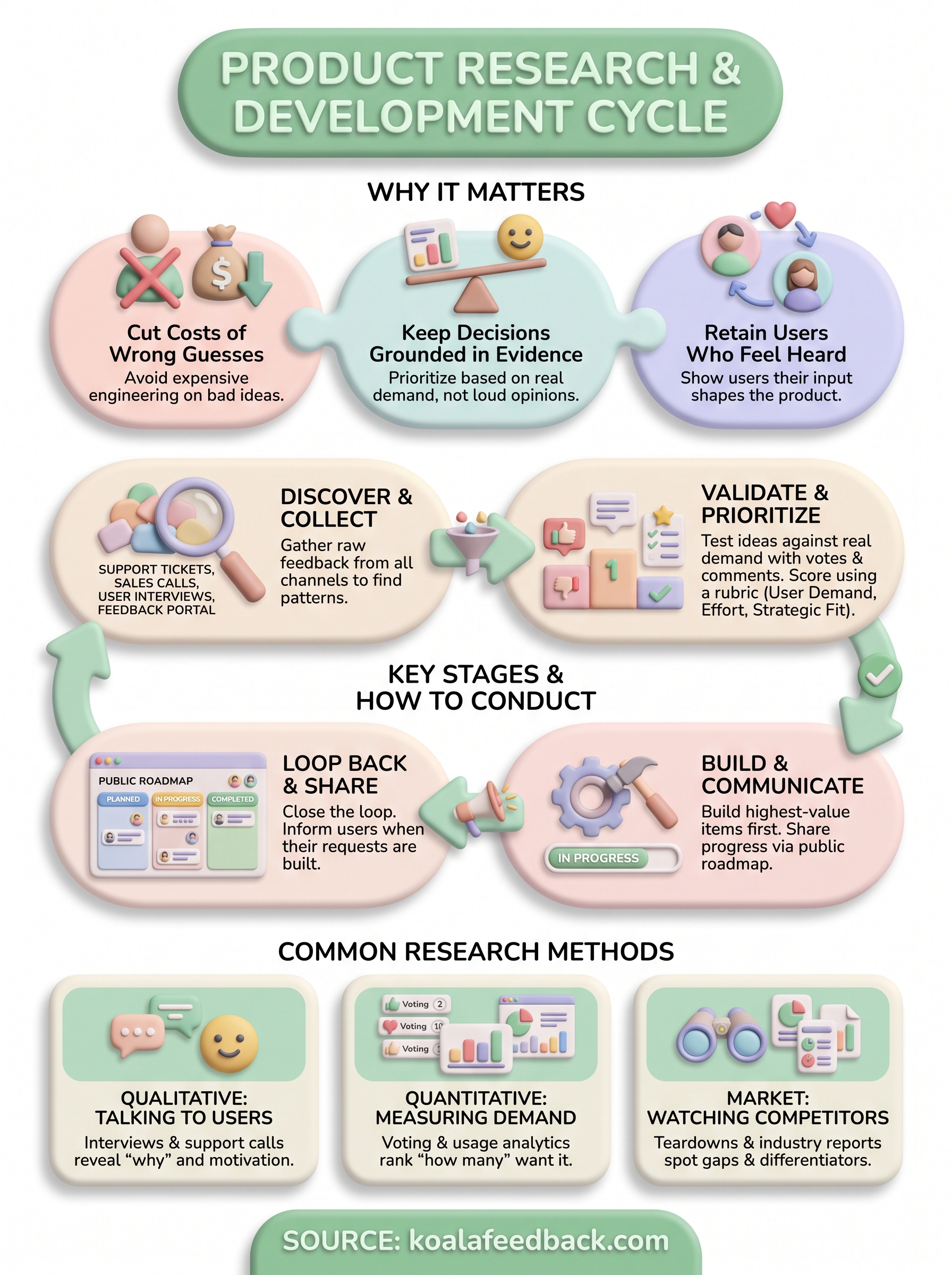
Every solid research cycle moves through the same core stages, whether you're a five-person startup or a two-hundred-person product org. Skipping a stage doesn't speed things up, it just means you'll circle back to it later once the feature already lives in production.
Gathering signal comes first: support tickets, sales calls, user interviews, and a feedback portal where users can submit ideas directly. This is where research and development in product development actually starts, not in a design sprint. The goal of the product discovery process isn't to collect opinions, it's to collect patterns you can act on.
Once ideas pile up, idea management means testing them against real demand instead of internal enthusiasm. Voting counts, comment threads, and usage data tell you which requests represent five loud users versus five hundred quiet ones.
A feature idea is worth nothing until it's been tested against real user demand.
After you've picked what to build, the roadmap becomes the bridge between research and delivery. A public, status-driven roadmap keeps users informed and closes the loop on the feedback they gave you.
Here's the typical sequence, laid out as a checklist:
Each stage feeds the next. Miss the validation step and you're back to guessing, just with extra paperwork attached.
Running this process well doesn't require a research department. It requires a repeatable system that pulls information into one place, weighs it fairly, and pushes decisions back out to your team and your users.
Start by giving users one obvious place to submit ideas instead of scattering feedback across email, Slack, and support tickets. A dedicated feedback portal does this job, and it also lets you organize user feedback with tags by product area so patterns surface faster. Koala Feedback's feedback collection tools handle the categorization and deduplication automatically, so you're not manually sorting through hundreds of near-identical requests every month.
Once requests are centralized, use a simple scoring rubric for feature requests and score each one against a few fixed criteria: user demand (votes and comments), effort to build, and strategic fit. This is where product development research turns into an actual decision rather than a gut call. A simple scoring table works better than intuition here.
| Criteria | Weight | Why it matters |
|---|---|---|
| User votes/comments | High | Shows real demand, not assumed demand |
| Engineering effort | Medium | Keeps scope realistic |
| Strategic fit | Medium | Aligns with where the product is headed |
| Support ticket volume | Low-Medium | Flags churn risk tied to the request |
A prioritization framework only works if you apply it consistently, not just when it agrees with you.
Before committing engineering time, confirm the request still matters by checking recent votes and running a quick follow-up with a few requesters. Prioritization boards make this step visible to the whole team, so nobody's surprised when a long-requested item finally moves to "in progress." That visibility is what keeps research on product development honest instead of theoretical.
No single method tells you everything, so most teams run a mix and cross-check the results. Product research and development works best when qualitative signal (why people want something) meets quantitative signal (how many people want it).
Conducting user interviews and support calls surfaces the reasoning behind a request, the workaround someone built because a feature doesn't exist yet, or the exact moment a workflow breaks down. Five focused conversations often reveal more than fifty survey responses, because you can ask follow-up questions on the spot.
Voting, comments, and usage analytics turn scattered opinions into numbers you can rank. A feedback portal where users vote on ideas gives you a running tally of demand without a single meeting. Koala Feedback's voting and comments feature does this automatically, so prioritization data builds itself as users interact with your roadmap.
Talk to a few users to learn why, then measure the crowd to learn how many.
Competitor teardowns, industry reports, and win-loss interviews with sales prospects round out the picture, showing you what's becoming table stakes versus what's still a genuine differentiator, which is where customer insights vs market research pull in different directions.
| Method | Best for | Limitation |
|---|---|---|
| User interviews | Understanding motivation | Small sample size |
| Surveys | Broad sentiment checks | Shallow follow-up |
| Voting/comments | Ranking demand at scale | Needs an existing user base |
| Usage analytics | Confirming actual behavior | Can't explain intent |
| Competitor research | Spotting market gaps | Says nothing about your users specifically |
Combining even two of these methods catches blind spots that any single one misses on its own.
Good product research and development isn't a one-time project, it's a habit you build into every release cycle. Collect feedback continuously, score it against real evidence, and communicate what you're building before you build it. Teams that treat this as routine spend less time rebuilding features nobody asked for and more time shipping the ones users actually voted for.
None of this requires a dedicated research team or a complicated process. It requires one place to capture ideas, a fair way to prioritize them, and a roadmap that shows users their input mattered. That's the whole loop, and it's what separates products that keep improving from ones that keep guessing.
If you're ready to put this into practice, use Koala Feedback to capture user feedback in one place and give your users a real seat at the table.

Start today and have your feedback portal up and running in minutes.