Every product team collects ideas. Few actually manage them. Idea management is the structured process of capturing suggestions from customers, employees, or stakeholders, then evaluating, prioritizing, and tracking them through to a decision, whether that's building the feature or shelving it with a clear reason why. Without that structure, good ideas get buried in Slack threads, support tickets, and sales call notes.
If you're asking what idea management actually looks like in practice, the answer comes down to four repeatable steps: collecting submissions in one place, screening them for duplicates and clarity, scoring them against criteria like demand and effort, and routing the winners into your roadmap. Companies that skip a formal process end up guessing which features matter, and that guesswork shows up later as churn or missed opportunities.
This article breaks down the full idea management process, from where ideas originate to how teams evaluate and implement them. You'll see the tools and criteria that make prioritization objective rather than political, and why treating idea management as a discipline, not a side task, leads to products people actually want.
Most companies collect feedback in five or six different places at once: support tickets, sales call notes, App Store reviews, Slack DMs, and the occasional email from a frustrated user. Each channel captures a piece of the picture, but nobody owns the whole thing. Idea management solves this by giving every one of those signals a single home, so a request that shows up three times in three different formats gets recognized as one idea with real demand behind it, not three unrelated complaints. Teams without this structure routinely miss patterns that would have told them exactly what to build next.
A good idea nobody tracks is worse than no idea at all, because it creates the illusion that you're listening.
When there's no formal system, feature decisions tend to follow whoever spoke last in a meeting, often called the HiPPO effect (highest paid person's opinion). That approach feels efficient in the moment, but it optimizes for internal politics instead of customer value. Structured evaluation replaces that dynamic with criteria everyone can see: how many users asked for something, how much revenue it touches, how complex it is to build. Once you can point to a scoring model instead of a hunch, disagreements between product, sales, and engineering get resolved with data rather than seniority.
Customers who submit an idea and never hear about it again stop submitting ideas. That's a measurable cost, not just a bad feeling. A visible roadmap and status updates, even a simple "under review" or "planned" tag, tell users their input actually goes somewhere. Public roadmaps turn passive feedback into an ongoing conversation, which is why platforms like Koala Feedback build voting and status tracking directly into the submission process rather than treating them as an afterthought.
Organizations that formalize idea management typically report faster decision cycles and fewer wasted engineering hours on features nobody wanted. Consider the difference between an unstructured approach and a managed one:
| Without idea management | With idea management |
|---|---|
| Requests live in scattered inboxes and tickets | Requests centralize in one portal |
| Loudest voice wins prioritization | Scoring criteria wins prioritization |
| Users get silence after submitting | Users get status updates and roadmap visibility |
| Duplicate requests inflate backlog | Duplicates merge automatically into one idea |
Getting this right isn't just an internal efficiency win. Retention improves when users feel heard, and product teams stop shipping features built on assumptions instead of evidence. That combination, faster internal alignment plus stronger customer trust, is the real reason idea management has moved from a nice-to-have to a core part of how modern product teams operate.
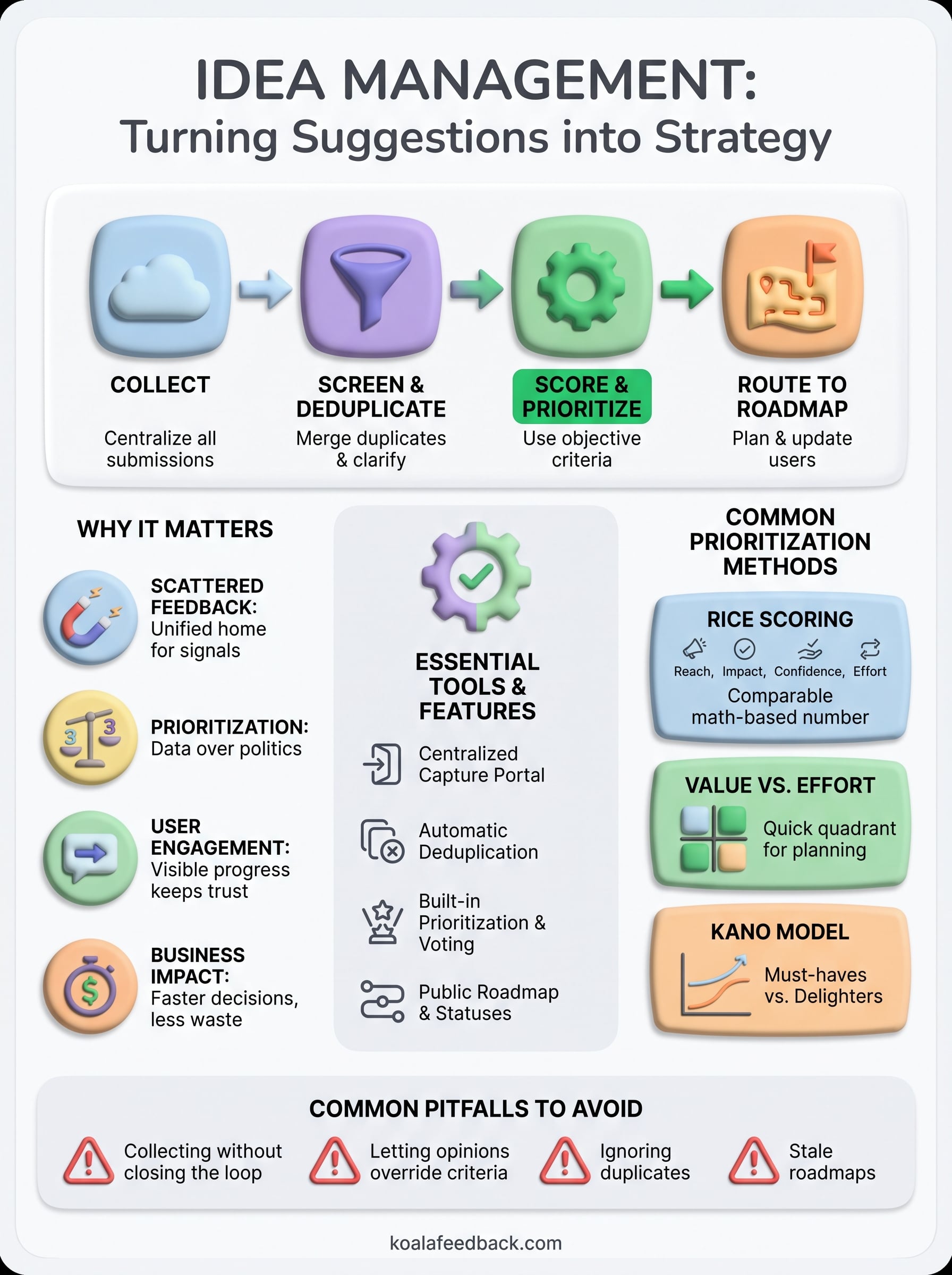
Every idea management workflow follows the same backbone, even if the tools differ. Ideas come in, get checked for duplicates, get scored against real criteria, and then move into a roadmap where the team and the requester can both track progress. Skip any one of these steps and the whole system breaks down into a pile of unread suggestions.
Collection starts with a feedback portal or form that sits somewhere customers and employees actually visit, not buried three clicks deep in a settings menu. Every submission should capture who asked, what they need, and why it matters to them, because that context is what makes scoring possible later. Teams that skip this step end up rebuilding the same request from scratch every time someone mentions it in a support call.
Once ideas land in the system, someone needs to merge duplicates and clean up vague submissions before they clutter the backlog. A request titled "make it faster" is useless without a follow-up question about which feature and what "faster" means in practice.
An idea management process only works if every submission gets the same three questions: what, why, and how many people want it.
This is where prioritization frameworks enter, scoring each idea on factors like customer demand, revenue impact, and engineering effort. The next section covers these frameworks in detail, but the point here is consistency: every idea gets measured the same way, not judged by whoever happens to be in the room.
Winning ideas move onto a public roadmap with a status like "planned" or "in progress," while rejected ideas get closed out with a reason. Both outcomes matter:
Closing that loop, in either direction, is what separates a real process from a suggestion box nobody checks.
Choosing how you score ideas matters as much as collecting them in the first place. A handful of proven frameworks turn subjective opinions into a repeatable scoring system, and picking one that fits your team keeps prioritization consistent from one sprint to the next. The right framework also gives you a paper trail you can point to when a stakeholder pushes back on a decision.
The framework you pick matters less than picking one and sticking to it every time.
RICE stands for Reach, Impact, Confidence, and Effort, four factors you multiply and divide into a single comparable number. Reach measures how many customers a feature touches, Impact estimates how much it moves the needle, Confidence accounts for how sure you are about your estimates, and Effort caps the score by development cost. Teams like it because the math forces everyone to defend assumptions with numbers instead of adjectives.
Some teams prefer a simpler two-axis matrix, plotting customer value against implementation effort on a quadrant chart. Ideas in the high-value, low-effort corner get built first, while high-effort, low-value requests get parked or declined outright. It's less precise than RICE but much faster to run in a quick planning meeting.
Kano model sorts features into basic expectations, performance features, and delighters, based on how satisfaction shifts as you invest more in each category. It's useful when a backlog is stuffed with "nice to have" requests, because it separates features that prevent frustration from features that actually create loyalty.
| Framework | Best for | Speed to run |
|---|---|---|
| RICE | Data-heavy teams comparing many ideas | Slower, needs estimates |
| Value vs. Effort | Quick planning sessions | Fast |
| Kano | Distinguishing must-haves from delighters | Moderate |
Whichever method you choose, apply it consistently across every idea in your backlog, not just the ones under active debate. Consistency, more than precision, is what makes idea management decisions defensible six months later.
Picking software for idea management comes down to a short list of capabilities that actually move the needle, not a long feature checklist stuffed with things you'll never use. The right tool should handle collection, scoring, and communication without forcing your team to bolt on spreadsheets or separate roadmap slides just to fill gaps.
Look for a platform that lets you embed a feedback portal directly into your product or website, so submissions land in one queue instead of scattering across email and chat. Automatic duplicate detection matters just as much, since it merges near-identical requests and shows you real demand instead of ten separate tickets that all mean the same thing.
A tool worth paying for gives users the ability to vote on existing ideas, which surfaces demand without you manually tallying support tickets. On the internal side, you want fields for scoring criteria like effort and impact, so your team can apply whatever prioritization framework you settled on directly inside the tool rather than exporting data elsewhere.
If your tool can't show you demand and effort side by side, you're still guessing.
Customers need to see where their idea landed, and a public roadmap with customizable statuses like "under review," "planned," and "shipped" does that automatically. Koala Feedback builds this directly into the same workflow as the feedback portal, so a submitted idea and its roadmap status stay connected without extra manual updates.
| Feature | Why it matters |
|---|---|
| Feedback portal | Centralizes submissions from every channel |
| Duplicate detection | Prevents inflated backlogs and repeated requests |
| Voting and comments | Quantifies real demand from users |
| Custom statuses | Sets clear expectations without extra emails |
| Branding and custom domain | Keeps the portal consistent with your product |
Skip any of these and you'll end up rebuilding the missing piece manually, which defeats the purpose of adopting software in the first place.
Even teams with the right tools stumble over the same handful of mistakes, and most of them come down to process, not software. Recognizing these patterns early saves you from rebuilding your entire system a year in.
Organizations build a beautiful feedback portal, invite users to submit ideas, and then let submissions sit untouched for months. Users notice the silence fast, and they stop bothering to submit anything at all. Closing the loop, even with a simple decline and a reason, keeps trust intact and keeps the pipeline of future submissions alive.
A feedback portal that never updates its statuses is just a more elegant complaint box.
A team adopts RICE or a value versus effort matrix, then abandons it the moment a senior stakeholder pushes a pet feature to the top of the list. Skipping the framework once sets a precedent, and soon every score becomes negotiable depending on who's in the room. If you're going to score ideas, score every idea, including the ones your VP cares about.
Without deduplication, the same request submitted five different ways looks like five weak signals instead of one strong one. That mistake buries real demand and makes your backlog longer than it needs to be, which slows down every review cycle that follows.
A public roadmap that says "in progress" for a feature shipped six months ago tells users you've stopped paying attention. Stale statuses erode the exact trust a roadmap is supposed to build, so someone on the team needs explicit ownership of keeping it current.
Some teams gather ideas purely to look responsive, with no intention of ever changing the roadmap based on what comes in. That approach wastes user goodwill and turns idea management into theater instead of a real input into product decisions.
Good ideas exist in every company already. What separates teams that ship the right features from teams that guess is a repeatable process: one place to collect requests, a consistent framework to score them, and a public roadmap that shows users their voice mattered. Skip any of those steps and you're back to Slack threads and HiPPO decisions, no matter how many ideas you've gathered.
None of this requires reinventing your workflow from scratch. It requires picking a system, applying it to every idea the same way, and closing the loop even when the answer is no. That consistency is what turns idea management from a buzzword into a habit your team actually keeps.
If you're still running this process across spreadsheets and inboxes, you're leaving real signal on the table. See how Koala Feedback brings capture, prioritization, and roadmapping into one place your users can actually see.

Start today and have your feedback portal up and running in minutes.