Product discovery and delivery are two essential tracks in product development. Discovery focuses on figuring out what problem to solve and for whom. It's about understanding your users, testing ideas quickly, and gathering evidence before you commit resources. Delivery focuses on building reliable, scalable solutions that work for real customers at scale. Most teams understand delivery because it produces visible results like shipped features and working code. Discovery feels less tangible but matters just as much. Without effective discovery, you risk building features nobody needs. Without solid delivery, your great ideas never reach customers. You need both working together.
This article breaks down the core differences between discovery and delivery. You'll learn why both matter, how to balance them effectively, and the common mistakes teams make when they focus too heavily on one track. We'll cover practical scenarios that show when to emphasize discovery versus delivery, plus real examples of how successful teams navigate between the two. By the end, you'll know exactly how to apply these concepts to your own product work.
You can't build successful products by excelling at just one track. Discovery without delivery means endless research and testing that never ships. Delivery without delivery means shipping features fast that nobody uses. Both extremes waste time and money while frustrating your team and users. The most successful product teams know exactly when to emphasize each track based on what they need to learn.
When you skip discovery, you build based on assumptions instead of evidence. Your team invests weeks or months creating features that solve the wrong problems or target the wrong users. You discover these mistakes only after launch, when usage is low and feedback is negative. This approach burns budget and team morale while competitors who understand their users move ahead. Research shows that most product failures stem from building solutions nobody needs, not from poor execution.
Teams that master discovery reduce waste by validating ideas before heavy investment in production-quality code.
Discovery alone doesn't create value for customers. You need working, reliable software that people can actually use. Teams that endlessly research and test without committing to delivery never prove their ideas work at scale. You miss market opportunities while gathering perfect data. Your stakeholders lose confidence when they see research reports but no shipped features that drive real business outcomes.
Understanding product discovery vs delivery helps you avoid both traps. You learn when to slow down and gather evidence, and when to move fast and ship.
You don't need to split your team between discovery and delivery. Instead, run both tracks in parallel with the right people focused on each. A common approach involves dedicating part of your team to continuous discovery while others handle delivery work. This keeps learning and shipping happening at the same time without creating handoffs or coordination overhead.
Start by assigning 20-30% of your team's capacity to discovery activities. This typically means having a product manager, designer, and engineer form a discovery trio. They focus on user research, testing assumptions, and validating ideas before committing to full development. The rest of your team concentrates on building and shipping production-quality features based on validated learnings. This split ensures you're always learning what matters while delivering value to current users.
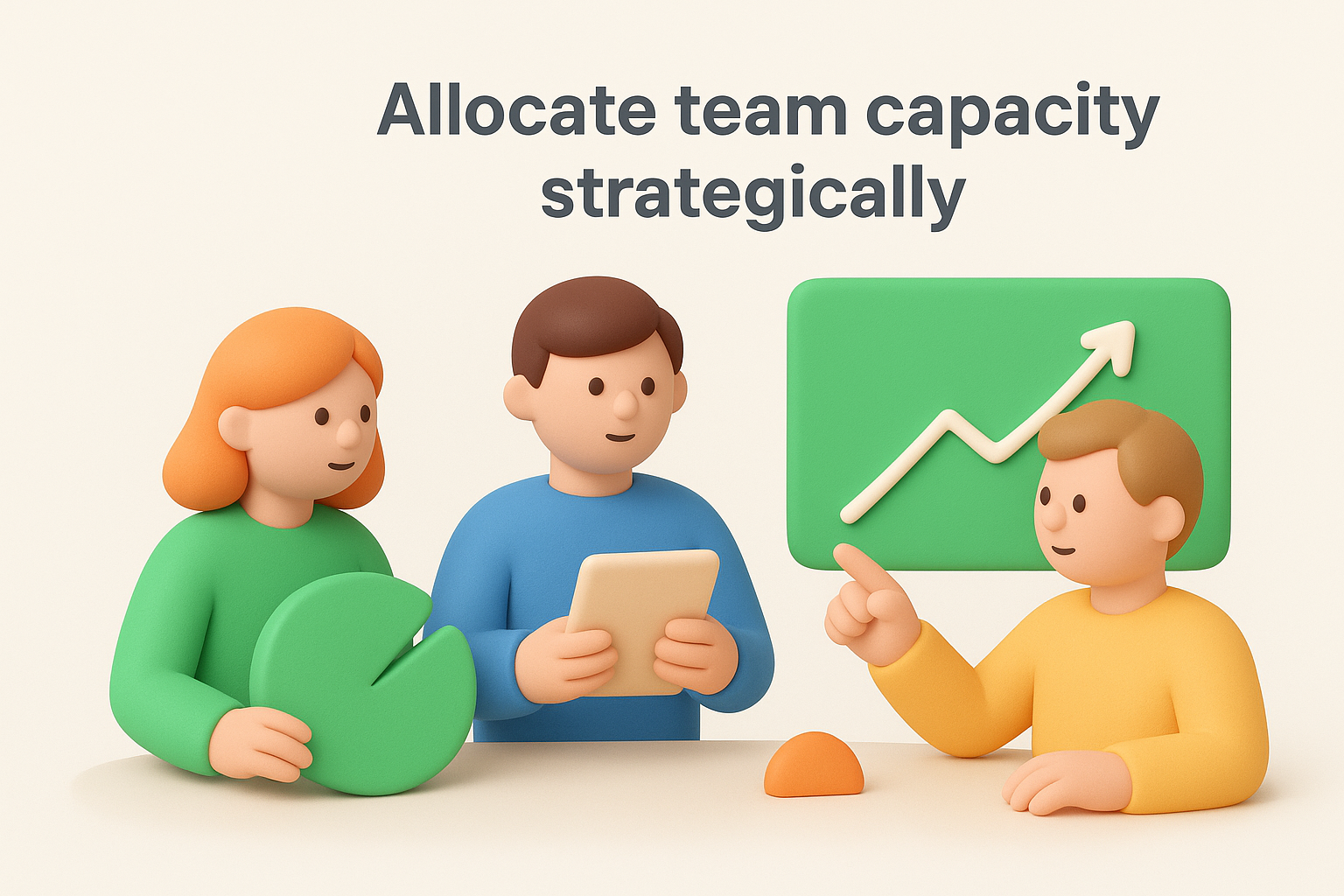
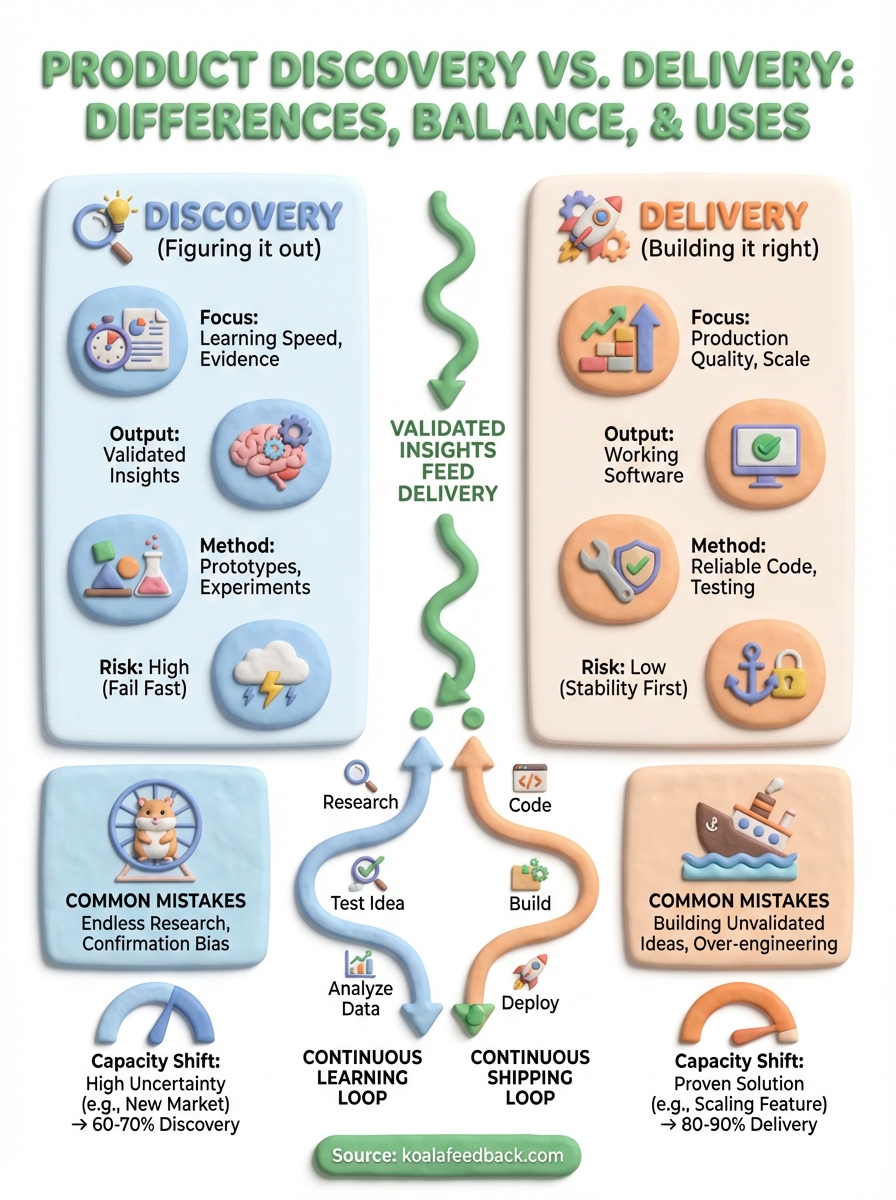
The exact ratio depends on your uncertainty level. When you're exploring new markets or solving unfamiliar problems, shift more capacity to discovery. When you're scaling proven solutions or maintaining existing features, delivery takes priority. Adjust based on what you need to learn versus what you need to build.
Teams that balance product discovery vs delivery successfully treat discovery as continuous work, not a separate phase that happens before building.
Your discovery and delivery tracks need regular touchpoints to stay aligned. Schedule weekly sessions where the discovery trio shares new learnings and validated insights with the full team. Use these moments to decide which opportunities warrant investment in production-quality solutions. When discovery reveals an idea isn't worth pursuing, the delivery team avoids wasted effort. When discovery validates a strong opportunity, delivery knows exactly what problem they're solving and why it matters.
Track both tracks using the same goals and metrics. If your team aims to increase user retention, both discovery work and delivery work should connect to that outcome. This shared focus prevents discovery from becoming theoretical research and keeps delivery aligned with real user needs.
The core distinction in product discovery vs delivery lies in what you're optimizing for at each stage. Discovery optimizes for learning speed and evidence gathering with minimal resource investment. Delivery optimizes for production quality and reliability at scale. Discovery answers whether you should build something. Delivery ensures you build it right. Each track requires different mindsets, processes, and success metrics from your team.
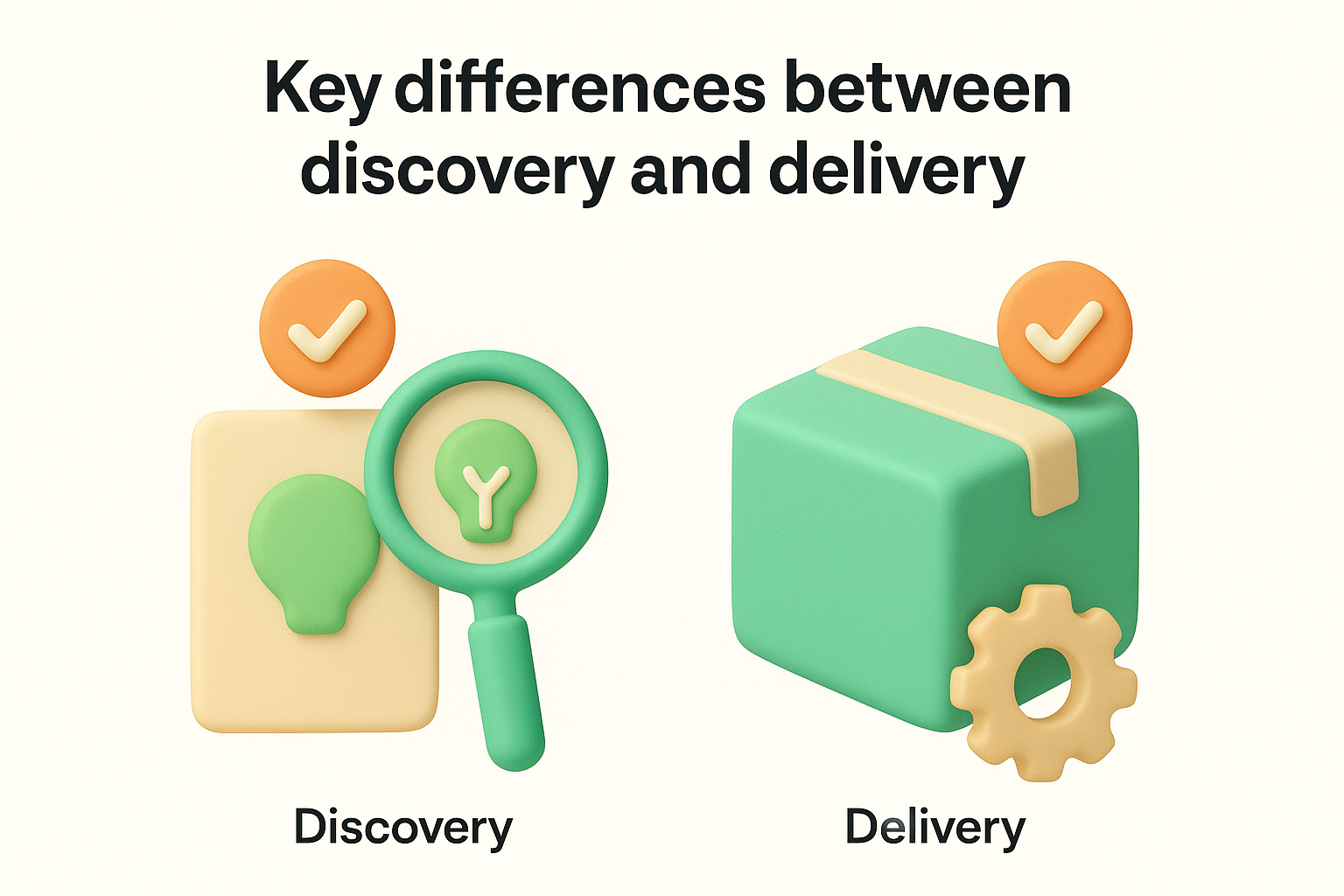
Discovery produces validated learnings about customer problems and potential solutions. You run experiments, conduct interviews, and test prototypes to gather evidence about what might work. The output isn't production code but rather insights and data that inform decisions. Your goal is proving or disproving assumptions quickly before committing significant resources. Discovery work succeeds when it helps you avoid building the wrong thing.
Delivery produces working software that customers can depend on. You build scalable, maintainable systems with proper testing, security, and performance. The output is production-quality code that runs your business and serves real users reliably. Your focus shifts from learning fast to building right. Delivery work succeeds when it creates measurable value for users and the business.
Discovery moves fast by accepting higher risk and lower fidelity. You create quick prototypes and run small experiments to test ideas with opt-in users. Speed matters more than polish because you're testing assumptions, not serving your full user base. Discovery accepts that most ideas won't work, so you design processes to fail fast and learn quickly without major consequences.
Delivery moves more deliberately because production stability matters. You can't compromise on security, performance, or reliability when serving all customers. The code you ship needs proper testing and monitoring because failures affect revenue and user trust. Delivery accepts slower pace in exchange for confidence that what you release works consistently.
Discovery uses throwaway prototypes and mockups that aren't meant to last. You might hand-code a fake backend or use no-code tools to simulate functionality. Production quality doesn't matter because these artifacts exist only to generate learning. Once you validate an idea, you often discard discovery work completely.
Delivery requires production-grade code with full testing suites, documentation, and monitoring that teams maintain long-term.
Understanding product discovery vs delivery helps you avoid the pitfalls that trap most teams. These mistakes aren't obvious when you're focused on shipping or researching. They creep in slowly and undermine your effectiveness before you notice the damage. Recognizing these patterns early helps you course-correct before wasting months of effort or losing team confidence. Most teams make these mistakes because they optimize for the wrong outcomes in each track.
The biggest discovery mistake is treating research as validation instead of falsification. You design studies to confirm your ideas work rather than attempting to prove them wrong. This creates confirmation bias where you ignore evidence that contradicts your assumptions. Your team spends weeks gathering data that supports what you already believed, learning nothing useful in the process.
Another common trap involves running endless discovery without committing to building. Your team keeps researching and testing because you fear making the wrong choice. This perfectionism paralyzes decision-making and frustrates stakeholders who see no shipped features. Discovery should produce quick answers to specific questions, not comprehensive market research reports.
Teams often mistake discovery for a phase that happens once before building, when it should run continuously alongside delivery work.
The worst delivery mistake is building before validating the problem matters. Your team receives requirements and immediately starts coding production-quality solutions. You invest weeks in scalable architecture, proper testing, and documentation for features that users don't need. This waste happens because delivery teams skip discovery or ignore its findings.
Teams also fail by treating all delivery the same. You apply the same rigor and timeline to every feature regardless of uncertainty. Small experiments and major platform changes both get full production treatment, slowing learning and burning resources. Smart teams scale their delivery investment based on how much evidence they've gathered during discovery.
Real situations help clarify when to lean into product discovery vs delivery. These examples show how different uncertainty levels and business contexts should guide your approach. You'll recognize patterns from your own work and learn exactly when each track deserves more attention. The scenarios below reflect common situations most product teams face regularly, from launching new products to scaling existing features.
Your team wants to enter a new market segment with different user needs than your current customers. You have no evidence about their problems or whether your solution fits their workflow. In this scenario, you should dedicate 60-70% of capacity to discovery work. Run user interviews, test prototypes with potential customers, and validate assumptions before building. Your delivery track maintains existing features while discovery explores the unknown territory. Only shift resources to heavy delivery once you've proven the opportunity is real and you understand the solution requirements.
Another discovery-heavy scenario involves fixing low engagement with an existing feature. You see the usage data but don't know why users struggle. Discovery helps you understand the actual problems through user testing and observation before you redesign or rebuild anything. This prevents wasting delivery effort on changes that don't address root causes.
You've validated a solution through discovery and initial small-scale testing. Users want it, the business case is clear, and you've tested the core functionality with early adopters. Now you need to scale it reliably to your full user base. This scenario demands 80-90% delivery focus to build production-quality systems with proper security, performance, and monitoring. Your discovery work shifts to smaller refinements and monitoring adoption patterns after launch.
Successful teams recognize that scaling proven solutions requires different investment than exploring new opportunities.
Your discovery work reveals an assumption was wrong about a planned feature. Users don't actually need what you thought they needed. Smart teams stop delivery immediately and return to discovery mode. This pivot saves weeks of wasted building time and redirects efforts toward validated opportunities that create real value.
Mastering product discovery vs delivery transforms how your team builds products. You stop guessing what users need and start gathering real evidence before committing resources. Your delivery work becomes more focused because you know exactly which problems matter most to solve. Both tracks working together create a sustainable rhythm where learning feeds building and shipped features validate your assumptions.
The key is collecting and organizing user feedback continuously so discovery decisions come from data rather than opinions. Koala Feedback helps you centralize feedback collection, prioritize feature requests based on real user demand, and communicate your product roadmap transparently. When you know what users actually want, you spend less time on discovery research and more time building features that create value.

Start today and have your feedback portal up and running in minutes.