Most teams use the terms interchangeably, but customer insights vs market research serve different purposes and lead to different outcomes. One tells you what's happening in a broader market. The other tells you why your specific users behave the way they do. Mixing them up doesn't just cause confusion, it can send your product strategy in the wrong direction.
Market research helps you understand the playing field: competitors, trends, demographics. Customer insights dig into the people already using your product, their frustrations, requests, and motivations. Both are valuable, but they answer fundamentally different questions. Knowing when to use each one gives you a real advantage in how you build and prioritize.
At Koala Feedback, we help product teams collect and organize user feedback so they can turn raw input into actionable customer insights. That hands-on experience has taught us exactly where these two concepts overlap and where they diverge. This article breaks down the key differences between customer insights and market research, explains when each matters most, and shows you how to use both effectively in your product decisions.
When you treat customer insights and market research as the same thing, you often end up with data that doesn't help you make the specific decision in front of you. A product manager who turns to market research to figure out why users are dropping off after onboarding will get broad demographic trends, not the direct feedback that explains the real problem. On the flip side, relying only on what your current users say can create blind spots around market trends that matter for long-term positioning. Pulling the right tool for the right question is what separates teams that move with confidence from teams that stay stuck in analysis paralysis.
Imagine your product team is debating whether to build a new reporting feature. If you rely purely on market research, you might find that 60% of companies in your segment use reporting tools. That sounds like a green light. But if your existing users are consistently telling you they want better notification settings first, market research just pointed you toward a decision your customers don't actually support. Using broad market signals to answer narrow product questions creates a real gap between what you build and what the people paying for your product actually need.
The customer insights vs market research distinction is not academic. It directly shapes which features you prioritize, which problems you solve, and which users you retain.
Market research is strongest early. When you're entering a new market, sizing an opportunity, or trying to understand what competitors offer, it gives you the landscape you need to make smart bets. It answers questions about who else is out there, what buyers generally expect, and whether there's a viable audience for what you want to build.
Customer insights take over once you have real users. At that point, you already have people with active opinions about your product. Their feedback, behavior, and feature requests are far more relevant to your next sprint than generic industry data. Knowing that your highest-value users are frustrated with a specific workflow tells you something no market report will ever surface.
Treating these two types of information as interchangeable means you either over-invest in broad trends when you should be listening closely to your users, or you hyper-focus on your existing base when you actually need to understand the wider market. The strongest product decisions layer both: market research sets the context, and customer insights fill in the specifics that move the needle.
Market research is the process of gathering data about a broad market, industry, or audience before or during product development. It looks outward, focusing on competitors, potential buyers, industry trends, and market size. The goal is to give you a reliable picture of the external environment so you can make informed strategic decisions about where to play and how to position your product.
Market research pulls from several established methods. Surveys and questionnaires reach large audiences and return statistical data you can use to identify patterns across a demographic. Focus groups, competitive analysis, and industry reports give you a structured way to understand how buyers in your target segment think before they ever touch your product. These methods work because they cast a wide net, giving you breadth over depth.
Market research is built for questions about markets, not about your existing users, which is what separates it from customer insights in the customer insights vs market research debate.
Market research is the right tool when you need to answer questions like: Is there a real market for this product? or How does our pricing compare to competitors? It helps you validate assumptions before you commit resources to a direction. You can use it to size an opportunity, identify underserved segments, or understand what buyers generally expect from a product category.
What market research does not answer well is why your specific users are churning, or what feature your highest-paying customers want next. Those questions require a different approach entirely. Knowing where market research stops is just as useful as knowing where it starts.
Customer insights are specific, actionable findings drawn from the people who are already using your product. Unlike market research, which scans the broader landscape, customer insights focus tightly on the behaviors, needs, and frustrations of your actual users. They come from real interactions, not hypothetical buyer profiles, which makes them directly relevant to the decisions you face day to day.
You collect customer insights through methods that put you in direct contact with real users. Feature request tracking, in-app surveys, user interviews, and support ticket analysis are the most common approaches. Each method captures something different: interviews surface the "why" behind a behavior, while feature requests show you what users want you to fix or build next. The common thread is that every method here gathers data from people with firsthand experience using your product.

In the customer insights vs market research comparison, this is where the distinction gets sharpest. Customer insights reveal the specific friction points, unmet needs, and priorities of people paying for your product right now. That is a different category of information from what any industry report or competitive analysis can provide.
When you know that a vocal segment of your best users keeps requesting the same feature, you have a signal that is worth more than a broad market trend.
Your existing user base holds patterns that directly predict what will reduce churn and increase engagement. Customer insights surface those patterns so you can act on them with precision, rather than guessing based on general market data.
The clearest way to understand customer insights vs market research is to look at three dimensions: what each one covers, how each one collects data, and what each one produces at the end. These differences are not minor. They determine which questions each method can actually answer and where each one breaks down.
Market research operates at the category or industry level. It maps what a market looks like, who the buyers are in aggregate, and where competitors sit. Customer insights work at the individual user level, focused on the people who are already in your product. That difference in scope means market research can tell you whether a market exists, while customer insights tell you whether your current product is working for the people inside it.
The scope you choose determines the questions you can answer, so matching scope to your actual decision is what makes either method useful.
Market research relies on structured, quantitative data gathered from large samples: surveys with fixed responses, published reports, and demographic breakdowns. Customer insights pull from qualitative and behavioral sources like user interviews, feature requests, support tickets, and in-app feedback. One gives you statistical patterns across a population; the other gives you specific, textured signals from real users.
The outputs are just as different as the inputs. Market research delivers reports, segment profiles, and competitive benchmarks that inform strategy and positioning decisions. Customer insights produce prioritized feature lists, identified pain points, and direct user quotes that inform sprint planning and product iteration. Market research shapes where you play; customer insights shape what you build next.
| Dimension | Market Research | Customer Insights |
|---|---|---|
| Scope | Industry-wide | Existing user base |
| Data type | Quantitative, structured | Qualitative, behavioral |
| Primary output | Strategic benchmarks | Actionable product signals |
| Best used for | Market entry, positioning | Feature prioritization, retention |
The most effective product teams don't choose between customer insights and market research. They use both at the right stages. Think of market research as the foundation you lay before you build anything new, and customer insights as the ongoing signal you rely on once users are inside your product. Sequencing them correctly is what turns raw data into decisions you can act on with confidence.
Before you build anything new or enter a new segment, run a round of market research to understand the competitive landscape and confirm there is real demand. This gives you a baseline: who else is solving this problem, what buyers expect, and where gaps exist. Without this step, you risk building features that make sense to your existing users but miss the broader opportunity entirely.
Once you have that market context, customer insights vs market research stops being an either/or question. You use market research to confirm the direction, then shift to customer insights to figure out exactly what to build next. Pull your feature requests, review support tickets, and run short user interviews to identify which problems are real and urgent for the people already paying you.
The teams that get this workflow right build less, ship faster, and retain more users because every decision connects back to something a real user told them.
Your feedback portal becomes the engine here. When you collect and organize user feedback continuously, you always have fresh customer insights ready to pair with your market-level context, so no decision happens in a vacuum.
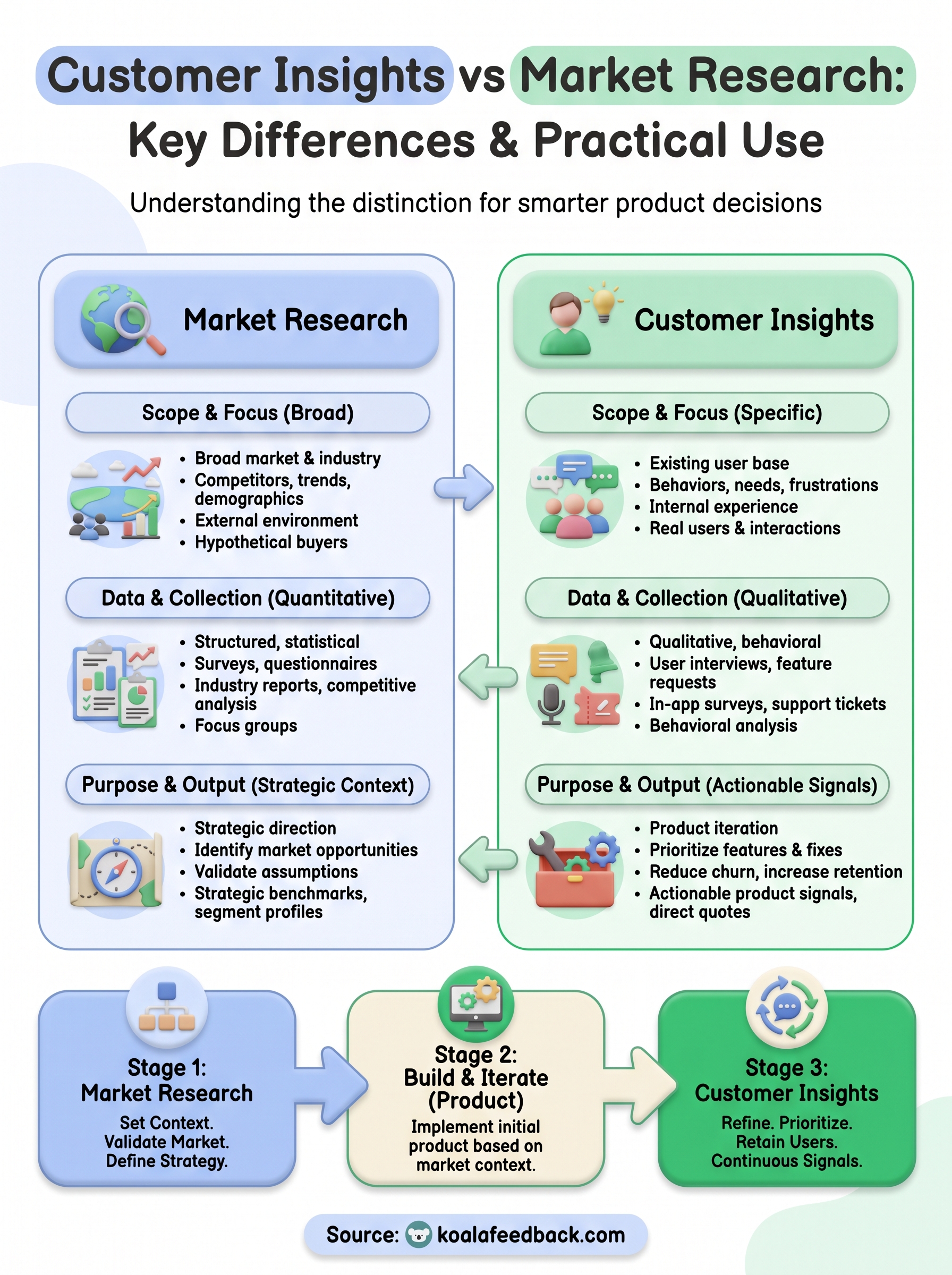
The customer insights vs market research distinction comes down to timing and purpose. Market research helps you understand the landscape before you commit to a direction. Customer insights tell you what to build next once real users are inside your product. Using both correctly means you make fewer guesses and ship features that actually matter.
Start by auditing how you currently collect feedback. If you rely mostly on industry reports and skip direct user input, you are missing the signals that drive retention and feature adoption. If you only listen to your existing users, you risk losing sight of the bigger market picture.
The most practical first step is setting up a structured way to collect and organize user feedback continuously. That is exactly what Koala Feedback is built for. It gives you a centralized place to capture feature requests, spot patterns, and turn raw user input into decisions your whole team can act on.

Start today and have your feedback portal up and running in minutes.