Shipping a half-baked feature is expensive. You burn engineering time, confuse your users, and end up rebuilding the thing six months later anyway. The gate process for product development exists to stop that from happening by forcing a decision at every major checkpoint before work moves forward.
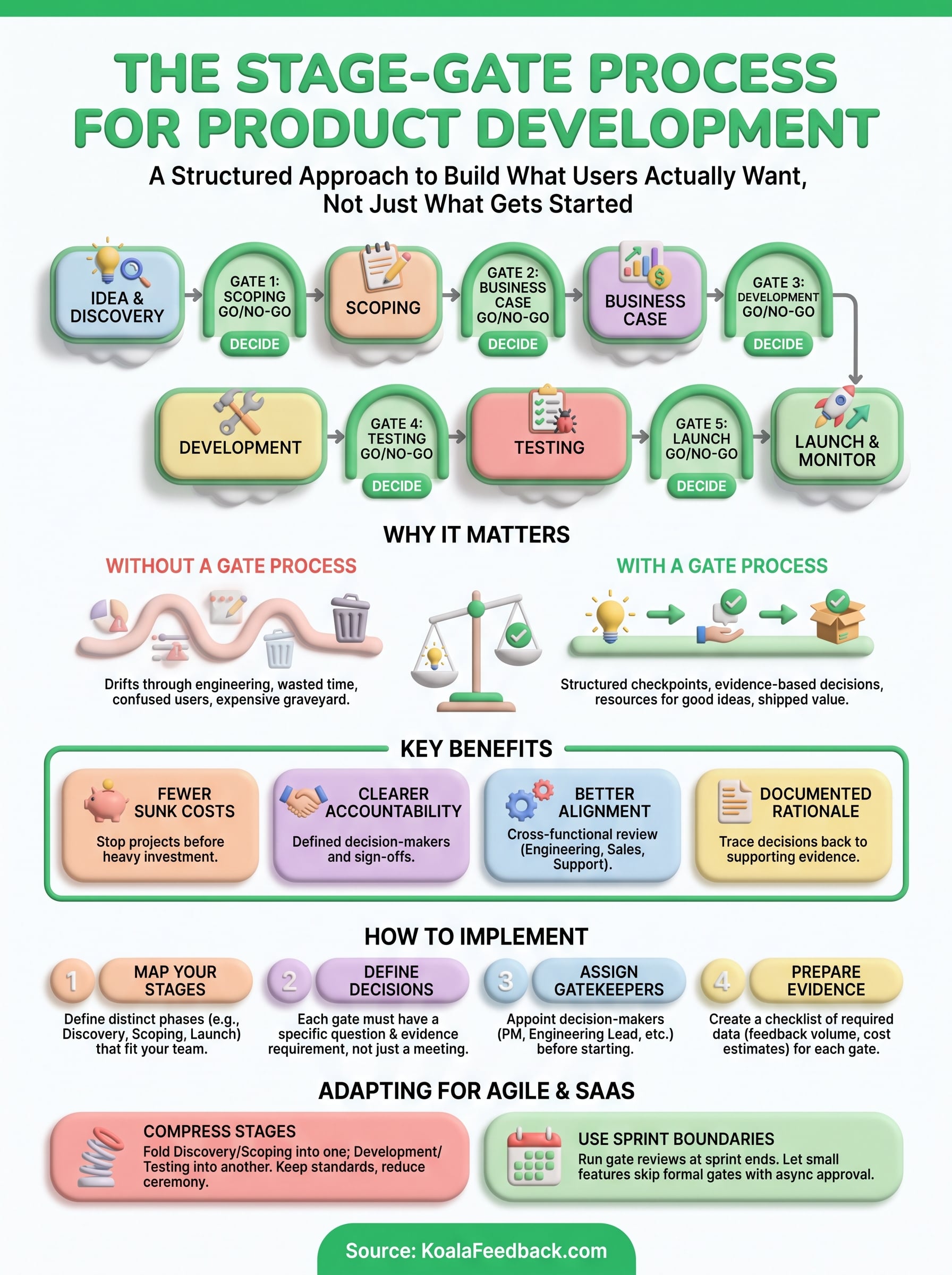
At its core, a stage-gate process breaks new product development into distinct phases, like discovery, scoping, business case, development, testing, and launch, with a go/no-go gate sitting between each one. A cross-functional team reviews progress at that gate and decides whether the idea has earned the right to move to the next stage, gets sent back for more work, or gets killed outright. That structure keeps weak ideas from quietly consuming your roadmap.
This article walks through exactly how the stage gate process in new product development works: the typical stages, what happens at each gate, who should be in the room, and how to adapt the model for a smaller team or a fast-moving SaaS product. If you're building out a roadmap and want a repeatable way to validate ideas before you commit real resources, this is the framework to know.
Every roadmap has a graveyard of half-shipped features nobody uses. The gate process for product development exists specifically to keep that graveyard small. Instead of letting an idea drift through months of engineering work on the strength of one enthusiastic pitch, a stage-gate model forces someone to ask, at fixed points, whether the evidence still supports moving forward. That single habit, checking your assumptions before you spend more money, is what separates teams that ship things customers actually want from teams that just ship things.
Skipping checkpoints doesn't save time, it just moves the cost downstream. A feature that gets full engineering investment before anyone validates demand often gets discovered to be wrong only after launch, when a support queue fills up with confused users or a customer churns because the thing they actually needed never got built. Fixing a bad decision at the idea stage costs a conversation. Fixing it after launch costs a rebuild, a re-announcement, and credibility with your users.
A bad idea killed at gate one is cheap. The same idea killed after launch is a quarter of wasted work.
The framework traces back to Robert G. Cooper's research on why some new products succeed and others fail, work that's still referenced by product management organizations like the Product Development and Management Association as a foundation for structured innovation processes. Cooper's finding was straightforward: companies that used disciplined go/no-go decision points had meaningfully higher new-product success rates than companies that let ideas run on momentum alone. That's not a small claim. It's the reason the product development gate process has stuck around for decades across manufacturing, hardware, and now software teams building SaaS products.
Protecting your roadmap isn't just about killing bad ideas. It's about giving good ideas the resources they've earned and nothing more, at each stage, until they've proven they deserve the next investment. A well-run stage-gate process for new product development delivers several concrete benefits:
Compare what typically happens to a feature request under each approach:
| Situation | Without a gate process | With a gate process |
|---|---|---|
| Vague customer request | Goes straight to the backlog, built on assumption | Scored against feedback volume before scoping starts |
| Mid-build scope creep | Absorbed silently, timeline slips | Flagged at the next gate, reviewed before continuing |
| Weak business case | Discovered after launch | Caught at the business-case gate, killed early |
| Cross-team disagreement | Resolved informally, inconsistently | Resolved formally at a scheduled review |
The pattern is consistent: gates don't slow good ideas down, they just stop bad ones from quietly draining your team's time. That's the whole point of building the discipline into your new product development gate process rather than leaving prioritization to whoever argues loudest in a planning meeting.
Rolling out a stage-gate product development process doesn't require a massive process overhaul on day one. Start with the shape of the model, then tighten the details as your team gets comfortable with it. The goal isn't bureaucracy for its own sake, it's making sure every idea passes through the same filter before it eats up engineering time.
Begin by naming the stages that actually reflect how your team works, rather than copying a generic six-stage template wholesale. Most SaaS teams land on some version of this sequence:
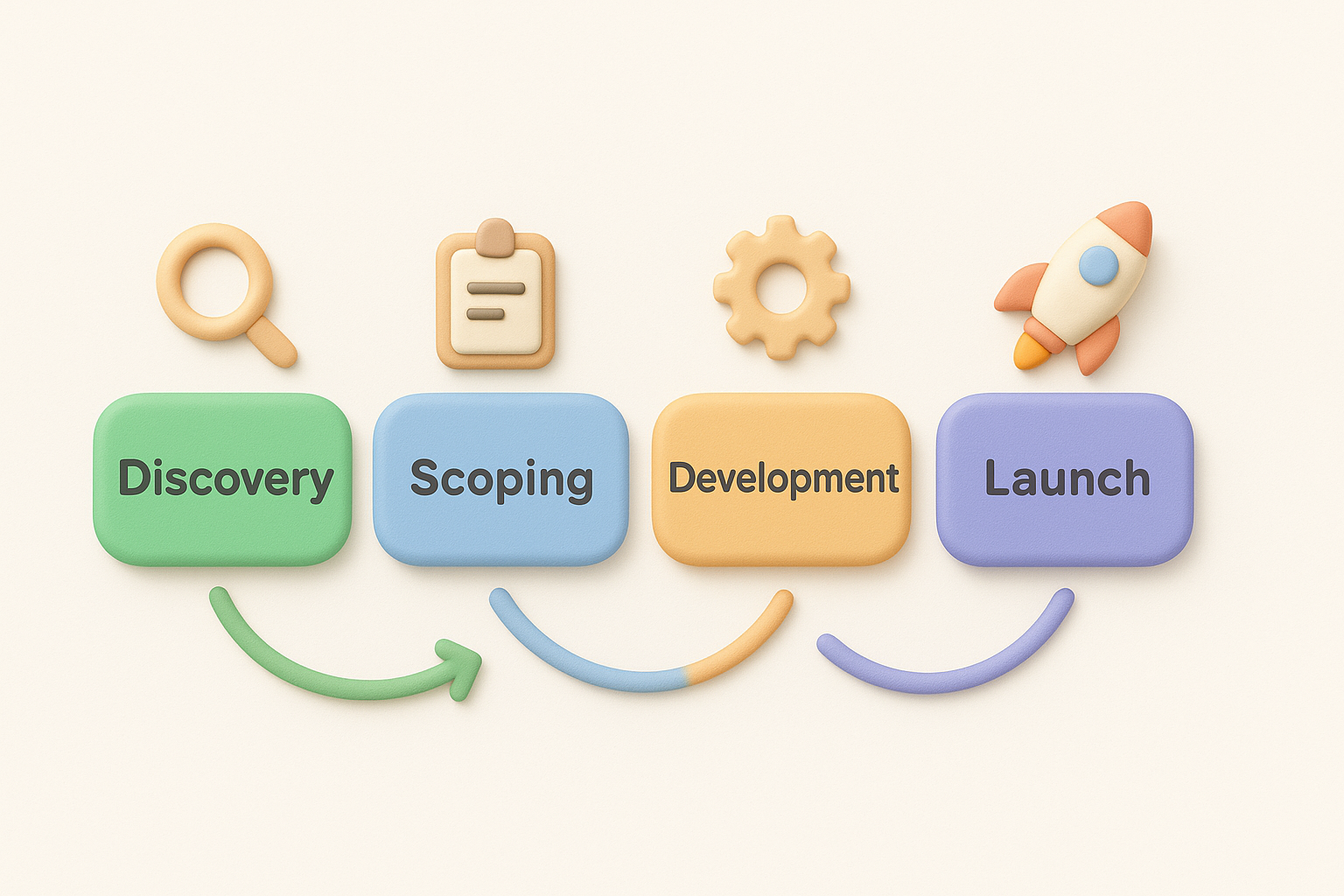
Collapse stages if your team is small; a five-person startup rarely needs a separate business-case stage distinct from scoping. What matters is that each stage has a clear entry point and a clear output.
Each gate needs a specific question attached to it, not a vague "does this look good" checkpoint. The discovery-to-scoping gate should ask whether enough users are asking for this to justify a deeper look. The scoping-to-development gate should ask whether the cost estimate still makes sense against the expected impact. Write these questions down before you run your first review, because a gate without a defined decision criterion just becomes a status meeting.
A gate without a clear decision criterion is just a meeting with extra steps.
Gatekeepers are the people with authority to say no, and you need to name them before the first idea reaches a gate, not scramble to find a decision-maker mid-review. For most SaaS teams, that's a product manager, an engineering lead, and someone representing customer-facing teams like sales or support. Keep the group small, three to five people is plenty, because a large committee slows decisions down without improving them.
Documenting the whole flow, stages, gate questions, and gatekeepers, in one place gives your team a reference they can point to instead of re-litigating the process every quarter. That single artifact is what turns the new product development stage gate process from an idea into a habit your team actually follows.
A gate review only works if the person presenting shows up with evidence, not opinions. Walking into a review with a slide deck of feelings instead of data is how weak features sneak through, and it's also how good ideas get killed for the wrong reasons. Preparation before the meeting matters more than performance during it, so build a habit of assembling the same package of information every time, regardless of who's presenting or how confident they feel about the idea.
Build a checklist that matches each stage of your stage gate process product development flow, since the evidence a gatekeeper needs at discovery looks nothing like what they need before launch.
| Gate | What to bring |
|---|---|
| Discovery to scoping | Feedback volume, source quotes, rough segment of who's asking |
| Scoping to business case | Proposed solution, effort estimate, dependencies |
| Business case to development | Revenue or retention impact, cost estimate, opportunity cost |
| Development to testing | Working build, known gaps, test plan |
| Testing to launch | Bug list, usability findings, rollout plan |
Getting this list documented once means nobody has to guess what to prepare next time, and gatekeepers stop wasting review time asking for information that should've been on the slide already.
Every gate review, regardless of stage, should answer three questions clearly enough that a gatekeeper who missed the last meeting could still follow along:
Skipping any of these three turns the review into a status update instead of a decision point, which defeats the purpose of having a gate at all.
If the presenter can't answer what changed since the last gate, the review isn't ready to happen yet.
Long meetings don't produce better decisions, they just produce fatigue. Cap gate reviews at 30 minutes and require the deliverables above to be shared beforehand, so the meeting time goes to discussion and decision rather than a live read-through of a document everyone could've reviewed on their own. Presenters who know the format in advance also prepare tighter cases, which speeds up every future review across your product development stage gate process, not just the current one.
Most teams that abandon their stage-gate process don't fail because the model is wrong, they fail because they let it drift into theater. Watching a gate review turn into a rubber-stamp exercise is the single most common failure mode, and it usually happens gradually: a gatekeeper approves a weak business case because the presenter already spent two months on it, and suddenly the sunk-cost bias the whole process was built to prevent is back in charge.
Approving everything that reaches a gate defeats the point of having one. If your last ten reviews all ended in "yes, proceed," that's not a sign of good ideas, it's a sign nobody's willing to say no. Fix this by requiring gatekeepers to state, out loud, which piece of evidence justified their decision. A gate that can't produce a reason for its own approval isn't a gate, it's a formality.
If every gate review ends in approval, you don't have a gate process, you have a status update.
Bureaucracy creeps in fast once a process proves useful, and teams respond by adding more checkpoints instead of tightening the ones they have. A new product development gate process with nine gates for a five-person team isn't rigor, it's friction. Keep the number of gates tied to real risk: the more expensive a mistake would be at that stage, the more a formal review earns its place. Low-risk stages can move forward with a quick async approval instead of a scheduled meeting.
Gatekeepers who never say no eventually stop being trusted to say yes meaningfully. Some teams treat "kill" as an embarrassing outcome instead of a normal one, which quietly trains presenters to only bring forward ideas gatekeepers are guaranteed to approve. Normalize killing ideas early by tracking kill rate as a healthy metric, not a failure metric. A process with a 0% kill rate across a year isn't filtering anything.
Market conditions and user needs change between gates, especially when a project sits in development for months. Reviewing an idea against evidence collected six months earlier, without checking whether it still holds, lets outdated assumptions carry a project all the way to launch. Require a quick recheck of the original assumption at every gate, not just at the business-case stage, so your stage-gate process for new product development stays anchored to current reality instead of a snapshot from the past.
Agile teams often bristle at the word "gate" because it sounds like the opposite of iterative work. That reaction is fair if you try to bolt a rigid, six-month manufacturing process onto a two-week sprint cycle. The fix isn't to drop the framework, it's to compress it. A stage-gate product development process built for SaaS keeps the same discipline, evidence before investment, decision points before scaling, but shrinks the stages to fit sprint-sized chunks instead of quarter-sized ones.
Instead of scheduling gate reviews on a fixed quarterly calendar, tie them to sprint boundaries or milestone completions. A feature moving from scoping to development can clear its gate at the end of the sprint where scoping wrapped up, rather than waiting for the next scheduled review three weeks later. This keeps momentum intact for the ideas that deserve it while still forcing a real go/no-go decision before engineering time gets committed.
Gates should follow your sprint cadence, not fight it.
Most SaaS teams collapse the classic six-stage model into three or four practical checkpoints:
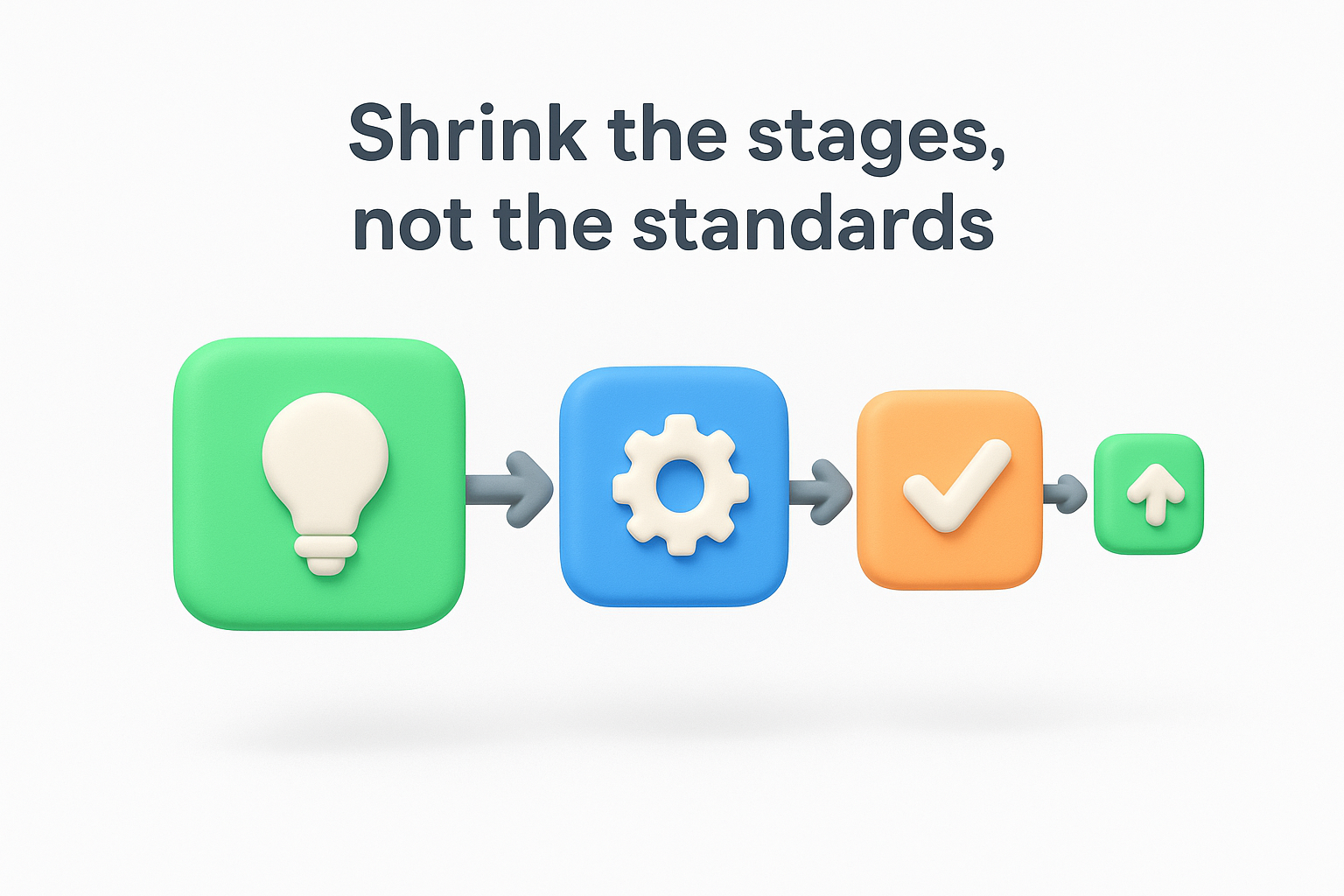
| Traditional stage-gate | Compressed SaaS version |
|---|---|
| Discovery + Scoping | Idea validation (one gate) |
| Business case | Folded into idea validation for small features |
| Development + Testing | Build and QA (one gate) |
| Launch | Ship and monitor |
The evidence bar at each gate stays the same, you still need feedback volume, a cost estimate, and a rollout plan, but you're asking for it once instead of three separate times. This keeps the new product development stage gate process honest without slowing a team that ships weekly.
Not every change needs a formal review. A copy tweak or a minor UI fix doesn't require the same scrutiny as a new pricing tier. Set a threshold, based on engineering hours or customer impact, below which a single async approval from a product lead replaces the full gate meeting. Reserve the full stage gate process in new product development for work that actually carries risk: multi-sprint builds, anything touching billing, or features that affect a large share of your user base.
Done well, this adapted model gives agile and SaaS teams the same protection the original framework was built for, just without the meetings that made engineers dread the word "process" in the first place.
A stage-gate process lives or dies on whether the evidence behind each decision is easy to find. If a gatekeeper has to hunt through Slack threads and old spreadsheets to remember why a feature got approved at scoping, the process stops being a decision framework and turns into paperwork nobody trusts. The right tools don't replace judgment, but they make the evidence visible in one place so every gate review starts from the same facts instead of someone's memory of a meeting three months back.
The discovery and business-case gates depend entirely on knowing how many users actually want something, not just who complained loudest last week. A feedback management platform like Koala Feedback solves this by collecting requests through a public portal, letting users vote and comment, and automatically grouping duplicate submissions so you're not counting the same request five times under five different names. That gives you a real number to bring to a gate review instead of a guess.

A gate review is only as good as the evidence sitting behind it.
Beyond intake, you need somewhere to log the actual go/no-go outcomes and the reasoning behind them. Some teams use dedicated stage-gate software built for formal product development; others get by with a shared board in Notion, Airtable, or Jira, as long as it captures the decision, the date, and who signed off. What matters less is the specific tool and more that the record survives staff turnover and time. A gate decision that only lives in someone's head disappears the day that person changes teams.
Once an idea clears its gates and moves into development, users who submitted the original request deserve to see it move. A public roadmap tool closes that loop by showing planned, in-progress, and completed statuses without you manually emailing every requester. Koala Feedback pairs this directly with its feedback boards, so the same request that triggered a discovery gate can be tracked all the way through to launch, under your own domain and branding.
| Gate stage | Tool category | What it provides |
|---|---|---|
| Discovery | Feedback portal | Volume, votes, deduplication |
| Business case | Spreadsheet or PM tool | Cost and impact estimates |
| Development to launch | Roadmap tool | Status visibility for users |
Pick tools that reduce the effort of gathering evidence, not ones that add another dashboard nobody checks between reviews.
The gate process for product development isn't about adding red tape to your roadmap. It's about making sure every feature earns its next round of investment with evidence, not enthusiasm. Start small: name your stages, write down what each gate actually decides, and assign gatekeepers who are willing to say no. The teams that get the most out of a stage-gate process for new product development treat it as a living habit, not a one-time document nobody reopens.
None of this works without visibility into what users actually want at the discovery stage, and without a way to show them their request moving through the pipeline once it clears. That's exactly the gap a feedback and roadmap tool fills. If you're ready to bring real evidence into your gate reviews, try Koala Feedback and give your team a single source of truth for every decision.

Start today and have your feedback portal up and running in minutes.