Most teams build features first and ask questions later. They ship what an executive wants, what a competitor already has, or whatever the loudest customer demanded last week. Then they wonder why adoption stalls. A clear strategy for product development fixes that by giving every decision a reason tied to real user needs and business goals.
At its core, a new product development strategy is a structured plan for deciding what to build, why, and in what order, from spotting an opportunity through launch and iteration. It typically moves through stages: idea generation, validation, prioritization, roadmapping, and delivery, each one grounded in evidence rather than guesswork. Get this sequence right and you stop wasting engineering hours on features nobody uses.
This article breaks down what a strategy product development process actually looks like in practice, the key steps you need to define one, and frameworks you can borrow instead of building from scratch. We'll also show where structured feedback collection and prioritization tools, like the kind Koala Feedback provides, fit into each stage so your roadmap reflects what users actually want, not just what's loudest in the room.
Skip the planning step and you pay for it later, usually in wasted sprints and features nobody asked for. A documented strategy for product development forces you to answer hard questions before a single line of code gets written: who is this for, what problem does it solve, and how will we know it worked, which is exactly why product strategy matters for growth. Teams that skip this step tend to confuse motion with progress, shipping constantly while user satisfaction and retention stay flat.
A product built without strategy is just a guess with a deadline attached.
Without a strategy, prioritization becomes a popularity contest. Whoever shouts loudest in the Slack channel, usually a sales exec chasing one deal or a founder chasing a hunch, gets their feature built first. Engineering time gets burned on requests that serve one customer instead of your broader base. Support tickets pile up because nobody validated whether the feature solved a real problem before it shipped. Compare the two paths side by side:
| Without a strategy | With a strategy |
|---|---|
| Features prioritized by whoever asks loudest | Features prioritized by validated demand and impact |
| Roadmap changes weekly based on mood | Roadmap tied to measurable goals |
| Teams duplicate work or contradict each other | Teams align around shared priorities |
| Users feel ignored or confused by direction | Users see a clear, communicated path forward |
Once you have a new product development strategy, engineering, design, marketing, and support stop working from different assumptions. Everyone can point to the same document to explain why feature A shipped before feature B. This matters more as teams grow. A five-person startup can rely on hallway conversations to stay aligned. A fifty-person company can't. Strategy becomes the shared reference point that keeps departments rowing in the same direction instead of pulling against each other.
Strategy also speeds up decision-making, which sounds counterintuitive since planning takes time upfront. But once your criteria for prioritization are set, evaluating a new feature request takes minutes instead of another round of debate. You already know whether it fits your target segment, aligns with your current quarter's goals, and clears the bar compared to what's already in the backlog. Product managers who lean on a structured approach, backed by centralized feedback like what Koala Feedback's feedback portal collects, can point to actual vote counts and comments instead of relying on gut feeling alone.
Customers notice the difference too. When a company can explain why it built what it built, and show a public roadmap tracking progress, one of the clearest payoffs of a shared roadmap shows up: trust goes up. Users stop feeling like they're shouting into a void and start feeling like partners in the process. That trust translates directly into retention, since people stick around longer with products where they feel heard and see visible movement on the requests that matter to them.
Building a working strategy for product development doesn't require a consultant or a six-month planning cycle. It requires a clear sequence of steps that force you to gather evidence before committing engineering time. Skip a step and you'll likely repeat it later, usually after a launch flops.
Follow this order and you'll avoid the most common planning gaps:
Skipping validation is the single fastest way to turn a strategy into a wish list.
Going out of order causes real damage. Teams that jump straight to prioritization without collecting feedback end up ranking guesses instead of validated needs. Others build a roadmap before setting goals, then can't explain why one feature outranks another when a stakeholder pushes back. Sequencing keeps every downstream decision grounded in the step before it, which is exactly what separates a documented new product development strategy from a loose set of good intentions floating around a Notion doc nobody reads after week one.
A strategy for product development only works if you understand what product development actually involves at each stage it governs. Each stage answers a different question, and skipping one usually means answering it later, under worse conditions, after money's already spent. Here's the full sequence most teams should follow, whether they're building a new product or adding major features to an existing one.
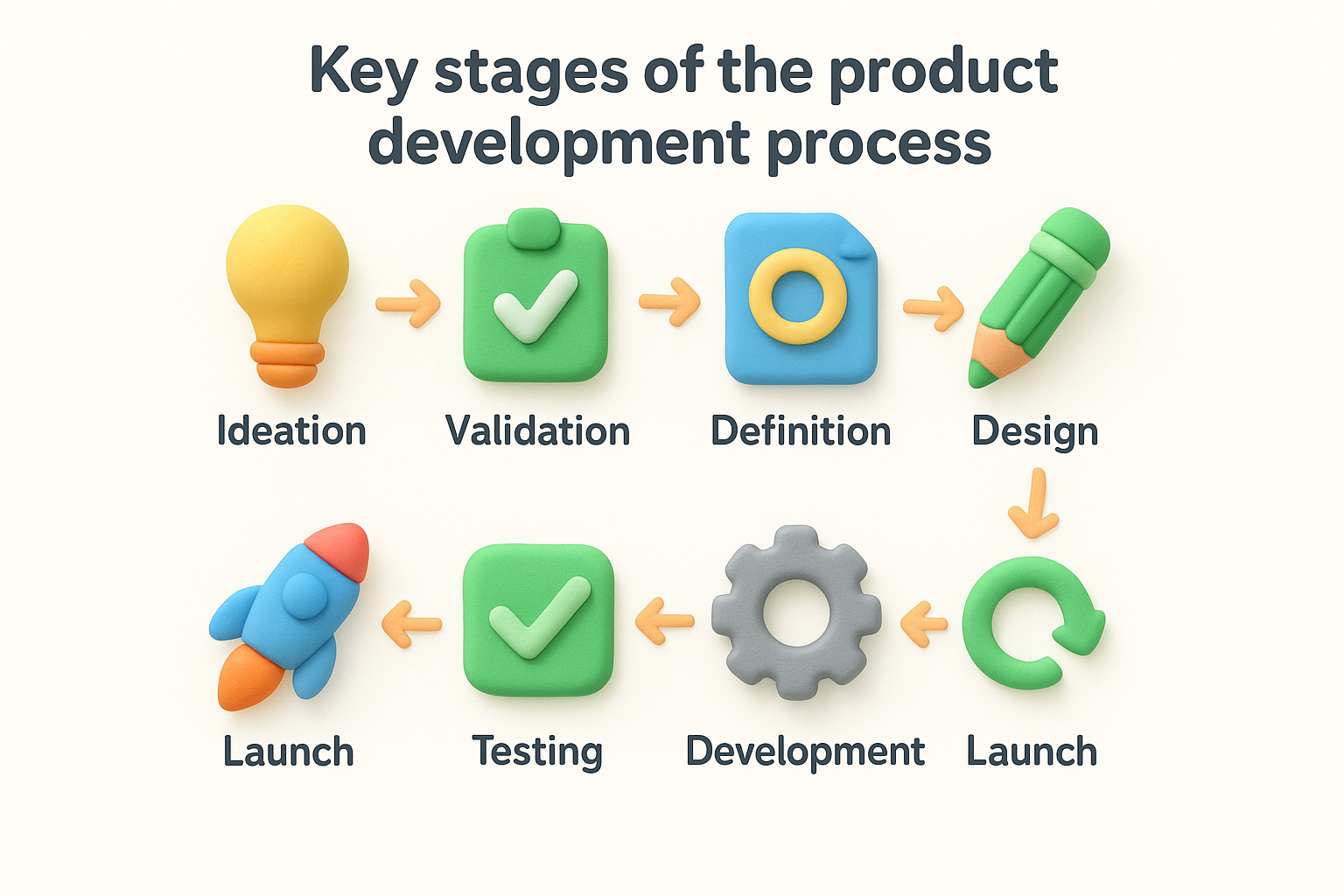
Every cycle starts with idea generation, pulling from customer requests, support tickets, competitor gaps, and internal brainstorming. That raw list then moves into validation, where you test demand before building through user interviews, surveys, or a feedback portal where people can vote on what matters most. This is where most weak ideas should die, before they consume a sprint.
The cheapest place to kill a bad idea is before it reaches a sprint board, not after.
Once an idea survives validation, it enters definition, where you write specs, set success metrics, and scope what "done" looks like. Design and prototyping follow, giving the team something concrete to react to before engineering commits real time. Then comes development, the actual build phase, followed by testing, where QA and beta users catch issues before a wider release.
| Stage | Core question it answers |
|---|---|
| Ideation | What could we build? |
| Validation | Does anyone actually want it? |
| Definition | What does success look like? |
| Design | How will it work and feel? |
| Development | How do we build it? |
| Testing | Does it work as intended? |
| Launch | How do we release it well? |
| Iteration | What do we improve next? |
Launch marks release, but it's not the finish line. Post-launch iteration closes the loop, feeding fresh usage data and feedback back into the next round of ideation. Treat these stages as a cycle, not a straight line, and your roadmap stays grounded in what's actually happening after ship, not just what you predicted beforehand.
No single approach fits every company, but most successful teams pick from a handful of proven models rather than inventing one from scratch. Choosing the right strategy for product development depends on your market position, resources, and how much risk you can tolerate. A startup fighting for its first hundred customers needs a different playbook than an enterprise defending market share.
A market-driven strategy starts with customer pain points, using feedback and demand signals to decide what gets built. Slack grew this way, expanding features based on how teams actually used the tool, and it's one of many strategies you can study side by side. A technology-driven strategy flips that order, starting with a technical capability and finding the market for it afterward. Apple's early iPhone bets leaned this direction, betting that a capacitive touchscreen would create demand nobody had explicitly asked for yet.
Pick your starting point on purpose. Drifting between market-led and tech-led thinking mid-project is how roadmaps lose focus.
Other companies build a platform strategy, creating infrastructure that other products or third parties build on top of, think Shopify's app ecosystem. A differentiation strategy wins by being distinctly better on one dimension, like speed or design, rather than competing on price. A cost-leadership strategy competes by delivering similar value more cheaply, often through efficiency gains rather than feature cuts.
| Strategy type | Starting point | Example |
|---|---|---|
| Market-driven | Customer demand | Slack |
| Technology-driven | Technical capability | Early iPhone |
| Platform | Ecosystem enablement | Shopify apps |
| Differentiation | Unique value on one axis | Design-focused competitors |
| Cost-leadership | Efficiency and price | Budget SaaS tools |
Most real companies blend two of these rather than picking one purely. Knowing which one dominates your decisions, though, keeps prioritization conversations honest instead of reactive.
Strategy stays theoretical until you have product strategy software that captures feedback, scores it, and turns it into a visible plan. A strategy for product development without supporting tools tends to live in scattered spreadsheets, half-updated decks, and Slack threads nobody can search six months later. The right platform closes that gap by giving every stage, from idea capture to public roadmap, a single home.
Strategy without tooling is just a plan nobody can execute consistently.
Before picking software, check that it covers the full loop, not just one piece of it:
Koala Feedback maps directly onto the stages covered earlier. Its feedback portal handles idea generation and validation, letting users submit requests and vote on the ones that matter to them, which gives you real demand signals instead of anecdotes. Prioritization boards organize that input by product area, so scoring effort against impact happens with actual data in front of you rather than a hunch. Once priorities are set, the public roadmap communicates progress back to users, closing the loop that keeps trust high and support tickets low.
Ownership of your process matters too. Customizable statuses let you define what "planned," "in progress," and "shipped" actually mean for your team, and branding the portal with your own domain and colors keeps the experience consistent with the rest of your product. None of this replaces judgment, but it removes the guesswork that sinks most new product development strategy efforts before they get past the first quarter.
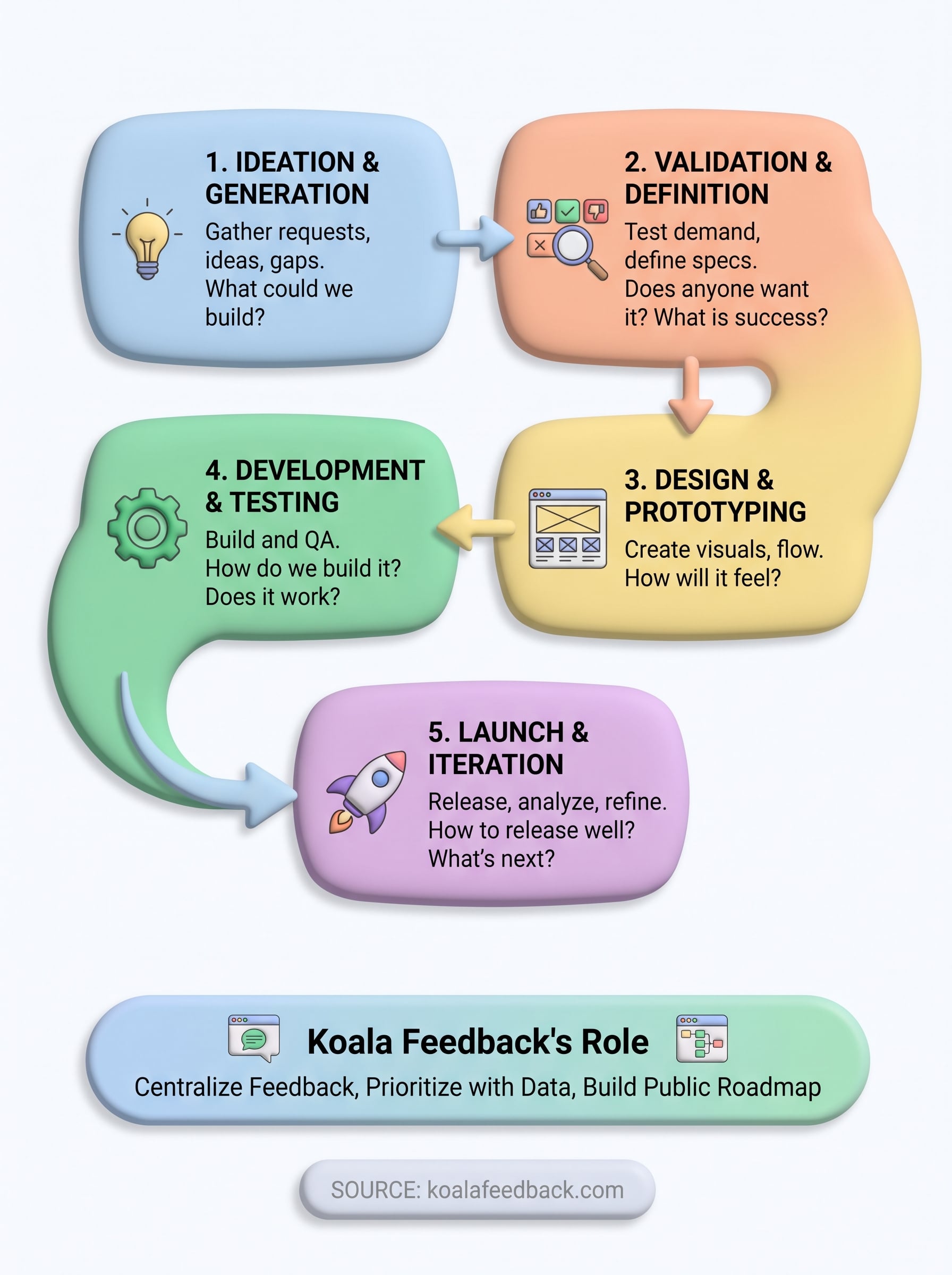
A solid strategy for product development isn't a document you write once and file away. It's a loop: collect feedback, validate demand, prioritize with evidence, build, launch, and listen again. Teams that treat it this way stop guessing and start shipping features people actually use, which shows up directly in retention and satisfaction scores.
Start small if you need to. Pick one stage, maybe feedback collection or roadmap communication, and fix it before overhauling everything at once. Momentum matters more than perfection here. Every improvement compounds once decisions rest on real user signals instead of whoever spoke up last in a meeting.
You don't need to build this infrastructure from scratch. Start collecting feature requests in one place with Koala Feedback, free, and give your team a centralized way to capture requests, prioritize what matters, and show users the roadmap that proves you're listening.

Start today and have your feedback portal up and running in minutes.