You need a way to align your team on product priorities, gather feedback from users, and communicate what you're building next. Spreadsheets break down when feedback piles up. Email threads lose context. Stakeholders ask the same questions over and over. Without the right product strategy software, you're stuck playing telephone between customers, your team, and leadership.
This guide compares 12 product strategy tools you can actually use in 2026. Each platform helps you capture ideas, prioritize features, and share roadmaps, but they differ in how they approach product planning and execution. Some focus on discovery and validation. Others emphasize portfolio management or analytics. A few excel at feedback collection and roadmap sharing. We've broken down what each tool does, who it serves best, and what you'll pay. By the end, you'll know which product strategy platform fits your team's workflow and budget.
Koala Feedback centralizes user feedback collection and roadmap sharing in one platform. You can capture ideas from multiple sources, organize requests by priority, and show users exactly what you're building. The tool emphasizes transparency and keeps customers engaged throughout your product development cycle.
The platform gives you a feedback portal where users submit ideas and vote on features they want most. Koala Feedback automatically deduplicates similar requests and groups them into logical categories. Your team can comment, discuss, and update status on each item. This product strategy software connects feedback directly to your roadmap, so you build what users actually need instead of guessing.
You get prioritization boards that organize feedback by product area or feature set. The public roadmap displays planned, in-progress, and completed work with customizable statuses. Users see when features move from idea to launch. You can brand the portal with your domain, colors, and logo to match your company identity. Voting and commenting features let you measure demand for each request quantitatively.
Koala Feedback turns scattered user requests into an organized strategy by connecting feedback collection, prioritization, and roadmap communication in one place.
Product managers at SaaS companies get the most value from Koala Feedback. Teams that want to increase transparency with customers and make data-driven prioritization decisions will find the voting system particularly useful. Startups and growing software teams that need to engage users in product development benefit from the straightforward setup and feedback-first approach.
Koala Feedback offers a free plan for teams getting started with feedback management. Paid plans provide custom branding, advanced prioritization tools, and increased submission limits. Pricing scales with your user base and feature requirements.
ProdPad positions itself as the first complete product management software on the market and continues to lead with AI-powered features that automate backlog refinement. You get tools for roadmapping, idea management, and feedback analysis in one platform. The system helps you stay focused on outcomes rather than simply shipping features.
The platform gives you three core modules: Roadmaps, Ideas, and Feedback. You can capture product ideas from anywhere, automatically deduplicate them with AI, and link related feedback to each concept. ProdPad pushes ideas through your workflow stages before they reach delivery, then syncs with your development tools to track progress. This product strategy software connects strategy to execution without forcing you into a timeline-based approach.
You work with the Now-Next-Later roadmap format, which ProdPad invented to prioritize problems over specific solutions. The two-tier hierarchy lets you organize Initiatives on your roadmap while nesting multiple Ideas underneath to test different approaches. ProdPad includes an OKR management tool and strategy canvas where you document your product vision. The AI assistant suggests roadmap initiatives, generates written content, and coaches you on product management best practices.
ProdPad's dual-level roadmap structure gives you room to experiment with solutions without reworking your entire strategy when plans change.
Outcome-focused product teams in agile environments get the most from ProdPad. Teams practicing continuous discovery and build-measure-learn cycles will appreciate the workflow tools that track ideas before they hit the roadmap. Organizations wanting consistent processes across multiple products benefit from the built-in best practices and templates.
ProdPad uses modular pricing where you select the capability levels you need. The Essentials and Advanced plans include all three modules (Roadmaps, Ideas, Feedback) starting at $116 per admin or editor monthly. You get unlimited Reviewer accounts who can submit ideas, add feedback, and collaborate without extra cost.
Productboard delivers a highly configurable platform for product teams that need flexibility in how they organize and visualize strategy. You can customize prioritization frameworks, create multiple roadmap views, and gather feedback from various sources. The tool requires significant setup time but adapts to complex workflows once configured.
The platform collects user feedback through integrations with support tools, CRMs, and analytics platforms. You can tag and organize requests, then link them to product features you're considering. Productboard surfaces feedback themes automatically using AI analysis, helping you spot patterns across thousands of user inputs. The system connects feedback insights to your roadmap decisions so you can show stakeholders which customer needs drive your priorities.
You build custom prioritization frameworks by defining the factors that matter most to your product decisions. Productboard displays your backlog in grid or matrix views based on these weighted criteria. The roadmap module supports kanban boards, timelines, and release-based views that you can switch between depending on your audience. However, this product strategy software uses a single-level hierarchy, meaning you cannot nest multiple solution ideas under broader strategic initiatives. The AI features for generating insights and speeding up documentation cost $20 extra per user on top of base pricing.
Productboard's strength lies in its configurability, but teams should expect to invest time defining their workflows and prioritization criteria before seeing full value.
Mature product teams with established processes benefit most from Productboard's customization options. Organizations managing complex product portfolios that need detailed feedback analysis and multiple stakeholder views will find the configuration flexibility valuable. Teams comfortable with setup complexity and willing to pay for advanced AI features get the best return.
The Pro plan starts at $59 per user monthly with a two-user minimum. You face limits on objectives, feedback portals, and roadmaps at this tier. AI capabilities require an additional $20 per user. Enterprise pricing unlocks unlimited roadmaps, SSO, and dedicated customer success support.
Aha! Roadmaps focuses on traditional timeline-based planning with robust tools for documentation and reporting. You can manage multiple products in one workspace and generate detailed operational reports for stakeholders. The platform suits teams that prioritize feature delivery tracking over discovery-focused workflows.
The platform provides timeline roadmaps where you schedule features against specific dates and releases. You can organize work into portfolio views that roll up individual product roadmaps into a coordinated overview. Aha! includes a built-in whiteboard tool for mapping user flows and collaborative sessions, letting you link visual outputs directly to roadmap items. The system centers on tracking feature requests from customers through to delivery rather than exploring multiple solution approaches.
You get a central strategy area where you document your product vision using pre-built templates like SWOT analysis and competitive positioning frameworks. The reporting suite generates custom dashboards that track operational metrics across your product portfolio. Aha! supports idea portals where customers vote on feature requests, but the single-level roadmap structure prevents you from nesting multiple solution ideas under broader initiatives. This product strategy software pushes you toward committing to specific features early rather than maintaining flexibility for discovery and iteration.
Aha! Roadmaps excels at detailed operational reporting and documentation but structures your workflow around features instead of problems to solve.
Large organizations with traditional product management practices benefit from Aha!'s reporting capabilities and portfolio management. Teams that work from customer feature requests rather than conducting extensive discovery will find the feature-centric approach familiar. Product managers who need to deliver complex operational reports to stakeholders get value from the advanced dashboard options.
Pricing starts at $59 per user monthly when you bundle Roadmaps with the basic Ideas module. Advanced features like OKRs, automation rules, AI assistance, and customizable portals require the premium tier at over $200 per user. Enterprise pricing includes user access controls and dedicated support.
Jira Product Discovery integrates directly with Atlassian's development ecosystem, giving you a connected workflow from idea capture through delivery. You can gather input from stakeholders, prioritize features against business goals, and maintain alignment across your organization. The tool works best when your team already uses Jira Software for development tracking.
The platform helps you capture and prioritize ideas while keeping everyone informed about product decisions. You can collect feedback from multiple sources, organize concepts into views that make sense for your workflow, and share roadmaps with stakeholders. Jira Product Discovery connects insights to delivery by syncing with Jira Software, so engineering teams see exactly what they need to build. This product strategy software brings product managers, developers, and stakeholders into one shared workspace.
You get customizable views that let you organize ideas by priority, theme, or business objective. The platform supports custom fields and labels that highlight how your product capabilities map to customer needs. You can create roadmaps that show both timeline and now-next-later formats depending on your audience. Integration with Jira Timelines visualizes how each development phase contributes to your overall product vision.
Jira Product Discovery reduces friction between product strategy and engineering execution by keeping both teams connected through native Jira integration.
Product teams already using Atlassian tools get the smoothest experience with Jira Product Discovery. Organizations that need tight integration between product planning and software development workflows benefit from the native Jira Software connection. Teams wanting to reduce tool sprawl while maintaining visibility across product and engineering work will appreciate the unified ecosystem.
Jira Product Discovery offers a free tier for small teams getting started. Paid plans scale based on user count and provide advanced customization options, unlimited projects, and priority support.
Airfocus delivers a modular product strategy software that adapts to different team workflows and approaches. You can configure workspaces to match your specific process instead of forcing your team into a rigid structure. The platform emphasizes flexibility and customization, letting you pick the features and views that make sense for your organization.
The platform provides customizable workspaces where you organize ideas, roadmaps, and feedback according to your team's needs. You can capture input from multiple channels and centralize it in one system. Airfocus connects feedback directly to features and initiatives so you maintain visibility across the entire product development cycle. The tool lets you switch between different views and roadmap formats depending on which stakeholders you're presenting to.
You get prioritization tools including scoring frameworks you can customize and prioritization poker for collaborative decision-making. Airfocus supports both Now-Next-Later and timeline roadmaps that you can tailor to specific audiences. The feedback management system integrates with Slack and Intercom to gather insights from various touchpoints. You can link customer requests to backlog items to inform discovery and surface frequently requested features quantitatively.
Airfocus stands out by letting teams configure their workspace to match existing processes rather than forcing everyone into one predefined workflow.
Organizations with disparate teams working in different ways benefit from Airfocus's customization options. Product managers who need adaptable views for various stakeholder groups will find the flexible presentation formats useful. Teams comfortable investing time in initial setup to create workflows that fit their unique processes get the most value.
Pricing starts at $59 per user monthly for the base package. Advanced features like prioritization tools, AI assistance, user access controls, and multiple feedback portals require the Scale plan with custom pricing. Enterprise features including OKRs, reporting, and Salesforce integrations sit behind contact-only pricing.
ProductPlan began as a roadmap-focused tool and has expanded to offer broader product management capabilities. You can create multiple roadmap formats, gather feedback, and track feature delivery through various presentation styles. The platform emphasizes visual communication and makes it easy to share roadmaps with different stakeholder groups.
The platform lets you build timeline, list, and table-based roadmaps from the same underlying data. You can switch between views depending on which stakeholders you're presenting to without rebuilding your roadmap. ProductPlan includes a launch planning tool that helps you coordinate go-to-market activities as features approach release. However, feedback collection remains manual since this product strategy software lacks integrations for capturing input from support systems or CRMs.
You get multiple roadmap layouts that present your strategy in formats suited to different audiences. The system supports single-level hierarchy only, preventing you from organizing broader initiatives with nested solution ideas underneath. ProductPlan includes basic feedback tagging that lets you categorize user requests manually. You can flag ideas as "in discovery" to indicate validation work, though the platform provides no workflow automation or AI assistance for managing your backlog.
ProductPlan delivers strong roadmap visualization options but requires manual processes for feedback management and lacks AI-powered workflow tools.
Small to mid-sized teams that prioritize stakeholder communication over extensive discovery workflows get value from ProductPlan. Product managers who need flexible presentation formats for roadmaps but have manageable feedback volumes will find the visual options useful. Teams comfortable with manual feedback logging and basic prioritization processes fit the platform's capabilities.
ProductPlan requires you to contact sales for pricing information. The company offers no transparent pricing on their website, meaning you need to schedule a consultation to understand costs.
Roadmunk started as a roadmap-only solution but now offers broader product management features for teams that prioritize stakeholder communication. You can switch between different roadmap presentations to match various stakeholder preferences without rebuilding your strategy. The platform works well when you need to present product plans to leadership in multiple formats.
The platform helps you create and export roadmaps that communicate effectively to different audiences. You can organize ideas into views that suit your workflow and share plans with stakeholders across your organization. Roadmunk restricts idea submission to product managers only, giving you complete control over what enters your backlog. This product strategy software recently added a feedback portal where customers can submit product input, though you cannot capture feedback through integrations with other tools.
You get robust portfolio roadmap tools that roll up multiple individual product roadmaps into coordinated views. The platform supports various roadmap formats but does not include a Now-Next-Later option, pushing you toward timeline-based planning instead. Roadmunk emphasizes ease of use with a user-friendly interface that lets you get started quickly. However, integration options remain limited to Jira and Azure DevOps for pushing roadmap items to development teams. You cannot connect Roadmunk to communication tools or route feedback from CRMs or support systems.
Roadmunk delivers portfolio management strength and presentation flexibility but lacks the integration ecosystem needed for comprehensive feedback capture.
Teams managing multiple products that need coordinated portfolio views benefit from Roadmunk's rollup capabilities. Product managers who present to stakeholders with different format preferences will appreciate the ability to switch between views easily. Organizations wanting simple setup and straightforward roadmap communication without extensive feedback management get the best fit.
Roadmunk requires annual commitments with no monthly payment options. Basic single-user roadmap access costs $19 annually. Complete product management capabilities start at $99 per user monthly, paid annually. Enterprise pricing adds unlimited reviewers and dedicated customer success support.
Craft.io provides a unified platform for defining, planning, and executing product strategy across your organization. You can connect strategic goals to tactical work while maintaining visibility from high-level initiatives down to individual features. The platform helps you align teams around shared objectives and track progress toward strategic outcomes.
The platform lets you document your product vision and cascade it through various levels of your organization. You can create strategic themes, break them into initiatives, and link features that deliver on each goal. Craft.io connects roadmaps to execution by integrating with development tools so your team sees how daily work contributes to broader strategy. This product strategy software bridges the gap between strategic planning and feature delivery.
You get goal management tools that track progress against strategic objectives throughout your product development cycle. The roadmap module supports both timeline and now-next-later formats with portfolio views that roll up multiple products. Craft.io includes prioritization frameworks where you score ideas against strategic criteria. The platform provides feedback collection through integrations and connects user requests to the features you're building.
Craft.io focuses on maintaining clear connections between strategic objectives and tactical execution throughout your entire product organization.
Product organizations managing multiple products benefit from Craft.io's portfolio capabilities and strategic alignment features. Teams that need to demonstrate how feature work connects to business goals will find the cascading structure valuable. Organizations wanting comprehensive strategy documentation alongside roadmapping get the most from this platform.
Craft.io offers tiered pricing based on team size and feature requirements. You need to contact their sales team for specific pricing details tailored to your organization's needs.
Wrike operates as a work management platform that extends into product strategy capabilities rather than starting as specialized product management software. You get tools for task management, project planning, and cross-functional collaboration alongside features that help you organize product work. The platform suits teams wanting unified work management across product development and other business functions.
The platform provides customizable workflows where you track work from initial concept through delivery. You can create project templates, assign tasks to team members, and monitor progress across multiple initiatives. Wrike includes Gantt charts, kanban boards, and calendar views that help you visualize work in formats that match different team preferences. The system connects product planning to broader organizational work by bringing various departments into one shared workspace.
You get custom dashboards that display metrics and progress indicators relevant to your product work. Wrike supports request forms where stakeholders submit ideas and feedback that flow into your workflow. The platform includes prioritization capabilities through custom fields and scoring mechanisms you define. Integration options connect Wrike to development tools and communication platforms, though this product strategy software focuses more on task execution than discovery workflows.
Wrike bridges product strategy and general work management by providing a flexible platform that accommodates both product planning and cross-functional coordination.
Organizations needing unified work management across product teams and other departments benefit from Wrike's broad capabilities. Teams that want one platform for product roadmaps, marketing campaigns, and operational projects will appreciate the flexibility. Product managers in companies where cross-functional visibility matters more than specialized product features get the best fit.
Wrike offers a free plan for small teams with basic features. Professional plans start at tiered pricing based on user count and required capabilities. Enterprise plans provide advanced customization, dedicated support, and enhanced security features.
Cascade positions itself as a strategy execution platform that helps you translate business objectives into actionable product initiatives. You can connect company goals to product roadmaps and track progress across your entire organization. The platform focuses on keeping teams aligned around strategic priorities rather than getting lost in tactical feature delivery.
The platform helps you document strategic plans and cascade them through different levels of your organization. You can define business objectives, break them into product initiatives, and assign ownership to teams responsible for execution. Cascade tracks how product work contributes to broader business outcomes by connecting roadmaps to strategic goals. This product strategy software brings visibility to how daily product decisions support company priorities.
You get goal management tools that link product initiatives to business objectives through measurable key results. The platform supports various strategic planning frameworks including OKRs, balanced scorecards, and strategy maps that structure your approach. Cascade provides reporting dashboards that show progress toward strategic goals across product portfolios and business units. You can create multiple views that present strategy differently depending on whether you're communicating with executives, product teams, or stakeholders.
Cascade connects product strategy to business outcomes by maintaining clear visibility from company goals down to individual product initiatives.
Product leaders in larger organizations benefit most from Cascade's focus on strategic alignment. Teams that need to demonstrate how product work supports business objectives will find the goal tracking capabilities valuable. Organizations wanting unified strategy management across product development and other business functions get strong value from this platform.
Cascade offers tiered pricing based on organization size and required capabilities. You need to contact their sales team for specific pricing tailored to your team's needs and strategic planning requirements.
Strategy operates as an AI and business intelligence platform that brings data-driven insights into your product planning process. You get tools for integrating multiple data sources, analyzing product performance, and making decisions backed by governed enterprise data. The platform focuses on delivering insights and AI readiness at scale rather than traditional roadmapping features.
The platform helps you connect and analyze data from across your organization to inform product decisions. You can integrate various data sources, run analytics on product performance, and generate insights that guide your strategic planning. Strategy provides governed data access that ensures teams work with accurate, consistent information when making product choices. This product strategy software emphasizes data foundation over workflow management.
You get data integration capabilities that pull information from multiple systems into one unified view. The platform supports AI-powered analysis that surfaces patterns and trends across your product data. Strategy includes visualization tools that help you present insights to stakeholders and connect performance metrics to strategic objectives. The system provides enterprise-grade governance features that control data access and maintain security standards.
Strategy transforms product planning from opinion-based to data-driven by connecting your team to governed insights at enterprise scale.
Large enterprises managing complex data environments benefit from Strategy's governance and integration capabilities. Product leaders who need data-driven decision support rather than roadmap visualization tools will find value in the analytics focus. Organizations wanting to build AI readiness into their product planning processes get the most from this platform.
Strategy offers enterprise pricing tailored to organization size and data requirements. You need to contact their sales team for specific pricing based on your data volume, user count, and required features.
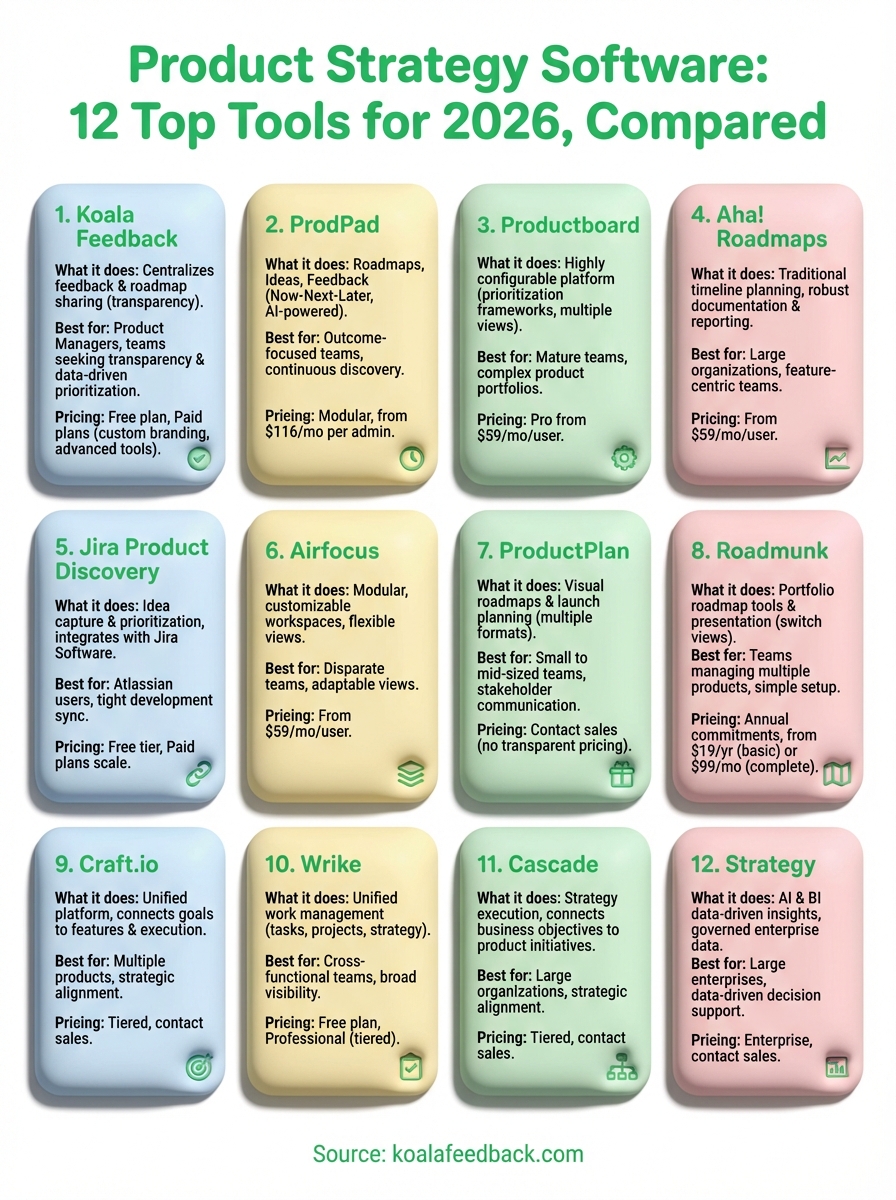
You've compared 12 product strategy software platforms with different approaches to feedback collection, roadmap management, and team alignment. Each tool brings unique strengths depending on whether you prioritize discovery workflows, timeline planning, or portfolio coordination. Your next move depends on your team's specific needs and current product management maturity.
Start by testing platforms that match your workflow requirements. If transparent feedback collection and public roadmaps matter most to your team, try Koala Feedback to see how centralized user input transforms prioritization decisions. Most vendors offer free trials or demos that let you evaluate features with your actual product data before committing to annual contracts.

Start today and have your feedback portal up and running in minutes.