Most product teams don't fail because they lack ideas. They fail because they never turn those ideas into a clear direction everyone can follow. If you're staring at a backlog full of requests, competing priorities from sales, and a roadmap that changes every quarter, you already know the pain of building without a plan. Learning how to create a product strategy fixes that problem at the root, before another sprint gets spent on features nobody asked for.
This guide gives you the exact steps to build a strategy that connects your business goals to what customers actually need. You'll define your vision, size up the market, set priorities based on real evidence rather than the loudest voice in the room, and turn all of it into a roadmap your team and users can see progress against. No theory for theory's sake, just a repeatable framework you can apply this week.
Along the way, you'll see how structured feedback collection and prioritization tools fit into each stage, since a strategy is only as strong as the data behind it. By the end, you'll have a clear process for setting priorities and communicating them, so your roadmap reflects what matters most to your users instead of guesswork.
A product strategy is the plan that connects your company's business goals to the specific problems you'll solve for customers, and the order you'll solve them in. It's not a list of features. It's the reasoning behind why those features exist at all: who you're building for, what outcome you're driving toward, and how you'll know you got there. Without that reasoning, teams end up reacting to whoever asked last, whether that's a sales rep chasing a deal or an executive with a pet idea.
People mix these terms up constantly, and that confusion is where a lot of misaligned roadmaps start. Your vision is the long-term destination, often three to five years out. Your strategy is the set of choices and trade-offs that get you there. Your roadmap is the sequenced, time-bound execution of that strategy.
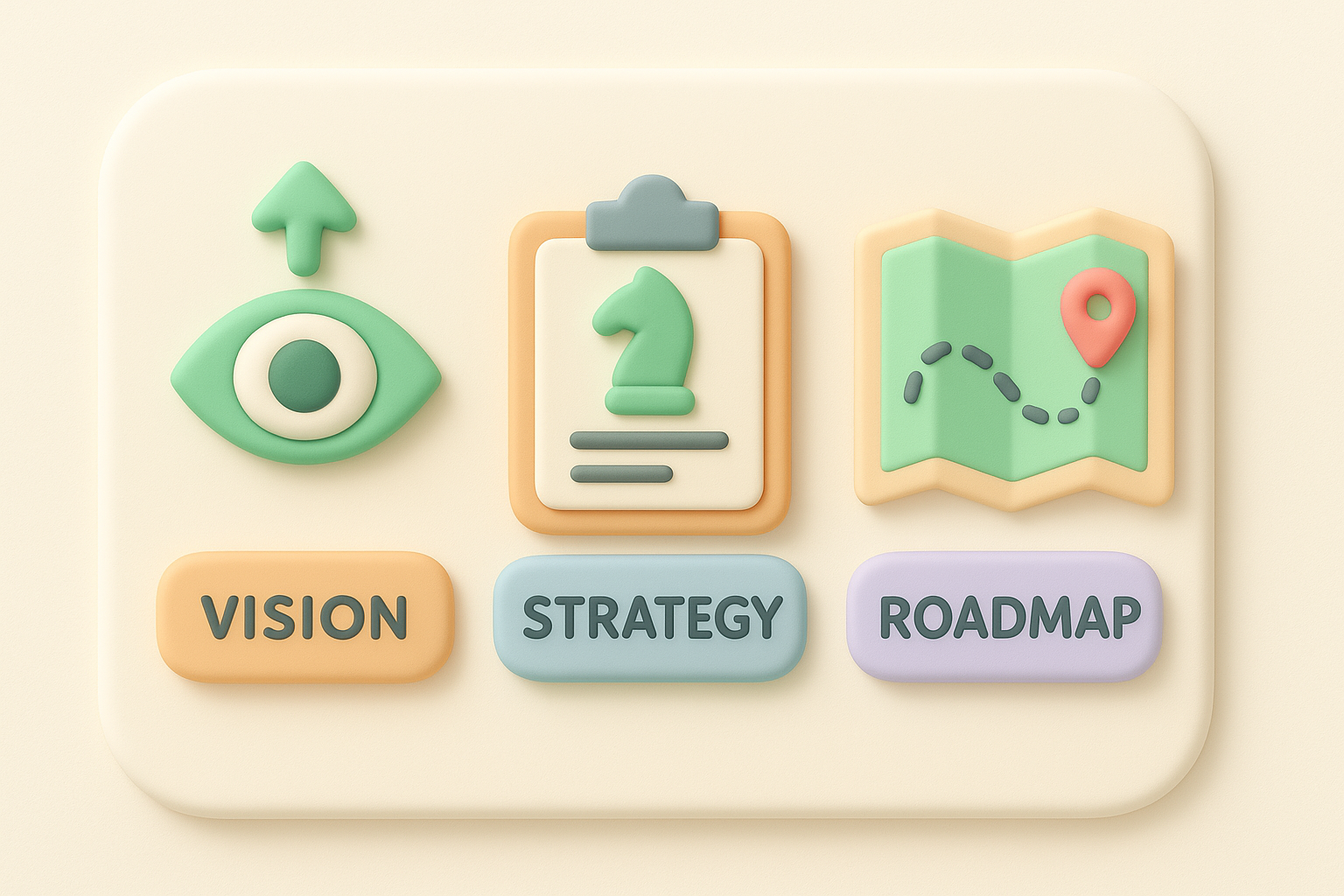
| Element | Time horizon | Answers the question |
|---|---|---|
| Vision | 3-5 years | Where are we headed? |
| Strategy | 6-18 months | What will we prioritize, and what will we say no to? |
| Roadmap | Weeks to quarters | What are we building, and when? |
Skip the strategy layer and you get a roadmap built on gut feeling instead of a defensible plan.
Teams without a documented strategy tend to ship features that look busy on a release log but don't move any business metric. Support tickets pile up requesting things that were never scoped against customer value, and every planning meeting turns into a debate instead of a decision. A clear strategy gives you a filter: does this request move us toward the outcome we defined, or not?
A product strategy is the filter that turns every incoming request into a yes, a no, or a not yet.
If you're already collecting feedback through a portal or voting board, strategy is what turns that raw input into direction. A tool like Koala Feedback can surface which requests get the most votes, but votes alone don't tell you which ones align with your business goals. That judgment call is exactly what a strategy exists to make, and it's why the research step comes next.
Every strategy stands on evidence, not intuition, so start by gathering what you already have before chasing new research. Pull together customer feedback, support tickets, sales call notes, churn interviews, and usage analytics. You're looking for patterns: which problems keep coming up, which segments feel the most pain, and where your product already wins against alternatives.
Scattered feedback is the biggest blocker here. If requests live in spreadsheets, Slack threads, and someone's inbox, you can't spot real patterns. Set up a feedback portal where users submit and vote on ideas, so demand becomes visible instead of anecdotal. Koala Feedback automatically groups duplicate requests, which means you see the true volume behind an idea instead of ten separate tickets that look like ten separate problems.
Once you understand your own customers, look outward. Answer these before moving to strategic pillars:
Data without a decision attached to it is just trivia. Research exists to make your next choice obvious.
Document your findings in a shared doc your whole team can reference. This becomes the evidence base you'll cite when someone questions why a feature made the cut, or why it didn't.
With research in hand, you can write a vision statement that says where your product will be in three to five years and why that matters to customers. Keep it short enough to repeat from memory. A vision like "become the default way mid-market teams manage customer feedback" gives everyone a destination, but it says nothing about how you'll get there. That's what strategic pillars are for.
Avoid vague mission-statement language that could apply to any company in any industry. Test your draft against three questions: does it name who you serve, does it name the outcome you deliver, and could a competitor claim the exact same sentence? If a competitor could copy-paste your vision, rewrite it until it's specific to what you actually learned in your research.
Pillars are the handful of themes that will absorb most of your effort over the next 6 to 18 months. Pull them straight from the patterns you found in Step 1, not from a brainstorm.
If a request doesn't map to one of your pillars, it doesn't belong on this quarter's roadmap.
Every pillar should trace back to a metric you already track, so strategic pillars stay accountable instead of aspirational. This is also the moment to rank feedback board requests against each pillar, since that ranking becomes your first draft of priorities.
Once your pillars are set, translate them into a sequenced roadmap that shows what ships when. This is where strategy stops being a slide deck and starts guiding actual sprints. Group every backlog item under the pillar it supports, then rank items within each pillar by impact and effort, not by who asked loudest.
A simple scoring model keeps prioritization consistent across teams. Rate each feedback item on a scale of 1 to 5 for these factors:
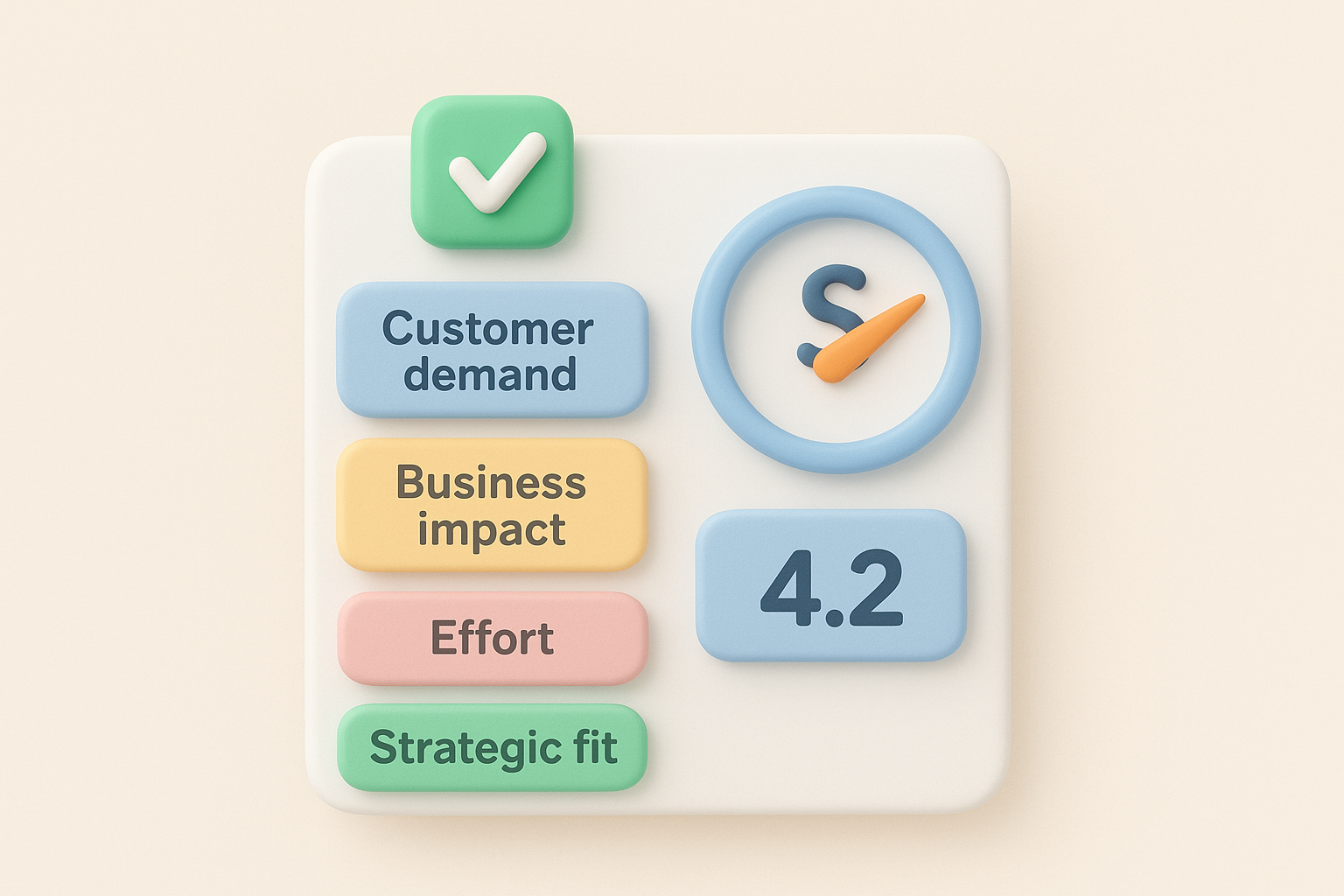
Divide demand plus impact plus strategic fit by effort, and you get a rough priority score you can defend in any planning meeting. Koala Feedback's prioritization boards let you organize requests this way by product area, so the highest-scoring items naturally rise to the top instead of getting buried under the newest request.
A roadmap without scoring is just a list of promises made under pressure.
Customers stop trusting a roadmap that never updates. Set customizable statuses like Planned, In Progress, and Shipped, and move items through them as work actually happens. Publish this as a public roadmap tied back to your feedback portal, so the people who requested a feature can see it move without opening a support ticket to ask. That visibility alone reduces the "is this ever happening" tickets that eat up your team's time.
A strategy that lives in one person's head dies the moment that person goes on vacation. Once your roadmap is sequenced, share it in plain language with your team, your executives, and your customers, each in the format they'll actually use. Engineers need ticket-level detail, executives need the pillar-level story, and customers need a public roadmap that shows what's coming without the internal jargon.
Shipping ten features means nothing if none of them move the metric your pillar was built to fix. Tie every release back to a number: did churn drop, did activation improve, did the support queue shrink? Set a review cadence, monthly for fast-moving teams, quarterly for slower ones, and check actual results against the goals you wrote in Step 2.
Ship the feature, then check the number. If the number doesn't move, the feature wasn't the strategy.
Your product strategy isn't a document you file away after one planning cycle. Markets shift, competitors launch, and customer priorities change every quarter, so treat the strategy as a living plan you revisit on a set schedule.
Keeping this loop measurable and public is what separates teams that iterate deliberately from teams that just react to whoever emailed last.
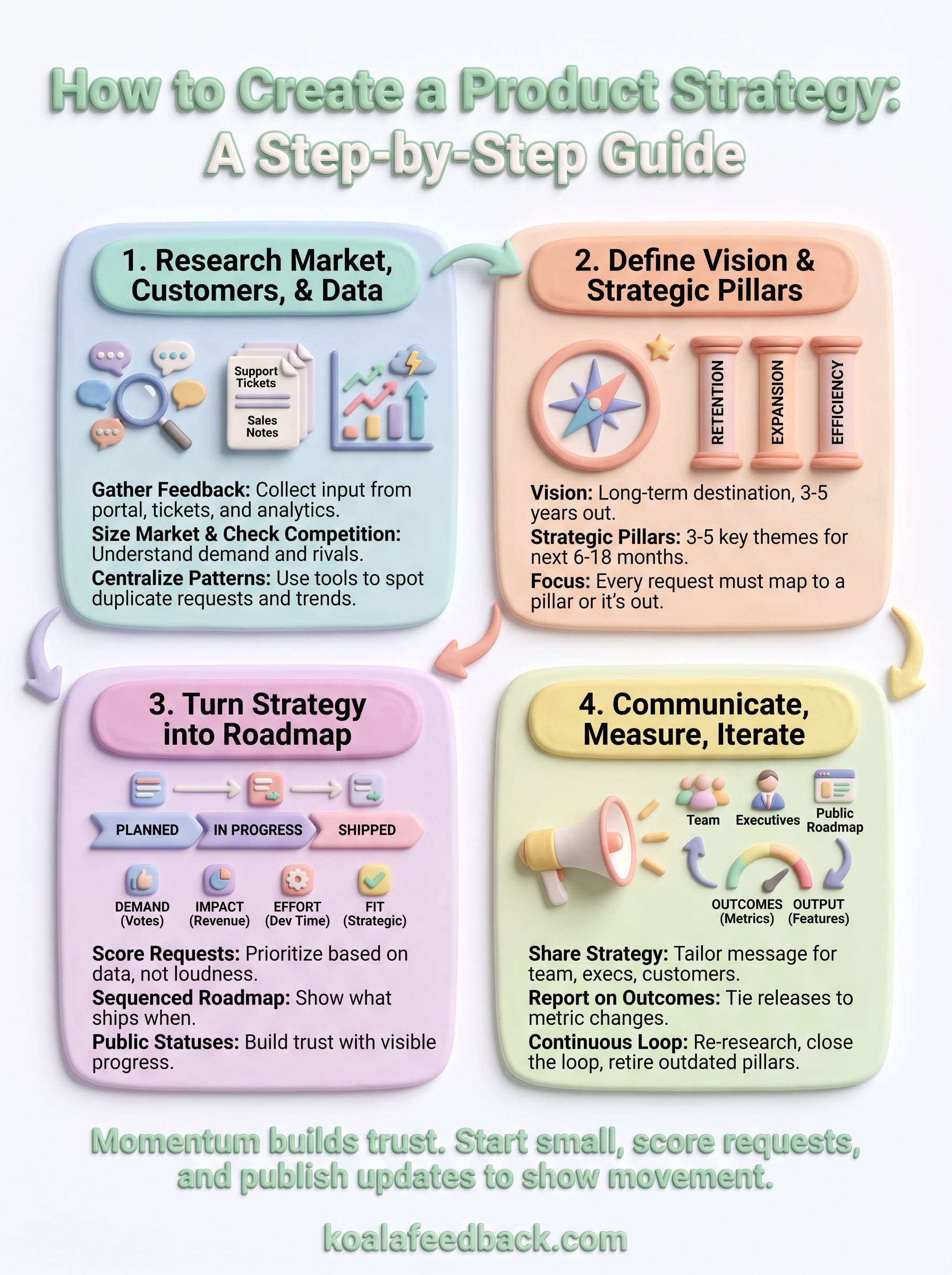
A product strategy only earns its keep when it changes what your team ships next sprint. Research told you where the real pain lives, your vision and pillars gave that pain a direction, and your roadmap turned direction into dated commitments. Skip any of those steps and you're back to guessing, no matter how good your intentions are.
Start small if you need to. Pick one pillar, score the requests sitting in your backlog against it, and publish a roadmap update this week so customers see movement. Momentum builds trust faster than a perfect plan ever will, and trust is what keeps users voting and commenting instead of churning quietly.
You don't need new tools to start researching or scoring today, but you'll move faster with a single source of truth for feedback and priorities. Try Koala Feedback to centralize votes, comments, and your public roadmap in one place, so your next strategic decision has real evidence behind it.

Start today and have your feedback portal up and running in minutes.