You built something users asked for, but adoption fell flat. Your team chases feature requests without knowing which ones move the needle. Stakeholders pull you in different directions, each convinced their priority matters most. Without a clear product strategy, you end up building what's easiest or loudest instead of what drives real value.
A strong product strategy solves this. It connects your vision to execution by defining what problems you solve, who you solve them for, and how you'll win in your market. This strategic foundation helps you prioritize features, align stakeholders, and make confident tradeoffs when resources are tight.
This guide walks you through developing an effective product strategy from scratch. You'll learn how to clarify your vision and success metrics, map user needs against market opportunities, choose your positioning, and translate strategy into an actionable roadmap. We'll also share proven frameworks, real examples, and ready to use templates you can apply to your own product today.
A product strategy document isn't just a collection of goals and features. When you learn how to develop product strategy effectively, you create a decision-making framework that answers three fundamental questions: where you're going (vision), how you'll get there (approach), and what success looks like (metrics). The strongest strategies balance ambition with realism, giving your team clarity without constraining them with excessive detail.
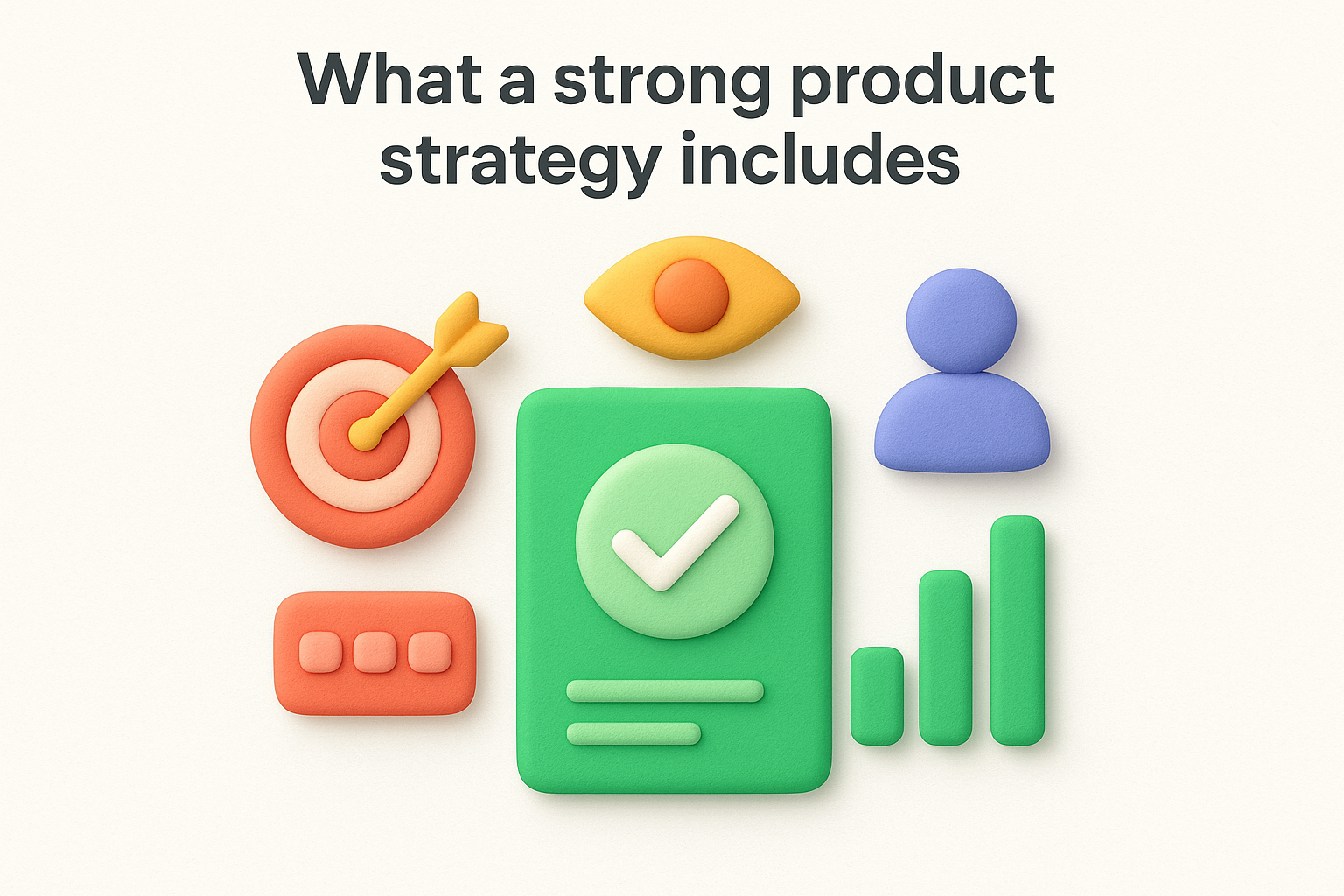
Your strategy needs four essential elements working together. First, a clear vision statement defines the future state you're building toward and the customer problems you'll solve. Second, your target market and user personas specify exactly who benefits most from your solution. Third, your value proposition and positioning explain how you differentiate from alternatives and why customers should choose you. Fourth, strategic objectives with measurable success metrics let you track whether your approach is working.
These components connect in a logical flow. Your vision anchors everything else. Your target market shapes which problems matter most. Your positioning determines which capabilities to build first, and your metrics tell you when to pivot or double down on what's working.
A strategy without clear success metrics is just wishful thinking.
Knowing what to leave out matters as much as what you include. Your product strategy should not contain detailed feature specifications, implementation timelines, or tactical execution plans. Those belong in your roadmap and backlog. Strategy defines the "what" and "why" at a high level, while roadmaps handle the "when" and "how" at a granular level.
Strong strategies also avoid vague aspirations like "be the best" or "delight customers." Instead, they make specific strategic choices about which customer segments to serve, which problems to solve first, and which capabilities will drive competitive advantage. When you exclude specifics that change frequently, your strategy stays stable enough to guide decisions over months or years while remaining flexible enough to adapt as you learn.
The first step in how to develop product strategy is establishing where you're headed and how you'll measure progress. Your vision statement acts as your north star, while success metrics tell you whether you're moving in the right direction. Without these foundational elements, you'll struggle to make consistent decisions or know when to adjust course.
Your product vision should describe the future state you're building toward in a single, memorable sentence. This statement needs to be specific enough to guide decisions but broad enough to remain relevant as your product evolves. A strong vision answers what problem you solve and the impact you create for users.

Use this simple template to craft your vision statement:
Vision Statement Template:
For [target customer]
who [statement of need or opportunity],
[product name] is a [product category]
that [key benefit or compelling reason to use].
Unlike [primary competitive alternative],
our product [primary differentiation].
Here's a concrete example: "For product managers who struggle to centralize user feedback, Koala Feedback is a feedback management platform that transforms scattered requests into prioritized roadmaps. Unlike generic project tools, our product connects directly to your users and shows them exactly what you're building based on their input."
Once you've defined your vision, you need quantifiable metrics that indicate whether your strategy is working. Choose three to five key metrics that directly reflect your strategic objectives. These should balance leading indicators (what predicts success) with lagging indicators (what confirms you achieved it).
Your metrics should align with your product lifecycle stage. Early products focus on validation metrics like user activation rate, feature adoption, and qualitative feedback scores. Mature products track growth metrics like monthly recurring revenue, net retention rate, and customer lifetime value.
The best success metrics directly connect user behavior to business outcomes.
Create a simple metrics framework using this structure:
| Metric Type | Example Metric | Target | Why It Matters |
|---|---|---|---|
| Engagement | Weekly active users | 500 by Q2 | Shows product stickiness |
| Adoption | Feature usage rate | 60% of users | Validates core value |
| Business | MRR growth | 15% month over month | Confirms market fit |
| Quality | NPS score | 40+ | Measures satisfaction |
Review these metrics quarterly and adjust them as your product matures. What matters most when you launch differs dramatically from what drives sustainable growth at scale.
Once you've established your vision and metrics, you need to ground your strategy in reality by understanding what users actually need and how the market behaves. This step connects abstract strategy to concrete customer problems and competitive dynamics. When you learn how to develop product strategy through this lens, you make decisions based on evidence rather than assumptions.
Start by gathering feedback from multiple touchpoints across your customer journey. You should capture input through support tickets, sales conversations, user interviews, in-app surveys, and feature request submissions. The goal isn't just collecting data but identifying patterns that reveal unmet needs and pain points.
Create a simple feedback categorization system to organize what you learn. Tag each piece of feedback with the customer segment, problem type, and frequency. This structure helps you spot which issues affect your most valuable users versus edge cases that distract from strategic priorities.
Use this framework to evaluate feedback strength:
| Criteria | High Value Feedback | Low Value Feedback |
|---|---|---|
| Frequency | Multiple users mention it | Single request |
| Segment | Core target users | Edge case users |
| Impact | Blocks key workflows | Nice to have feature |
| Alignment | Fits your vision | Unrelated to strategy |
Feedback volume doesn't equal feedback value. One request from your ideal customer matters more than ten from users outside your target market.
Your feedback analysis should inform and complement broader market research. Study your competitive landscape by identifying direct competitors, adjacent solutions, and the status quo your users tolerate today. Focus on understanding where competitors succeed and where they leave gaps your product can fill.

Document market trends affecting your space using publicly available data. Look at industry reports, analyst coverage, and social conversations to identify emerging needs your current competitors haven't addressed. This research reveals whether your strategy aligns with where the market is heading or fights against inevitable shifts.
Build a lightweight competitive matrix that maps key capabilities against customer needs:
Capability Analysis Template:

User Need 1: [Description]
- Your Product: [Your approach]
- Competitor A: [Their approach]
- Competitor B: [Their approach]
- Gap/Opportunity: [What's missing]

User Need 2: [Description]
- Your Product: [Your approach]
- Competitor A: [Their approach]
- Competitor B: [Their approach]
- Gap/Opportunity: [What's missing]
Connect your feedback patterns to market opportunities by asking where user pain points intersect with competitive gaps. These intersections become strategic leverage points where you can differentiate and win.
With user feedback and market research in hand, you now face the most critical decisions in how to develop product strategy: where you'll compete and what you'll prioritize. This step transforms analysis into action by defining your unique position in the market and the specific capabilities you'll build to win. Your positioning choices directly determine which opportunities you pursue and which you intentionally ignore.

Your positioning statement articulates why customers choose you over alternatives. This goes deeper than features by connecting your product's strengths to specific customer problems that competitors handle poorly. Strong positioning makes tradeoffs explicit and gives your team a clear filter for evaluating new opportunities.
Use this positioning framework to craft your statement:
Positioning Statement Structure:
We help [specific target segment]
who are dissatisfied with [current alternative]
by [unique approach or capability]
so they can [desired outcome].
Here's how this works in practice: "We help product managers who are frustrated with scattered feedback across email and Slack by centralizing all requests in one prioritized view so they can build features users actually want." This statement immediately clarifies who you serve, what problem you solve, and how you differ from generic project management tools.
Your positioning should highlight one or two differentiators where you're demonstrably better than alternatives. Trying to win on every dimension dilutes your message and spreads resources too thin. Choose positioning that leverages your team's unique strengths and aligns with underserved market needs you discovered in your research.
Strategic bets are focused investments in specific capabilities that deliver your positioning. Each bet represents a conscious choice to excel in one area while accepting good enough performance elsewhere. These decisions shape your roadmap priorities and resource allocation for the next 6 to 12 months.
Document your strategic bets using this template:
| Strategic Bet | What We'll Build | What We'll Sacrifice | Expected Outcome |
|---|---|---|---|
| Bet 1: [Focus area] | [Specific capability] | [What you won't do] | [Measurable result] |
| Bet 2: [Focus area] | [Specific capability] | [What you won't do] | [Measurable result] |
| Bet 3: [Focus area] | [Specific capability] | [What you won't do] | [Measurable result] |
For example: Your first bet might focus on seamless feedback collection by building browser extensions and email integrations, while sacrificing advanced analytics features initially. This tradeoff reflects a strategic choice to solve the capture problem first before optimizing analysis tools.
Strategic clarity comes from deciding what not to build as much as what to build.
Limit yourself to three strategic bets maximum. More than that signals lack of focus and prevents your team from achieving meaningful differentiation in any single area.
Your strategy document means nothing if it doesn't translate into concrete execution plans. This step connects high-level strategic bets to the specific features, improvements, and fixes your team builds each sprint. The final piece of how to develop product strategy involves creating a roadmap that communicates direction and a backlog that breaks work into manageable chunks. Without this translation layer, your strategy stays theoretical while your team continues building whatever seems urgent.
Your roadmap should organize work around strategic themes rather than individual features. Each theme represents one of your strategic bets and groups related initiatives together. This approach keeps stakeholders focused on outcomes and value instead of getting lost in feature-level debates about timing and specifications.
Structure your roadmap using quarterly themes that ladder up to your strategy:
Roadmap Template:

Q1 2025 Theme: [Strategic Bet 1]
Goal: [Specific measurable outcome]
Key Initiatives:
- [Initiative 1]: [Brief description]
- [Initiative 2]: [Brief description]
- [Initiative 3]: [Brief description]

Q2 2025 Theme: [Strategic Bet 2]
Goal: [Specific measurable outcome]
Key Initiatives:
- [Initiative 1]: [Brief description]
- [Initiative 2]: [Brief description]
Each initiative on your roadmap should directly support one of your strategic bets. If you can't draw a clear line from a roadmap item back to strategy, question whether it deserves a spot. This discipline prevents scope creep and keeps your team aligned on what matters most.
Roadmaps should inspire confidence in your direction, not serve as a detailed schedule of deliverables.
Your backlog translates roadmap initiatives into actionable user stories and tasks. Every item in your backlog needs a clear connection to your strategic themes. Use a simple scoring system to evaluate whether backlog items deserve attention based on strategic alignment, user impact, and effort required.
Create a prioritization framework using these criteria:
| Scoring Criteria | High (3 points) | Medium (2 points) | Low (1 point) |
|---|---|---|---|
| Strategic Alignment | Directly advances a strategic bet | Indirectly supports strategy | Unrelated to current strategy |
| User Impact | Solves major pain point for core users | Improves experience for segment | Nice to have feature |
| Effort Required | Can ship in 1-2 weeks | Requires 3-6 weeks | Multi-month project |
Calculate a priority score by adding strategic alignment and user impact, then divide by effort. Items scoring above 1.5 belong at the top of your backlog. This quantitative approach removes emotion from prioritization decisions and keeps your team focused on high-leverage work that advances strategy.
Review your backlog monthly to remove items that no longer align with your strategic direction. Products evolve, and yesterday's priority often becomes tomorrow's distraction. Regular pruning ensures your backlog remains a useful tool rather than a growing list of abandoned ideas.
You don't need to reinvent the wheel when learning how to develop product strategy. Proven frameworks provide structure for your strategic thinking, while real examples show how successful companies articulate their positioning. Templates accelerate your work by giving you ready-to-use formats you can adapt to your specific product and market. This section equips you with practical tools you can apply immediately to build or refine your strategy.
Several frameworks help structure your strategic thinking, and each emphasizes different aspects of strategy development. The Lean Canvas focuses on problem-solution fit and helps you articulate assumptions you need to validate. It works particularly well for early-stage products where uncertainty is high and you're still discovering your market. The Business Model Canvas takes a broader view by mapping how you create, deliver, and capture value across nine building blocks including customer segments, value propositions, and revenue streams.
You can also use Geoffrey Moore's positioning framework from Crossing the Chasm, which forces you to articulate your target segment, the alternatives they currently use, your unique differentiator, and the specific benefit you provide. Pick the framework that matches your current strategic questions rather than trying to complete multiple frameworks simultaneously.
The best framework is the one your team actually uses to make decisions, not the most comprehensive one.
Slack's early product strategy provides a clear example: "We help teams who waste time switching between communication tools by bringing conversations, files, and integrations into one searchable workspace so they can spend less time coordinating and more time doing actual work." This statement identifies a specific target, their pain point, the solution approach, and the desired outcome without listing features.
Another strong example comes from Notion's positioning: "We replace fragmented tools like docs, wikis, and project trackers by providing one flexible workspace where teams can write, plan, and organize everything together." Both examples share common traits including a clearly defined problem, a specific approach that differentiates from alternatives, and measurable value for users.
Use this structure to document your complete product strategy:
Product Strategy Document

Vision Statement:
For [target customer] who [need/problem],
[product] is a [category] that [key benefit].
Unlike [alternative], we [differentiation].

Target Market:
- Primary segment: [description]
- Secondary segment: [description]
- Excluded segments: [who you won't serve]

Strategic Positioning:
We help [segment] who [current pain] by [unique approach]
so they can [outcome].

Strategic Bets (Next 12 Months):
1. [Bet name]: [What you'll build] to [expected outcome]
2. [Bet name]: [What you'll build] to [expected outcome]
3. [Bet name]: [What you'll build] to [expected outcome]

Success Metrics:
- [Metric 1]: [Target] by [Date]
- [Metric 2]: [Target] by [Date]
- [Metric 3]: [Target] by [Date]
Fill in each section with specific details from your vision, research, and positioning work. Share this document with stakeholders and revisit it quarterly to ensure your strategy remains relevant as market conditions change.
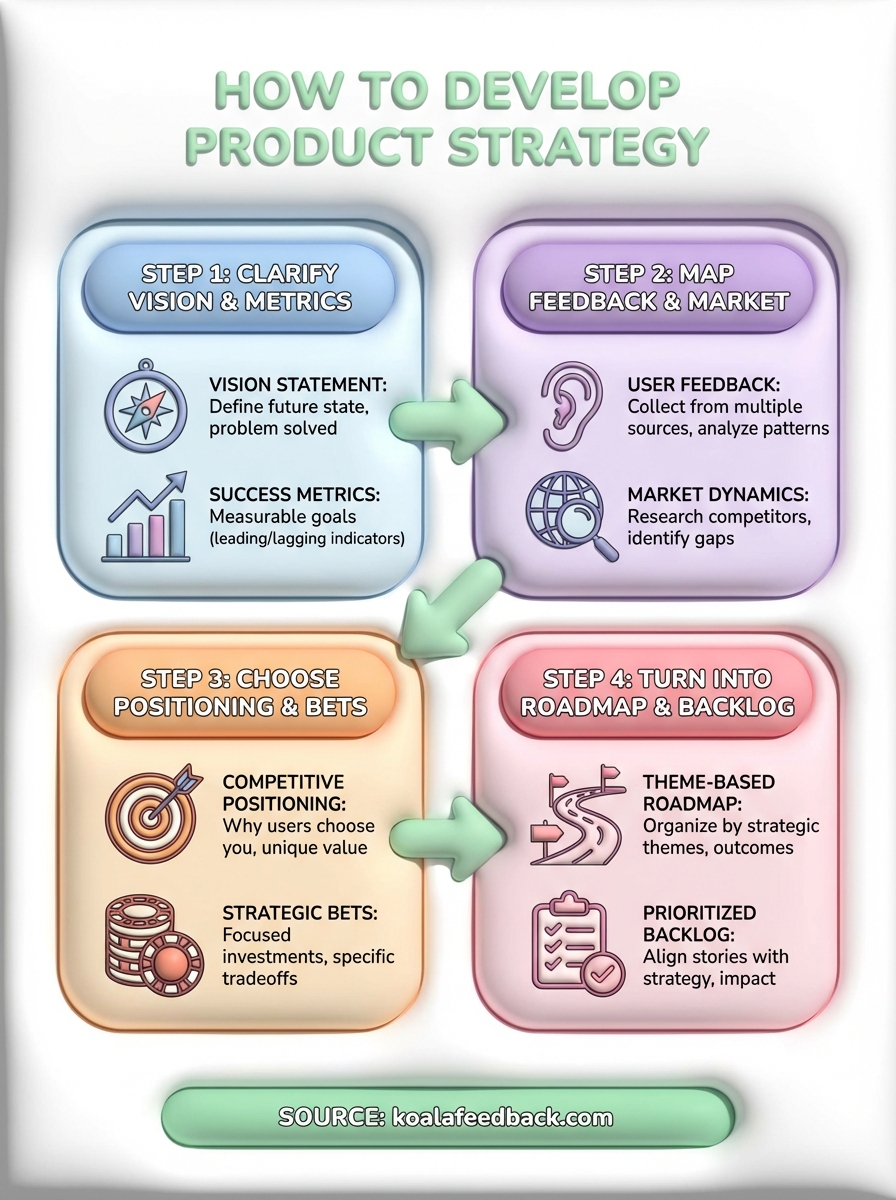
You now have a complete framework for how to develop product strategy that connects vision to execution. Start by clarifying your vision and success metrics to establish direction. Map user feedback and market dynamics to ground your strategy in reality. Make deliberate positioning choices and strategic bets that focus your team's energy. Finally, translate strategy into a roadmap and backlog that guides daily decisions.
The best product strategies evolve through regular refinement based on what you learn from users. When you centralize feedback and connect it directly to your roadmap, you create a transparent loop that keeps strategy aligned with real customer needs. Koala Feedback helps product teams capture user input, prioritize features based on demand, and share progress through public roadmaps. This approach ensures your strategy remains grounded in the problems users actually face rather than assumptions about what they might want.

Start today and have your feedback portal up and running in minutes.