Most product launches fail quietly. The product works, the team is proud, and almost nobody shows up. A solid marketing strategy for a new product prevents that by deciding who you are selling to, what you promise, and how people will hear about it before you ship.
Here is the short answer. Build your strategy in six steps: research the market, set measurable goals, define your target audience, position the product, set a price, and choose your promotional tactics. Skip one and the rest get shaky. Positioning without research is a guess. Pricing without a clear audience is a coin flip.
Below, you get each step with a concrete example you can adapt. We also cover a point many guides miss: real user feedback is your best research tool. At Koala Feedback, we see teams validate product ideas, spot demand, and shape launch messaging by listening to users early. You can do the same, whatever your budget.
A marketing strategy for a new product is a written plan that links what you built to the people who will pay for it. It answers four questions: who is this for, why should they care, what does it cost, and where will they hear about it. Everything else comes after those answers, from ad copy to launch emails.
Teams often mix these up. Your strategy is the reasoning: the audience you chose, the promise you make, and the price you set. Your marketing plan turns that reasoning into tactics, owners, and dates. The launch is just the first stretch of that plan.
Get the order right and the work gets easier. Write the strategy first, because tactics picked without it tend to chase whatever channel is trendy this month. A strong strategy lets you say no to ideas that do not fit your audience or budget.
Strategy decides what you say and to whom. Tactics only decide where you say it.
The marketing strategy of a new product breaks into six parts. The table shows the question each part answers and what you should have in hand when you finish it.
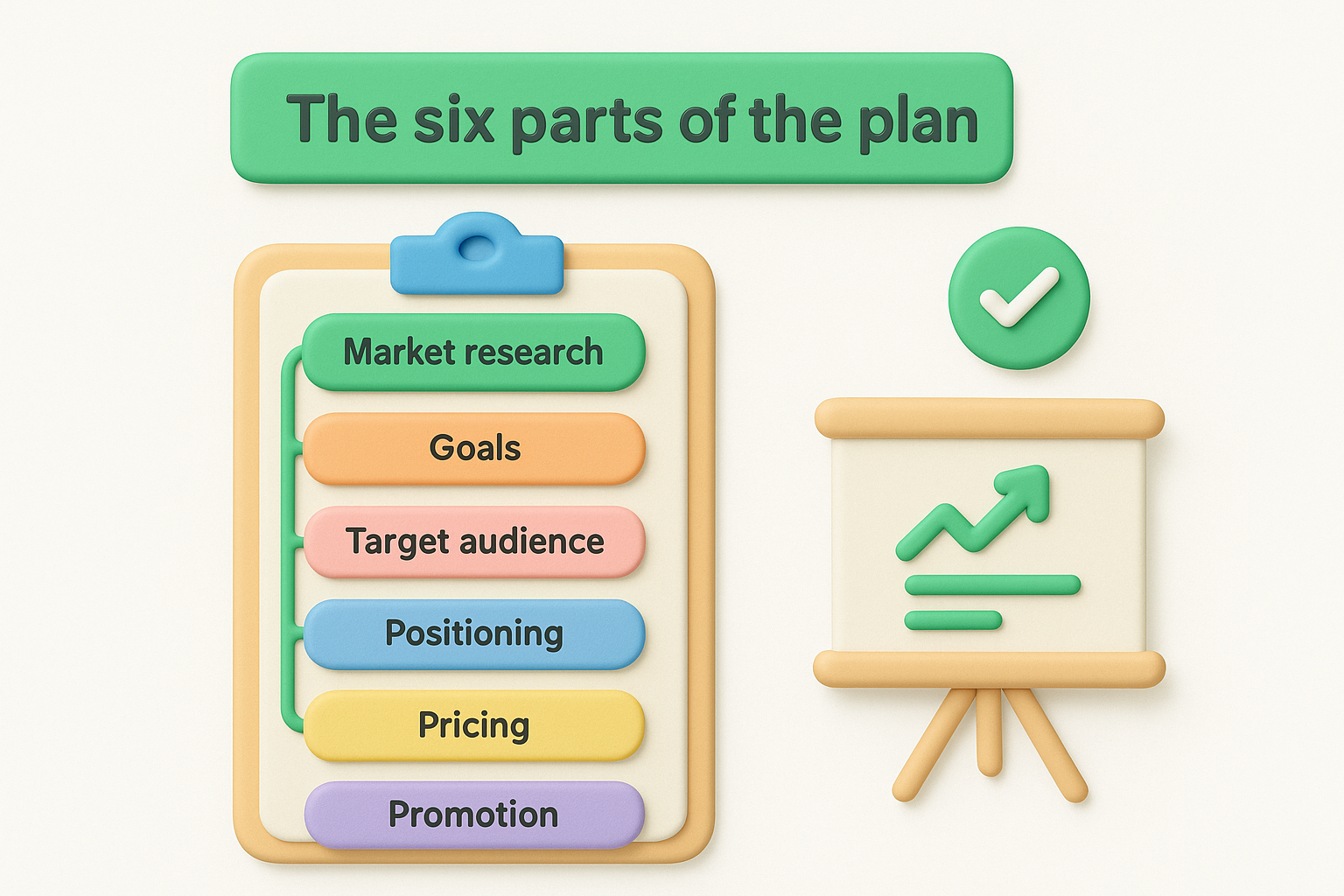
| Part | Question it answers | What you should have |
|---|---|---|
| Market research | Is there real demand, and who else serves it? | A competitor grid and a list of customer pain points |
| Goals | What does success look like? | 2 to 3 measurable targets with deadlines |
| Target audience | Who needs this most? | One primary persona and a short list of segments |
| Positioning | Why choose this over the alternatives? | A one-sentence value statement |
| Pricing | What will people pay, and how? | A price point or tier structure with a rationale |
| Promotion | How will the audience find out? | 2 to 4 chosen channels and a launch calendar |
This guide groups those six parts into five steps. Research comes first, audience and goals second, positioning and pricing third, channels fourth, and measurement last. Each step ends with one concrete deliverable, so you can check your progress as you go.
Established products coast on brand awareness, customer data, and word of mouth. A new product moving through the stages of new product development has none of that. You have no conversion rates, no testimonials, and no search demand yet, so every assumption is a risk until you test it.
Because of that, a launch strategy leans harder on research and early feedback. Interviews, waitlists, and a feedback portal give you real signals before you spend on ads. Budget matters less than how fast you learn from the people you want as customers.
Market research gives your marketing strategy for a new product its facts. Give it one to two weeks. You are answering two questions: do enough people have this problem, and who already tries to solve it? Your aim is to collect evidence you can point to instead of guessing.
Start with 5 to 10 short user interviews with people who match your likely buyer. Ask about past behavior, not opinions, because people are poor at predicting what they will buy. These three questions work well:
Next, review the signals you already own. Support tickets, survey answers, and a feedback portal such as Koala Feedback show which requests keep repeating and how users describe their pain in their own words, which is why it helps to collect and prioritize feedback in one system. Save those phrases. You will reuse them in your messaging later.
Then map the alternatives. Include direct rivals and the workaround people use today, like a spreadsheet. Fill in one row per competitor:
| Competitor | Target customer | Price | Main promise | Weak spot |
|---|---|---|---|---|
| Rival A | Small teams | $29/mo | Fast setup | No integrations |
| Rival B | Enterprise | Custom | Full control | Slow onboarding |
| Spreadsheet | Solo founders | Free | Familiar | Breaks at scale |
Read public reviews, especially the three-star ones. Complaints that repeat across several products point to gaps you can own.
The best positioning idea is usually a complaint your competitors keep ignoring.
Finish by writing down your deliverable: a competitor grid and a ranked list of customer pain points. If the same problem comes up in most interviews and no rival handles it well, you have a real opening. If not, adjust the idea now and test the assumptions behind it, before you spend a dollar on promotion.
Your research now feeds two decisions: who you sell to first and what counts as a win. Make both explicit. A marketing strategy for a new product that targets "everyone" and aims for "more sales" gives your team nothing to act on. Give this step about half a week.
Start narrow. Pick one primary segment from your interview notes: the group with the sharpest pain and the clearest ability to pay. Secondary segments can wait until after launch. A tight focus makes messaging and channel choices much easier.
Capture that segment in a short profile built from real interview details, not invented ones:
Next, turn the launch into numbers. Every goal needs a metric, a target, and a deadline. "Get more signups" fails that test. "Collect 500 waitlist signups in 30 days" passes it. Pick two or three measurable product goals, and make sure they cover the full path from awareness to revenue.
| Goal type | Example goal | How to track it |
|---|---|---|
| Awareness | 5,000 landing page visits in 30 days | Google Analytics |
| Interest | 500 waitlist signups (10% conversion) | Email tool |
| Activation | 60% of trial users finish setup in 7 days | Product analytics |
| Revenue | 40 paying customers in 60 days | Billing system |
A goal without a number and a deadline is just a wish.
Work backward from the revenue target to check that the plan is realistic. If 5% of trial users convert, 40 customers means roughly 800 trials. Then ask whether your audience is big enough, and your channels strong enough, to deliver 800. If not, lower the target or widen the audience now.
Finish with two deliverables: a one-page audience profile and a goals table. Both keep the marketing strategy of a new product honest once launch week gets busy.
Positioning and pricing turn your marketing strategy for a new product into an offer a buyer can accept or reject. Give this step about a week. Use the competitor grid and interview notes from Step 1, because both decisions need evidence, not gut feel.
Your positioning statement is one sentence that says who the product is for and why it beats the alternatives. Fill in this template:
For [target audience] who [problem],
[product] is a [category] that [key benefit].
Unlike [main alternative], it [key difference].
Here is a filled-in version. For product managers at small SaaS teams who lose feature requests across email and Slack, our tool is a feedback portal that collects and ranks requests in one place. Unlike a spreadsheet, it lets users vote and shows a public roadmap.
Test the draft on three people from your interviews. If they repeat it back in their own words, it works. If they ask "so what does it do?", cut the jargon and lead with the problem.
If a buyer cannot repeat your positioning in one breath, you do not have positioning yet.
Three methods cover most launches. Pick the one that fits your product.
| Method | How it works | Best when |
|---|---|---|
| Cost-plus | Add a margin to your unit cost | Physical goods with clear costs |
| Competitor-based | Price near the rivals in your grid | Crowded markets with similar features |
| Value-based | Price from the time or revenue you save | Software and B2B tools |
Software teams should usually start with value-based pricing. Ask interviewees what the problem costs them in hours or lost customers, then price at a fraction of that. Next, check the number against your grid. If rivals charge $29 a month, you need a clear reason to charge $59.
Finish with two deliverables: a positioning statement and a price with a one-line rationale. Consider a temporary launch offer, such as a founding-member discount, and label it as temporary so it does not become your permanent price.
Channels are where your marketing strategy for a new product meets real buyers. Allow about a week. The rule is to go where your audience already looks, using the profile from Step 2, and to skip the rest.
Pick two to four channels, no more. A small team cannot run eight well. Use the "where they look for answers" line in your profile, then weigh each option by budget and speed.
| Channel | Best for | Speed | Cost |
|---|---|---|---|
| Email waitlist | Warm launch audience | Fast | Low |
| Content and SEO | Long-term demand | 3 to 6 months | Medium |
| LinkedIn or social | B2B reach | Medium | Low |
| Product Hunt | Tech early adopters | One-day spike | Low |
| Paid ads | Testing messages fast | Fast | High |
For the product manager audience in Step 2, a workable mix is waitlist email, LinkedIn posts, and one Product Hunt launch. Start content early, since it pays off slowly.
Two channels run well beat six channels run badly.
Working backward from launch day, give every task in your product launch strategy an owner and a date. A simple three-phase calendar keeps a marketing strategy new product plan from drifting:
Keep the loop open after launch. Early users will tell you what is missing, so collect those requests in one place and publish a public roadmap for your startup to show what is planned and in progress. A tool like Koala Feedback handles both, and it gives early adopters a reason to stay. Your deliverable for this step is a channel shortlist and a dated launch calendar.
Launch day starts your testing. It does not end your work. Your marketing strategy for a new product only proves itself once real buyers respond to it. Set a weekly review for the first eight weeks and compare every result to the goals table from Step 2.
Check the metrics that show product success on a fixed schedule, not whenever you feel anxious. Pull each metric from the tools you named in Step 2, and act on the gap between target and actual.
| Metric | When to check | If it lags |
|---|---|---|
| Landing page visits | Daily in launch week | Rewrite the headline, shift effort to the best channel |
| Waitlist conversion | Weekly | Shorten the form, sharpen the promise |
| Trial setup completion | Weekly | Fix onboarding, add a setup checklist |
| Trial to paid | Every 2 weeks | Revisit pricing and positioning |
Always fix the earliest weak stage first. A leak at the top of the funnel makes every later number look worse, so do not cut your price just because visits are low.
Numbers tell you what happened. Users tell you why. Ask every new customer one question: "What almost stopped you from signing up?" Log the answers, along with feature requests, in one place such as a feedback portal. Vote counts show which problems repeat, and that tells you what to change first.
Launch is the first experiment, not the finish line.
Then close the loop with the users who gave feedback. Update your roadmap statuses, tell users what you shipped because of their input, and turn happy responders into testimonials. People who see their request built tend to stay and recommend you.
At day 30, write a one-page report. List each goal, the result, your best guess at the cause, and one change per weak metric. Treat the marketing strategy of a new product as a living document, and revise the audience, message, or channel mix based on what the report shows. Your deliverable for this step is a review schedule and that first report.
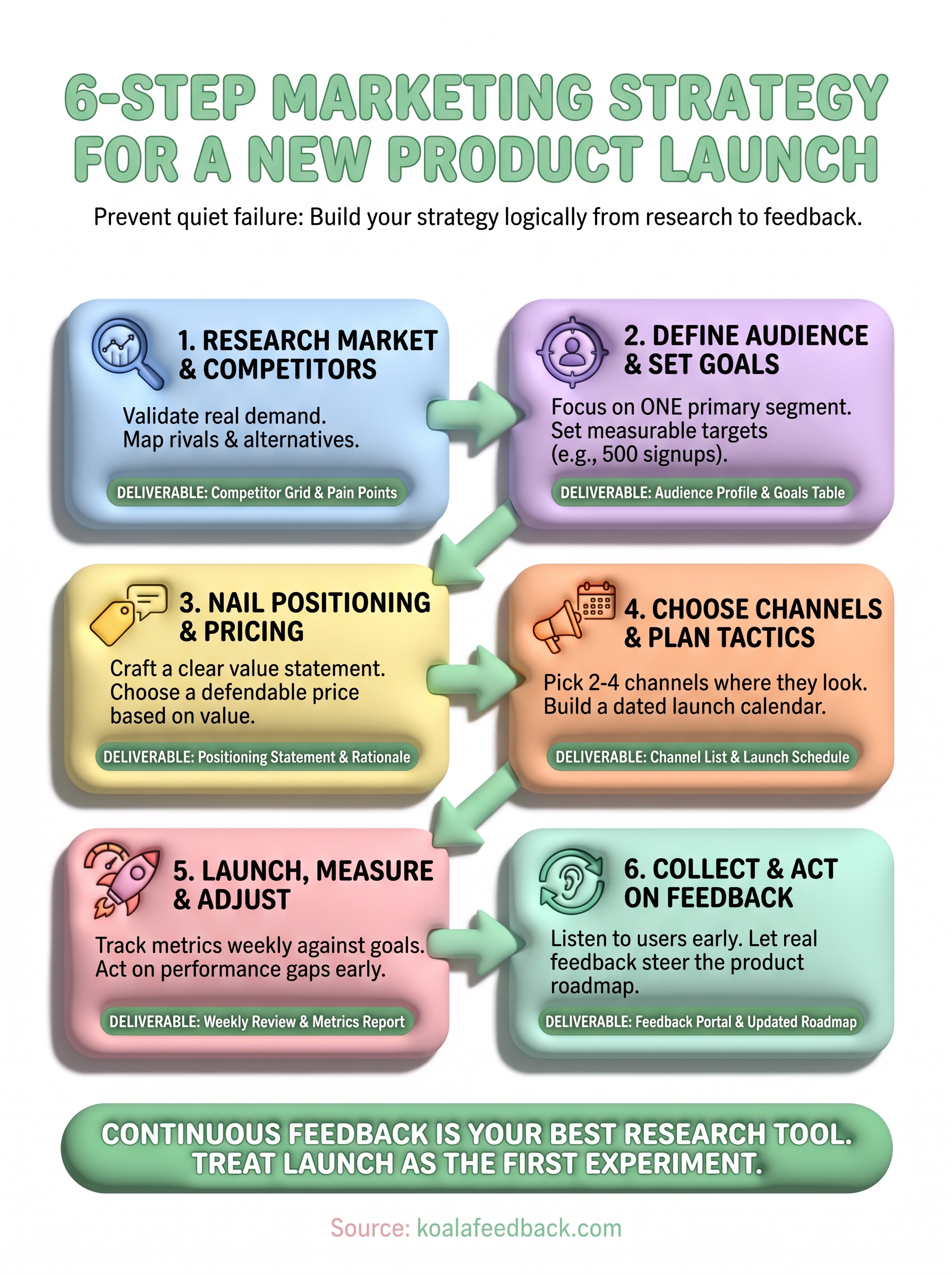
A strong marketing strategy for a new product comes down to a few decisions made in order. Research the market, pick one audience, set numbers you can track, position and price with evidence, then focus on a few channels. After launch, measure weekly and adjust based on what buyers actually do.
Start small this week. Book five customer interviews and fill in the first row of your competitor grid. Each step ends with a deliverable, so you always know what done looks like. Momentum matters more than a perfect plan.
Finally, keep listening once you ship. The best teams treat launch as the first experiment and let user feedback steer the roadmap. If you want one place to collect requests, let users vote, and share progress, set up a customer feedback system with Koala Feedback for your launch and build what your users actually ask for.

Start today and have your feedback portal up and running in minutes.