Product strategy objectives are specific, measurable goals that define what your product needs to achieve within a set timeframe. They turn your big picture vision into concrete targets you can track and act on. Think of them as the bridge between where your product is now and where you want it to be. Without clear objectives, you end up building features that feel productive but might not move the needle on what actually matters to your business and users.
This guide breaks down everything you need to know about setting product strategy objectives that work. You'll learn why they matter for product success, how to write objectives that your team can rally around, and what separates weak goals from powerful ones. We'll walk through real examples with matching KPIs, show you how to align objectives with your roadmap, and highlight the mistakes that trip up most teams. By the end, you'll have a practical framework for creating objectives that drive meaningful progress instead of just keeping everyone busy.
Your team can't execute on fuzzy aspirations. Product strategy objectives give everyone a shared target and eliminate the guesswork about what success looks like. Without them, your product team drifts between competing priorities, stakeholders push their pet features, and you end up measuring progress by how busy everyone looks rather than what actually gets accomplished. Clear objectives cut through this noise by defining exactly what you need to achieve and when you need to achieve it.
Objectives unite your cross-functional teams around common goals instead of letting each department chase their own metrics. When engineering, design, marketing, and sales all understand the specific objectives they're working toward, decisions become faster and disputes get resolved more easily. Your engineering team stops questioning why certain features matter, and your marketing team knows exactly which product improvements to highlight. Alignment reduces friction and keeps everyone rowing in the same direction instead of accidentally working against each other.

Clear objectives turn abstract strategy into something your entire team can understand and execute on.
You face constant tradeoffs about where to invest time, budget, and talent. Well-defined objectives make these decisions straightforward by giving you a framework to evaluate every request and opportunity. When someone pitches a new feature or initiative, you can ask whether it moves you closer to your objectives or distracts from them. Resource allocation becomes less political and more strategic because you have concrete criteria for what matters most right now.
Objectives with clear key performance indicators let you measure real progress instead of vanity metrics that look impressive but don't reflect meaningful change. You know whether you're on track, falling behind, or exceeding expectations at any point in your development cycle. This visibility helps you course-correct early when something isn't working rather than discovering problems months later when they're much harder to fix. Your stakeholders get honest updates based on data rather than optimistic guesses about how things are going.
Setting effective product strategy objectives requires a structured approach that connects your product vision to measurable results. You need to work backward from where you want your product to be and create specific milestones that signal progress. The process involves understanding your business priorities, translating them into product terms, and defining success metrics that your team can influence directly. Start by gathering input from stakeholders, analyzing your market position, and identifying the gaps between your current state and desired future state.
Your objectives must support the broader business strategy and product vision rather than existing in isolation. Begin by reviewing your company's quarterly or annual goals, whether they focus on revenue growth, market expansion, customer retention, or competitive positioning. Ask yourself how your product can directly contribute to these outcomes and where it currently falls short. Map each potential objective back to a business priority so you can demonstrate clear value and secure buy-in from leadership.

Look at your product vision statement and identify what needs to happen in the next three to six months to move closer to that vision. If your vision is to become the simplest project management tool for remote teams, your objectives might target onboarding friction, collaboration features, or integration capabilities. Every objective should answer why it matters to both your users and your business.
Vague objectives like "improve user experience" or "increase engagement" give your team nothing concrete to work toward. You need to attach specific metrics that clearly indicate success or failure. Instead of improving user experience, set an objective to reduce time-to-first-value from ten minutes to three minutes. Instead of increasing engagement, aim to boost weekly active users by 25% or raise feature adoption rates from 15% to 40%.
Pick metrics you can actually influence through product changes rather than external factors beyond your control.
Choose between leading indicators that predict future success and lagging indicators that confirm past results. Leading indicators like activation rates or feature discovery help you course-correct quickly, while lagging indicators like revenue or retention validate that your changes worked. Your objectives should include both types so you spot problems early and prove impact later.
Objectives need defined deadlines that create urgency without setting your team up for failure. Most product strategy objectives work best on quarterly timeframes, giving you enough runway to ship meaningful changes while maintaining focus and momentum. Longer timeframes let priorities drift and make it harder to measure what actually drove results. Shorter timeframes force rushed decisions and prevent you from gathering enough data to validate your approach.
Consider your development capacity and existing commitments when setting deadlines. An objective that requires six major features won't work in a single quarter if your team already has a full backlog. Break ambitious objectives into smaller milestones you can achieve sequentially rather than trying to do everything at once.
Share your draft objectives with engineering, design, sales, marketing, and customer success teams before finalizing them. Each group brings perspective on feasibility, customer needs, and market dynamics that you might miss working alone. Your engineering team can flag technical constraints that affect timelines, while your customer success team shares pain points that should influence your priorities. Collaborative validation surfaces potential conflicts early and builds commitment across the organization.
Test whether each objective passes the "so what" question. If someone asks why this objective matters, you should have a clear answer that connects to user value and business impact. Objectives that survive stakeholder scrutiny and the "so what" test become the foundation for your product roadmap and sprint planning.
Strong product strategy objectives separate teams that ship with purpose from teams that just ship. The difference comes down to how you write them and what criteria they meet. A weak objective sounds good in a strategy deck but gives your team no real direction when they sit down to prioritize features or make tradeoffs. Strong objectives pass several tests that ensure they actually guide decisions and measure progress rather than just filling space in your documentation.
Your objective needs enough detail that your team can use it to evaluate every feature request, bug fix, and improvement that crosses their desk. "Increase user engagement" fails this test because it doesn't tell you whether to focus on daily active users, session length, feature adoption, or something else entirely. Specificity means naming exactly what behavior or metric you're targeting and what change you expect to see. An objective like "Increase weekly active user rate from 35% to 50% among paid customers" passes because your team immediately knows which users matter and what success looks like.
Every choice your team makes should become easier when they check it against your objective. If you can't quickly determine whether a proposed feature moves you closer to or further from your objective, you haven't been specific enough. Clear objectives eliminate debates about priority and keep everyone focused on the same target.
You need to track progress on your objective using data you already collect or can easily start collecting. Objectives that require building new analytics infrastructure or waiting months for meaningful sample sizes create frustration and delay learning. Check that you have reliable baseline measurements and can instrument your product to track changes as you ship updates.
The best objectives use metrics your team can check weekly or daily rather than waiting until the end of the quarter.
Choose metrics that reflect actual user value rather than activity that looks good but doesn't matter. Time spent in your app might go up because you made navigation confusing, not because users find more value. Pick metrics that correlate with retention, satisfaction, and willingness to pay.
Strong objectives stretch your team without setting them up to fail. You want goals that require focus and good execution but don't demand miracles or depend entirely on factors outside your control. Review your historical data to understand what growth rates or improvement curves look like for your product. If you've never moved a metric by more than 10% in a quarter, setting a 100% improvement goal creates cynicism rather than motivation.
Balance ambition with realism by considering your team capacity, technical constraints, and market dynamics. An objective that requires shipping twelve major features in three months won't work if your team historically delivers four. Your objectives should feel challenging but within reach when everyone does their best work.
Product strategy objectives come to life when you see how different companies and teams apply them to solve real problems. The following examples show you how to pair objectives with specific KPIs that track progress and prove impact. Each category addresses common challenges that product teams face and demonstrates how the right objective focuses your efforts on measurable outcomes. You can adapt these examples to your own context by adjusting the metrics, timeframes, and targets to match your product stage and business priorities.
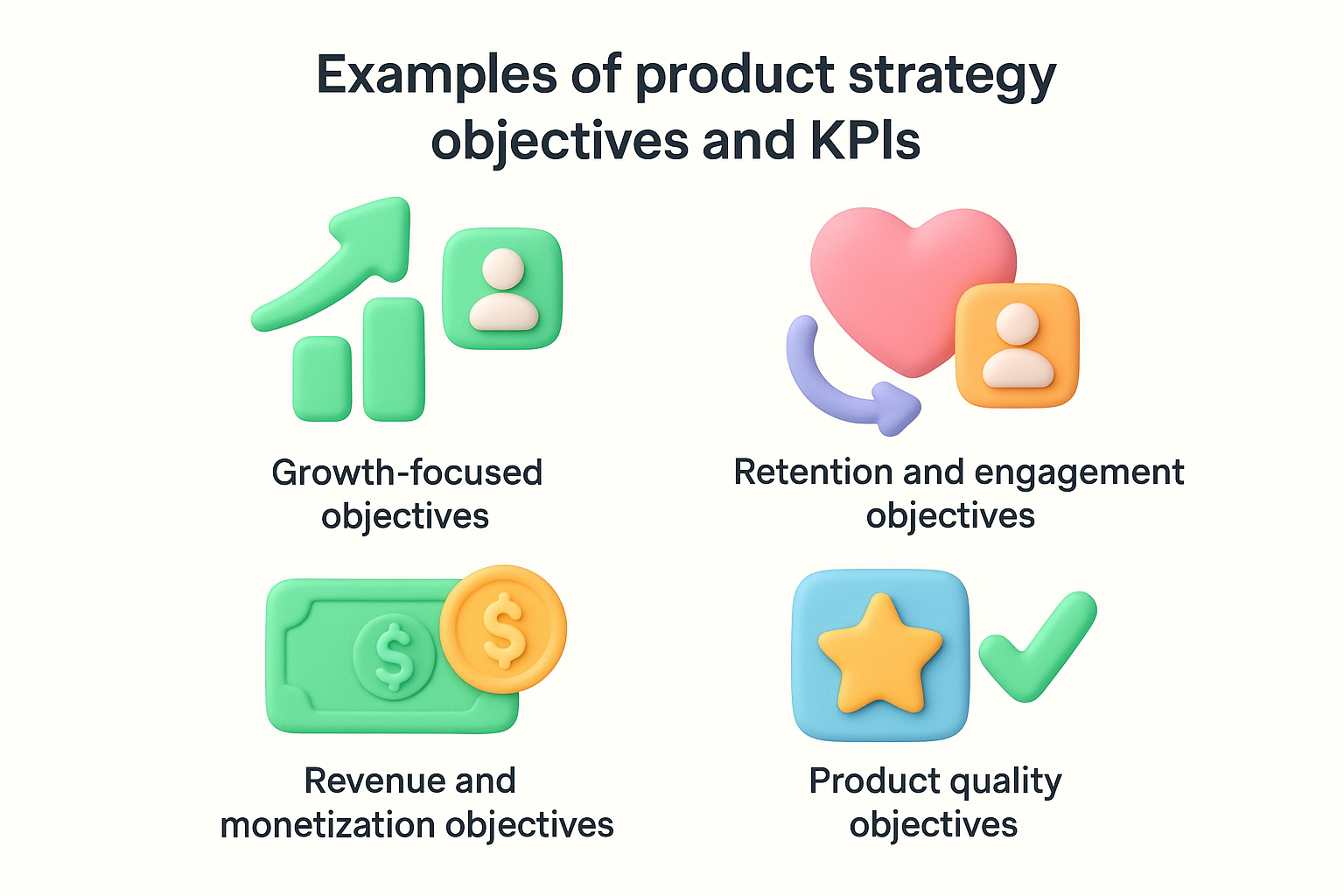
Your product needs new users to expand its market reach and prove its value to a broader audience. Acquisition objectives target the top of your funnel by making it easier for prospects to discover, try, and activate your product. An objective like "Increase free trial signups from 500 to 1,200 per month by improving landing page conversion and reducing signup friction" gives your team clear direction on where to focus improvements.
Track this objective using KPIs like signup conversion rate, cost per acquisition, and time to first signup. You might also measure activation rate within the first session to ensure new users don't just sign up but actually experience value. Monitor traffic sources to identify which channels drive qualified users versus tire-kickers who never convert.
Keeping existing users delivers more value than constantly chasing new ones. Retention objectives focus on the behaviors and experiences that make users stick around and get value from your product over time. Set an objective like "Reduce 30-day churn from 18% to 10% among new customers by improving onboarding and feature discovery" to address the critical early period where most users decide to stay or leave.
Your KPIs should include churn rate, customer lifetime value, weekly active users, and feature adoption metrics. Cohort analysis helps you compare retention across different user groups and time periods. You want to see improving retention curves that show each new cohort staying engaged longer than previous ones.
Strong retention objectives target specific user segments and time windows where you see the biggest drop-off.
Growth means nothing if you can't turn users into revenue. Monetization objectives address how you capture value from the product you've built and how you expand that value over time. An objective like "Increase average revenue per user from $45 to $65 by launching two premium features and improving upgrade messaging" connects product improvements directly to business outcomes.
Measure success through monthly recurring revenue, conversion rate from free to paid, upgrade rate to higher tiers, and expansion revenue from existing customers. Watch for changes in payment friction, pricing page effectiveness, and in-app upgrade prompts. Your best users should encounter clear paths to pay more as they extract more value from your product.
Users abandon products that frustrate them with bugs, slow performance, or confusing experiences. Quality objectives ensure your product works reliably and delivers smooth experiences that support rather than hinder user goals. Set an objective like "Reduce critical bug reports by 60% and improve app performance score from 2.8 to 4.2 stars" to make quality improvements concrete and trackable.
Track error rates, crash frequency, page load times, support ticket volume, and user satisfaction scores. Performance monitoring tools give you real-time visibility into technical health. You should see declining support volume and rising satisfaction scores as quality improvements take effect across your user base.
Your product roadmap translates strategy into action by showing what you'll build and when. Without tight alignment between your objectives and roadmap, you end up with a planning document that looks impressive but doesn't actually guide your team's work. Strong alignment ensures that every feature, improvement, and initiative on your roadmap directly contributes to achieving your product strategy objectives. This connection makes your roadmap more than a list of features by explaining why each item matters and how it drives measurable progress toward your goals.
Start by listing your active objectives alongside your roadmap and drawing explicit connections between them. Each major roadmap item should tie to at least one objective, and you should be able to explain how shipping that feature or improvement moves the needle on your target metrics. If you have a roadmap item that doesn't support any objective, question whether it deserves priority or if you're just building it because someone asked for it.

Break larger objectives into smaller initiatives that fit within your development cycles. An objective to reduce churn by 40% might require multiple roadmap initiatives like improved onboarding, better feature discovery, and proactive support triggers. Your roadmap shows the sequence and timing of these initiatives while your objectives define the overall target you're working toward. Sequence matters because some initiatives lay groundwork for others or deliver compounding benefits when shipped together.
Your roadmap should tell a coherent story about how you'll achieve your objectives rather than listing random features.
Your objectives help you explain to stakeholders why certain features made the roadmap while others didn't. When someone questions your priorities, you can point to how each roadmap item supports your measurable objectives and ask which objective they'd deprioritize to make room for their request. This shifts conversations from political battles to strategic discussions about where you'll have the biggest impact.
Use your objectives to create transparency around tradeoffs you're making. Your team and stakeholders need to understand that focusing on one objective means other areas get less attention. If your primary objective targets retention, your acquisition initiatives might move slower this quarter. Making these tradeoffs explicit through your roadmap prevents confusion and misaligned expectations about what you can realistically accomplish.
Most teams stumble over the same obstacles when setting product strategy objectives. These mistakes drain momentum, create confusion, and make it harder to prove your product's impact. The good news is that you can avoid these pitfalls once you recognize the patterns. Learning from common errors helps you create objectives that actually guide your team instead of gathering dust in strategy documents.
Your team cannot chase five major objectives simultaneously without spreading themselves too thin. You dilute focus, fragment resources, and make it nearly impossible to move any single metric meaningfully when you try to accomplish everything at once. Limit yourself to two or three objectives per quarter so your team can concentrate their efforts and make real progress rather than showing marginal improvement across too many areas.
Pick objectives that build on each other or address your most critical business need right now. If retention is bleeding, your acquisition objectives can wait. Your roadmap should reflect this focus by dedicating most of your capacity to initiatives that support your top objectives.
Choose depth over breadth by focusing on a few objectives you can actually achieve rather than many you'll barely move.
Objectives that lack specific metrics give your team no direction, while objectives that get too detailed become inflexible and constraining. "Improve customer satisfaction" fails because it doesn't tell you what to measure or how much improvement matters. "Increase help article page views by 247 within 30 days" fails because it's unnecessarily precise and focuses on a metric that might not reflect actual user value.
Find the middle ground by setting clear targets on meaningful metrics while leaving room for your team to determine the best path forward. Your objective should define what success looks like without dictating exactly how to achieve it.
You set yourself up for failure when your objectives require more work than your team can realistically deliver. Ambitious goals motivate teams, but impossible goals create frustration and burnout. Review your team's velocity and past performance before committing to objectives that assume perfect execution and no unexpected problems.
Account for ongoing maintenance work, bug fixes, and technical debt that consume 20-40% of most teams' capacity. Your objectives should reflect what you can accomplish with the time and people you actually have, not what you wish you had.
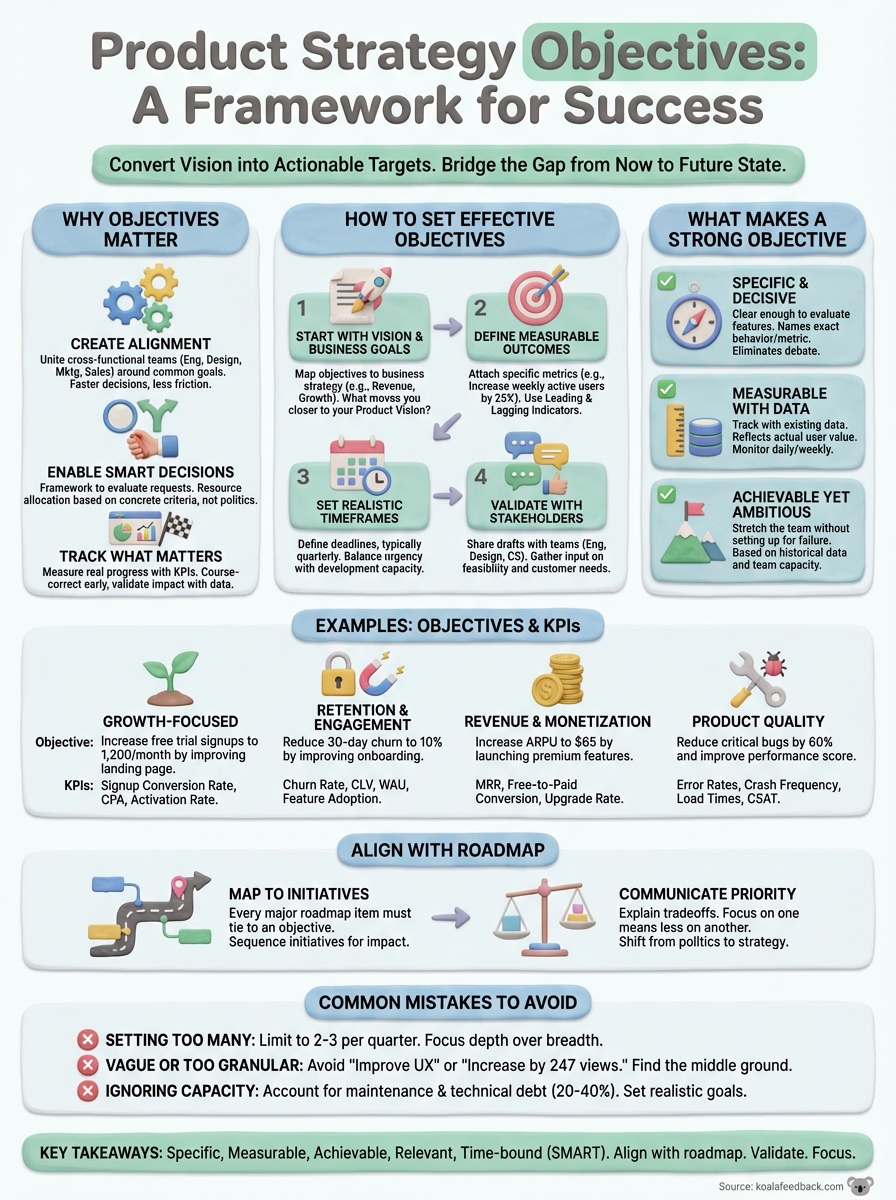
Product strategy objectives transform your vision into actionable targets that your team can execute against. They need to be specific enough to guide daily decisions, measurable with accessible data, and achievable within realistic timeframes. Focus on two or three objectives per quarter rather than spreading your team thin across too many goals. Connect each objective to clear KPIs that track progress and prove impact to stakeholders.
Your objectives should align tightly with your roadmap so every feature serves a defined purpose. Avoid vague aspirations by setting clear targets on meaningful metrics while leaving room for execution flexibility. Strong objectives require stakeholder validation, honest assessment of team capacity, and explicit tradeoffs about where you'll focus attention.
Track user feedback systematically to inform your product strategy objectives and measure whether improvements actually deliver value. Collect and prioritize feedback from users to ensure your objectives reflect real customer needs rather than internal assumptions.

Start today and have your feedback portal up and running in minutes.