Every product team drowns in opinions eventually. Someone in sales swears a feature will close deals. A support ticket says the opposite. Without a clear system, you end up guessing which voice actually represents your users. Product feedback is the fix: it's the structured information users give you about what works, what's broken, and what they wish existed, and it's the raw material every good roadmap decision is built on.
If you're trying to pin down what counts as feedback versus just noise, or you want real examples of feedback for a product before you write your own survey questions, this article gives you both. You'll see the different types of feedback, from feature requests to bug reports to satisfaction scores, and how each one should shape your next release.
We'll also walk through practical methods for collecting it, in-app widgets, interviews, NPS surveys, and dedicated portals, plus how to organize what comes in so it doesn't just pile up unread. By the end, you'll know how to turn scattered comments into a prioritized, actionable list your whole team can work from.
Teams that skip structured feedback collection end up building on guesswork, and guesswork is expensive. You can ship a feature that took three months of engineering time only to watch adoption sit at 2%, because nobody asked the people who'd actually use it. Product feedback removes that gamble by replacing internal debate with evidence from the people who pay you, which is why customer feedback drives better products than any internal hunch. It's not a nice-to-have for customer success teams to gather in their spare time; it's the input layer for every decision your roadmap depends on.
Guessing feels efficient in the moment, but it's the slowest way to build a product people actually want. When you rely on the loudest voice in the room, whether that's a sales rep, an executive, or your own intuition, you're optimizing for whoever spoke last instead of what your broader user base needs. Structured feedback flips that. Instead of one anecdote, you get patterns: forty users asking for the same integration, a recurring complaint about onboarding, a feature nobody uses despite being everyone's favorite in planning meetings. That pattern recognition is only possible when feedback is collected consistently and stored somewhere your team can search, not scattered across Slack threads and forgotten email replies.
If you're not collecting feedback systematically, you're not making product decisions, you're making guesses with extra steps.
Unhappy customers rarely announce themselves before they leave. They quietly stop logging in, downgrade their plan, or let their trial expire without a word. Customer retention improves when you catch friction early, and feedback channels are often your earliest warning system. A spike in complaints about a slow feature, a repeated request for a missing permission setting, or a drop in satisfaction scores after a redesign all tell you something is wrong before the churn report confirms it a quarter later, which is exactly what customer surveys and feedback are there to surface. Companies that treat feedback as a retention tool, not just a product research exercise, catch these signals while there's still time to act.
Asking for feedback and then doing nothing with it is worse than not asking at all. Users notice when their suggestions vanish into a black hole, and it teaches them that submitting feedback is a waste of time. On the other hand, when you close the loop, tell someone their bug report got fixed, or show that a requested feature shipped, you build a kind of trust that marketing copy can't buy. This is exactly why tools like a public roadmap matter: they turn feedback from a one-way submission into a visible, ongoing conversation. Koala Feedback's feedback portal is built around this idea, giving users a place to submit ideas, vote on existing ones, and watch their status change from planned to in progress to done.
Without a shared feedback system, every department ends up with its own private version of "what users want." Support hears about bugs. Sales hears about missing features that would close deals. Product hears whatever made it into the last quarterly survey. These versions rarely match, and reconciling them in a meeting wastes hours that could go toward actually building something. Keeping product feedback in one system, categorized and searchable, gives every team the same source of truth. That alignment alone can cut weeks off a planning cycle because nobody's arguing over whose anecdote is more representative.
The difference between teams that formalize feedback collection and teams that don't shows up in outcomes you can actually track, not just in vague cultural benefits.
| Without structured feedback | With structured feedback |
|---|---|
| Roadmap driven by internal opinion | Roadmap driven by user demand data |
| Churn signals discovered too late | Early warning from recurring complaints |
| Users feel ignored, stop submitting ideas | Users see status updates, stay engaged |
| Teams argue over priorities | Shared, visible priority list |
| Feature requests lost in email/Slack | Requests tracked, voted on, and searchable |
Getting these outcomes doesn't require a massive research department. It requires a system, even a simple one, that captures feedback consistently and makes it visible to the whole team. The next section breaks down the different types of feedback you'll actually encounter, so you know what you're looking at before you try to organize it.
Not all feedback deserves the same response, and treating a bug report the same way you treat a feature request is how backlogs turn into chaos. Before you can collect or prioritize anything, you need to recognize the different flavors of customer feedback landing in your inbox, because each one signals a different kind of urgency and requires a different owner on your team. Some of it needs a fix today, some of it needs a vote count over months, and some of it just needs an acknowledgment. Sorting these out at the point of collection saves you from re-reading the same comment three times trying to figure out what to do with it.
Requests are the most common form of feedback for a product, and feature request examples range from small tweaks ("let me sort this table by date") to entirely new capabilities ("add a Zapier integration"). These are forward-looking; the user isn't reporting a problem with what exists, they're describing something that doesn't exist yet. Volume matters here more than eloquence: one polished suggestion from a single power user carries less weight than fifteen scattered, badly worded requests for the same integration. A feedback portal where users can upvote existing requests instead of submitting duplicates makes this volume visible instantly instead of buried across support tickets.
Bugs are feedback about a gap between what you promised and what actually happens. A user clicks a button and nothing loads, or a report exports with the wrong numbers. Unlike feature requests, bugs usually need triage speed, not vote counts, because they represent something actively broken for whoever hit them. Still, tracking bug reports alongside other feedback types matters: a bug mentioned by one user is a fix; the same bug mentioned by forty is a fire.
Confusing a bug report with a feature request is the fastest way to misprioritize your entire backlog.
Surveys like NPS and CSAT capture sentiment rather than specific asks. A score alone tells you little, but a score paired with an open comment ("I'd recommend you, but onboarding took forever") tells you where to look. This category is less about individual action items and more about tracking trend lines over time.
Usability comments describe friction, not missing features or broken code. "I couldn't find the export button" or "I didn't realize I needed to save before switching tabs" point to design and copy problems, not engineering ones.
| Feedback type | What it signals | Typical owner |
|---|---|---|
| Feature request | Missing capability | Product |
| Bug report | Broken behavior | Engineering |
| Satisfaction score | Overall sentiment trend | Product/CS |
| Usability comment | Design or copy friction | Design/Product |
Recognizing which bucket a comment falls into, before it gets logged, is what makes the collection process described next actually usable instead of just noisy.
Gathering product feedback only works if you make it easy for users to give it in the moment they're actually thinking about your product, not three weeks later when you send a survey they've forgotten the context for. Different methods for collecting product feedback catch different moments, so most mature teams run several channels at once instead of betting on one. The goal isn't to collect the most feedback possible; it's to collect feedback that's specific, attributable, and easy to act on later.
Website feedback widgets embedded directly in your product catch feedback while the frustration or idea is fresh, which is exactly when users are most honest and specific. A dedicated feedback portal, like the one Koala Feedback provides, goes further by giving users a permanent place to submit ideas, browse what others have already suggested, and vote instead of duplicating a request that's already been logged; it helps to know what to look for in a feedback portal before you set one up. This also solves a problem widgets alone can't: visibility. Users see their idea sitting next to fifty others' votes, which tells them (and you) how much real demand exists.
A feedback portal turns scattered one-off comments into a visible, votable list your whole team can act on.
Interviews get you depth that no widget or survey can match. A fifteen-minute call with a customer who just churned, or one who just upgraded, surfaces the reasoning behind a decision, not just the decision itself. Talking through a workflow live also reveals usability friction the user wouldn't think to write down in a form. The tradeoff is scale: you can't interview a thousand users a month, so treat interviews as a way to add texture to the patterns your other channels already surfaced.
Surveys work best when they're short and specifically timed, not blasted quarterly to your entire user base. An NPS survey sent right after a support ticket closes tells you something different than one sent to a brand-new trial user, so choose the questions worth asking in a product survey for each moment. Keep the open-text field mandatory when the score is low; a number without context is nearly useless.
Some of your best feedback for a product never arrives through a form at all. It's buried in support tickets, sales call notes, and public reviews on sites like G2 or Capterra. This feedback is passive, meaning nobody's specifically asking for it, so it needs a deliberate process to pull it into your central system rather than staying siloed in whatever tool your support team uses.
| Method | Best for | Effort to run |
|---|---|---|
| Feedback portal | Ongoing requests, voting, prioritization | Low once set up |
| In-app widget | Catching friction in the moment | Low |
| Interviews | Deep context, understanding "why" | High |
| NPS/CSAT surveys | Sentiment trends over time | Medium |
| Support/sales/reviews | Passive signals you'd otherwise miss | Medium (needs a routing process) |
Whichever mix you choose, route everything into one place. Feedback split across five disconnected tools is functionally the same as feedback nobody collected at all.
Most feedback fails not because users lack opinions, but because they write vague ones. "This is confusing" or "please improve the dashboard" gives your team nothing to act on. Good product feedback is specific enough that someone reading it six months from now, with zero context, still understands exactly what happened and why it mattered. Whether you're coaching your users toward better submissions, writing a feature request that gets prioritized, or giving feedback yourself as part of a beta test, the same rules apply.
Saying "the export button doesn't work" tells you something broke, but not what, where, or for whom. Compare that to "clicking export on the monthly report tab returns a blank CSV when I filter by date range." The second version names the exact screen, the exact action, and the exact result. Specificity like this turns a mystery into a reproducible ticket, which is the difference between a bug getting fixed this week or sitting untouched for a month because nobody can recreate it.
Vague feedback gets ignored. Specific feedback gets fixed.
Context turns a complaint into a priority. A missing feature is easy to dismiss until you know it's blocking someone from closing a $50,000 deal, or that it's the reason three teammates on the same account stopped logging in. When you write feedback for a product, include what you were trying to accomplish, what got in the way, and what happened as a result. "I couldn't set custom permissions for a new hire, so I had to give them full admin access, which our security team flagged" tells a much richer story than "need better permissions."
Users often propose a specific fix when what actually matters is the outcome behind it. Someone asking for a "dark mode toggle" might really be asking for less eye strain during long sessions, which could be solved several ways. Encouraging people to describe the outcome they want, alongside any solution they have in mind, gives your product team room to find the best fix rather than being boxed into one specific implementation that might not be technically feasible.
A single feedback entry that bundles three unrelated complaints is nearly impossible to categorize, vote on, or resolve cleanly. Split multi-part feedback into separate entries so each one can be tracked, tagged, and voted on independently. This matters most inside a feedback portal, where votes only carry meaning if they're attached to one clear idea instead of a paragraph covering five different requests.
A simple template helps guide users toward this structure without making the process feel like homework:
What happened: [describe the specific action and result]
Where: [screen, feature, or workflow]
Why it matters: [impact on your work, team, or business]
What you'd want instead: [desired outcome, not necessarily a fix]
Sharing a lightweight prompt like this in your feedback portal's submission form costs nothing to set up and pays off every time someone writes "broken" instead of describing what actually broke.
Collecting feedback is the easy part. The hard part is handling two hundred incoming feature requests, forty bug reports, and a handful of executives each convinced their pet feature is the priority. Product feedback only creates value once it's ranked against something, whether that's user demand, business impact, or effort required. Without a framework, prioritization turns into whoever argues loudest in the planning meeting, which defeats the entire point of collecting feedback in the first place.
Gut-feel prioritization breaks down the moment your backlog crosses a hundred items, because nobody can hold that much context in their head at once. Scoring requests against consistent criteria fixes this by forcing every request through the same lens: how many users asked for it, how much it would move a metric you care about, and how expensive it is to build. Prioritization frameworks like RICE (reach, impact, confidence, effort) and simpler weighted vote counts both work fine; the model matters less than using one consistently. Boards inside a feedback portal make this easier because vote counts already give you a reach number without extra research.
A backlog ranked by data beats a backlog ranked by whoever spoke last in the meeting.
One detailed, passionate email from a single enterprise account can feel urgent, but it isn't the same signal as fifty quieter votes from across your user base. Both matter, just differently. A request from your biggest account might justify a custom build even with low overall volume, while a widespread but low-intensity request might justify a smaller, faster fix that satisfies many people at once. Tagging feedback by account size and plan tier when it comes in, not after, lets you weigh these two signals separately instead of accidentally treating a squeaky wheel as a majority opinion.
Raw feedback almost never arrives already organized into clean categories, which means ranking it too early usually means ranking duplicates against each other. Before scoring anything, cluster similar requests into themes and tags so a vote count actually reflects demand instead of being split across five near-identical entries. Prioritization boards inside Koala Feedback's prioritization tools are built for exactly this: grouping requests into logical categories by product area so you're ranking themes, not scattered one-off comments.
Deciding what to build is only half the job; showing your users what happened next is what keeps them submitting feedback instead of giving up on the process. Sharing your roadmap publicly with statuses like planned, in progress, and done turns a private prioritization decision into a visible commitment. Users who voted on a request see it move through stages instead of disappearing into a backlog they can't see. This step is often skipped because it feels like extra work, but it's the single biggest driver of whether people bother giving you feedback again.
| Prioritization signal | What it tells you | Where to find it |
|---|---|---|
| Vote count | Breadth of demand | Feedback portal |
| Account size/plan tier | Weight of a single request | CRM, tagged feedback |
| Effort estimate | Cost to build | Engineering |
| Status visibility | Whether users stay engaged | Public roadmap |
Once you've got a ranked, grouped list and a way to show progress publicly, feedback stops being a pile to manage and becomes an actual input into what ships next.
Reading examples side by side makes the difference between weak and strong product feedback obvious in a way that abstract advice can't. Below are real-world scenarios rewritten to show what changes when someone applies the specificity and context described in the last section. Each pair starts with the kind of comment that lands in most inboxes and ends with a version your team could act on the same day.
Users often submit feedback the moment something annoys them, which means the first draft is rarely the most useful version. "The dashboard is slow" tells you nothing about which dashboard, which action, or which browser. A stronger version names the exact trigger: "Loading the analytics dashboard on Chrome takes over 15 seconds when a date range longer than 90 days is selected." That single sentence gives engineering a reproducible starting point instead of a guessing game.
Compare "add SSO please" to a submission that includes the stakes behind it: "We can't roll this out to our security team without SSO, and that's 40 seats we're holding off on activating." The second version turns a generic ask into a prioritization signal your product team can actually weigh against effort and reach. This is exactly why encouraging context in the submission form pays off, since the same request can sit at the bottom of a backlog or jump to the top depending on how much impact the user attaches to it.
The best feedback reads less like a complaint and more like a business case.
Good bug reports read almost like a lab notebook. Instead of "export is broken," a well-written report looks like this:
What happened: CSV export returns an empty file
Where: Reports > Monthly Summary tab
Steps: Filter by custom date range, click Export CSV
Expected: File with filtered row data
Actual: File downloads but contains only headers
Handing engineering this level of detail cuts the back-and-forth that normally happens when a bug can't be reproduced from a one-line ticket.
Sometimes the best example isn't the initial submission but what happens after. A user requests a feature inside a feedback portal, other users add votes over the following weeks, and the status changes from "planned" to "in progress" to "done." The original submitter gets notified automatically, sees their idea reflected in a shipped feature, and often comes back to submit more feedback because they watched the process actually work. Koala Feedback's public roadmap feature exists specifically to make this visible, so the example isn't hypothetical, it's what a product feedback loop that actually runs looks like end to end.
| Weak version | Strong version |
|---|---|
| "This is confusing" | "I couldn't find where to invite teammates from the settings page" |
| "Add dark mode" | "Dark mode would reduce eye strain during our team's evening support shifts" |
| "Export is broken" | Reproducible steps with expected vs. actual result |
| "Please prioritize this" | "This is blocking a $50k renewal for our account" |
Notice that none of these strong examples require more effort to write, just more specificity about what happened, where, and why it mattered.
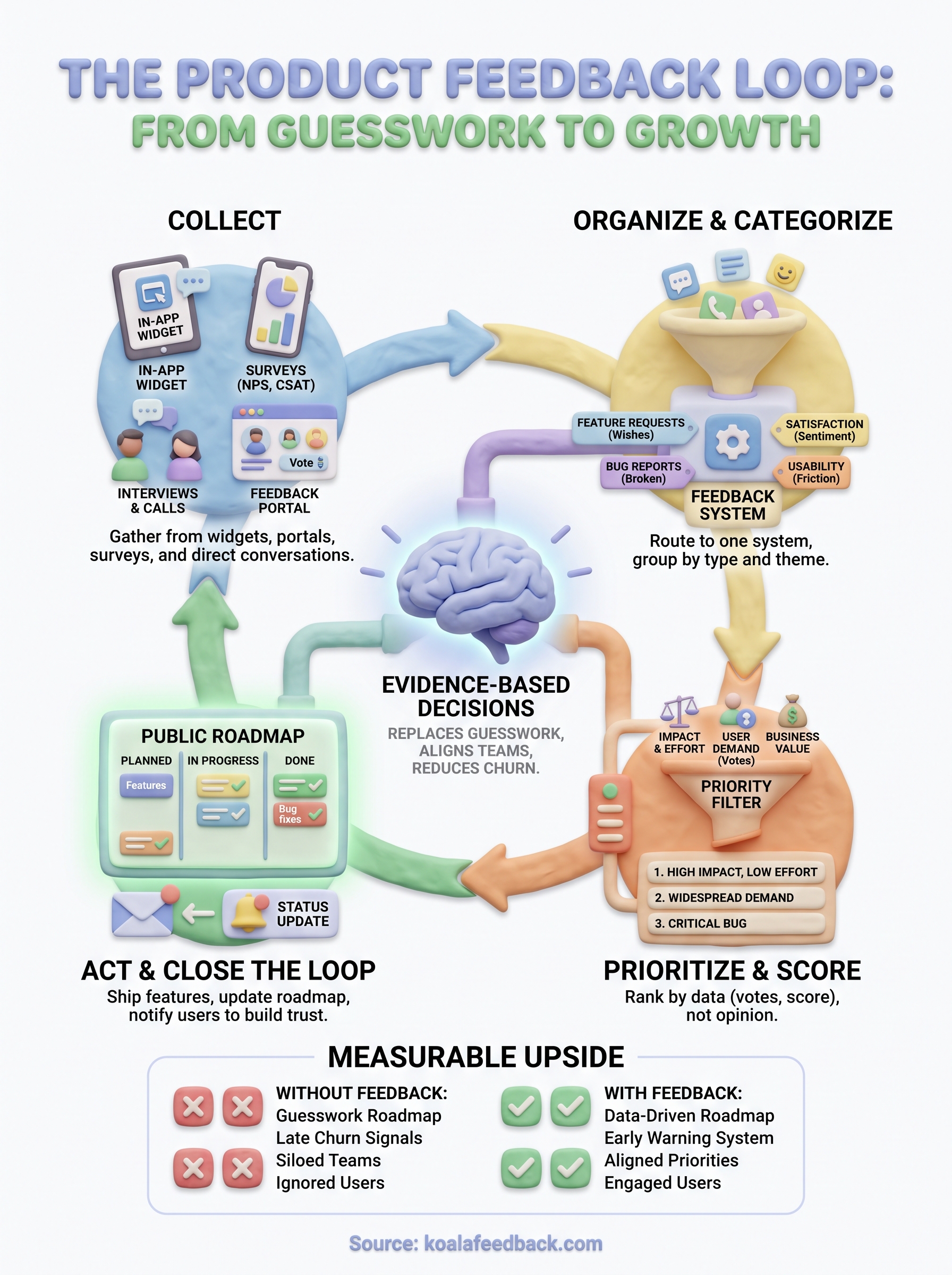
Good product feedback isn't a one-time survey you run before a launch. It's a habit: collect it consistently, sort it by type, write it with enough context to act on, and prioritize it against real demand instead of whoever spoke last in a meeting. The teams that do this well don't have more opinions to work with than everyone else. They just have a system that turns scattered comments into a ranked, visible list, and they close the loop publicly so users keep coming back with more.
You don't need a research department to start. You need one place where feedback for a product lands, gets voted on, and moves through a status your users can actually see. If you're still managing requests across spreadsheets and Slack threads, that's the gap worth closing first. Try Koala Feedback and give your users a real place to submit and vote on ideas.

Start today and have your feedback portal up and running in minutes.