Every feature you ship without user input is a gamble. Some pay off. Many don't. The SaaS teams that consistently win are the ones who've figured out how to collect product feedback and actually use it to drive development decisions.
But here's the problem: feedback is everywhere and nowhere at once. It's buried in support tickets, scattered across Slack channels, mentioned in sales calls, and hiding in NPS responses. Without a clear system, the most valuable insights get lost, or worse, the loudest voices drown out what most users actually need.
This guide covers 12 practical methods for collecting product feedback, whether you're validating a new feature idea or improving an existing product. At Koala Feedback, we've built a platform to help teams centralize and prioritize this input. But whatever tools you use, these methods will help you listen better and build smarter.
You can't ask the right questions if you don't know who you're asking or what they've done in your product. Before you send a survey or schedule an interview, gather the context that will make those conversations valuable. This groundwork separates useful insights from noise.
Start by identifying who your users are and how they use your product. Different user segments have different needs, and mixing their feedback together creates confusion. A user on your free plan who logs in once a month has different priorities than an enterprise customer using your product daily.
Build a simple segmentation framework based on actual usage patterns and customer attributes. You need this data in your system before you start collecting feedback so you can filter responses and spot patterns.
User Segmentation Template:
- Plan Type: Free, Pro, Enterprise
- Usage Frequency: Daily, Weekly, Monthly, Inactive
- Role: Admin, Member, Viewer
- Company Size: 1-10, 11-50, 51-200, 201+
- Time as Customer: 0-30 days, 31-90 days, 91-365 days, 365+ days
Product analytics reveal what users actually do, not what they say they do. Before you ask for feedback, track key behaviors that signal engagement, frustration, or interest. This data gives you the power to ask targeted questions instead of generic ones.
Set up tracking for feature adoption rates, drop-off points, and repeated actions. If users keep clicking a disabled button or repeatedly visit a specific screen, you've found something worth investigating. These signals tell you where to dig deeper with qualitative feedback.
Behavioral data also helps you validate what users tell you. Someone might say they'd use a feature every day, but if similar features show 5% adoption in your current product, you have a reality check built in.
Behavioral data reveals the problems users experience but can't always articulate.
Asking for feedback without a clear goal wastes everyone's time. You need to know what decisions this feedback will inform and what you'll do with the answers before you start collecting responses. Vague questions produce vague insights.
Write down specific questions you need answered before launching any feedback initiative. Are you validating a new feature concept? Identifying pain points in an existing workflow? Understanding why users churn? Each goal requires different questions and different collection methods.
Your goals should tie directly to product decisions you're making. If you're not prepared to act on the feedback, don't collect it. Users notice when their input disappears into a black hole, and they'll stop responding.
Feedback Goal Framework:
1. Decision to make: [What are you deciding?]
2. Key question: [What do you need to know?]
3. Who to ask: [Which user segment?]
4. Success metric: [How will you measure if feedback was valuable?]
5. Timeline: [When do you need answers?]
Understanding how to collect product feedback starts with this preparation work. The methods you choose in the next section will be far more effective when you know your segments, have behavioral context, and have clear goals driving the process.
A feedback loop is only as good as the system that closes it. Most teams collect feedback and then watch it pile up in different tools, channels, and spreadsheets. The loop never closes because no one owns the process, and insights get lost in translation between teams. You need a structure that captures feedback, routes it to the right people, and tracks action from start to finish.
Someone needs to be responsible for the feedback system. Without clear ownership, feedback sits in limbo while everyone assumes someone else is handling it. Assign a specific person or team to manage incoming feedback, triage requests, and ensure responses reach users.
This owner doesn't need to answer every piece of feedback personally, but they coordinate the flow. They tag feedback by category, route technical questions to support, send feature requests to product, and make sure nothing falls through the cracks.
Pick one central location where all feedback lives, regardless of where it originated. When you scatter feedback across email, Slack, support tickets, and spreadsheets, you lose the ability to spot patterns and prioritize effectively. Everything should flow into your central system.
Build a simple intake process that captures feedback from every channel and moves it to this central location. If a customer mentions a feature in a sales call, it goes into the system. If support hears a complaint, it goes into the system. If someone tweets feedback, it goes into the system.
A centralized feedback system reveals patterns that scattered data hides.
Feedback Intake Checklist:
□ Set up email forwarding rules to central system
□ Add feedback collection links to support workflows
□ Create Slack commands or integrations for quick logging
□ Train sales team to submit feedback after calls
□ Set up automated imports from survey tools
Knowing how to collect product feedback means building it into your existing processes, not treating it as a separate activity. Add feedback review sessions to your regular sprint planning or roadmap discussions. Make it a standard agenda item, not an occasional check-in.
Set up automatic notifications when high-value feedback arrives. If an enterprise customer reports a bug or an active user requests a feature, the right people should know immediately. Create review cadences that match your development cycle so feedback informs decisions while they're still being made.
Mastering how to collect product feedback means using multiple channels that reach users at different stages of their journey. You won't get complete picture from a single method. Some users will respond to in-app prompts while others prefer giving feedback through direct conversations. The best teams deploy a mix of these approaches and adjust based on what generates the most actionable insights.
Capture feedback inside your product where users experience problems or discover needs. In-app methods work because they catch users in context, right when they're thinking about your product. You get immediate reactions instead of asking users to remember their experience later.
Feedback widgets let users submit ideas without leaving your product. Microsurveys pop up after specific actions to gauge satisfaction or gather quick reactions. Feature voting boards embedded in your app let users upvote existing requests and see what others want. NPS surveys triggered at key milestones measure overall satisfaction and identify promoters versus detractors.
Schedule one-on-one interviews with users who represent your key segments. These conversations uncover the "why" behind behavior that data alone can't explain. User testing sessions show you exactly where people struggle with your interface or workflow.
Send targeted email surveys to specific user groups based on their behavior or characteristics. Keep surveys short and focused on one decision. Phone or video calls with high-value customers build relationships while gathering detailed feedback about their needs and challenges.
Direct conversations reveal context and motivation that surveys miss.
Build a public feedback portal where users submit ideas, vote on requests, and see your roadmap. This creates transparency and reduces duplicate requests by showing users that others share their needs. Monitor support tickets systematically for recurring themes that signal product gaps.
Track social media mentions and participate in relevant communities where your users discuss problems your product could solve. Analyze churn surveys to understand why users leave and what would have kept them. Set up feedback buttons in your documentation and help center to catch users when they're searching for solutions that don't exist yet.
Collecting feedback is only half the battle. The real challenge is transforming hundreds of raw requests into a prioritized backlog that drives actual product decisions. Without a clear prioritization framework, you'll end up building the loudest requests or the easiest fixes instead of the features that move your business forward.
Assign each piece of feedback a priority score based on potential impact and required effort. Impact measures how many users this affects and how significantly it improves their experience. Effort estimates the development resources and time needed to build it.
Create a simple scoring system that your team can apply consistently. You don't need complex formulas. A basic framework helps you compare requests objectively instead of relying on gut feelings or whoever spoke up most recently in your planning meeting.
Priority Scoring Template:

Impact Score (1-10):
- How many users does this affect? (1-4 points)
- How critical is this to their workflow? (1-3 points)
- Does this unlock revenue or reduce churn? (1-3 points)

Effort Score (1-10):
- Development complexity (1-4 points)
- Design requirements (1-3 points)
- Testing and deployment difficulty (1-3 points)

Priority = Impact Score / Effort Score
Users describe the same problem in different ways. One person requests a bulk edit feature while another asks for multi-select options, but they're both trying to save time on repetitive tasks. Grouping similar feedback reveals the underlying need and shows you how many users share it.
Tag each request with categories and themes as it comes in. Look for patterns across different user segments. When ten users from different companies describe variations of the same workflow problem, you've found something worth prioritizing. This aggregation transforms scattered complaints into clear product opportunities.
Grouped feedback reveals problems that individual requests hide.
Link each piece of feedback to your business metrics and user outcomes. Knowing how to collect product feedback matters less if you can't connect requests to results. Ask yourself what changes if you build this feature. Does it increase activation, improve retention, or unlock expansion revenue?
Build a traceability system that connects feedback to roadmap items and eventually to shipped features. Track which requests influenced each decision so you can measure whether the feedback led to positive outcomes. This connection helps you refine your prioritization process over time and proves the value of listening to users.
Users who take time to share feedback expect acknowledgment and action. When you collect input and then go silent, you train people to stop responding. The loop isn't complete until you communicate back what happened with their suggestions. This communication builds trust and keeps users invested in your product's direction.
Send an immediate acknowledgment when someone submits feedback. A simple automated message confirming you received their input shows respect for their time. Include what happens next and when they might hear more. This basic courtesy prevents the feeling that feedback disappeared into a void.
Follow up with personal responses when possible, especially for detailed suggestions or feedback from high-value users. You don't need to commit to building every request, but explain your thinking. If you're not prioritizing something, tell them why. If you need more context, ask clarifying questions.
Acknowledgment Email Template:

Subject: We received your feedback about [Feature/Issue]

Hi [Name],

Thanks for taking the time to share your thoughts on [specific topic].
We've added your feedback to our system and our product team will review it.

You can track the status of this request at: [link to feedback portal]

We'll update you when there's progress to share.

[Your name]
[Your team]
Build a public roadmap that displays planned, in-progress, and completed features linked to user requests. When users see their feedback move from submitted to planned to shipped, they understand their voice matters. This transparency demonstrates that understanding how to collect product feedback is worthless without showing what you do with it.
Update request statuses regularly and notify users who voted for or commented on items as they progress. Send notifications when you start building a requested feature and again when you ship it. These updates keep users engaged and watching for changes.
Users stay engaged when they see their feedback transform into actual features.
Announce new releases by highlighting the users who requested them. Credit specific feedback that influenced your decisions. This recognition rewards participation and encourages others to share their ideas. You build a community of invested users who feel ownership in your product's evolution.
Send personalized launch announcements to users who requested a feature or voted for it. Show them exactly how their input shaped the final implementation. Thank them for pushing you to build something better than your original plan.
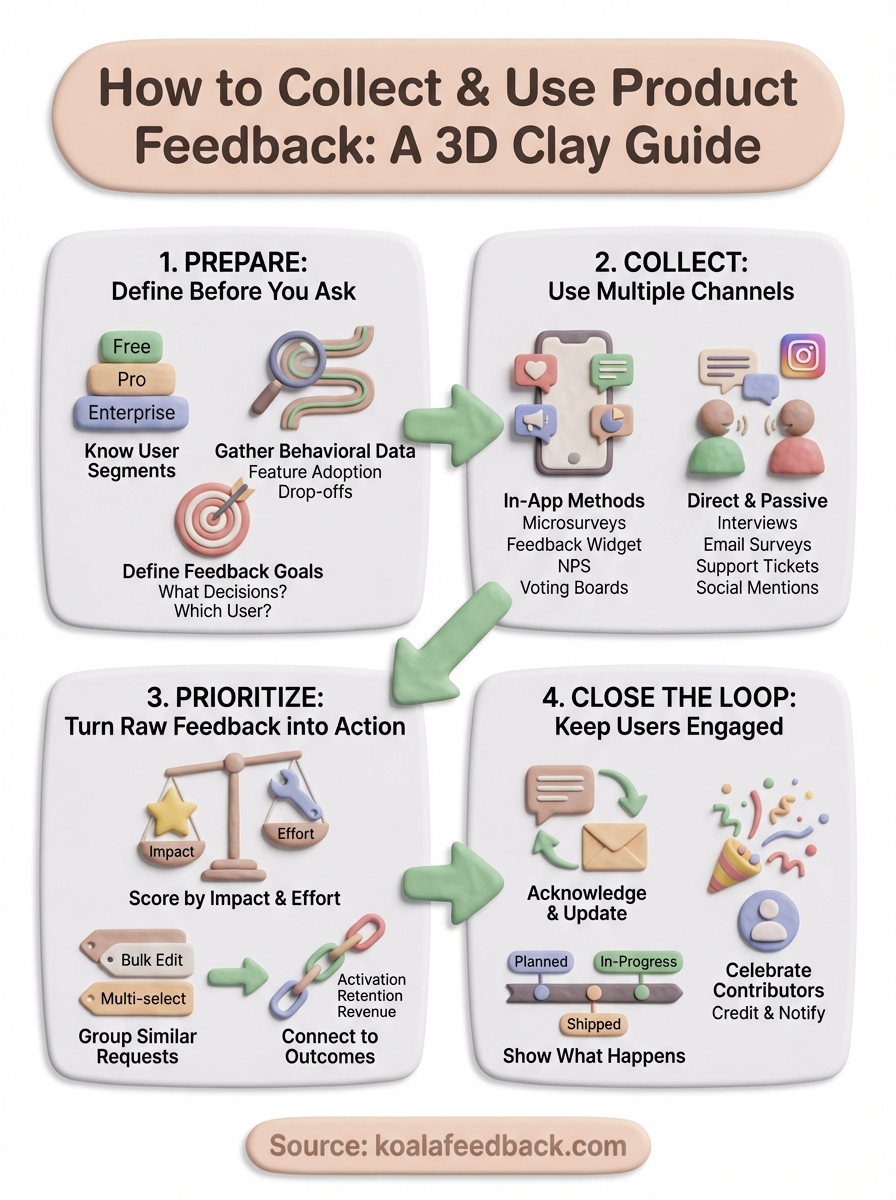
Understanding how to collect product feedback is only valuable when you act on what you learn. Start with one or two methods from this guide that match where your users spend time. Build consistency before expanding to more channels.
Review collected feedback weekly with your product team. Pick the highest-impact requests that align with your roadmap and ship them. Track which sources generate the most actionable insights and double down on those methods.
The teams that win close the feedback loop consistently. They listen, prioritize, build, and communicate results back to users who contributed. Without action, collected feedback won't improve your product.
Koala Feedback helps you centralize all this input in one place, organize requests by priority, and share your roadmap with users. You can start collecting and acting on feedback today instead of building features in the dark.

Start today and have your feedback portal up and running in minutes.