Your customers are already telling you what they think, through support tickets, reviews, social media posts, and survey responses. The challenge isn't collecting that feedback. It's making sense of it at scale. That's exactly where customer sentiment analysis tools come in, helping you detect patterns in how people feel about your product, identify frustrations before they escalate, and spot opportunities you'd otherwise miss.
At Koala Feedback, we help teams collect and organize user feedback in one place. But understanding the emotion behind that feedback, whether someone is frustrated, delighted, or about to churn, requires a different layer of analysis. Sentiment analysis software bridges that gap, turning raw opinions into structured, actionable data that product and support teams can actually use to make better decisions.
We reviewed dozens of tools and narrowed the list to 11 that stand out in 2026. Below, you'll find options ranging from AI-powered enterprise platforms to free tools suited for smaller teams, along with what each one does best and where it falls short.
Koala Feedback is built for product teams that want to centralize user feedback and understand what users actually want from their product. While many customer sentiment analysis tools focus on social media monitoring, Koala Feedback zeroes in on the feedback that comes directly from your users, making it easier to detect patterns in requests, complaints, and feature suggestions.
Koala Feedback excels at collecting and organizing structured feedback from your user base in one place. Its automatic deduplication and categorization mean you spend less time sorting through noise and more time acting on real signals. When multiple users report the same frustration, the platform groups those requests together so you can gauge sentiment at a glance without reading every individual submission.
The ability to see which issues and requests are generating the most votes gives you an immediate read on what your users care about most.
Koala Feedback pulls in feedback through its dedicated feedback portal, where users can submit ideas, vote on existing requests, and leave comments. You can embed the portal directly into your product or share it as a standalone link, which means feedback comes from active users who are already engaged with what you're building.
The platform's voting and commenting system lets users signal how strongly they feel about a request, giving you a simple but effective way to rank sentiment by intensity. The public roadmap feature goes further by letting you close the loop with users, showing them what's planned, in progress, and completed so they stay informed throughout the development cycle.
Setup takes minutes. You get a customizable feedback portal with your own domain, colors, and logo. Native integrations connect Koala Feedback to the tools your team already uses, so feedback flows into your existing workflow without friction or manual work.
Koala Feedback offers a free plan that gives smaller teams access to core features without a credit card. Paid plans scale with your team's needs and unlock advanced customization, making it a practical option whether you run a two-person startup or a growing product organization.
Built for enterprise teams that process large volumes of customer feedback, Chattermill is an AI-powered customer intelligence platform that goes beyond basic sentiment scores. It uses deep learning models to detect nuanced sentiment tied to specific product themes, giving you a more precise read on how customers actually feel.
Chattermill stands out among customer sentiment analysis tools for its ability to unify fragmented feedback into one structured view. The platform automatically links sentiment to specific product areas or customer journey stages, so you can quickly pinpoint where users struggle most rather than reading through thousands of raw responses.
Teams using Chattermill can connect feedback trends directly to business metrics like churn and NPS, making it easier to justify product decisions with real data.
The platform pulls data from multiple feedback channels and centralizes everything into one dashboard. Supported sources include:
This gives your team a unified view of customer sentiment without switching between separate tools.
Topic modeling and theme detection are Chattermill's strongest technical assets. You can drill into specific themes, filter by time period, and track how sentiment around a feature shifts after a product update or change.
Chattermill connects with tools like Zendesk, Intercom, and Salesforce, with setup typically handled by their onboarding team. This approach makes it better suited for larger organizations with dedicated implementation resources.
Pricing follows a custom enterprise model with no public tiers listed. There is no free plan available, so you'll need to contact their sales team directly to get a quote.
Sprout Social is primarily a social media management platform, but its built-in sentiment analysis makes it a practical option for teams that want to track how customers feel about their brand across social channels without juggling a separate tool. If your feedback volume is concentrated on social media, Sprout Social covers that ground well as one of the more accessible customer sentiment analysis tools in this category.
Sprout Social's Smart Inbox aggregates mentions, comments, and direct messages from multiple social platforms into one feed, and the platform automatically assigns a sentiment score to each conversation. This lets your team spot negative sentiment spikes in real time without manually reviewing every post or thread.
When a product issue goes public on social media, the speed at which you detect and respond to negative sentiment directly affects how far the situation escalates.
Sprout Social monitors sentiment across major social platforms including X (formerly Twitter), Facebook, Instagram, and LinkedIn. It does not pull in data from review sites, support tools, or in-app feedback channels, so its coverage is limited to social conversations.
The Sentiment Trends report tracks shifts in brand perception over time, and you can filter results by keyword, hashtag, or date range. The platform also flags urgent messages that need immediate attention based on sentiment severity.
Sprout Social connects to Salesforce and Hubspot, and the setup process is straightforward enough for most teams to handle without dedicated technical support.
Sprout Social offers a 30-day free trial on paid plans. Paid tiers start at $249 per seat per month, which makes it a significant investment for smaller teams with limited budgets.
Brandwatch is an enterprise-grade social listening and analytics platform that tracks brand mentions and consumer conversations across the web at scale. For teams that need broad visibility into public perception, it ranks among the most comprehensive customer sentiment analysis tools available in 2026.
Brandwatch excels at large-scale social listening, processing billions of data points to help you understand how people talk about your brand, competitors, and industry topics in real time. Its AI models assign sentiment labels with strong context awareness, delivering more than a simple positive/negative classification with each data point.
When you need to monitor brand perception across multiple markets simultaneously, Brandwatch's data coverage gives you a level of scale most other tools cannot match.
The platform crawls social media platforms, news sites, blogs, forums, and review sites, giving you broad coverage well beyond social channels alone. This wide reach makes it useful for teams tracking public sentiment across the full web, not just a single channel.
Brandwatch's image analysis feature detects brand logos in photos even without a text mention. Its demographic filters let you segment sentiment by audience characteristics like age, location, and gender for more targeted analysis.
Brandwatch integrates with tools like Salesforce, HubSpot, and Hootsuite. Setup typically requires dedicated onboarding support, which makes it better suited for teams with the resources to manage a structured implementation process.
Brandwatch follows a custom pricing model with no publicly listed tiers. There is no free plan available, so you need to contact their sales team directly to get a quote.
Talkwalker is a consumer intelligence platform that combines social listening with AI-powered sentiment analysis to help brands track public perception at scale. If you need to monitor how conversations about your product evolve across multiple channels and markets, Talkwalker sits among the more capable customer sentiment analysis tools available in 2026.
Talkwalker's core strength is real-time monitoring across a massive range of online sources. Its Blue Silk AI technology processes conversation data quickly and surfaces sentiment trends tied to specific topics, campaigns, or brand events so you can react to shifts in perception before they become larger problems.
Talkwalker's image recognition capability lets you track brand logos in visual content, catching mentions that text-based monitoring would miss entirely.
The platform monitors over 150 million websites, including social networks, news outlets, blogs, forums, and review platforms. This breadth means you get a wide view of where your audience talks and what they say, rather than a narrow slice of one or two channels.
Talkwalker includes conversation clustering and theme detection that automatically groups related mentions, saving your team significant time during manual analysis. You can also benchmark your brand sentiment against competitors over custom time ranges for a direct comparison.
Talkwalker connects with tools like Salesforce and Hootsuite, and onboarding is typically supported by their customer success team for enterprise accounts.
Talkwalker uses custom enterprise pricing with no publicly listed plans. There is no free tier, so you will need to contact their sales team for a quote.
Awario is a brand monitoring and social listening tool built for small to mid-sized businesses that need affordable sentiment tracking without enterprise-level complexity. It monitors mentions across the web and social media in real time, making it one of the more accessible customer sentiment analysis tools for teams working with tighter budgets.
The tool focuses on real-time mention monitoring and delivers sentiment scores alongside each alert, so you always know whether a brand mention carries a positive, negative, or neutral tone. Its straightforward interface means smaller teams can get up and running quickly without a lengthy onboarding process.
For coverage, Awario monitors social networks, news sites, blogs, forums, and review platforms including Facebook, X, Reddit, and YouTube. This gives you solid reach across the channels where your audience is most likely to voice opinions about your product.
Tracking Reddit and forum conversations alongside social media surfaces unfiltered user sentiment that often appears before issues ever reach your support queue.
Awario includes a Boolean search mode that lets you build precise monitoring queries to filter irrelevant noise. Its Leads feature identifies mentions where users actively ask for product recommendations, which is useful for both sales and product teams acting on intent signals.
Setup is straightforward, with Slack notifications and a basic API available for custom integrations. No heavy implementation process is required, keeping it accessible for lean teams without dedicated technical resources.
Plans start at $29 per month on the Starter tier, with a 7-day free trial included. There is no permanent free plan available.
Hootsuite is best known as a social media scheduling platform, but its built-in sentiment analyzer makes it a solid option for teams that already manage their social presence there and want to layer in basic sentiment tracking without adopting a separate tool. Among customer sentiment analysis tools designed for social channels, Hootsuite offers a practical middle ground between simplicity and insight.
Hootsuite's sentiment analyzer works directly inside your existing social media dashboard, so you don't have to switch contexts to understand how your audience is reacting to your posts or brand mentions. The platform assigns positive, negative, or neutral sentiment scores to monitored conversations and surfaces trends over time so you can catch shifts before they gain momentum.
Keeping sentiment monitoring inside the same tool you use to schedule and publish content cuts down on the number of platforms your team needs to check daily.
Hootsuite monitors sentiment across major social platforms including X, Facebook, Instagram, and LinkedIn. It does not extend coverage to review sites or forums, so its reach is limited to social conversations.
The platform includes sentiment trend graphs and lets you filter mentions by keyword or timeframe to track how perception around a specific campaign or product update shifts over time.
Hootsuite connects with tools like Salesforce and Zendesk, and the setup process is straightforward for teams already on the platform.
Paid plans start at $99 per month, with a 30-day free trial available. There is no permanent free tier.
NICE CXone is a cloud-based contact center platform that embeds sentiment analysis directly into customer interaction management. Unlike tools focused on social media listening, it targets teams handling high volumes of support interactions across phone, chat, and digital channels, making it one of the more specialized customer sentiment analysis tools for service-heavy organizations.
NICE CXone excels at real-time sentiment detection during live customer interactions, flagging negative signals mid-call so supervisors can step in before a conversation deteriorates. Its AI continuously analyzes tone and language patterns, giving your support team an immediate read on customer emotion without waiting for post-interaction surveys.
Catching negative sentiment during a live call rather than after the fact gives your team a chance to recover the interaction before the customer disengages entirely.
The platform processes sentiment data from phone calls, live chat, email, and digital messaging channels, centralizing analysis across every touchpoint your support team manages in a single dashboard.
NICE CXone includes interaction analytics and quality management tools that score agent performance alongside customer sentiment, helping you identify coaching opportunities tied directly to experience gaps rather than relying on manual call reviews.
The platform connects with major CRM systems including Salesforce, though implementation typically requires professional services support given the platform's complexity and configuration requirements.
NICE CXone uses custom enterprise pricing with no publicly listed tiers. There is no free plan available, so you need to contact their sales team directly for a quote.
Repustate is an NLP-powered text analytics platform that specializes in multilingual sentiment analysis, making it a strong fit for teams that manage customer feedback across more than one language or region. Among customer sentiment analysis tools built around API-first architecture, Repustate gives technical teams significant flexibility to embed sentiment scoring directly into their own products or workflows.
Repustate's core strength is its support for over 23 languages, with sentiment models trained on industry-specific data rather than generic text. This means you get more accurate results when analyzing feedback tied to specific domains like healthcare, finance, or media without extensive custom training.
Multilingual sentiment accuracy matters most when your user base spans multiple regions and a single-language model would misread cultural context or phrasing.
Repustate works primarily as an API-based service, so you feed it data from whatever sources your team already collects, including survey responses, support tickets, and social media exports. It does not include a built-in monitoring dashboard for live channel tracking.
The platform includes aspect-based sentiment analysis that breaks down feedback by specific topics rather than assigning one overall score. You also get semantic clustering that groups related themes automatically, reducing manual tagging work across large datasets.
Repustate connects via a REST API, making it straightforward to integrate into existing data pipelines for teams with developer resources. No dedicated onboarding support is required.
Repustate offers a free tier with limited API calls per month, with paid plans scaling based on usage volume.
MeaningCloud is a text analytics API platform that provides sentiment analysis, topic extraction, and text classification for teams that want to process unstructured text without building their own NLP models from scratch. It sits among the more developer-friendly customer sentiment analysis tools in 2026, giving technical teams a low-barrier entry point into automated text analysis.
MeaningCloud excels at fine-grained sentiment scoring, returning results that go beyond positive, negative, and neutral labels. It can detect sentiment around specific entities and aspects within a single piece of text, which makes it useful for analyzing survey responses or product reviews where multiple topics appear in one submission.
Getting aspect-level sentiment from a single API call removes a significant chunk of manual tagging work for teams processing large feedback datasets.
MeaningCloud works as an API-based service, so you supply the text from whatever source your team already collects. It does not include a built-in monitoring dashboard or live social listening capability.
The platform includes multilingual support and industry-specific dictionaries that improve accuracy when analyzing feedback tied to particular domains. You can also use its text classification feature to automatically sort incoming responses into predefined categories alongside sentiment scoring.
MeaningCloud offers a REST API that integrates into existing data pipelines with minimal setup. A Google Sheets add-on is also available for teams that prefer working outside a coding environment.
MeaningCloud provides a free tier with a limited number of API calls per month, with paid plans scaling based on request volume.
SentiStrength is an open-source sentiment analysis tool developed by academic researchers, originally designed to analyze the emotional intensity of short social media texts. Among customer sentiment analysis tools built for research and budget-conscious teams, it occupies a unique position as one of the few options that costs nothing to access and run.
SentiStrength focuses on measuring the strength of both positive and negative sentiment independently, returning dual scores for each piece of text rather than collapsing everything into a single classification. This means a sentence can score as both strongly positive and mildly negative at the same time, which reflects how people actually write more accurately than a binary label would.
Dual-score sentiment measurement captures mixed emotions in customer feedback that a single positive/negative rating would flatten into a misleading result.
SentiStrength works as a standalone desktop application or a callable library, so you bring your own text data from whatever source your team already collects. It does not connect to live channels or provide any built-in monitoring dashboard.
The tool includes a customizable lexicon that you can extend with your own terms, which improves accuracy when your product or industry uses specific language that general models miss.
SentiStrength runs locally, and you can call it via command line or integrate it into Python pipelines with community-built wrappers. No cloud setup is required.
SentiStrength is completely free to use, with the source code and lexicon files available for download directly from the research team's academic site.
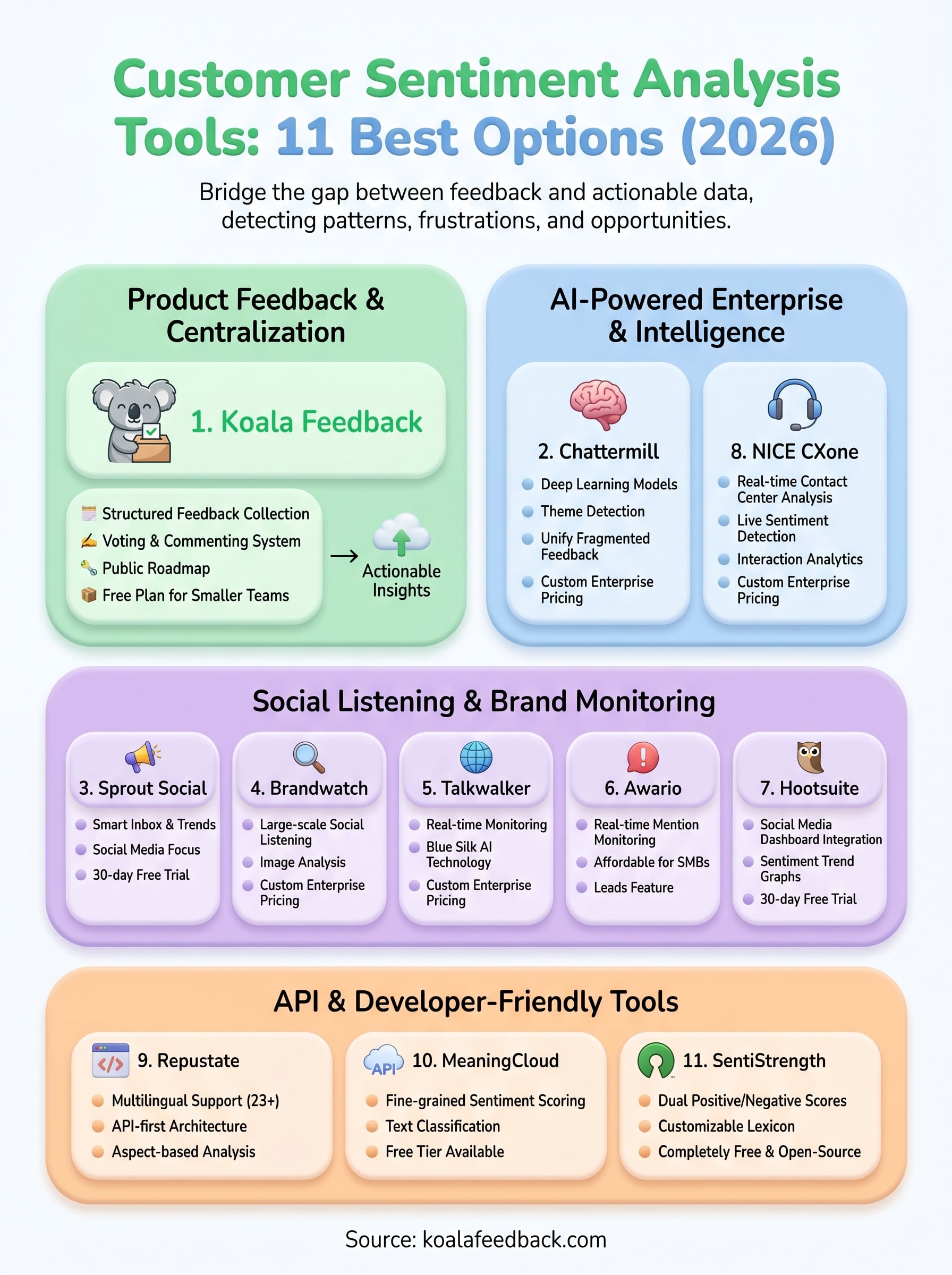
The right tool from this list depends entirely on what kind of feedback you need to analyze and where that feedback lives. If you monitor social media brand perception at scale, platforms like Brandwatch or Talkwalker give you the data coverage you need. For support-heavy operations, NICE CXone handles real-time interaction analysis well. Developers building custom pipelines will get more flexibility from Repustate or MeaningCloud than from any dashboard-first tool.
But if you want to understand what your actual users think about your product and act on that feedback in a structured way, the most effective starting point is capturing that input directly. Customer sentiment analysis tools work best when the underlying feedback is organized and tied to specific product areas. That's exactly what Koala Feedback helps you do. You can start collecting and prioritizing user feedback today on a free plan, with no credit card required.

Start today and have your feedback portal up and running in minutes.