Picking the right customer satisfaction survey software can be the difference between acting on real insights and drowning in spreadsheets full of data nobody reads. These tools help you measure how customers feel about your product, support, and overall experience, so you can fix what's broken before people churn.
But with dozens of platforms on the market, each promising to be the ultimate feedback solution, choosing one isn't straightforward. Some excel at simple NPS surveys. Others handle complex multi-channel distribution. A few do both well. The right pick depends on your team size, budget, and what you actually plan to do with the results.
At Koala Feedback, we build tools that help product teams collect and prioritize user feedback, so we spend a lot of time thinking about how companies listen to their customers. We evaluated 16 survey platforms based on features, pricing, ease of use, and integration options to help you find the one that fits your workflow.
Here's a breakdown of the best customer satisfaction survey tools available right now, what they do well, where they fall short, and who each one is built for.
Koala Feedback takes a different angle than most customer satisfaction survey software. Rather than focusing purely on sending surveys, it gives your team a dedicated feedback portal where users submit ideas, vote on feature requests, and stay informed about what you're building. If you want to understand what customers want and actually act on it, Koala Feedback connects those two steps in one place.
Instead of managing feedback across support tickets, emails, and chat logs, Koala Feedback centralizes every submission into a single portal. Users visit your branded feedback page, submit ideas or issues, and comment or vote on existing requests from other users. This removes the scramble of tracking down feedback spread across multiple channels.
Your portal is fully customizable with your own domain, logo, and brand colors, so it feels like a natural extension of your product rather than a third-party tool your users are hesitant to engage with.
Koala Feedback automatically deduplicates and categorizes submissions, which means you spend less time sorting and more time making decisions. You can organize requests into prioritization boards grouped by product area or feature set, giving your team a clear view of what users care about most.
When you can see which requests carry the most votes, you stop guessing what to build next and start making decisions backed by actual user demand.
One of the biggest drivers of low satisfaction is users feeling ignored after they submit feedback. Koala Feedback lets you publish a public roadmap that shows what's planned, what's in progress, and what's already shipped. You can set customizable statuses to manage expectations and update users as items move through your pipeline.
Closing the loop builds trust with your users and cuts down the volume of repetitive support requests asking when a feature will arrive.
Koala Feedback offers a free plan to get started, with paid tiers that unlock additional customization, custom domains, and deeper branding controls. Pricing scales with your needs, making it workable for early-stage startups and established SaaS teams alike.
You can review current plan details at koalafeedback.com. The paid plans make the most sense once you need the portal to feel fully integrated with your product and brand.
Few names in customer satisfaction survey software carry as much recognition as SurveyMonkey. Teams across industries use it to build and distribute surveys quickly without needing a technical background or a designer on hand.
SurveyMonkey offers a large library of pre-built templates, including ready-made CSAT and NPS formats you can customize and launch in minutes. You can adjust rating scales, reword questions, and add your logo without touching any code. The drag-and-drop builder keeps the process fast even when you need a survey with multiple question types.
The template library removes most of the setup work, so your team can focus on asking the right questions rather than building from zero.
You can schedule surveys to go out automatically based on time intervals or specific triggers, cutting out the manual distribution work. SurveyMonkey also lets you set automated reminder emails to follow up with non-respondents, which consistently improves completion rates without adding work for your team.
The platform provides built-in dashboards that display response data through charts and summary statistics as results come in. You can filter by respondent segment and export data in multiple formats:
SurveyMonkey offers a free plan with basic features and a cap on responses per survey. Paid plans start at around $25 per user per month, with team and enterprise tiers available for organizations that need advanced analytics, custom branding, and collaboration tools.
Typeform positions itself as customer satisfaction survey software built around the respondent experience. Rather than presenting a long list of questions on a single page, it shows one question at a time, which reduces friction and typically drives higher completion rates compared to traditional survey formats.
When your survey feels approachable, more people finish it, and you end up with enough data to make real decisions.
The design puts one question on screen at a time, keeping the interface clean and the respondent focused. The mobile-optimized layout works consistently across devices, so you don't lose responses from users on phones or tablets.

You can use conditional logic to route respondents to different questions based on their previous answers. This keeps each path relevant and removes unnecessary questions from the flow.
A respondent who gives a low satisfaction score can automatically receive follow-up questions that dig into the specific issue, while a satisfied customer gets a shorter, lighter experience.
Your data flows directly into tools like HubSpot, Salesforce, and Google Sheets through native integrations. You can also use Zapier or Make to connect Typeform to hundreds of other platforms without custom development work.
Typeform offers a free plan with a monthly response cap. Paid plans start at around $25 per month and unlock higher response limits, advanced logic features, and the option to remove Typeform branding from your surveys.
Qualtrics XM is enterprise-grade customer satisfaction survey software built for organizations running large-scale experience programs across multiple customer touchpoints. If your team needs a platform that can handle complex survey programs at significant volume, Qualtrics is one of the most capable options available.
Qualtrics gives you access to sophisticated survey design tools that support advanced question types, randomization, and multilingual distribution. The platform handles programs that span multiple business units, products, or geographies from a single dashboard, making it practical for large organizations that need consistency across regions or teams.
When your experience program spans dozens of markets, you need a platform built for that complexity from day one.
You can target specific customer segments and fire surveys automatically based on behavioral triggers, such as a completed purchase or a closed support ticket. This means your surveys reach the right users at the right moment, which improves both response rates and the relevance of the data you collect.
Qualtrics connects survey responses to automated workflows that route alerts to the right team when a low score comes in. You can close the loop faster by assigning follow-up tasks directly from within the platform rather than manually forwarding results through email.

Qualtrics does not publish standard pricing publicly. Enterprise contracts are custom-quoted based on volume and feature needs, so you need to contact their sales team directly for a number.
Delighted is customer satisfaction survey software built around simplicity. It strips away complexity and focuses on getting one-question surveys in front of your customers quickly, making it a strong fit for teams that want clean data without a steep learning curve.
Delighted keeps surveys deliberately short by design. You send a single rating question, and respondents can optionally leave a comment afterward. This low-friction format consistently drives higher response rates than multi-question surveys, since customers can complete the whole thing in under 30 seconds.
When you remove every barrier between your customer and their response, you end up with far more data to work with.
Rather than sending surveys on a fixed schedule, Delighted lets you trigger sends based on specific events, such as a closed support ticket, a completed onboarding flow, or a recent purchase. This timing ensures your survey reaches customers when the experience is still fresh, which produces more accurate and actionable responses.
Delighted's reporting keeps things visual and straightforward. You get trend lines, score breakdowns, and comment summaries without needing to configure anything. Your team can spot patterns quickly without digging through complex report builders.
Delighted offers a free plan that covers basic NPS and CSAT surveys with limited monthly responses. Paid plans start at around $17 per month, with higher tiers adding more responses, additional survey types, and integrations with tools like Salesforce and Slack.
Survicate is customer satisfaction survey software that focuses on meeting users where they already are. You can deploy surveys across multiple channels from a single platform, making it practical for teams that need consistent feedback collection across a product, website, and email list without juggling separate tools.
You can place surveys directly on your website, inside your application, or inside email messages with Survicate. Each channel uses the same setup process, so running coordinated feedback programs across surfaces doesn't require reconfiguring your approach for each one. The multi-channel coverage gives you a fuller picture of user sentiment across different stages of the customer journey.
Rather than sending surveys to everyone at once, Survicate lets you set behavioral targeting rules that trigger surveys based on actions like time spent on a page, specific URL visits, or scroll depth. This precision means your survey reaches users at the most relevant moment, which pushes both response rates and data quality higher.
Timing your survey to a specific user action consistently produces more accurate responses than sending to your entire list on a fixed schedule.
When a low satisfaction score comes in, Survicate can automatically alert the right team member based on rules you configure. This keeps negative responses from sitting unread and gives your team a faster path to recovering frustrated customers before they churn.
Survicate offers a free plan for basic use. Paid plans start at around $99 per month and include higher response limits, advanced integrations, and expanded targeting options.
SurveySparrow is customer satisfaction survey software that replaces traditional form-based surveys with a conversational chat-like format. Instead of presenting respondents with a wall of questions, it simulates a back-and-forth exchange that feels more natural, which tends to push completion rates noticeably higher than standard survey designs.
SurveySparrow's core differentiator is its chat-style survey interface, which delivers questions one at a time in a messaging format your respondents already recognize. The experience reduces the feeling of filling out a form and encourages people to complete the full survey rather than dropping off halfway through.
When your survey format feels familiar, respondents stay engaged longer and give you more complete data to work with.
You can distribute surveys through email, web links, in-app embeds, and SMS without switching between platforms. SurveySparrow handles each channel from a single dashboard, so your team maintains a consistent survey experience regardless of where customers encounter it.
SurveySparrow lets you schedule recurring surveys on a cadence you define, which keeps satisfaction tracking continuous rather than tied to individual campaign pushes. You can also set automated follow-up messages to reach non-respondents without manual intervention from your team.
SurveySparrow offers a free trial to test the platform. Paid plans start at around $19 per month, with higher tiers adding more responses, white-labeling, and advanced integrations.
Alchemer is enterprise-focused customer satisfaction survey software designed for teams that need more control over their survey logic, data governance, and reporting than most standard tools provide. It sits in a middle ground between lightweight consumer tools and full enterprise platforms like Qualtrics, making it a practical choice for mid-sized organizations that have outgrown simpler options.
Alchemer gives you a wide range of question types and branching logic options that let you build surveys tailored to specific audiences or scenarios. You can set up complex skip patterns, custom validation rules, and piped responses that pull earlier answers into later questions to keep the experience relevant for each respondent.
When your survey adapts to each respondent's answers, you collect more targeted data and put fewer irrelevant questions in front of people who don't need to see them.
Alchemer includes role-based access controls that let you define exactly what each team member can view, edit, or publish. This makes it workable for organizations where multiple departments run separate survey programs but need centralized oversight to maintain consistency and data security.
You can build custom reporting dashboards that surface the metrics your team actually tracks, rather than working around a fixed report layout. Alchemer supports real-time data filtering and lets you export results in multiple formats for stakeholder presentations or deeper analysis.
Alchemer does not publish a free plan. Paid plans start at around $55 per month, with enterprise tiers available for larger teams that need advanced governance and integrations.
QuestionPro is customer satisfaction survey software that gives teams a broad toolset for building, distributing, and analyzing surveys without requiring significant technical overhead. It covers everything from simple CSAT surveys to research-grade data collection, making it a flexible option for product teams and market researchers alike.
QuestionPro provides a large library of pre-built survey templates, including CSAT, NPS, and CES formats you can customize and deploy quickly. You adjust the question wording, rating scales, and branding to match your needs, then launch through email, web link, or embedded format. The template-first approach cuts setup time significantly when your team needs to get a satisfaction program running without building from scratch.
Starting from a proven template reduces the risk of poorly worded questions that skew your data before the first response comes in.
QuestionPro includes access to built-in respondent panels, which lets you reach specific demographics or customer profiles outside your existing user base. This is useful when you need external benchmark data or want to validate satisfaction findings against a broader market sample before making product decisions.
The platform lets you run cross-tabulation reports that compare satisfaction scores across different respondent segments side by side. You can filter results by any variable you collected and export clean reports in PDF or Excel for stakeholder reviews without extra configuration.
QuestionPro offers a free plan with basic survey features. Paid plans start at around $99 per month, with research and enterprise tiers available for teams that need panel access, advanced analytics, and expanded response volumes.
Medallia is enterprise-level customer satisfaction survey software designed for large organizations that need to track and respond to customer sentiment across every touchpoint in the buying and service experience. If your team manages feedback from multiple channels and business units, Medallia centralizes it into a single system built to handle that scale.
Medallia pulls feedback data from web, mobile, contact center, and in-store interactions into one unified view. Rather than managing separate tools for each channel, your team sees the full picture of customer sentiment in one place. This cross-channel visibility is especially valuable when satisfaction issues span multiple touchpoints and need coordinated responses across departments.
When you can see every feedback signal in one system, you stop treating symptoms and start identifying the root causes of low satisfaction scores.
Beyond traditional surveys, Medallia captures unstructured feedback from sources like support call transcripts, chat logs, and social mentions using text analytics. This means you collect satisfaction signals even when customers never fill out a form, giving you a more complete picture of how users actually feel about your product and service.
Medallia routes low satisfaction scores and critical feedback to the right team member automatically. You can configure rules that trigger alerts based on score thresholds, assign follow-up tasks, and track resolution, so your team closes the loop on negative experiences before they escalate into churn.
Medallia uses custom enterprise pricing and does not publish standard rates publicly. You need to contact their sales team directly for a quote based on your volume and feature requirements.
HubSpot Service Hub is customer satisfaction survey software built directly into the HubSpot CRM ecosystem. If your team already runs sales, marketing, and support through HubSpot, adding satisfaction surveys happens without importing contact lists or setting up separate integrations. The tight platform connection is the main reason teams choose it over standalone survey tools.
Service Hub lets you automatically send CSAT and NPS surveys when a support ticket closes. You configure the trigger once, and every resolved ticket kicks off a survey without your team manually queuing each send. This timing puts the survey in front of your customer right when the interaction is still fresh, which consistently produces higher response rates and more accurate scores than batch sends.
When your survey fires automatically at the right moment, you spend zero time on distribution and more time acting on the results.
Every survey response writes directly back to the contact record in HubSpot. Your support reps see satisfaction scores alongside conversation history, previous tickets, and deal data without switching between tools. This complete contact-level view makes it easy to spot patterns in how individual customers respond to your service over time.
HubSpot's reporting tools let you connect satisfaction scores to revenue data already living in your CRM. You can filter CSAT results by customer tier, deal size, or lifecycle stage and surface those findings in shared dashboards your whole team can access.
Service Hub offers a free tier with basic ticketing and limited survey features. Paid plans start at around $15 per seat per month, with professional and enterprise tiers unlocking automation, custom reporting, and expanded survey functionality.
Zendesk operates as customer satisfaction survey software built directly into its support platform. If your team already handles tickets in Zendesk, you can track satisfaction without bolting on a separate tool. Your CSAT data lives alongside every ticket, agent note, and conversation from the moment you turn the feature on, which eliminates the setup work that comes with connecting external survey platforms to your help desk.
Zendesk sends a one-click satisfaction rating request automatically when an agent marks a ticket resolved. Customers choose a positive or negative rating and can leave a short comment explaining their score. The automated timing captures feedback while the interaction is still fresh, which produces more accurate scores than delayed batch sends ever will.
When your survey fires at ticket close without any manual steps, your team stops managing distribution and starts acting on the data.
Zendesk's built-in reporting lets you break satisfaction scores across multiple dimensions without building custom reports from scratch:
This granular breakdown helps you pinpoint exactly where satisfaction drops instead of chasing high-level averages that mask real problems.
When a negative rating comes in, Zendesk can automatically flag the ticket, reassign it to a senior agent, or push an internal alert. These automated workflows reduce the chance that a frustrated customer waits too long before someone on your team follows up.
Zendesk support plans start at around $19 per agent per month, with higher tiers unlocking advanced reporting, AI tools, and expanded automation. CSAT surveys are included across paid plans without requiring a separate add-on purchase.
Nicereply is customer satisfaction survey software built specifically for customer support teams that want to measure CSAT, NPS, and CES without leaving their existing help desk environment. The platform fits neatly into support workflows rather than adding a parallel process your team needs to manage separately.
Nicereply connects directly with major help desk platforms like Zendesk, HelpScout, Freshdesk, and Intercom. Once connected, it automatically sends satisfaction surveys when an agent closes a conversation, removes the manual distribution step entirely, and ensures every resolved ticket generates a feedback opportunity without your team lifting a finger.
When your survey process runs automatically inside the tools your agents already use, response rates go up and setup friction disappears.
You have flexibility in how and when surveys reach your customers with Nicereply. You can embed ratings directly in email signatures, which captures feedback even before a ticket officially closes. You can also send post-resolution emails or trigger in-app surveys, giving your team multiple touchpoints to collect satisfaction data without bombarding customers with duplicate requests.
Nicereply's reporting breaks satisfaction scores down by individual agent, team, and time period. You can spot which agents consistently receive low ratings and use that data to guide coaching conversations with specific evidence rather than general impressions.
Nicereply does not offer a permanent free plan. Paid plans start at around $59 per month, with higher tiers scaling based on the number of monthly responses and agents on your team.
SimpleSat is customer satisfaction survey software designed for small to mid-sized service businesses that want a no-fuss way to measure CSAT and NPS without managing a complex platform. The tool prioritizes simplicity over feature depth, which makes it a practical fit for teams that need reliable satisfaction data without spending hours on configuration.
SimpleSat keeps its survey setup intentionally simple and fast. You pick your survey type, customize the question and branding, and send it out. There are no complicated logic trees or advanced configurations to navigate, which means your team spends less time building surveys and more time acting on the responses you collect.
When your satisfaction program is simple enough for anyone on the team to manage, it actually gets used consistently instead of falling off the priority list.
SimpleSat connects with tools like Zendesk, Freshdesk, and HubSpot, so your surveys fire automatically based on ticket activity without any manual distribution steps. The integrations handle the timing for you, ensuring customers receive satisfaction requests right after a service interaction closes.
Your results land in a clean, visual dashboard that surfaces overall satisfaction scores, response trends, and individual comments without requiring you to configure a custom report layout first. You can filter by time period or integration source to narrow your view when you need to examine a specific channel or date range more closely.
SimpleSat offers a free trial to test the platform before committing. Paid plans start at around $49 per month, scaling based on the number of monthly responses your team needs.
Hotjar approaches customer satisfaction survey software differently from most tools on this list. Rather than sending surveys through email or triggered messages, it embeds feedback collection directly on your website pages, letting you capture satisfaction signals at the exact moment users interact with your product or content.
Hotjar lets you place short surveys, rating widgets, and feedback buttons directly on any page of your site. Users respond without leaving the page they're already on, which reduces friction and captures reactions in the moment rather than hours later when the experience has faded from memory.
When you ask for feedback at the exact moment a user encounters something confusing or impressive, you get far more accurate responses than any delayed survey can produce.
This is where Hotjar separates itself from standalone survey tools. You can view survey responses alongside session recordings and heatmaps to see exactly what a user did before they rated your page poorly. Instead of reading a low score with no context, you watch the actual behavior that led to it, which makes diagnosing problems significantly faster.

Hotjar's combined data helps you pinpoint specific page elements or flows that consistently generate negative feedback. You can filter session recordings by users who submitted a low rating and watch what they experienced, giving your team direct evidence of friction points rather than educated guesses pulled from aggregate scores alone.
Hotjar offers a free plan that covers basic heatmaps and limited survey responses. Paid plans start at around $32 per month, with higher tiers adding more session recordings, expanded survey responses, and advanced filtering options.
Pendo is customer satisfaction survey software that lives inside your product rather than arriving in a customer's inbox. It's built for SaaS product teams that want to measure how users feel while they're actively working inside the application, capturing satisfaction signals in the context of real product use rather than relying on delayed email outreach.
Pendo lets you deploy surveys as in-app guides that appear during a user's session without interrupting their flow. You control exactly when and where each survey appears, which means your team captures satisfaction data at meaningful moments like feature adoption milestones, onboarding completion, or after a user attempts a specific workflow.
Rather than broadcasting surveys to your entire user base, Pendo lets you target specific user segments based on product usage data. You can reach users who have hit a certain feature threshold or who have been active for a set number of days, ensuring your survey reaches the most relevant audience at the right point in their journey.
When your survey targets users based on what they actually did inside your product, the responses reflect real experience rather than vague general impressions.
Pendo connects survey responses directly to product usage metrics like feature adoption rates, session frequency, and retention data. This pairing gives your team the ability to link low satisfaction scores to specific usage patterns, which makes diagnosing product friction far more precise than survey data alone can achieve.
The platform offers a free plan with basic in-app guides and limited analytics. Paid plans are custom-quoted based on your monthly active user count, so you need to contact their sales team directly for specific pricing.
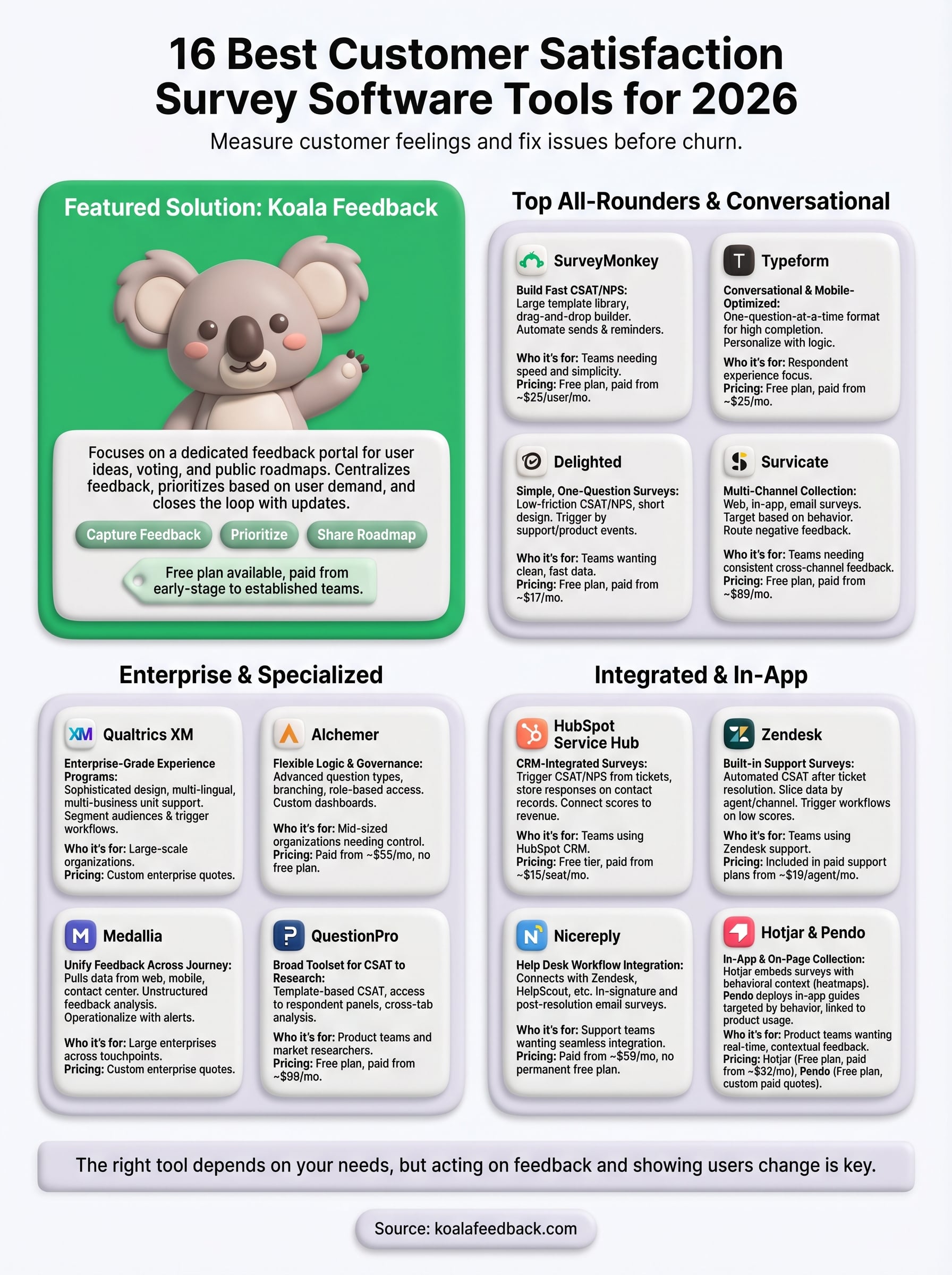
The right customer satisfaction survey software depends on what you actually plan to do with the data. If you run a support-heavy team, tools like Nicereply or Zendesk fit naturally into your ticket workflow. If you need enterprise-scale programs, Qualtrics or Medallia handle that complexity. And if you want a lightweight, conversational format, Typeform or Delighted get you running fast.
But collecting satisfaction scores only solves part of the problem. Users also want to see that their feedback drives real change, not just gets logged somewhere and forgotten. That's where a dedicated feedback and roadmap tool fills the gap that surveys leave open.
If you want to give your users a direct channel to share ideas, vote on what matters most, and track what you're building, start with Koala Feedback. The free plan lets you set up your portal today and start closing the loop with your users right away.

Start today and have your feedback portal up and running in minutes.