You just ran a survey or closed a support ticket, and now you're staring at a number wondering if it's actually good. That's the moment most product teams realize they never agreed on what customer satisfaction score actually means or how to read it. It sounds simple until you're the one explaining to leadership why a 72% CSAT is fine, or a warning sign.
A customer satisfaction score, often shortened to CSAT, measures how happy customers are with a specific interaction, feature, or your product overall, usually gathered through a short post-interaction survey. The calculation itself is straightforward: divide the number of satisfied responses by total responses, then multiply by 100. What trips people up is customer satisfaction scoring in context: knowing what counts as a good score for your industry, and what to do once you have the number.
This article walks through exactly that. You'll get a clear definition of CSAT, the formula and a worked example, benchmarks by industry, and practical ways to turn survey scores into a prioritized product roadmap your users can actually see progress on.
Customer satisfaction score matters because it's one of the few metrics that connects directly to revenue. Companies that track CSAT closely can spot unhappy customers before they churn, instead of finding out when the cancellation email lands. A dip in CSAT after a product update or a pricing change gives you an early warning that something needs fixing, weeks before it shows up in your churn report or your support ticket volume.
Beyond retention, CSAT gives every team a shared reference point. Support agents, product managers, and executives all argue about "how happy customers are" using gut feeling unless there's a shared metric everyone trusts. When product managers can point to a CSAT drop tied to a specific feature or release, prioritization conversations get a lot shorter. Nobody has to guess whether the new onboarding flow helped or hurt; the score tells you.
A customer satisfaction score turns "customers seem unhappy" into a number you can act on, track over time, and defend in a roadmap meeting.
Regularly measuring CSAT also builds a satisfaction feedback loop that customers notice. When you ask people how satisfied they are and then visibly act on the answer, whether that's fixing a broken feature or shipping something they requested, you signal that their input matters. That's a big part of why platforms built around customer feedback pair satisfaction tracking with a public roadmap. Users see their complaints turn into shipped features, which raises satisfaction on its own.
Finally, CSAT works as an early performance indicator for teams, not just products. Support managers use it to coach agents, product managers use it to validate releases, and customer success teams use it to flag accounts at risk. Because it's collected right after an interaction, the feedback is fresh and specific, unlike an annual survey where customers barely remember what happened. That immediacy is what makes CSAT more actionable than most other satisfaction metrics you'll come across, and why it's worth getting the calculation and benchmarks right, which is exactly what comes next.
Most CSAT surveys ask a single question after an interaction: "How satisfied were you with [support ticket/feature/purchase]?" Customers answer on a scale, usually 1 to 5 or 1 to 3, with the top two options counted as "satisfied." The CSAT formula is simple: divide the number of satisfied responses by the total number of responses, then multiply by 100.
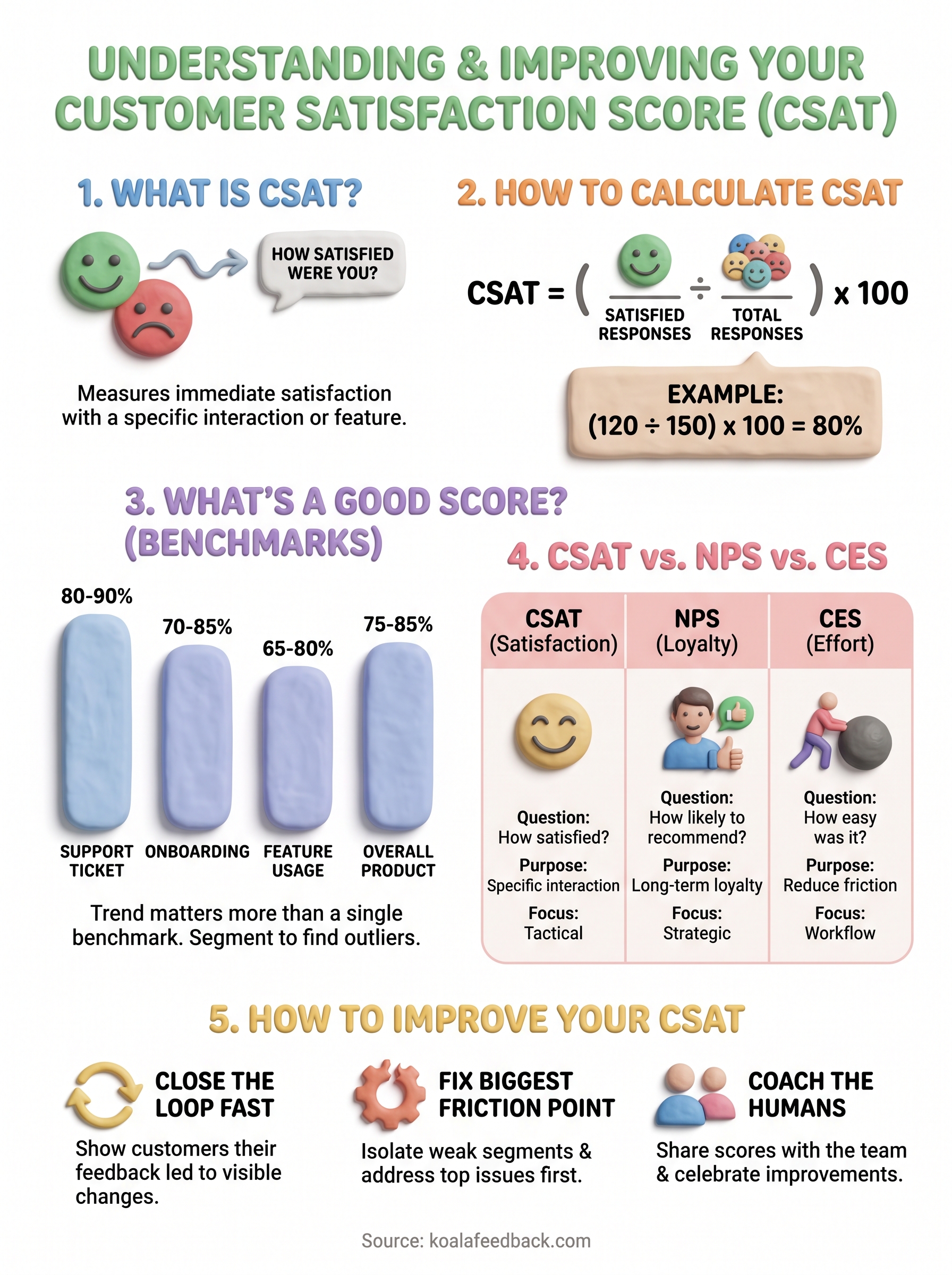
CSAT = (Number of satisfied responses ÷ Total number of responses) x 100
Say you send a survey to 200 customers after they close a support ticket, and 150 respond. Of those, 120 rate their experience a 4 or 5 on a 5-point scale. Your CSAT score is (120 ÷ 150) x 100, which equals 80%. That's the whole calculation. Customer satisfaction scoring gets more useful once you start segmenting: run the same formula by feature, by support channel, or by customer plan tier, and you'll usually find the aggregate number hides some ugly outliers.
The formula never changes: satisfied responses divided by total responses, times 100. What changes is how carefully you segment the data behind it.
Response rate matters here too. If only 20% of customers respond, a high CSAT can be misleading, because people who had a bad experience are more likely to skip the survey than answer it. Watch your response rate alongside the score itself, and treat any CSAT built on fewer than 30-40 responses per segment with some skepticism. Timing counts as well: surveys sent immediately after an interaction, while it's still fresh, produce more accurate answers than ones sent days later.
Eighty percent sounds impressive until you learn that some industries average 90% and others struggle to break 70%. There's no universal good CSAT score, because the number depends heavily on what you're measuring and who you're asking. A support ticket CSAT of 85% is solid, but that same score for a core product feature might mean a lot of quietly frustrated users who never bothered to complain.
General benchmarks still help you get oriented. Most SaaS companies land somewhere between 75% and 85% for post-interaction surveys, with anything above 90% considered excellent and anything below 60% worth investigating immediately, and a broader customer satisfaction index can give you benchmarks by industry.
| Interaction type | Typical CSAT range |
|---|---|
| Support ticket resolution | 80% to 90% |
| Onboarding experience | 70% to 85% |
| Feature usage | 65% to 80% |
| Overall product satisfaction | 75% to 85% |
There's no single good CSAT score, only a good score for your specific interaction, industry, and customer base.
Trend matters more than any single benchmark. A CSAT of 68% that's climbing steadily beats a static 85% that hasn't budged in a year, because the trend tells you whether your product decisions are actually working. Watch your own baseline over three to six months before comparing yourself to industry averages you found online.
Segment before you panic over a low number. An aggregate score of 70% might hide a support team scoring 90% and a billing flow scoring 45%. Isolating the weak segment turns a vague worry into a specific fix, which is the whole point of tracking customer satisfaction scoring in the first place instead of treating it as a vanity metric.
CSAT rarely travels alone. Product teams often run it alongside Net Promoter Score (NPS) and Customer Effort Score (CES), and mixing them up leads to confused roadmap discussions. Each metric asks a different question, measures a different moment, and predicts a different outcome, so knowing which one you're looking at matters as much as the number itself.
NPS asks how likely someone is to recommend your product to a friend or colleague, scored 0 to 10. It measures loyalty over the long haul, not satisfaction with any one interaction. CES asks how much effort a customer had to spend to get something done, like resolving a support ticket or setting up a feature. Low effort correlates strongly with retention, especially in support contexts. CSAT, by contrast, measures immediate satisfaction with a specific touchpoint, which makes it the most tactical of the three.
| Metric | Question asked | Best used for |
|---|---|---|
| CSAT | How satisfied were you? | Specific interactions, features, support tickets |
| NPS | How likely are you to recommend us? | Overall loyalty and long-term growth |
| CES | How easy was this to complete? | Reducing friction in a process or workflow |
CSAT tells you if this interaction went well, NPS tells you if customers will stick around, and CES tells you if you're making them work too hard.
Running all three isn't overkill if you tie each one to a decision. Use CSAT to catch problems fast, NPS to track whether your product is building genuine loyalty, and CES to find friction points worth fixing before they show up as a lower CSAT next quarter.
Knowing your customer satisfaction score is only half the job. The other half is closing the loop between what customers tell you and what you actually change. Most teams that raise CSAT don't discover some secret trick, they just follow a customer satisfaction improvement plan and get disciplined about acting on feedback instead of just collecting it.
Users notice when their complaints vanish into a survey tool and never resurface. Building a public feedback board where customers can submit requests, vote on existing ones, and see a status change from "planned" to "shipped" turns a one-way survey into a visible conversation. Koala Feedback's feedback portal and roadmap tools exist specifically for this, so satisfaction scores rise because people can see their input actually moves the needle.
Customers forgive a rough experience more easily than being ignored after they've told you about it.
Running customer satisfaction scoring by segment usually surfaces one weak spot dragging down the average. Prioritize that instead of chasing marginal gains everywhere at once:
Support agents and onboarding specialists influence CSAT more than any dashboard change. Sharing scores with the team weekly, and celebrating improvements publicly, keeps satisfaction a shared goal rather than a metric only leadership watches.
A customer satisfaction score only earns its keep when it changes what you build next. You now know the formula, what counts as a good score for your industry, and how CSAT differs from NPS and CES. The part that actually moves the number is discipline: segment your data, fix the worst-performing touchpoint first, and show customers their feedback led somewhere.
That last part is where most teams fall short. Collecting scores without a visible response trains customers to stop answering your surveys at all. Pair your customer satisfaction scoring with a public place where people can submit ideas, vote on what matters, and watch statuses move from planned to shipped.
If you're ready to turn survey numbers into a roadmap customers can actually see, centralize and prioritize feedback with Koala Feedback and start closing that loop today.

Start today and have your feedback portal up and running in minutes.