Most teams collect feedback. Fewer actually do anything useful with it. The gap between gathering customer opinions and turning them into product improvements is where most businesses lose momentum, and trust. A customer satisfaction feedback loop closes that gap by creating a structured cycle where feedback flows in, gets analyzed, drives action, and circles back to the customer who shared it.
Here's what makes a feedback loop different from a survey that sits in a spreadsheet: it's continuous. You're not just measuring satisfaction at a single point in time. You're building an ongoing conversation between your team and your users, one where every piece of input has a clear path toward a decision. When done right, this process shapes your roadmap, reduces churn, and makes customers feel like co-creators of your product rather than passive users.
This is exactly the problem we built Koala Feedback to solve. Our platform gives teams a centralized place to collect, prioritize, and act on user feedback, then share progress through public roadmaps so customers can see their input actually mattered. The feedback loop isn't just a concept for us; it's the core workflow our tool supports.
In this article, you'll learn what a customer satisfaction feedback loop is, how the process works step by step, and how to implement one that produces real results. We'll also walk through concrete examples so you can see the loop in action across different business scenarios.
A customer satisfaction feedback loop is a repeating cycle where you collect input from customers, analyze what they're telling you, take action based on what you find, and communicate those changes back to the people who gave you the feedback. The word "loop" matters here. It signals that this is not a one-and-done process but a continuous system that keeps running as long as your product or service exists. Every time a customer submits an idea, flags a problem, or rates their experience, that data enters the loop and moves through each stage until it produces a visible outcome.
What separates a feedback loop from simple data collection is the closed-loop principle. In an open loop, feedback comes in and decisions happen somewhere internally, but the customer never hears back. In a closed loop, the cycle completes. Customers see that their input influenced something real, whether that's a new feature on your roadmap, a resolved bug, or a policy change. That visible connection between input and outcome is what builds trust over time and keeps customers willing to share more.
Every feedback loop, no matter the industry or product type, moves through four distinct stages. Knowing each stage helps you spot exactly where your current process breaks down and where customers are quietly giving up on giving you feedback.
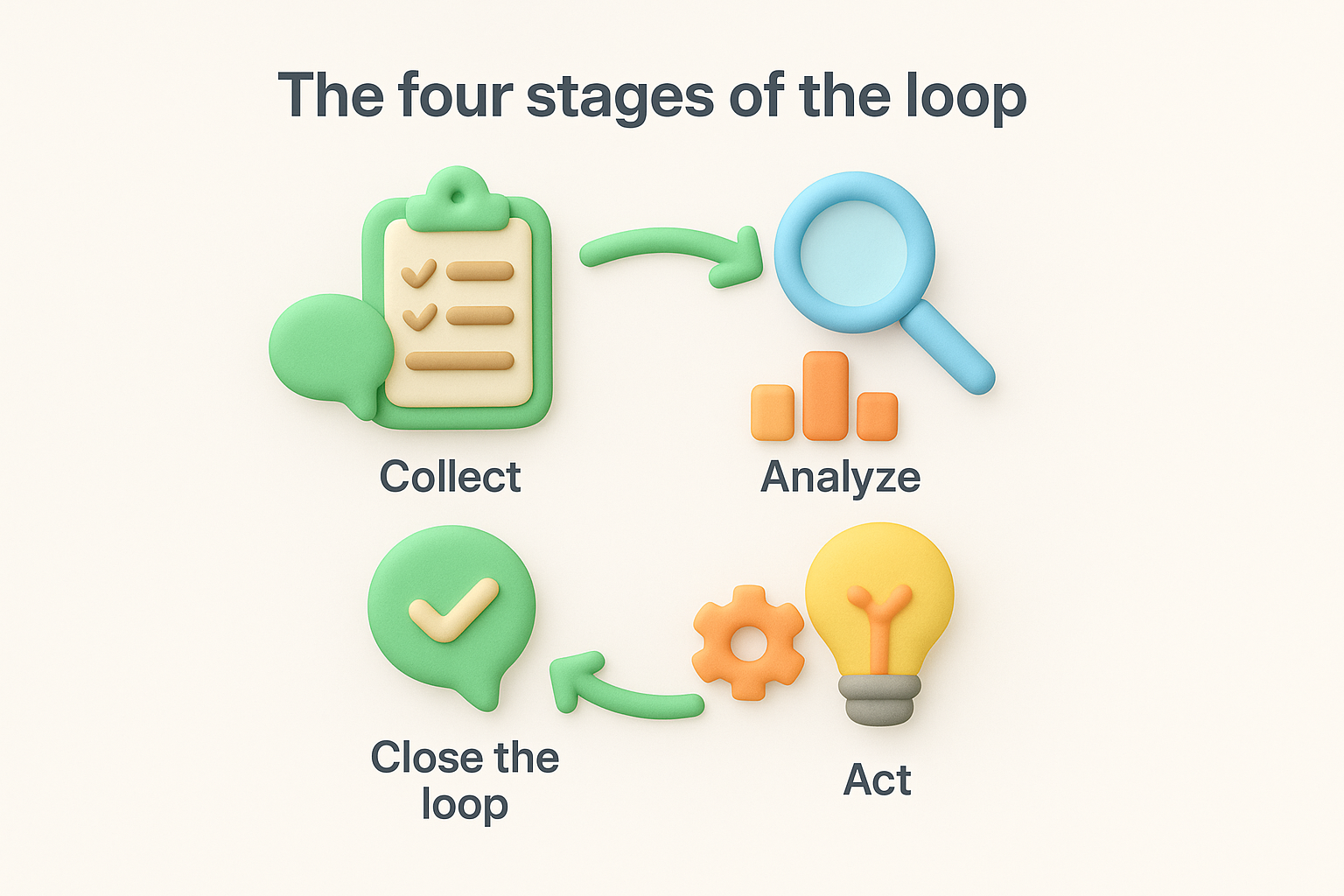
| Stage | What happens |
|---|---|
| Collect | You gather feedback through surveys, support tickets, in-app prompts, or dedicated feedback portals |
| Analyze | You sort, categorize, and prioritize what customers say to find repeating patterns |
| Act | You make decisions, update your product, fix problems, or adjust your roadmap |
| Close the loop | You tell customers what changed and connect the update back to their original input |
Each stage depends on the one before it. If your collection method captures vague or low-quality responses, your analysis will miss the real signal. If you analyze well but fail to act, the loop never closes and customers stop bothering to share anything at all.
The loop only works when all four stages connect. One broken link and the whole system stalls.
Customer satisfaction is not a static score you measure once a quarter. It's a dynamic reflection of how well your product matches what customers actually need at any given moment. The feedback loop is the mechanism that keeps your understanding of that match current and accurate, rather than based on assumptions from six months ago.
When customers submit feedback and receive no visible response, satisfaction tends to drift downward even if the product itself is performing fine. The act of being heard matters as much as the outcome. By contrast, when customers submit feedback and later notice that a feature they requested appeared in a new release, their satisfaction increases because of the experience of participation, not just the product improvement itself. Building this loop into your standard product workflow, rather than treating it as a periodic survey exercise, produces results that compound over time. Your customers become more engaged, more loyal, and more likely to share the specific, detailed input that actually helps you build something better.
Most businesses already track customer satisfaction scores, but tracking a number and actually improving it are two different things. When you run a consistent customer satisfaction feedback loop, you shift from reactive problem-solving to proactive product development. Instead of finding out customers are frustrated after they cancel, you catch the signals early and respond before the relationship deteriorates.
A feedback loop turns satisfaction data from a lagging indicator into an early warning system.
Churn rarely happens suddenly. Most customers who leave have been quietly dissatisfied for weeks or months before they actually cancel. Microsoft research has found that the majority of customers who stop using a product never bother to complain directly; they simply leave. A structured feedback loop gives those customers a low-friction channel to surface what's bothering them, which means you catch the frustration before it becomes a cancellation.
When customers see that their feedback produces a real response, their likelihood of staying increases in a meaningful way. The act of being acknowledged shifts their relationship with your product from passive to invested. You stop being just a tool they use and start being a team they contribute to, which is a very different psychological contract.
Every product decision carries risk. When you build a feature based on one sales conversation or a gut feeling from a leadership meeting, you're betting development time on incomplete information. A feedback loop replaces that guesswork with aggregated signal from real users, giving your team a far clearer picture of what customers actually need most before you commit a single engineering hour.
Teams that close the loop consistently also tend to waste less time on features that don't land. When you can look at a prioritized board of user-submitted requests sorted by vote count and customer segment, your next sprint becomes much easier to justify. Your roadmap stops reflecting internal assumptions and starts reflecting what will actually move satisfaction in the right direction.
Connecting feedback directly to product decisions also creates internal alignment across your team. When engineers, designers, and product managers all draw from the same source of customer input, debates about priority become grounded in evidence rather than opinion, and that makes every decision faster and more defensible.
A customer satisfaction feedback loop doesn't run on good intentions. It runs on a clear sequence of connected steps that each pass the baton to the next. When you understand what actually happens at every stage, you can find the exact point where your current process stalls and fix it with precision rather than guessing.
The loop starts the moment a customer has something to say. That might come through an in-app prompt after completing a task, a post-purchase email survey, a support ticket, or a public feedback portal where users submit and vote on ideas. Your job at this stage is to make submitting feedback as effortless as possible. Friction at the collection stage kills signal volume fast. If customers have to hunt for a place to leave feedback or fill out a ten-question form to report a simple issue, most of them won't bother.
Once the feedback comes in, your team needs to sort it into categories and look for patterns across multiple submissions. A single complaint about a broken button is noise. Thirty customers flagging the same issue in the same workflow is a signal worth acting on. This is where a centralized platform pays off because it surfaces those patterns automatically instead of forcing someone to scroll through a spreadsheet of raw responses.
Pattern recognition at the analysis stage is what separates teams that improve products from teams that just collect data.
After you identify a clear pattern, the feedback moves into your prioritization process. Your team weighs the request against development cost, strategic fit, and how many users it affects, then places it on your roadmap or flags it for a future sprint. The key here is that every piece of feedback gets a decision, even if that decision is "not now." Leaving requests in a holding queue with no status update erodes trust faster than rejecting them outright.
Closing the loop means going back to the customers who submitted the input and telling them what changed. If you shipped the feature they asked for, show them. If you decided against it, explain the reasoning briefly. That final step is what transforms a data collection exercise into a real conversation, and it's the part most teams skip entirely.
Building a customer satisfaction feedback loop that sustains itself over time requires more than picking a survey tool and sending it out once a quarter. Most loops break down not because teams lack feedback, but because they never set up the operational infrastructure to move that input through every stage reliably. The structure itself is straightforward once you commit to a few non-negotiable practices and hold them consistently.
The most common mistake teams make when setting up a feedback loop is opening too many channels at once. When feedback flows in from support tickets, email surveys, social mentions, and sales calls simultaneously with no central home, none of it gets analyzed properly and patterns get buried. Start by choosing one primary collection channel that fits where your customers already spend time, whether that's an in-product prompt, a dedicated feedback portal, or a post-interaction survey. You can expand to other sources later once the core loop is running without breaking down.
Consolidating your feedback into one place is the single fastest way to go from scattered data to actionable patterns.
A feedback loop without clear ownership is just a wishlist. Every stage of the loop needs a named person or team responsible for it. Someone owns collection and keeps the channel active. Someone owns analysis and reviews incoming submissions on a regular schedule. Someone owns the work of prioritizing and responding to what customers submitted. When ownership is fuzzy, feedback piles up, responses never go out, and customers stop submitting anything at all, which breaks the loop entirely.
Reviewing feedback whenever you have time means you never do it consistently. Set a fixed cadence, such as a weekly review of new submissions and a monthly pass at what needs to move onto your roadmap. The cadence forces the habit. Your team also gets a predictable rhythm for closing the loop with customers, which lets you batch updates and communicate changes in a structured way rather than scrambling to respond to each submission individually. Teams that hold to a schedule close their loops faster and consistently see higher re-engagement from the customers who originally gave feedback, because those customers trust that their input is actually going somewhere.
Not every feedback source feeds your customer satisfaction feedback loop equally well. Some channels generate high volume with low signal. Others produce fewer responses but with the specific, actionable detail your team can actually use. Knowing which sources to prioritize saves you from drowning in data that doesn't point anywhere useful.
Three survey types consistently produce useful data without burning out your customers with long questionnaires. Net Promoter Score (NPS) asks customers how likely they are to recommend your product on a scale of zero to ten. It's fast, produces a trackable number over time, and the follow-up open question often surfaces your most candid feedback. Customer Satisfaction Score (CSAT) measures how satisfied a customer was with a specific interaction, such as a support resolution or onboarding session, making it useful for identifying friction at particular touchpoints rather than overall sentiment.
Send surveys at a natural moment in the customer journey, not on a calendar schedule disconnected from actual product usage.
Customer Effort Score (CES) rounds out the core set by asking how easy it was to complete a task. When customers consistently rate an action as high effort, that's a direct signal your workflow needs work. Each of these three formats is short enough that response rates stay healthy, and each one maps to a different layer of the customer experience.
Surveys capture what customers choose to share when you ask. Passive sources capture what they share on their own, and that distinction matters. In-product feedback buttons let customers flag issues or submit ideas without leaving their workflow, which tends to produce more specific and timely input than a survey sent hours after the fact. Dedicated feedback portals go further by giving customers a persistent place to submit requests, vote on existing ideas, and follow the status of what they've asked for.
Support tickets and live chat logs also carry signal that many teams ignore entirely. When the same question or complaint appears repeatedly across your support channels, that's unstructured feedback pointing at a real gap in your product or documentation. Routing those recurring themes back into your loop, alongside your formal survey data, gives you a far more complete picture of where satisfaction is breaking down.
Seeing a customer satisfaction feedback loop in action across different business contexts makes it easier to spot what yours should look like. The mechanics stay the same in every case, but the specific touchpoints, timelines, and responses shift depending on what your product does and who your customers are.
Imagine your feedback portal starts collecting requests from multiple users asking for a way to export data in CSV format. The requests come in separately over two weeks, but because they land in a centralized tool, your product manager spots the pattern quickly. Your team votes the request onto the roadmap, schedules it for the next sprint, and updates the status in the portal to "in progress." When the feature ships, the portal automatically notifies everyone who submitted or upvoted the request. Those users open the update, try the feature, and several of them submit follow-up feedback about a small formatting issue, which restarts the loop.
The loop completing visibly is what keeps customers engaged enough to give you the next round of useful input.
Your support team notices that three separate tickets in one week reference confusion about the same step in the onboarding flow. Instead of resolving each ticket in isolation, the support lead tags all three and routes them to the product team as a grouped signal. The product team updates the onboarding copy, adds a tooltip, and emails all three customers directly to let them know the confusing step has been clarified. Each customer receives a one-line message linking the fix back to their original complaint. None of them had to ask twice, and the churn risk those tickets represented drops immediately.
Your team sends a standard NPS survey after the 30-day trial period ends. A cluster of detractors all mention the same friction point in their open-ended responses: the pricing page doesn't explain what's included in each tier clearly enough. Your team rewrites the pricing page, runs a second NPS wave two months later, and tracks whether the detractor percentage shifts. Connecting the survey result directly to a page change and then re-measuring is the loop completing in its most straightforward form, and it gives you clean before-and-after data to justify the work.
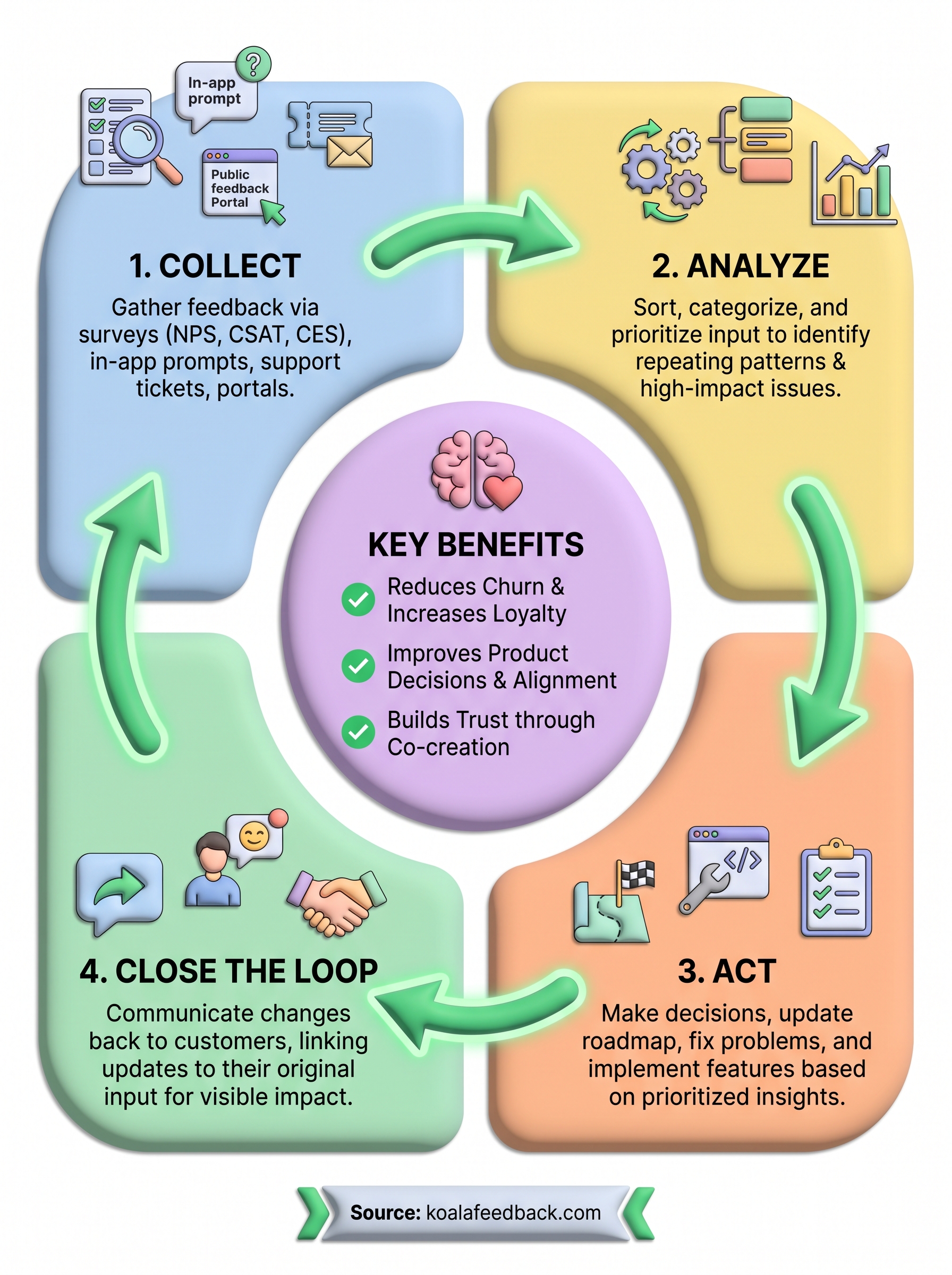
Running a customer satisfaction feedback loop that actually closes is not complicated, but it does require consistency at every stage. You collect input, analyze it for patterns, act on what matters most, and tell customers what changed. That sequence, repeated on a fixed cadence, is what turns scattered opinions into a product customers want to keep using.
Start small. Pick one collection channel, assign ownership for each stage, and hold your first weekly review. You will find patterns faster than you expect, and closing the loop on even one early request builds the kind of trust that keeps customers engaged for the long term.
If you want a purpose-built place to collect, organize, and respond to feedback while sharing your roadmap publicly, try Koala Feedback. It handles the infrastructure so your team can focus on acting, not administering.

Start today and have your feedback portal up and running in minutes.