Every product decision you make either moves your users closer to loyalty or pushes them toward a competitor. The difference often comes down to one thing: customer satisfaction definition, how well your product or service meets or exceeds what your customers actually expect. It sounds simple, but getting it right requires structure, not guesswork.
Customer satisfaction isn't just a feel-good metric. It directly influences retention, revenue, and word-of-mouth growth. Companies that measure it consistently make smarter product decisions because they're building on real user sentiment, not assumptions. That's exactly why tools like Koala Feedback exist, to help teams capture and act on the feedback that drives satisfaction up.
This article breaks down what customer satisfaction means, why it matters to your bottom line, and how metrics like CSAT give you a concrete way to track it. Whether you're a product manager trying to prioritize your next sprint or a founder figuring out what your users actually want, you'll walk away with a clear, practical understanding of the concept and how to apply it to your workflow.
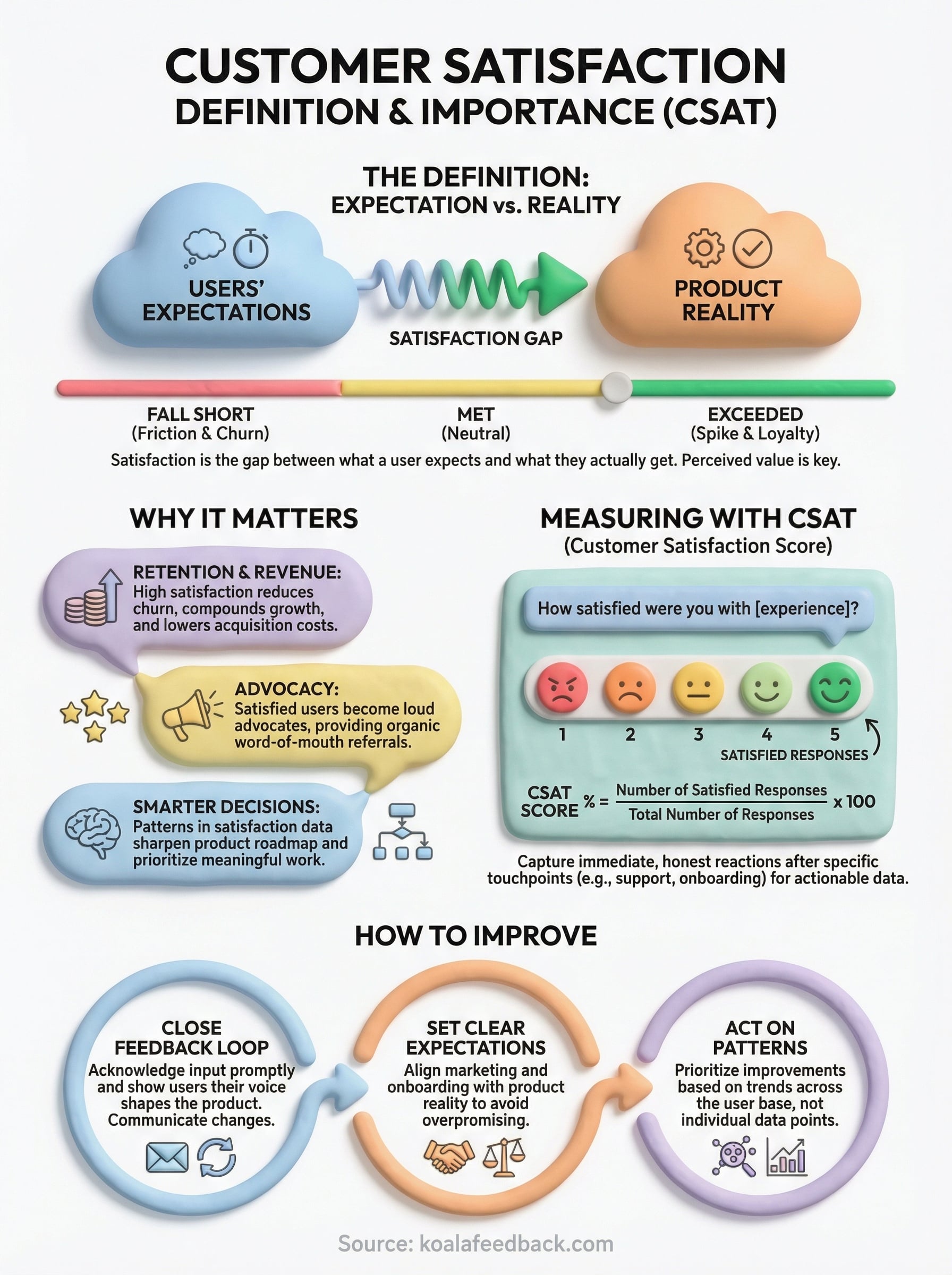
Customer satisfaction measures how well a product or service meets or exceeds what a user expected when they first engaged with it. At its core, the customer satisfaction definition is about the gap between expectation and reality: when your product delivers on its promise, satisfaction goes up; when it falls short, users disengage or churn. This is not a vague concept. Researchers and business frameworks have studied it for decades, and what consistently emerges is that satisfaction is tied directly to user perception, not just objective product quality.
When your users feel their expectations are consistently met, they stay longer and tell others.
The mechanics of satisfaction come down to a simple comparison that happens in every user's mind: what they thought they were going to get versus what they actually got. If your product delivers exactly what your users anticipated, satisfaction lands at a neutral level. If you exceed those expectations, satisfaction spikes. Fall below them, and you create friction that compounds over time.
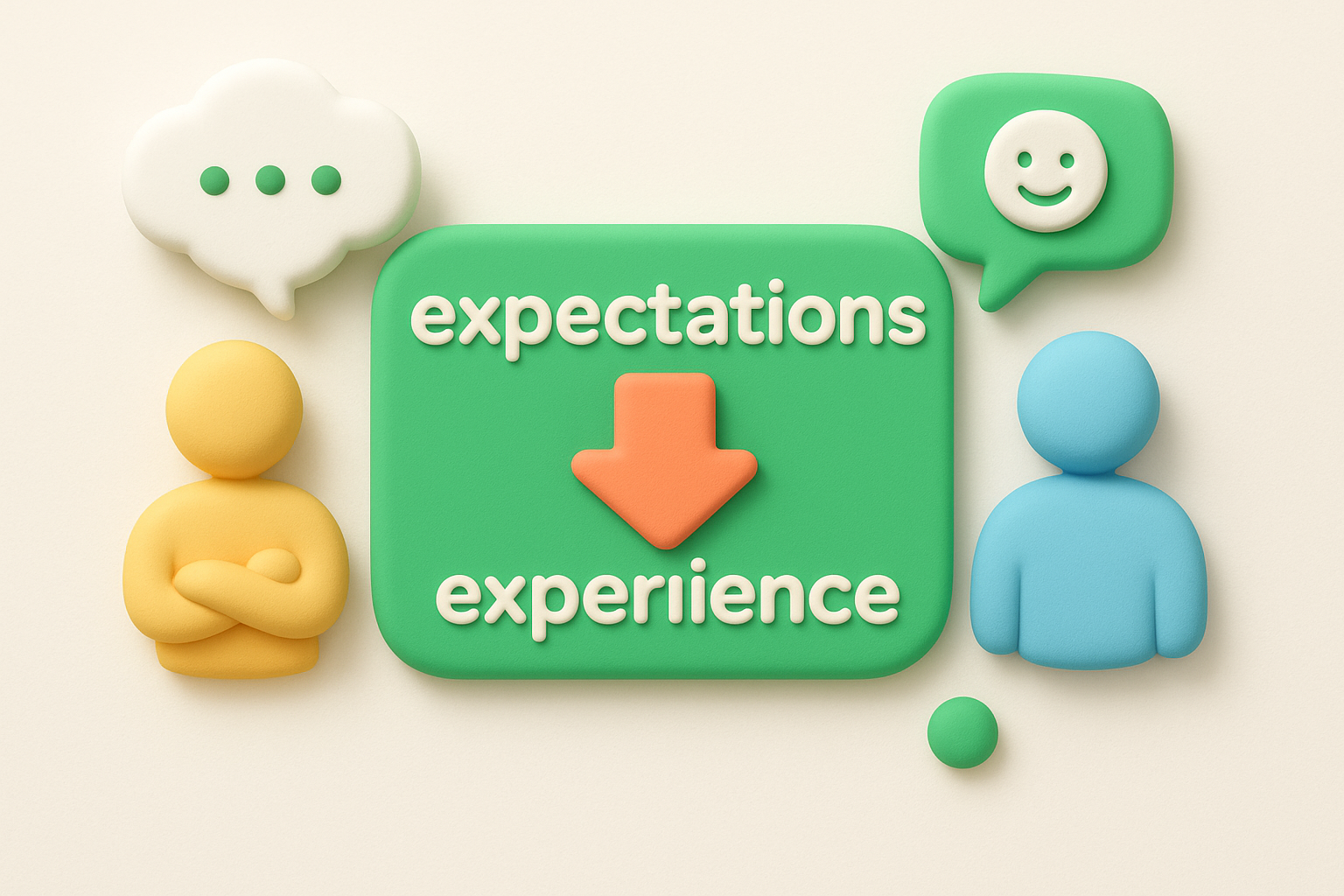
Understanding this gap gives you a concrete lens for evaluating every feature you ship and every support interaction you have. A user who contacts your support team expecting a two-day response and gets one in two hours walks away far more satisfied than a user who expected the same two-hour response and received it. The outcome was identical, but the starting expectation changed the entire result.
Customer experience describes the full journey a user takes with your product, from their first touchpoint through every interaction they have over time. Customer satisfaction is a specific measurement of how a person feels at a given moment within that journey. They are related but not interchangeable.
You can deliver a technically smooth customer experience and still score low on satisfaction if your users' expectations were set too high during onboarding or marketing. Conversely, a rough early experience can still yield satisfied users if your support team resolves issues quickly and your product improves visibly based on their feedback. What matters is that satisfaction reflects a user's emotional and rational assessment of your product at a specific point in time, not a blanket judgment of every touchpoint.
Tracking satisfaction at multiple moments across the user lifecycle gives you a much more complete picture than a single survey ever could. Product managers who understand this use satisfaction data at key intervals, post-onboarding, after a support interaction, or following a major update, to identify precisely where expectations and reality diverge.
The customer satisfaction definition centers on the gap between expectation and experience, but what actually moves that gap? Several specific factors shape whether your users feel satisfied after interacting with your product. Understanding these drivers gives you a clear, prioritized set of areas to address, rather than trying to improve everything at once and making progress on nothing.
Users come to your product to accomplish something specific. When your product does what it says it does, consistently and without friction, satisfaction follows naturally. When it breaks, loads slowly, or produces unexpected results, users start questioning whether they made the right choice. Reliability is the foundation that every other satisfaction driver builds on, which means a buggy or unstable product will undermine gains you make in any other area.
Quality also extends beyond core functionality. Clear documentation, intuitive navigation, and a UI that does not force users to guess all contribute to how people perceive your product. A feature that works technically but confuses users still damages their satisfaction with the overall experience.
How fast your product responds and how quickly your team resolves user issues both carry real weight. Load times, support reply speeds, and time-to-resolution are measurable signals that users translate directly into satisfaction. Research from Google consistently shows that users abandon slow-loading experiences at significantly higher rates, which means speed is not just a technical metric but a direct satisfaction driver with business consequences.
The faster you resolve a user's problem, the more confident they become that your product is worth staying with.
Your support team's responsiveness matters just as much as your product's performance. A user who hits a wall and receives a fast, useful response often ends up more satisfied than someone who never encountered the problem at all.
When users submit feedback and receive no response, they stop submitting feedback and start evaluating alternatives. Acknowledging input promptly, even when you cannot act on it right away, signals that you take your users seriously. Satisfaction rises because users are not only evaluating your product, they are also evaluating their ongoing relationship with your team and whether their voice actually influences what you build next.
Understanding the customer satisfaction definition gives you context, but knowing why it matters gives you motivation to act. Satisfied users stay longer and spend more, which makes satisfaction one of the most direct levers you have for driving revenue. Every improvement in satisfaction has a measurable effect on retention, and retention costs far less than acquisition.
Users who feel satisfied with your product do not spend time evaluating alternatives. High satisfaction reduces churn because it removes the motivation to look elsewhere. Research consistently shows that increasing customer retention by even 5% can dramatically lift profitability, which means the financial return on improving satisfaction is not marginal.
Keeping a satisfied user costs a fraction of what it takes to acquire a new one.
Revenue growth compounds when your existing users stay and expand their use over time. Upsells, plan upgrades, and expanded team seats all follow naturally when users trust your product and feel good about their ongoing experience with it.
Word-of-mouth referrals are one of the highest-converting acquisition channels available to any SaaS business, and they come almost entirely from satisfied users. When your product consistently meets or exceeds expectations, users talk about it without any prompting. That organic promotion carries more credibility than any paid campaign because it comes from a trusted peer, not an advertisement.
Dissatisfied users also talk, and they typically do so more loudly. A single unresolved complaint shared on a review platform can reach hundreds of potential customers before you even know it happened. Managing satisfaction proactively means you spend less time doing damage control and more time on meaningful product growth.
When you track satisfaction consistently, patterns in user sentiment point directly to areas of your product that need attention. Instead of guessing what to prioritize next, you work from real data that shows exactly where expectations and reality diverge.
Your product team makes better decisions when satisfaction scores sit alongside usage metrics in every planning conversation. Combining quantitative and qualitative signals gives you a complete picture of what users actually value, which keeps your roadmap focused on work that moves the needle.
Knowing the customer satisfaction definition is useful, but acting on it requires measurement. The Customer Satisfaction Score, commonly called CSAT, gives you a direct, simple way to quantify how users feel at specific moments in their experience with your product. Unlike broader metrics that capture general sentiment over time, CSAT captures a user's reaction immediately after a specific interaction, which makes it one of the most actionable tools available to product and support teams.
CSAT surveys ask users a single, straightforward question: "How satisfied were you with [experience]?" Respondents answer on a scale, typically from 1 to 5, where 1 represents very unsatisfied and 5 represents very satisfied. The format keeps the barrier to completion low, which means response rates tend to stay higher than longer feedback forms.
The simplicity of the question is the point. You are capturing a user's immediate, honest reaction rather than asking them to reflect on a complex set of criteria. That immediacy makes CSAT data directly tied to real moments in your product experience, not filtered through memory or second-guessing.
Your CSAT score is the percentage of satisfied responses out of all responses received. Responses of 4 or 5 on a 5-point scale typically count as satisfied. Divide the number of satisfied responses by the total number of responses, then multiply by 100.
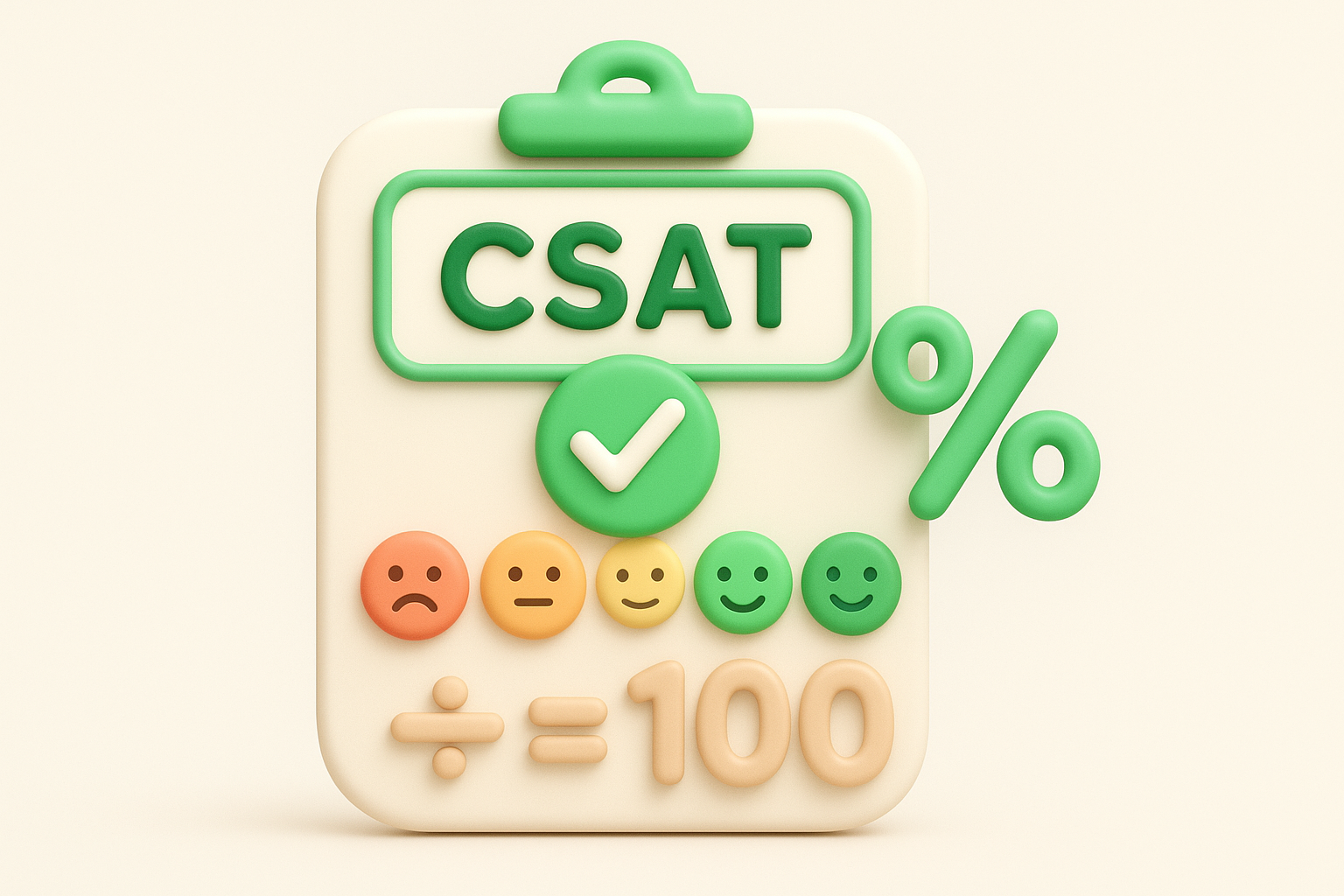
A CSAT score of 80% means 8 out of every 10 respondents rated their experience positively.
For example, if 120 out of 150 users rate their experience a 4 or 5, your CSAT score is 80%. Tracking this number over time reveals trends in user sentiment that correlate directly with product changes, support performance, and onboarding updates. Watching those trends across releases tells you far more than any single data point ever could.
Timing matters more than most teams realize. Sending a CSAT survey right after a specific touchpoint, such as a support interaction, a completed onboarding flow, or a new feature launch, ensures you capture accurate and relevant feedback. Surveys sent days after an interaction lose precision because users' recollections shift and the emotional context of the experience fades.
Knowing the customer satisfaction definition gives you the framework, but improvement comes from consistent action on the signals your users send you. Most teams already collect some form of feedback, but collecting it without a systematic response process produces no measurable change in satisfaction. The gap between gathering data and acting on it is where most improvement efforts stall.
When a user submits a feature request or reports a friction point, acknowledging that input directly is one of the fastest ways to move satisfaction scores. Users do not just evaluate your product on what it does today. They also evaluate whether your team listens and responds over time. Closing the loop means following up when you act on feedback, and explaining your reasoning clearly when you cannot.
Users who see their feedback lead to a real product change are significantly more likely to stay loyal and submit future input.
Tools like public roadmaps and status updates keep users informed without requiring individual responses to every request. When your users can see that their voice shaped something real, satisfaction builds around the relationship, not just the product.
Overpromising at any stage of the user journey creates a satisfaction gap that even a strong product cannot fully close. Your onboarding copy, marketing claims, and sales conversations all establish what users expect before they ever touch your product. When those expectations align closely with reality, satisfaction follows naturally.
Review your onboarding flow and feature descriptions regularly. If your documentation implies capabilities your product has not yet reached, you are setting users up for disappointment before they even start, which no amount of reactive support can fully repair.
A single low CSAT score tells you something went wrong in one interaction. A pattern of low scores after a specific action tells you exactly where your product or process needs attention. Prioritize improvements based on trends across your user base rather than reacting to isolated responses.
Combining CSAT data with qualitative feedback from open-ended survey questions gives your product team a complete picture of what to fix, in what order, and why it matters to your users.
The customer satisfaction definition comes down to one persistent question: does your product consistently meet what your users expected when they signed up? Tracking that gap with metrics like CSAT, closing the feedback loop quickly, and setting honest expectations across every touchpoint are the core actions that separate teams who improve satisfaction from teams who only talk about it. None of these practices require a large budget, just a consistent system for collecting, reviewing, and responding to what your users tell you.
Your next step is to build that system before your next product cycle starts. Start by centralizing where feedback comes in, then make it visible to your whole team so nothing falls through the cracks. Structured feedback tools make that process faster and far more consistent than managing scattered email threads or spreadsheets. If you want a practical starting point, explore how Koala Feedback helps teams collect and act on user feedback without adding complexity to your workflow.

Start today and have your feedback portal up and running in minutes.