If you're drowning in support tickets, survey responses, and feature requests scattered across five different tools, you already know manual feedback review doesn't scale. Customer feedback analysis ai solves this by reading through thousands of comments in minutes and telling you what actually matters.
At its core, this technology uses natural language processing to categorize feedback by topic, detect sentiment, and surface patterns you'd otherwise miss buried in spreadsheets. Instead of someone manually tagging every comment as "bug," "feature request," or "praise," the AI does it instantly and consistently, which means you spend time acting on insights instead of sorting data.
This article breaks down exactly what feedback analysis is when AI does the work, how the underlying machine learning models actually work, and what separates a genuinely useful tool from one that just slaps "AI-powered" on a basic keyword search. You'll see how automated categorization and sentiment analysis turn raw feedback into a prioritized list of what to build next, and why product teams are moving away from spreadsheet-based tracking toward platforms built for this exact job.
Manual feedback review breaks down the moment your product has more than a few hundred active users. A support team can read maybe 50 tickets in an hour and still miss the three-word complaint buried in ticket 47 that actually explains why churn spiked last month. AI feedback analysis tools don't get tired, don't skim, and don't let recency bias decide what feels important. That difference alone changes how a business makes decisions, and it's a big part of why listening to customers pays off, because you're reacting to what customers actually said instead of what the last person who complained loudly happened to mention in a meeting.
Speed is the first thing teams notice once they switch. A product manager who used to spend a Friday afternoon copying comments into a spreadsheet can now get a categorized, sentiment-scored summary the moment feedback comes in. This matters because feedback velocity compounds: the faster you spot a pattern, the faster you can ship a fix or a feature, and the faster your users see that their input actually goes somewhere. That visible responsiveness is what turns a passive user base into one that keeps submitting ideas instead of quietly leaving.
Once feedback is categorized and scored, prioritization stops being a guessing game. Instead of a roadmap built around whoever shouted loudest in a sales call, you get a ranked list based on volume, sentiment intensity, and how requests cluster together. Platforms like Koala Feedback take this a step further by feeding that categorized data directly into prioritization boards and a public roadmap, so the connection between "customers asked for this" and "we're building this" is visible to your whole team, and to your users.
If you can't tell which feature request came up 200 times versus twice, you're prioritizing on guesswork, not data.
Here's how the two approaches actually compare in practice:
| Factor | Manual review | AI-driven analysis |
|---|---|---|
| Time to process 1,000 comments | Days | Minutes |
| Consistency of tagging | Varies by reviewer | Consistent every time |
| Pattern detection across sources | Easy to miss | Surfaces automatically |
| Scales with growth | Requires more headcount | Scales with the same team |
| Bias risk | High (recency, personal opinion) | Low, based on full dataset |
Growth is where the case becomes hard to argue against. A team of two product managers can handle feedback from 500 users manually, but that same team drowns once you hit 5,000. Automated customer feedback analysis removes the headcount problem entirely, so scaling your user base doesn't force you to scale your feedback team at the same rate.
Retention is the quieter benefit, but it's arguably the bigger one. Customers who submit feedback and never hear back stop submitting it, and eventually stop renewing. When AI-generated customer insights flag a recurring complaint before it shows up in your churn numbers, you get a chance to fix the problem while the customer is still around to notice. That's the real business case: it's not just about organizing comments, it's about catching the signal that predicts revenue loss before it happens.
Underneath the dashboard, customer feedback analysis ai runs on a pipeline that turns raw text into structured data. It starts with ingestion, pulling comments from support tickets, survey responses, app store reviews, and your feedback portal into one place. Without that consolidation step, the AI has nothing to work with, since it can only find patterns in data it can actually see.
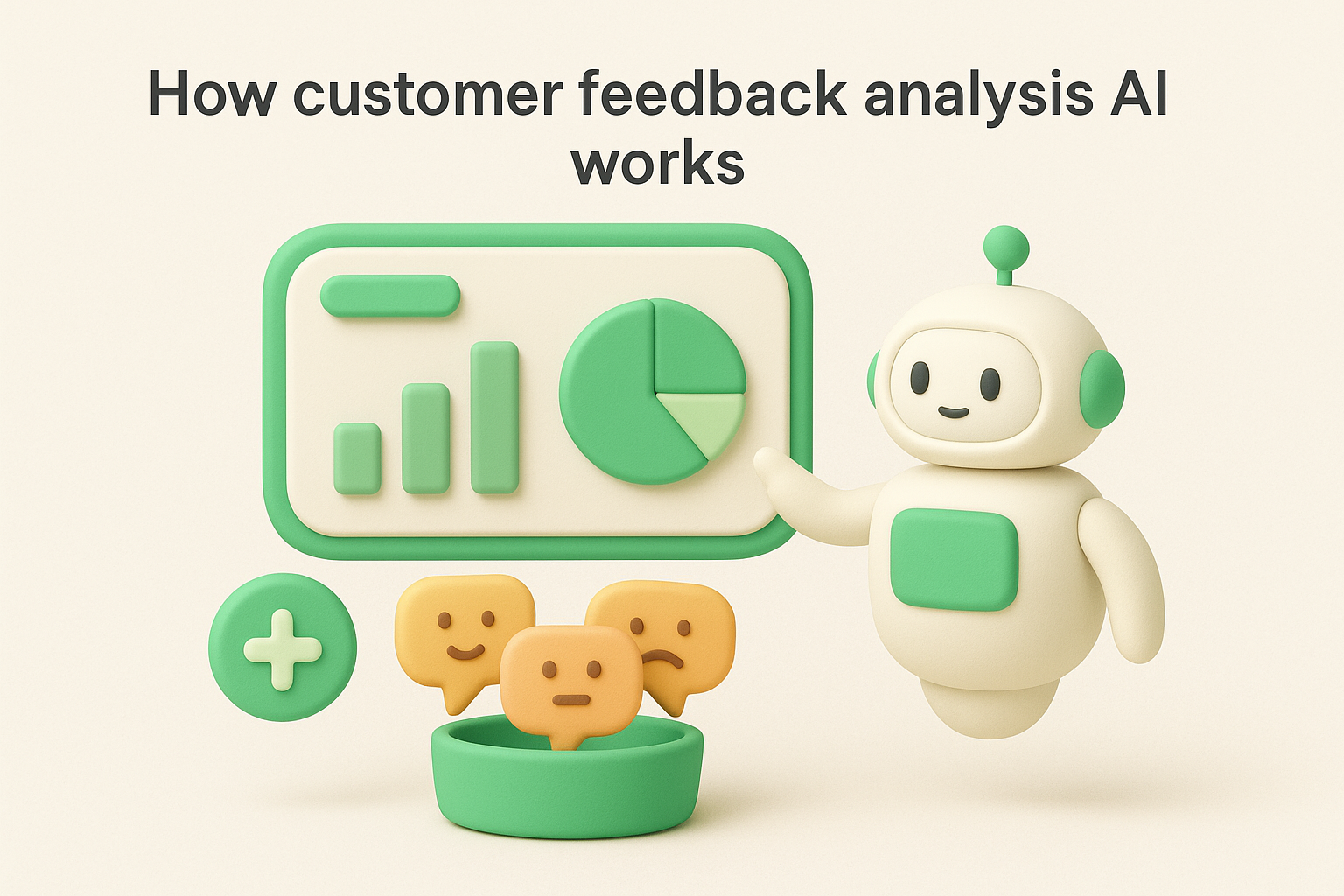
Once feedback lands in the system, natural language processing breaks each comment into tokens, strips out noise like greetings and filler words, and identifies the core subject matter. This is where duplicate detection happens too: if fifty users describe the same missing export feature in fifty different ways, the model recognizes they're talking about the same thing and groups them, rather than treating each one as a separate, unrelated request.
After the text is cleaned, machine learning models classify each piece of feedback against topic categories you define, like billing, onboarding, or a specific feature area, which is the same job as structuring feedback by theme and priority by hand. At the same time, sentiment analysis quantifies emotional tone with NLP, flagging whether a comment is frustrated, neutral, or enthusiastic. Combine those two outputs and you get a weighted signal: not just what people are talking about, but how strongly they feel about it.
A comment count tells you what people mention; a sentiment score tells you what actually needs to change.
The typical flow looks like this:
The model doesn't stay static. As your team confirms or corrects categorizations, the system refines its accuracy for your specific product vocabulary, since "crashes" means something different to a fintech app than a photo editor. That feedback loop is what separates real machine learning models from a basic keyword filter that never gets smarter.
Not every tool that claims AI feedback analysis actually delivers it, which is why it helps to compare the AI feedback tools product teams use in 2026 before deciding. Some products just run a keyword search and call it categorization, which leaves you doing the real analysis yourself. Before you commit to a platform, check that it handles the full pipeline, from ingestion to reporting, without requiring you to stitch together three separate tools, and see how the 16 leading AI-powered analysis platforms stack up on that test.
Your feedback doesn't live in one place, so your tool shouldn't expect it to. Look for a platform that pulls in support tickets, app reviews, survey responses, and direct submissions from a feedback portal into a single view, which is exactly what the better AI feedback collection tools are built to do. Koala Feedback's feedback portal is built around this idea: every submission lands in one place, gets categorized automatically, and feeds straight into prioritization without a manual export step.
Categorization only helps if it's consistent. Test any tool with a batch of messy, real feedback, not a clean demo dataset, and see whether it groups duplicate requests correctly. Duplicate detection that actually works saves you from a roadmap cluttered with ten versions of the same request under different names.
A tool that can't merge duplicates will always overstate how many separate problems you actually have.
Analysis without a way to act on it just becomes another report nobody reads. Prioritize tools that connect scored feedback directly to a public roadmap with customizable statuses, so users see their request move from "planned" to "in progress" to "done."
Here's a quick checklist to run through when evaluating options:
Getting these right up front saves you from switching platforms six months in, once you realize the "AI" was mostly marketing.
Even the best customer feedback analysis ai runs into predictable problems, and knowing them ahead of time saves you from blaming the tool when the real issue is how you set it up. Most teams hit the same three snags: messy input data, blind trust in the model's output, and feedback that stays scattered across tools that never talk to each other.
Garbage data produces garbage insights, no matter how sophisticated the underlying model is. If your support tickets are full of copy-pasted error logs or your survey responses are one-word answers, the AI has thin material to categorize accurately. Fix this by standardizing how feedback gets submitted wherever you can, a structured feedback portal with a few required fields beats an open text box every time, since it gives the model consistent context to work with, and setting one up properly takes an afternoon.
Overconfidence in automated output is the second trap. Sentiment scores and category tags are a starting point, not gospel, especially with sarcasm, industry jargon, or feature names that mean something specific to your users. Build in a lightweight review step where a team member spot-checks a sample of tagged feedback each week, and correct anything wrong, since those corrections are what actually train the machine learning models to fit your product's vocabulary.
Trusting AI output without ever checking it is how an unchecked AI feedback loop lets a single mistagged trend drive your whole roadmap.
Fragmentation quietly undermines everything else. If half your feedback lives in a spreadsheet, a quarter sits in support tickets, and the rest is scattered across email threads, no amount of AI accuracy fixes the fact that you're only analyzing part of the picture. Consolidate every channel into one system before you evaluate whether the analysis itself is working.
A quick way to catch these issues early:
Avoiding these three traps is less about picking a fancier tool and more about feeding it clean, consolidated data and staying involved in the loop.
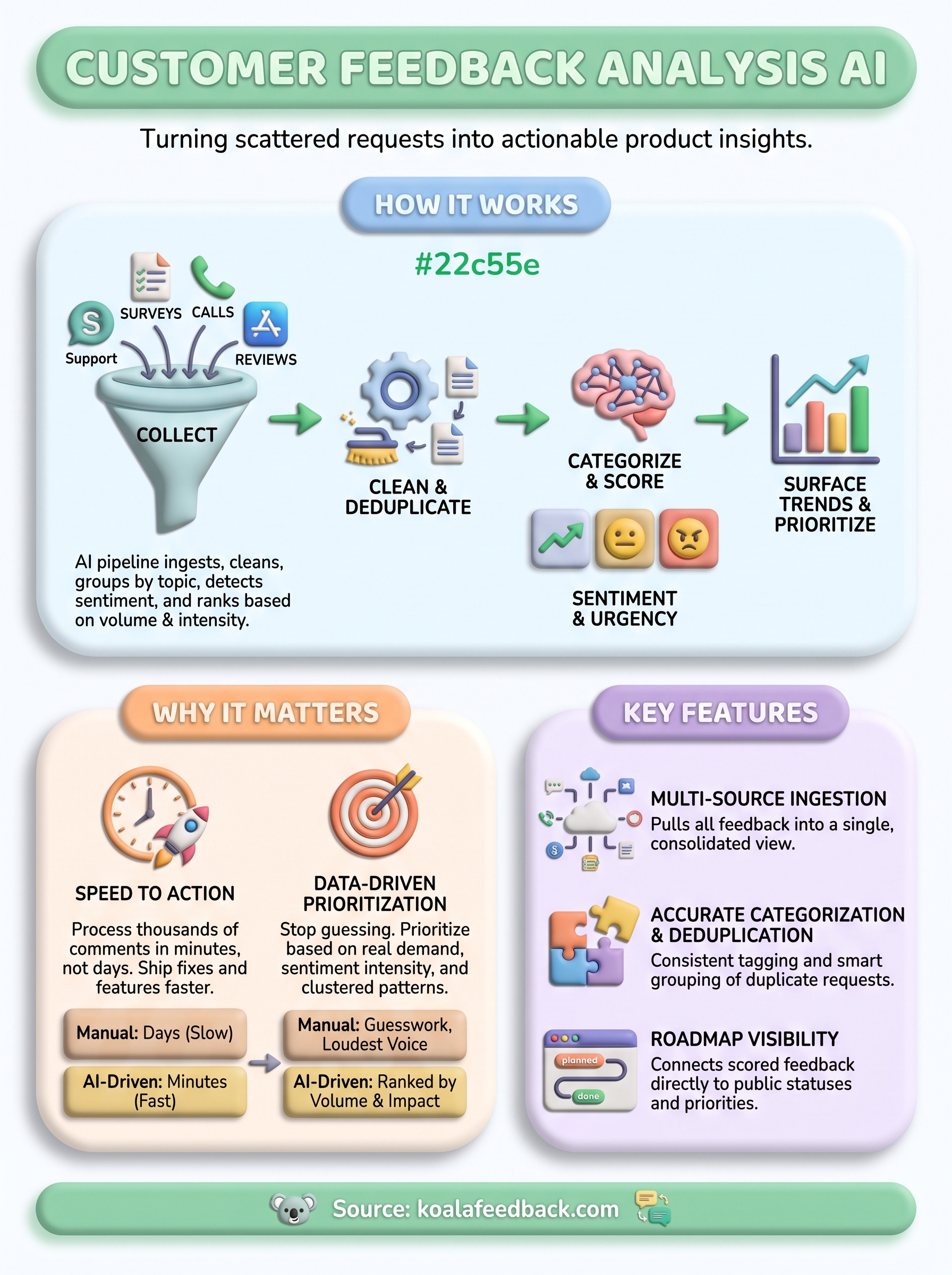
Getting value from customer feedback analysis ai doesn't require a massive rollout or a data science team. It requires consolidating your feedback into one place, letting the AI categorize and score it, and staying involved enough to catch the occasional mistagged comment. Teams that skip straight to the AI without fixing fragmented sources end up disappointed, not because the technology failed, but because they gave it a partial picture to work with.
Start small: pull your feedback into a single portal, let categorization run for a few weeks, and watch how much faster your prioritization conversations become once they're backed by real numbers instead of the loudest voice in the room. Once you see a recurring complaint flagged before it turns into churn, you won't want to go back to spreadsheets.
If you're ready to stop guessing and start prioritizing based on actual demand, bring every scattered request into one feedback portal and see how quickly it turns into a clear roadmap.

Start today and have your feedback portal up and running in minutes.