You've got feedback scattered across support tickets, app store reviews, sales calls, and a feedback portal, and no realistic way to read all of it. That's the problem customer insights ai was built to solve. Instead of manually tagging themes or guessing which complaints matter most, you let machine learning models scan thousands of comments and surface the patterns a human would take weeks to find.
So what does this actually mean in practice? AI for customer insights refers to using natural language processing and machine learning to analyze customer feedback, support conversations, and behavioral data, then automatically group it into themes, detect sentiment, and flag what's driving churn or demand. It's the difference between reading every comment yourself and getting a dashboard that tells you exactly what your users care about right now.
In this article, you'll learn how AI driven customer insights systems actually work under the hood, what separates a real insights engine from a glorified word cloud, and where tools built for this job fit into your existing feedback and roadmap process.
Most product teams already collect plenty of feedback. The problem isn't volume, it's turning that volume into decisions fast enough to matter. When you're relying on someone manually reading through hundreds of support tickets and portal comments once a quarter, you're making roadmap calls on stale data. Customer insights ai closes that gap by processing feedback continuously, so the themes you see on Monday reflect what customers said last week, not last quarter.
Without automation, prioritization tends to come down to whoever complains loudest or whichever request a sales rep mentioned in a meeting. That's not a data-driven process, it's recency bias with extra steps. AI models trained on your feedback data can cluster hundreds of similar requests into a single theme, weight them by frequency and customer value, and show you which features actually have the most demand behind them. This is exactly the kind of prioritization work Koala Feedback's categorization and voting features are built to support, giving you a structured view of demand instead of a gut feeling.
The teams that win aren't the ones with the most feedback, they're the ones who can act on it fastest.
Sentiment analysis of customer feedback is where ai driven customer insights really earns its keep. A drop in satisfaction usually shows up in language weeks before it shows up in your churn dashboard: shorter responses, more negative word choice, repeated mentions of a specific bug or missing feature. Manual review rarely catches this shift early enough to intervene. An AI model scanning feedback in real time can flag the change the same day it starts, giving your team a chance to fix the issue before customers start canceling.
Human reviewers, even good ones, tend to remember the feedback that's most recent, most dramatic, or most aligned with what they already believed. AI for customer insights doesn't have that problem. It processes every comment the same way, which means quieter but common complaints get surfaced instead of buried under a handful of loud outliers. That matters most for larger customer bases, where the volume of feedback makes it statistically impossible for one person to keep an accurate mental model of what users actually want.
Here's a quick comparison of what changes when you move from manual review to an AI-assisted process:
| Task | Manual process | AI-driven process |
|---|---|---|
| Time to analyze 500 comments | Days | Minutes |
| Consistency across reviewers | Varies by person | Consistent every time |
| Detecting sentiment shifts | Often missed until churn happens | Flagged in near real time |
| Identifying duplicate requests | Manual tagging, error-prone | Automatic clustering |
| Scaling with feedback volume | Breaks down past a few hundred entries | Scales linearly |
Once you see the difference laid out this way, the business impact of customer insights writes itself: faster analysis means faster shipping, and faster shipping means happier customers who keep renewing.
Building an AI-driven customer insights process isn't about installing a tool and waiting for magic. It's a workflow, and like any workflow, it needs the right inputs, the right processing layer, and a clear path back to your product decisions. Skip any one of those steps and you end up with a dashboard nobody trusts.
Before any AI model can find patterns, it needs a single place to look. Scattered feedback across email, Slack, support tickets, and app reviews means your model only ever sees a fraction of the picture. Start by routing everything into one system, like a feedback portal for collecting customer requests, where customers submit ideas directly and your team logs feedback from other channels as it comes in.
Once feedback lives in one place, you need models that can categorize, deduplicate, and score it. This is where ai for customer insights actually does its work: grouping similar requests into themes, tagging sentiment, and ranking themes by volume and customer value. Koala Feedback handles this automatically through its categorization and voting features, so you're not building a natural language processing pipeline from scratch.
An insights process is only as good as the data feeding it, garbage in still means garbage out, no matter how good the model is.
Turning clustered insights into shipped features requires a visible loop between what customers said and what you're building. Without that link, feedback analysis becomes an exercise nobody acts on. Push your prioritized themes straight into a public roadmap, updating statuses as work moves from planned to in progress to shipped, so customers see their input reflected in real decisions.
Underneath every insights dashboard is a stack of specific technologies, not one magic algorithm. Knowing what each piece does helps you evaluate a tool instead of just trusting a vendor's marketing page. Customer insights ai platforms typically combine several of these methods, layering them so the output is more than a list of keywords.
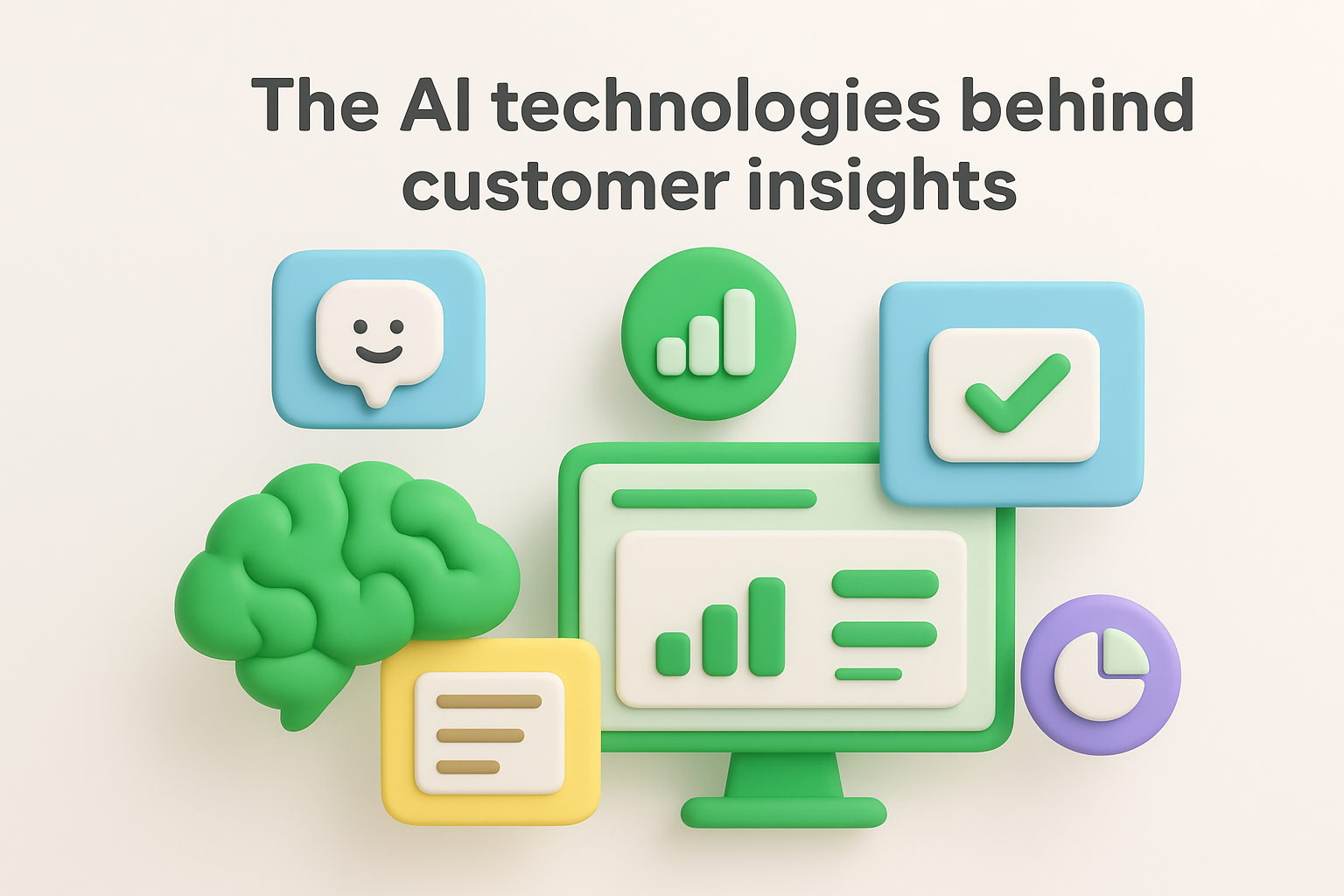
Natural language processing (NLP) is what lets a model read a comment like "the export feature keeps timing out" and understand it as a complaint about a specific feature, not just a string of words. Sentiment analysis builds on that by scoring tone, positive, negative, or neutral, so sentiment analysis tools let you track how customers feel about a theme over time, not just how often they mention it. This pairing is what separates real analysis from simple keyword counting.
Clustering algorithms group similar pieces of feedback together even when customers use completely different wording. One person says "the app is slow to load," another says "performance has gotten worse," and a clustering model recognizes both as the same underlying issue. Topic modeling takes this further by identifying recurring themes across your entire feedback set without you having to define categories in advance.
A model that can't tell two phrasings of the same complaint apart from two different complaints isn't giving you insights, it's giving you a transcript.
Classification models learn from labeled examples to sort new feedback into categories automatically, feature request, bug report, pricing complaint, and so on. Newer tools layer large language models (LLMs) on top, which can summarize dozens of comments into a single readable insight instead of just a category label. Here's how the main technologies typically split by function:
| Technology | What it does |
|---|---|
| NLP | Parses text and extracts meaning |
| Sentiment analysis | Scores tone as positive, negative, or neutral |
| Clustering | Groups similar feedback regardless of wording |
| Topic modeling | Surfaces recurring themes automatically |
| Classification models | Sorts feedback into predefined categories |
| LLMs | Summarizes clusters into readable insights |
Understanding this stack matters because vendors often use "AI-powered" loosely. A tool that only counts keyword frequency isn't doing the same job as one running full clustering and sentiment scoring.
Theory is easy to nod along to, but seeing how customer insights ai plays out in actual product teams makes the value concrete. Below are three customer insights examples for SaaS teams that show what changes when you swap manual review for an automated insights layer.
A mid-size SaaS company was collecting feedback through a portal, support tickets, and app store reviews, but only had bandwidth to review it once a month. By the time anyone spotted a pattern, customers had already been frustrated for weeks. After centralizing everything into one system with automatic categorization, the same volume of feedback got sorted into themes within hours instead of days. The product team started reviewing prioritized clusters every Monday instead of once a quarter, and shipped fixes for the top three recurring complaints within a single sprint.
When feedback review drops from weeks to hours, you stop reacting to old problems and start fixing current ones.
Retail and e-commerce companies deal with a flood of reviews, chat transcripts, and social mentions that no single person can read in full. Platforms marketed specifically around this use case, including standalone tools like CustomerInsights.AI, exist because sentiment analysis at this scale needs automation, not another spreadsheet. One retailer noticed sentiment on a specific product category slipping two weeks before return rates spiked, purely because the language in reviews shifted from neutral to frustrated. That early flag gave the team time to update product descriptions and fix a sizing issue before it became a bigger revenue problem.
Support teams often sit on the richest feedback data in the company, but it rarely reaches product managers in a usable form. One B2B software team started feeding support ticket exports into their feedback system alongside portal submissions, letting ai driven customer insights cluster tickets by root cause instead of ticket subject line. What used to look like dozens of unrelated complaints turned out to be five underlying issues, three of which became the top items on the next quarter's roadmap. That's the pattern worth copying: don't treat support data as separate from product feedback, treat it as the same input feeding the same model.
Even the best models run into friction once they meet real feedback data. Knowing these obstacles ahead of time saves you from blaming the tool when the real problem is process or data quality. Customer insights ai works well only when a few foundational issues get addressed first.
Fragmented feedback is the biggest blocker teams run into. If half your comments live in a spreadsheet, a third in a support tool, and the rest in someone's inbox, no model can find accurate patterns because it's only ever seeing part of the picture. Duplicate entries, inconsistent tagging, and missing context (like which plan tier a customer is on) all weaken the output. Fixing this means centralizing sources and having a repeatable way to clean and tag feedback before you worry about which AI features to turn on.
A model can only be as accurate as the data you feed it, and fragmented feedback produces fragmented insights.
Teams new to ai for customer insights sometimes treat every AI-generated summary as gospel, skipping the step of spot-checking clusters against the original comments. Sentiment scoring and clustering are strong, but not perfect. Sarcasm, industry jargon, and short comments without much context can get misclassified. Spend ten minutes a week reviewing a sample of clustered feedback against the raw text, just to catch drift before it shapes a roadmap decision.
Product managers who've spent years reading every ticket personally can be skeptical of a dashboard telling them what customers want. That resistance usually fades once the AI-generated themes get validated against a few known pain points the team already recognized, proving the model isn't just noise.
Organizations often expect a plug-and-play experience, but connecting support tools, importing historical feedback, and tagging sources correctly takes real setup time. Here's what typically causes delays:
Budgeting a few weeks for setup, rather than expecting instant results, keeps expectations realistic and adoption smoother.
Not every platform labeled "AI-powered" does the same job, so evaluating customer insights ai tools means looking past the marketing page of any AI-powered feedback analysis tool and testing how they actually handle your data. The right choice depends less on flashy dashboards and more on whether it fits the feedback you already collect and the roadmap process you already run.
Start by mapping where your feedback actually lives: portal submissions, support tickets, app reviews, sales call notes. A tool that only ingests one channel forces you to keep manually stitching data together, which defeats the point. Look for a platform that can pull from multiple sources into one place, the same way a feedback portal centralizes submissions before any AI layer touches them.
Some tools give you a summary with no way to see the raw comments behind it, which makes it impossible to spot-check accuracy. Ask any vendor to show you the individual pieces of feedback inside a cluster before you trust the label. If a tool can't show its work, you're trusting a black box with decisions that affect your roadmap.
If a tool can't show you the feedback behind its summary, you're trusting a black box with your roadmap.
Insights that stay trapped in a separate analytics tool rarely turn into shipped features. Prioritize platforms that connect clustered themes directly to a public roadmap, so prioritization and communication live in the same system instead of requiring a manual handoff between tools.
Run any shortlisted tool through these questions before committing:
Running a real pilot with your own messy data, not a vendor's clean demo set, tells you more in a week than any feature comparison page. Customer insights software options look similar in a sales pitch; the differences show up once your actual comments hit the model.
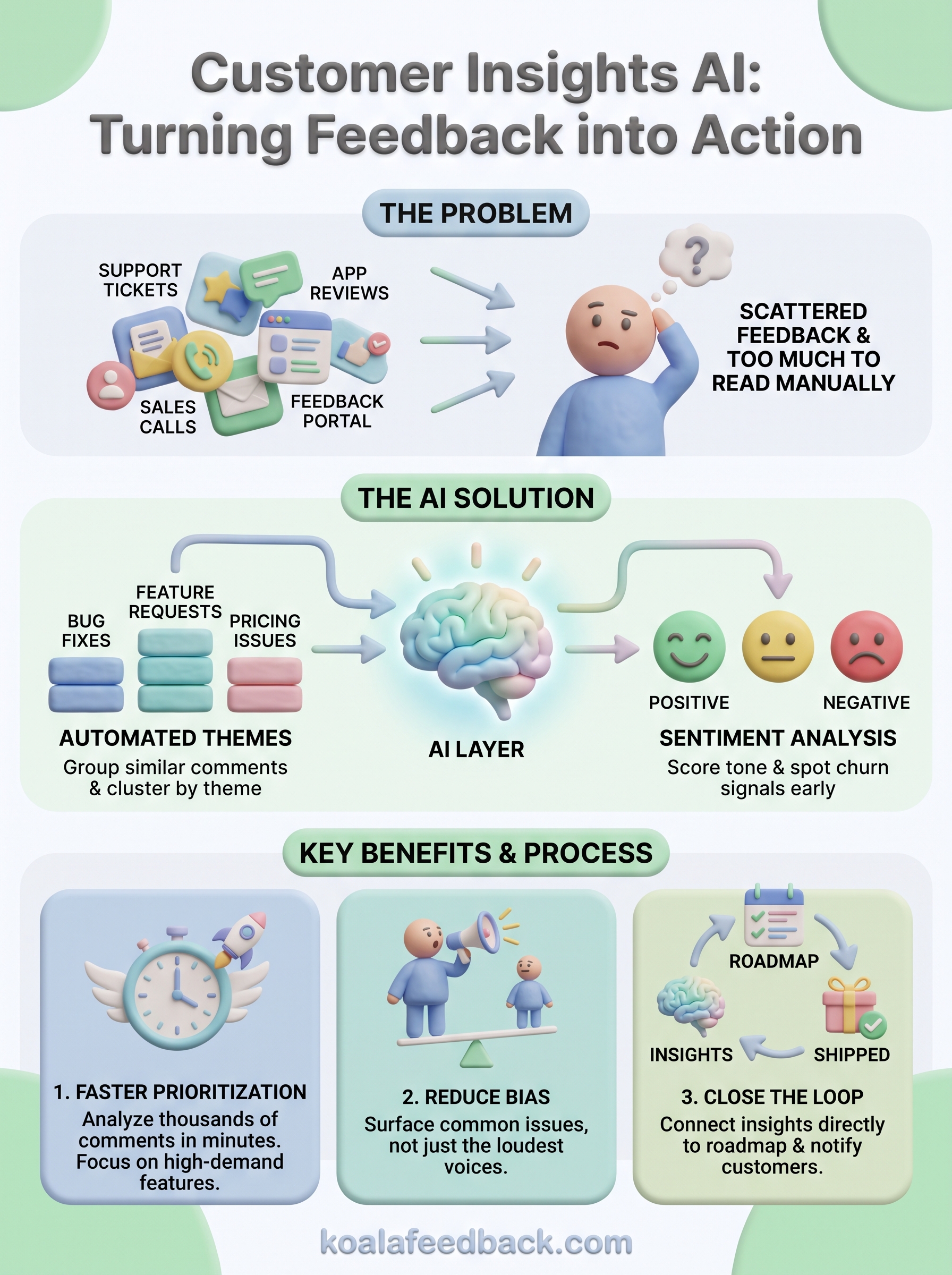
None of this matters if the insights stay locked in a dashboard nobody checks. Customer insights ai only earns its keep when clustered themes turn into roadmap items, and roadmap items turn into shipped features customers actually notice. Getting there doesn't require a massive overhaul: centralize your feedback, let the right models do the sorting, and build a habit of reviewing prioritized themes every week instead of once a quarter.
Organizations that treat ai driven customer insights as a continuous loop, rather than a one-time report, ship faster and lose fewer customers to preventable frustration. The tools exist to make that loop realistic even for small teams without a data science department.
If you're ready to stop guessing and start prioritizing based on real demand, centralize and prioritize user feedback in one portal with Koala Feedback and see how automatic categorization and a public roadmap turn scattered feedback into a process you can trust.

Start today and have your feedback portal up and running in minutes.