If you build products with AI features, you've probably heard the term AI feedback loop thrown around, sometimes as a warning, sometimes as a design goal. That's confusing when the same phrase describes both a healthy system that improves from real user input and a broken one that spirals into model collapse because it's training on its own recycled outputs. You need to know which one you're dealing with before you can trust the results.
An AI feedback loop, at its core, is any cycle where a model's outputs influence the data it later learns from or is judged against. This introduction won't leave you guessing: we'll define the term precisely, walk through the mechanics of the loop, and separate the productive version from the degenerative one that quietly corrupts model quality over time.
You'll also see how this concept connects to something product teams already manage every day: running a product feedback loop between what users say and what gets built. We cover the risks like bias amplification and drift, plus practical safeguards for AI systems that keep feedback loops working for you instead of against you.
Recommendation engines, chatbots, search rankings, and fraud detection systems all rely on a machine learning feedback loop to stay accurate. When that loop works, the model gets sharper with every interaction, catching edge cases a static training set would miss. When it breaks, the model starts confirming its own mistakes instead of correcting them, and nobody notices until accuracy quietly craters. That gap between a self-improving system and a self-deceiving one is why engineers and product leaders can't treat this as an abstract concept.
Stakes get higher as more of the internet's content gets generated by AI itself. Search engines like Google have already warned publishers about low-quality, automated content flooding results, and that same synthetic content often becomes training data for the next generation of models. Feed a model enough of its own unchecked output, and you get a compounding error problem: small inaccuracies get treated as ground truth, then amplified in the next training run.
A feedback loop only makes a model smarter if the data feeding it reflects reality, not the model's own guesses.
Businesses that build with AI features already understand a version of this dynamic from the product side. Teams that run a feedback portal know that a healthy loop between user input and product decisions makes the roadmap better over time, while ignoring or misreading that input sends development in the wrong direction. The same logic applies to AI systems: the quality of what goes back into the loop determines whether the system gets more useful or drifts further from what users actually need.
Strip away the jargon and an AI feedback loop boils down to four repeatable steps. A model makes a prediction, that prediction gets evaluated somehow, the evaluation becomes new training or ranking data, and the model updates based on that data. Understanding this cycle mechanically matters more than memorizing definitions, because it tells you exactly where things can go wrong.
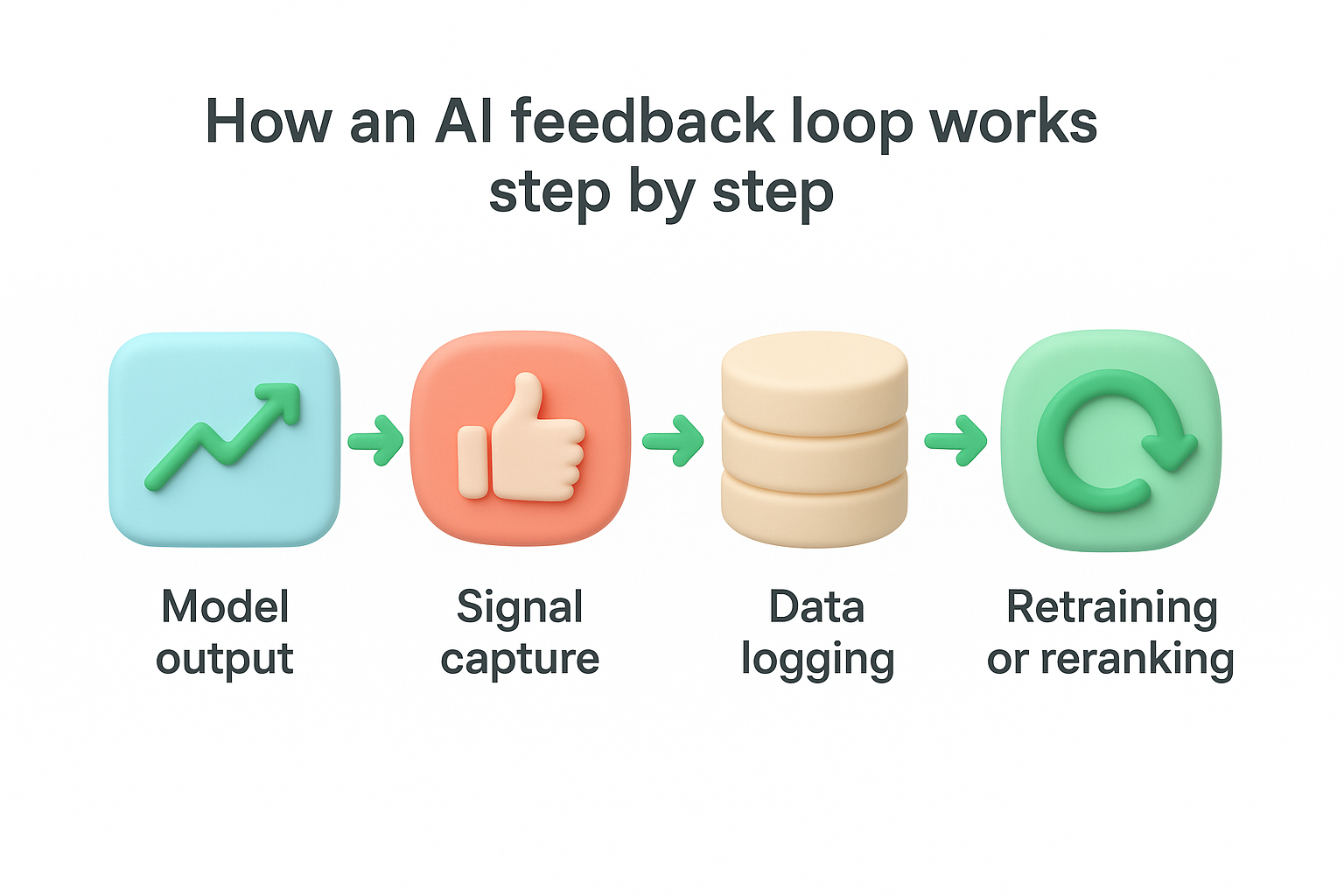
Here's the sequence in practice:
Every step in that cycle is a place where noise can sneak in and get treated as truth.
Users can behave differently once they know they're being watched. Search rankings can push certain content up simply because it already ranked well, not because it's better. Automated scoring can misjudge nuance a human would catch instantly. Each of these introduces distortion long before anyone notices a drop in quality.
Not every loop behaves the same way, and knowing which type you're dealing with changes how much you should trust the output. A reinforcing feedback loop amplifies whatever pattern already exists, which is great when that pattern is accuracy and terrible when it's bias. A balancing feedback loop works the opposite way, pulling the system back toward a stable target instead of letting small errors snowball. Somewhere between the two sits the distinction that matters most day to day: whether a human reviews the signal before it retrains the model, or whether the system updates itself with no one checking the data.
Designers of AI systems also draw a line between explicit feedback, like a thumbs up or a support ticket, and implicit feedback, like a click or a skipped result, much the way product teams separate the types of customer feedback they collect.
| Loop type | How it behaves | Common example |
|---|---|---|
| Reinforcing | Amplifies existing patterns | Recommendation engines pushing popular content further |
| Balancing | Pulls output back toward a target | Fraud models recalibrated against confirmed cases |
| Human-in-the-loop | Person reviews signal before retraining | Moderators labeling flagged content |
| Fully automated | System retrains without review | Search rankings updated from click data alone |
Feedback loops don't fail randomly. They fail in two predictable ways: bias amplification and model collapse. Bias amplification happens when a model's early errors get treated as signal, so the next training round leans harder into the same skew. A hiring model that once favored one resume format will keep ranking similar resumes higher, because the loop rewards its own past decisions rather than actual job performance.
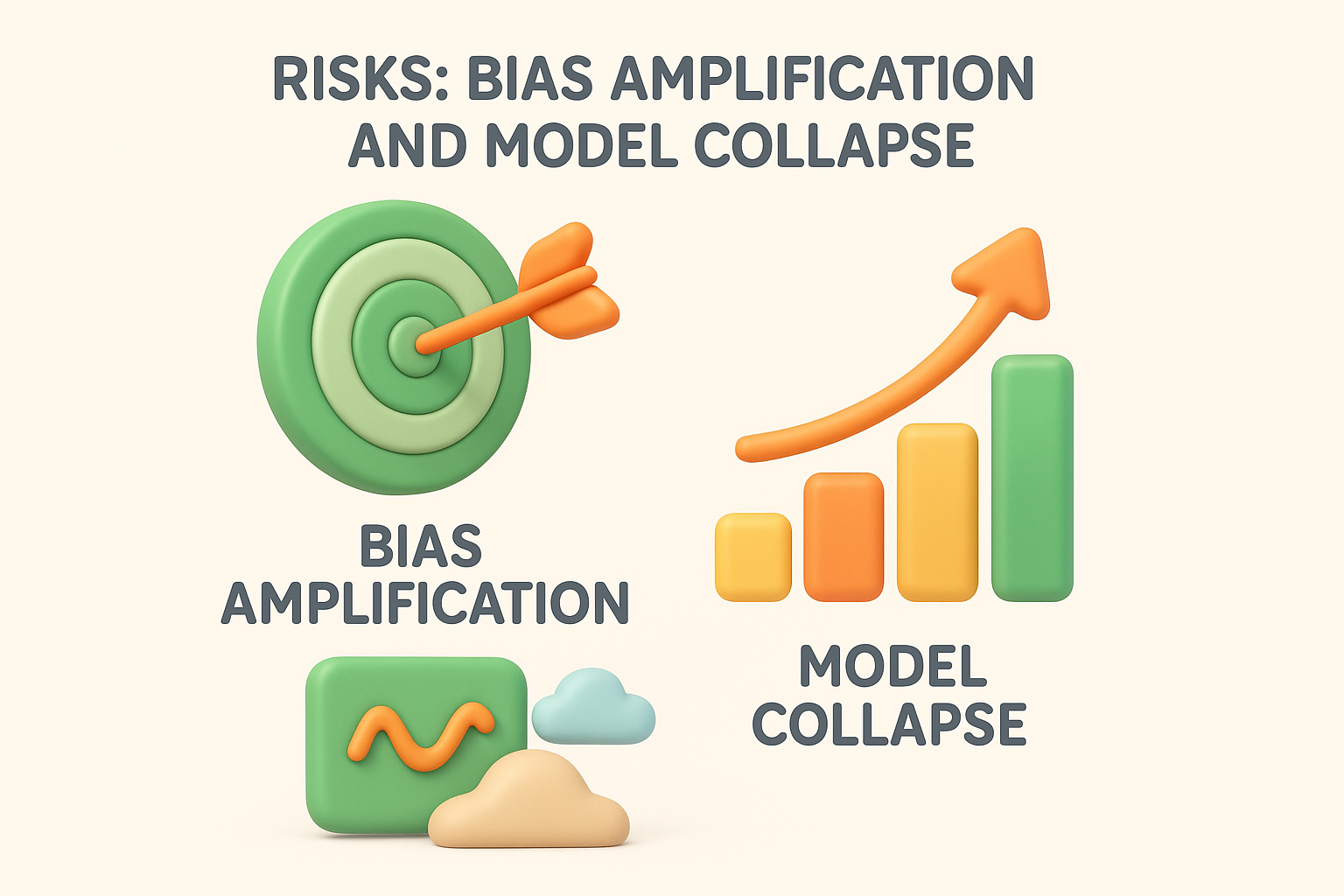
Model collapse is the slower, quieter version of the same problem. Researchers at Oxford and Cambridge documented this in 2024: models trained repeatedly on synthetic data generated by earlier models gradually lose the tails of the original distribution, flattening into generic, repetitive output. Rare cases and edge scenarios vanish first, since they're the least represented in the recycled data.
A model that only ever learns from itself eventually forgets what the real world actually looks like.
Both risks share a root cause: nobody validated the data going back into the loop before it shaped the next version of the model.
Getting a feedback loop right takes deliberate design, not luck. You need checkpoints that catch bad data before it retrains anything, and you need people who actually look at what the model is learning from.
Start by treating incoming signals with the same skepticism you'd apply to a suspicious support ticket. Hold out a portion of real, human-verified data in every training run so the model never learns exclusively from its own predictions. Track distribution shifts over time, not just accuracy scores, since a model can look accurate while quietly narrowing what it actually understands.
Trust the loop only as much as you trust the data going back into it.
A reliable AI feedback loop almost always includes a human checkpoint somewhere between output and retraining. Practical steps that work:
Teams that already run structured feedback collection for products, like a Koala Feedback portal, understand this instinct: unreviewed input shapes decisions poorly.
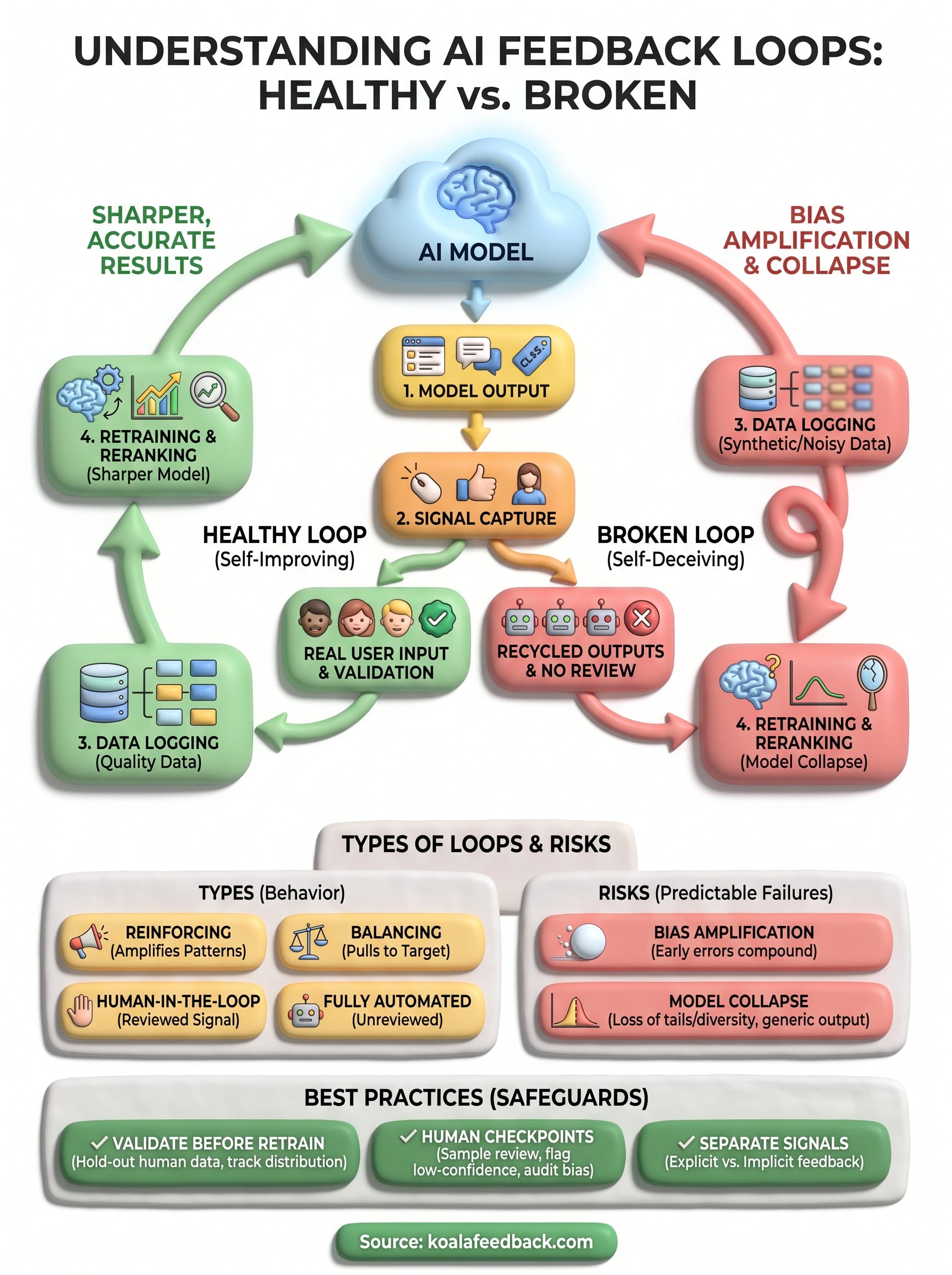
An AI feedback loop only earns your trust when you can see exactly what data feeds it and who checks that data before it reshapes the model. Get that discipline right and you avoid the two failure modes covered above: bias that quietly compounds and model collapse that flattens your outputs into generic mush. Skip it, and you're training on your own guesses dressed up as ground truth.
Product teams already know this pattern from a different angle. Closing the loop between user input and what you actually build works the same way: validate the signal, keep a human reviewing it, and act on what's real rather than what's loudest. If you want that same discipline applied to how your users shape your roadmap, centralize and act on user input with Koala Feedback and start collecting signal you can actually trust.

Start today and have your feedback portal up and running in minutes.