Agile methodology for product development is a way of building products in short cycles. You release small pieces, learn from real users, and adjust the plan before you spend months on the wrong thing. Instead of fixing the scope up front and delivering everything at the end, an agile team plans just enough, ships an increment, collects feedback, and repeats the loop.
This guide explains why the approach matters, how the agile product development process runs from vision to release, and which values and principles sit behind it. It then compares the frameworks teams actually use, including Scrum, Kanban, and XP. A worked example and a list of common mistakes close the article, so you can apply the method to your own product.
We built Koala Feedback for the part of agile that most teams handle badly, which is getting trustworthy user input into the backlog. You will see where feedback fits at each stage, because a short cycle is only useful if what you learn in it changes what you build next.
The agile approach matters because it moves the moment you learn you are wrong from the end of the project to the first few weeks. Traditional sequential development, often called waterfall, runs requirements, design, build, test, and release in strict order. Users see the product last, which is when changing it costs the most.
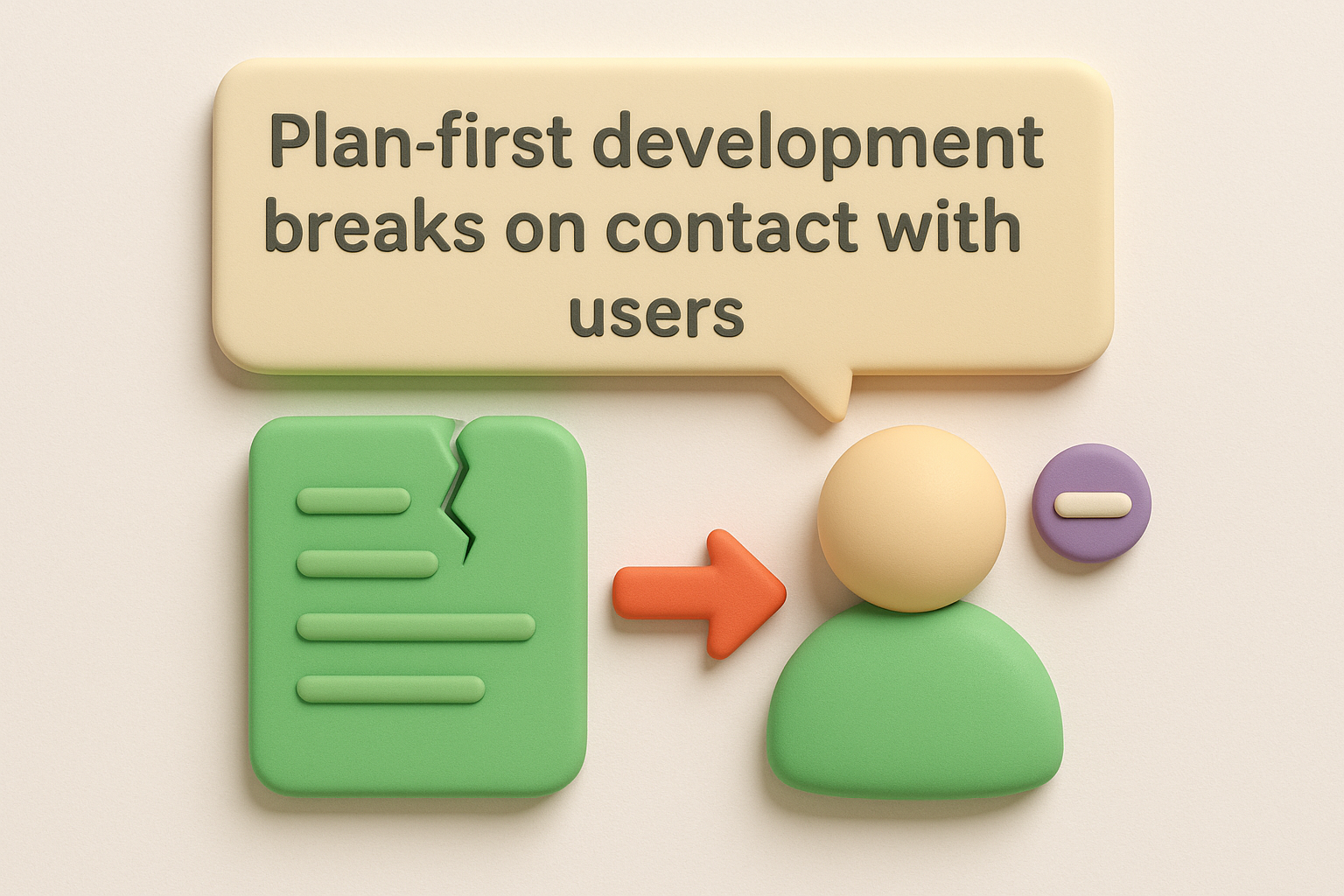
Picture a team that spends six months on a reporting module. At launch, customers say they mostly wanted a CSV export. An agile team would have shipped a basic export in the second sprint and watched how people used it. It would then build only what the usage justified. The gain is not raw speed. It is how early real evidence reaches the plan.
Agile does not make you build faster. It makes you find out sooner whether you are building the right thing.
Agile product development methodology changes six things about how a team works. The table sets them side by side with the sequential model.
| Aspect | Sequential (waterfall) | Agile |
|---|---|---|
| Feedback | After release or late testing | Every sprint or release |
| Scope | Fixed up front | Reprioritized each cycle |
| Change requests | Expensive exceptions | Expected, handled in the backlog |
| Risk | Concentrated at the end | Spread across small increments |
| Documentation | Detailed before building | Just enough to build and maintain |
| Delivery | One large release | Frequent small releases |
Agile does not remove planning. It plans in layers. You keep a rough roadmap for the quarter, a refined backlog for the next few sprints, and a firm commitment only for the current sprint. The further out the work is, the less detail you invest in it.
Agile works best when requirements are uncertain and you can reach users quickly. It fits less well when scope is fixed by contract or regulation, or when work has long physical lead times, such as tooling for a manufactured part. Even then, teams adapt it rather than drop it. A two-year hardware program can be split into milestones with design reviews and prototype tests, which keeps the feedback loop even if every cycle does not end with a finished product.
It also fails without access to customers. If nobody on the team can talk to users or read their requests, you get short cycles with no learning inside them, and the ceremonies become theater.
The agile product development process is a loop of seven steps that you repeat until the product meets its goals. This is the order most Scrum-style teams follow, whether the product is software or something physical.
Steps 2 and 7 are the same list seen at different moments. The backlog is never finished, because every release produces new evidence that reorders it.
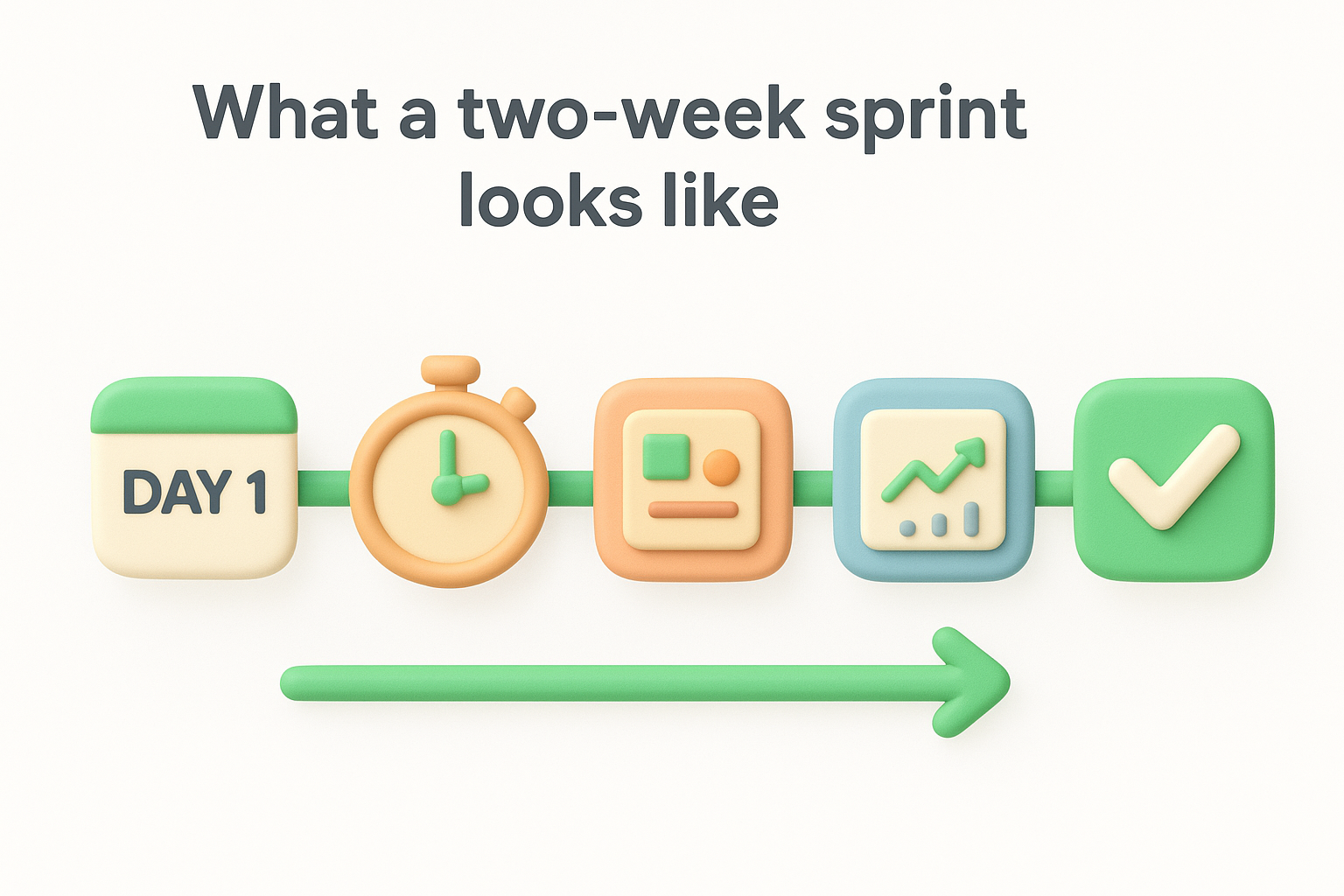
A sprint is a fixed time box with a handful of recurring meetings. Here is a typical two-week rhythm.
| Event | When | Purpose |
|---|---|---|
| Sprint planning | Day 1 | Choose items and agree on a sprint goal |
| Daily scrum | Every day, 15 minutes | Share progress and surface blockers |
| Backlog refinement | Ongoing, often mid-sprint | Clarify and size upcoming items |
| Sprint review | Last day | Demo working product and gather feedback |
| Retrospective | Last day, after review | Decide what to change in how the team works |
The Scrum Guide caps sprint planning at eight hours for a one-month sprint, and shorter sprints get proportionally less. Most two-week teams finish planning in about two hours. If your meetings routinely run longer, your backlog items are probably too vague.
A definition of done is a shared checklist that every item must pass. A practical one might read: code reviewed, tests passing, accessibility checked, documentation updated, and released behind a flag or to production. Without it, "done" means something different to each person, and the review turns into an argument.
Track few measures and keep them honest. Cycle time, the days from starting an item to shipping it, shows where work stalls. Sprint goal hit rate shows whether your planning is realistic. Adoption of shipped features shows whether you built something people wanted. Velocity is fine for forecasting your own team, but comparing it across teams rewards inflated estimates.
A feature that ships but nobody uses is not progress, so measure adoption, not just delivery.
The Agile Manifesto was written in 2001 by 17 software practitioners. It states four values: individuals and interactions over processes and tools, working product over comprehensive documentation, customer collaboration over contract negotiation, and responding to change over following a plan.
The manifesto adds that the items on the right still have value. It simply asks you to favor the items on the left when they conflict. In product work, that means you talk to the user before you write the spec, and you update the plan when the evidence changes.
The manifesto lists 12 principles. They are easier to use when grouped by the job they do for a product team.
| Theme | Principles | What it looks like in practice |
|---|---|---|
| Customer value | Satisfy the customer through early, continuous delivery; welcome changing requirements; deliver frequently, favoring shorter timescales | Release a small slice every sprint and reorder the backlog at each planning session |
| Collaboration | Business people and developers work together daily; build around motivated individuals; face-to-face conversation is best; self-organizing teams produce the best designs | Product, design, and engineering sit in one team and talk daily, with no ticket handoffs |
| Quality and pace | Working product is the main measure of progress; keep a sustainable pace; pursue technical excellence; keep things simple | Use a definition of done, avoid crunch, and cut scope before cutting quality |
| Learning | Reflect regularly and adjust | Hold a retrospective every sprint and act on at least one change |
The manifesto wrote "software," but the principles transfer to any product. Hardware teams swap "working software" for working prototypes and validated milestones. The intent stays the same: show something real to someone who can react to it, early and often.
Principles tell you what to protect when your process gets messy. Ceremonies are only one way to protect them.
Agile is not itself a framework. It is a set of values and principles, and frameworks such as Scrum and Kanban are specific ways to practice them. That is why people disagree about whether agile is a methodology. In everyday use, "agile methodology" means any approach that follows the manifesto, and the table shows the common ones.
| Framework | Core idea | Cadence | Best suited to |
|---|---|---|---|
| Scrum | Time-boxed sprints with defined events and artifacts | Fixed sprints, usually 1 to 4 weeks | Teams building a product with a prioritized backlog |
| Kanban | Visualize work and limit work in progress | Continuous flow, no sprints | Support, maintenance, and steady request streams |
| Extreme Programming (XP) | Engineering practices like pair programming, test-driven development, and continuous integration | Short iterations | Teams that need high code quality and fast change |
| Lean | Remove waste and deliver value fast | Continuous | Teams cutting handoffs and idle time |
| Scrumban | Scrum's cadence with Kanban's flow limits | Flexible | Teams moving from Scrum toward flow |
Lists of popular approaches often add Crystal, Feature-Driven Development, and Dynamic Systems Development Method. They are used less often, and most product teams start with Scrum or Kanban.
People searching for the "3 5 3 rule" are usually asking about how the Scrum framework works. It counts three accountabilities, five events, and three artifacts. The accountabilities are the Product Owner, who orders the backlog; the Scrum Master, who helps the team follow the framework; and the Developers, who build the increment.
The five events are the Sprint itself, Sprint Planning, the Daily Scrum, the Sprint Review, and the Sprint Retrospective. The three artifacts are the Product Backlog, the Sprint Backlog, and the Increment. This rule is a memory aid, not a law, but it covers the whole framework.
Pick by the shape of your work, not by popularity. Use these tests:
Start with one framework by the book for a few cycles. Then change what does not fit, since most mature teams end up with a blend.
Here is how the process might run for a small SaaS team. The vision is: "Help customer success managers show value to their accounts." Customers have asked for reports in many different ways, so the team groups the requests and finds that CSV export and a weekly summary email account for most of them.
Sprint one delivers a basic CSV export to ten customers who asked for it. At the review, the team learns the export is used heavily but people want to pick columns. Sprint two adds column selection. Sprint three starts the weekly summary email, and the team drops a dashboard idea after nobody votes for it. Six weeks in, the feature has shipped in three pieces. Each piece was shaped by evidence from the step before.
Teams like this need a clear place to collect and rank requests. With a feedback portal in Koala Feedback, customers submit and vote on ideas, duplicates are merged, and requests are sorted into boards by product area. The public roadmap then shows items as planned, in progress, or completed, so the people who asked can see what happened to their request.
Most failures are not caused by agile itself. They come from keeping the vocabulary and skipping the substance. Watch for these:
Yes, because the problem it solves has not gone away. Markets and customer needs still shift faster than annual plans can track, and new tooling does not change that. AI assistants can draft user stories or summarize feedback, but a team still has to decide what to build and check it with users. The short feedback loop remains the point, and the framework you pick is secondary.
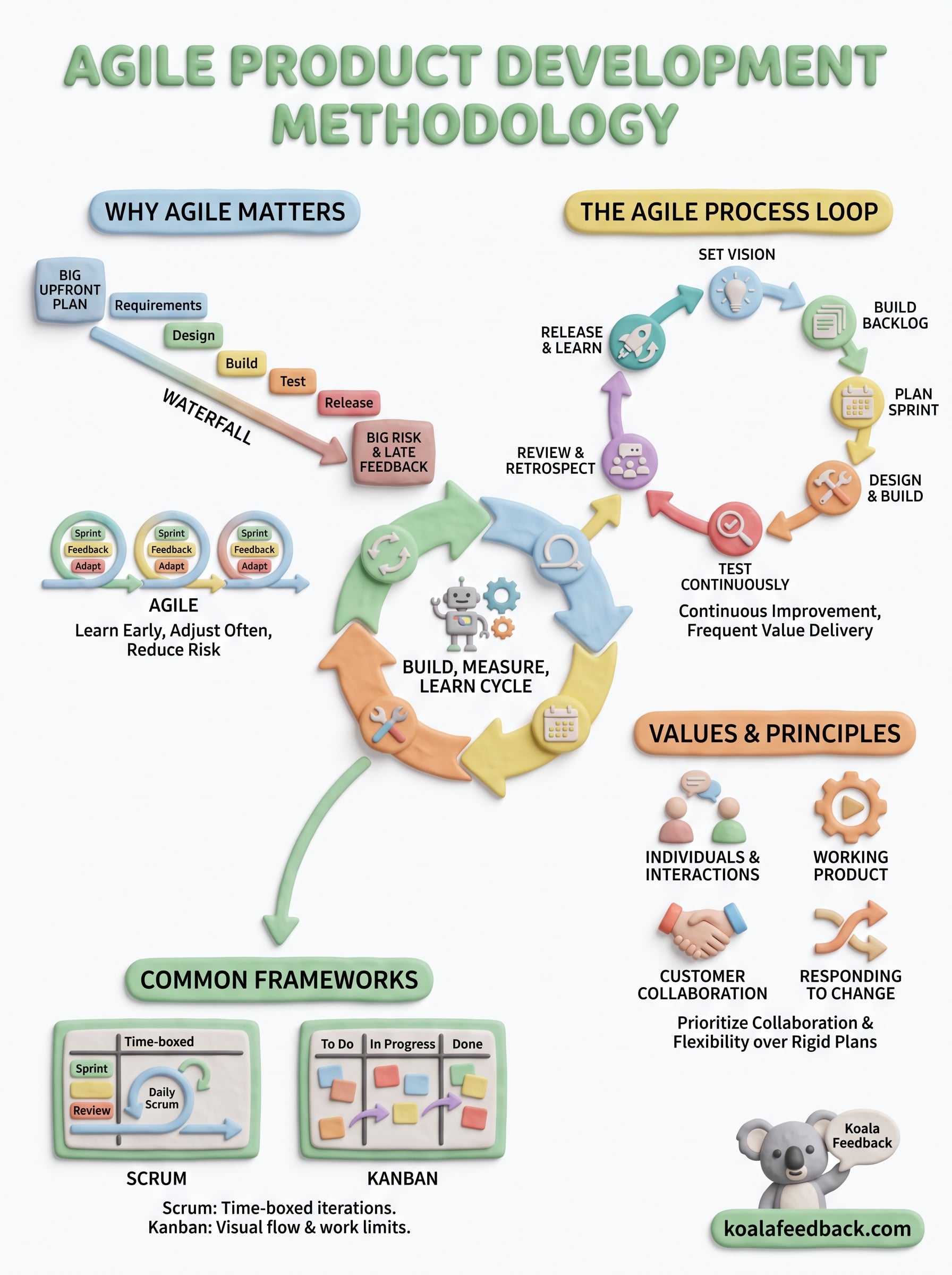
Agile methodology for product development comes down to one habit: build a small piece, put it in front of users, and let what you learn reorder the work. The values give you direction, the process gives you rhythm, and a framework like Scrum or Kanban gives you a place to start. Nothing here needs a transformation program. Pick one product, run three short cycles, and hold a retrospective after each.
The loop only works if user input is easy to collect and hard to lose. If your requests are scattered across email, chat, and support tickets, fix that first with a process for managing user feedback. You can set up a feedback portal and public roadmap with Koala Feedback and let your next sprint planning start from what users are actually asking for.

Start today and have your feedback portal up and running in minutes.