Teams say they are "agile" all the time, but ask three of them what that means and you get three different answers. Part of the confusion is that an agile development framework is not the same thing as the Agile Manifesto. The manifesto is a set of values. A framework turns those values into a repeatable way of working.
Here is the short answer. An agile development framework is a structured set of roles, routines, and rules for building software in small increments and adjusting based on feedback. You plan a little, ship a little, learn, and repeat. Scrum, Kanban, Extreme Programming (XP), and Lean all follow that loop, but they differ in how strict they are and where they focus.
This article explains the core principles and the basic steps behind agile development frameworks. Then it compares Scrum, Kanban, XP, and Lean side by side so you can see which one fits your team. We build Koala Feedback for product teams, and every one of these frameworks depends on the same input: real user feedback guiding what you build next.
Software projects fail less often from bad code than from building the wrong thing. Agile development frameworks exist to fix that problem. They give your team a fixed rhythm for checking its work against reality instead of against a plan written months ago.
Picture a team that spends six months on a reporting module. It launches, and users ask for something else. Nothing went wrong in the build. The problem is that nobody tested the idea until the end, when changing course costs the most.
An agile development framework shrinks that gamble. Work happens in cycles of one to four weeks, and each cycle ends with something users can react to. You learn in days instead of quarters, so a wrong guess costs two weeks, not half a year.
The real benefit of agile is not speed, it is how cheaply you can afford to be wrong.
The waterfall approach locks scope early and treats change as a failure of planning. Agile treats change as normal. The table shows where that difference appears in day-to-day work and in how much risk you carry.
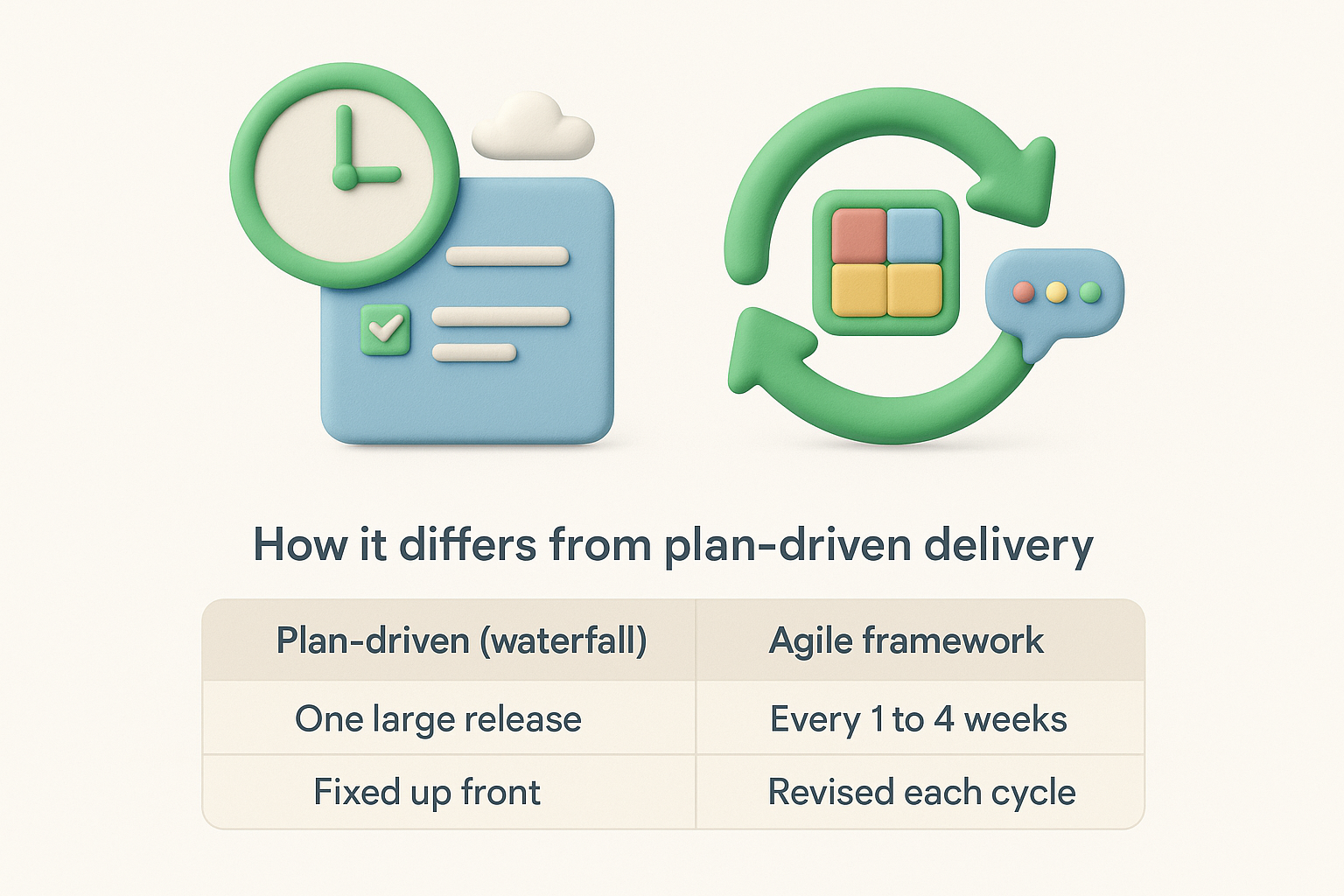
| Area | Plan-driven (waterfall) | Agile framework |
|---|---|---|
| Release cadence | One large release | Every 1 to 4 weeks |
| Requirements | Fixed up front | Revised each cycle |
| User feedback | Mostly after launch | During every cycle |
| Cost of change | High late in the project | Low, because batches are small |
| Risk | Found late | Found early |
Predictability comes first. Short cycles create a steady record of how much your team actually finishes, which makes forecasts honest. Stakeholders stop demanding fixed dates and start trusting observed delivery pace and a visible, ordered backlog.
Alignment follows. Regular planning sessions and reviews put designers, developers, and product managers in the same conversation, so disagreements surface in week one, not month five. Teams that centralize user feedback in one place, such as a feedback portal, bring evidence instead of opinions to those sessions, and that makes prioritization calls much easier to defend.
Picking a framework is a fit question, not a popularity contest. Match it to the way your work actually arrives, then commit long enough to judge it fairly.
Three questions narrow the field of agile development frameworks fast. Answer them about your team as it is today, not as you hope it will be, and the short list usually has one or two names.
Once you choose, run the framework exactly as described for three cycles before changing anything. Teams that customize on day one tend to drop the uncomfortable parts, and those are often the useful ones.
Run the framework as written first, then adapt it based on evidence.
Keep the backlog fed from a single source of user feedback so step one never stalls, and tell users what shipped so they keep contributing.
These agile development frameworks share one loop but disagree about structure. Scrum prescribes the most, Kanban the least, and XP goes deepest into code. Lean is a mindset more than a method.
| Framework | Cadence | Roles | Best for |
|---|---|---|---|
| Scrum | Fixed sprints, 1 to 4 weeks | Product owner, Scrum master, developers | Product teams with planned releases |
| Kanban | Continuous flow | None required | Support, ops, mixed requests |
| XP | Iterations of 1 to 2 weeks | Customer, coach, developers | Teams that need high code quality |
| Lean | None prescribed | None required | Startups testing ideas cheaply |
Roles show the gap clearly. Scrum names three roles, XP adds a coach, and Kanban and Lean name none. Fewer roles make adoption simple, but also easy to practice loosely.
Each framework limits something different. Scrum caps time with sprints, Kanban caps work in progress with column limits, and XP caps sloppy code with pairing and automated tests.
Scrum limits time, Kanban limits work in progress, and XP limits sloppy code.
Many teams blend them. Scrumban pairs Scrum's planning cadence with Kanban's flow limits, and XP practices such as test-first development slot into any of the four. Lean's habit of cutting waste, like features nobody asked for, improves all of them.
The Agile Manifesto, written in 2001 by 17 software developers, lists four values. It says the item on the left matters more than the item on the right, not that the right side is worthless. Every agile development framework is an attempt to put these values into practice.
Behind the values sit 12 principles. Four shape daily practice: deliver working software frequently, welcome changing requirements even late in development, have business people and developers work together every day, and reflect on how to improve at regular intervals.
Values explain why agile exists, and principles tell you what to do on Monday morning.
Notice how many of these depend on contact with real users. Without a steady stream of feedback, "welcome changing requirements" is just a slogan.
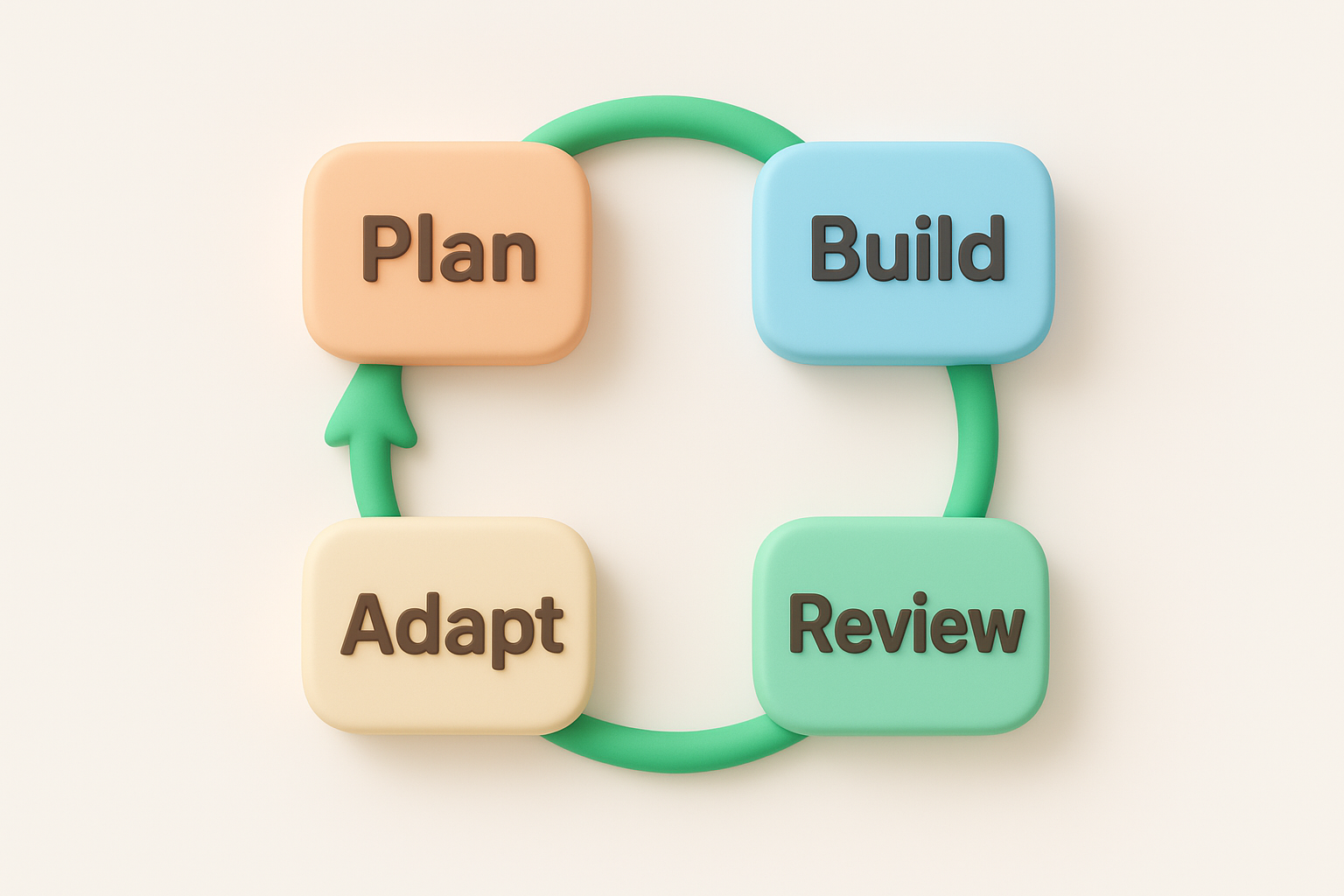
Whatever the framework, the work follows one cycle. Review is the step teams skip most often, and it is where user feedback reshapes the next plan.
Theory only goes so far, so here are two composite scenarios that show how an agile development framework behaves under real work. Neither describes a specific company, but both mirror patterns you will recognize from product teams.
Picture a six-person team building a project management app. They run two-week sprints and pull the top backlog items each Monday, such as a calendar sync that 40 customers asked for. Every sprint ends with a demo and one small process change.
Now take a three-person team that handles bug reports and small requests. Fixed sprints would collapse by Tuesday, so they use a board with To do, In progress, and Done columns. A work-in-progress limit of three stops everyone from starting everything at once, and cycle time shows how long a typical ticket takes.
The team might borrow XP's test-first habit or Lean's focus on cutting waste, and that is fine. Whichever approach they use, the board only sorts work. It cannot tell the team which work deserves doing.
A framework organizes the work, but the quality of your backlog decides the quality of the outcome.
Whichever framework you pick, feed it with real demand. A voting-based feedback portal such as Koala Feedback shows which requests many users share, so your next sprint or your next card comes from evidence.
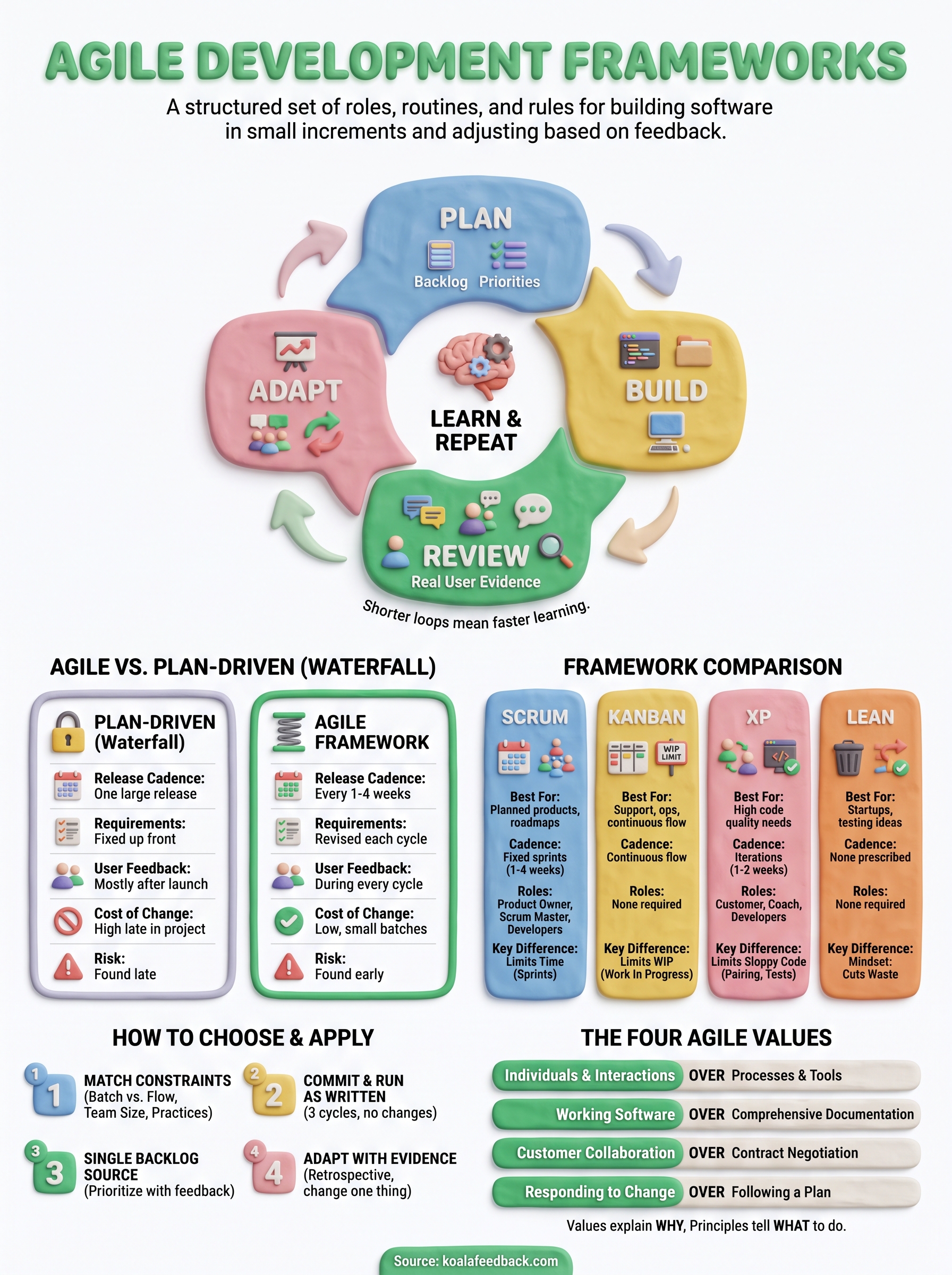
The best agile development framework is the one your team will actually follow. Scrum gives you structure and a fixed rhythm, Kanban gives you flow, XP protects code quality, and Lean keeps waste in check. Start with the one that matches how your work arrives, run it as written for three cycles, then adapt it based on what you see.
Every framework runs on the same loop of plan, build, review, and adapt. That loop only works when the review step brings in real user evidence, because a tidy process cannot rescue a weak backlog.
Ready to stop guessing what comes next? Start with one shared source of feedback, and let users vote on what matters. You can build a repeatable agile development workflow by collecting and prioritizing user feedback with Koala Feedback, then begin your next cycle with evidence.

Start today and have your feedback portal up and running in minutes.