Most teams say they're agile, but their workflow still looks like a slow-moving assembly line with sprint names slapped on it. If your backlog is a dumping ground, priorities shift every stand-up, and nobody can say what
Teams that skip a real agile development workflow pay for it in wasted sprints, missed deadlines, and features nobody actually asked for, usually because nobody agreed on how agile development actually works in the first place. Without a repeatable process, feedback scatters across Slack threads and email, backlogs balloon into wish lists, and stakeholders slowly lose confidence in the team's ability to ship. A working agile software development workflow gives everyone, developers, product managers, and customers, a shared rhythm for turning raw ideas into working software on a schedule people can trust.
A workflow you can't explain in two sentences isn't agile, it's just chaos with a calendar.
Consider what happens without one. Requirements shift mid-sprint because nobody locked scope before development started. QA gets rushed at the finish line because testing was never built into the cadence. Release dates slip because risks surface too late for anyone to react. Developers burn out from constant context-switching between
Building a real workflow starts before anyone writes a line of code, well before the agile development process steps that carry an idea to release. Setting up an agile development workflow means designing the pipeline that feedback, ideas, and requirements travel through before they become shipped features. Skip a step here and you'll feel it three sprints later when priorities collide or nobody remembers why a feature made the cut in the first place.
Grab a whiteboard and lay out every stage feedback and requirements pass through in your organization today, even the messy informal ones. Mapping the current process exposes where things stall, like ideas sitting in someone's inbox for weeks or QA getting skipped when deadlines tighten. You can't fix a bottleneck you haven't identified.
A workflow only counts as agile if you can point to the exact step where an idea turns into a task.
Once these steps run on repeat, your team stops reacting to whatever's loudest and starts shipping what's actually prioritized. That repeatable rhythm is what separates a genuine agile software development workflow from a calendar full of sprint labels.
Every agile development workflow cycles through the same core stages, whether you call your process Scrum, Kanban, or something homegrown. Recognizing each stage helps you spot exactly where a project stalls, whether that's a backlog nobody grooms or a review meeting that never happens. Think of these stages as the skeleton underneath whatever framework you choose later.
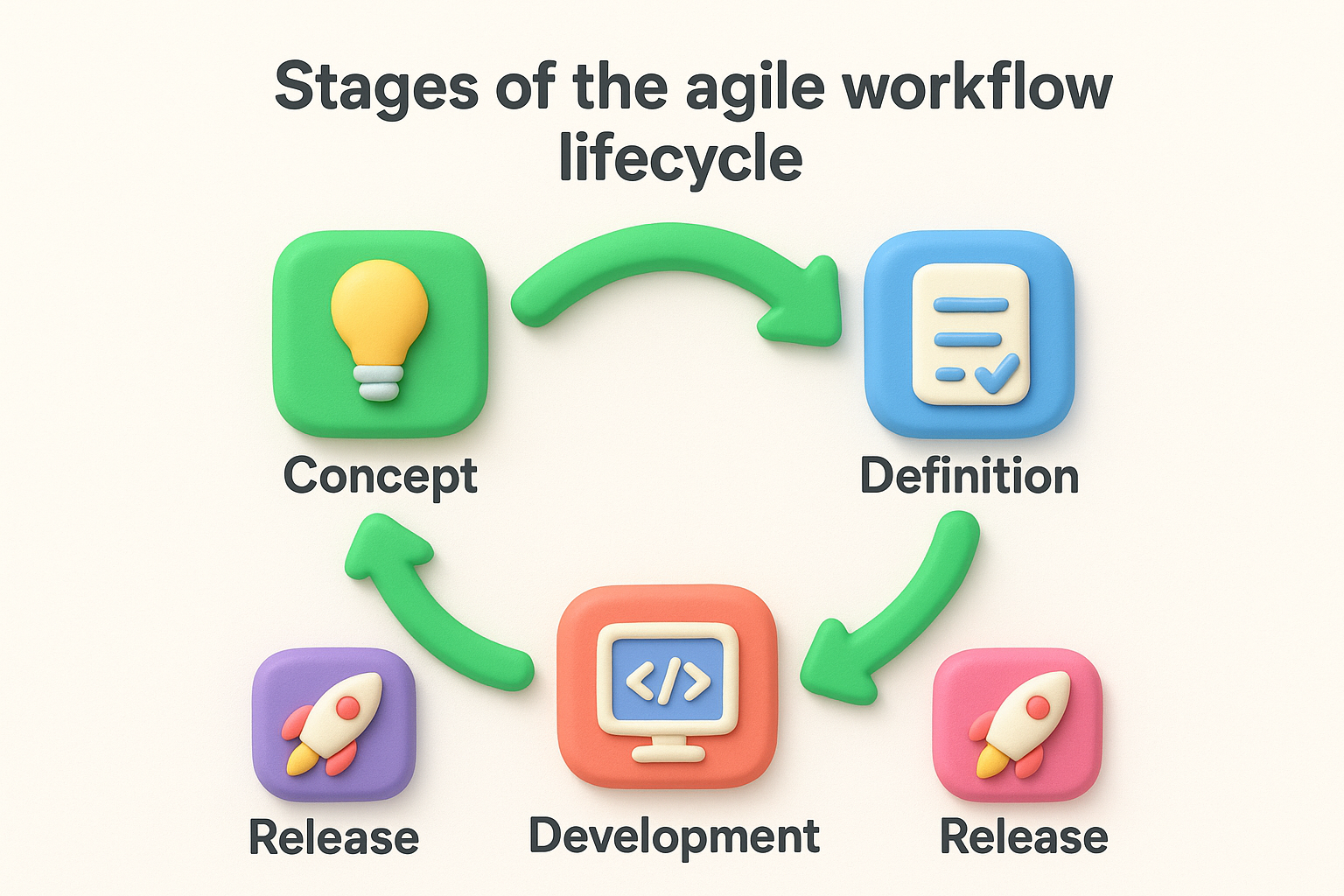
Concept, definition, design, development, and release form the backbone of the agile workflow lifecycle. Concept is where raw feedback and ideas get evaluated for business value. Definition turns a promising concept into user stories with clear acceptance criteria. Design covers the technical planning and, when needed, UX work before anyone touches code. Development is the sprint itself, where the team builds and tests in short cycles. Release ships the work and starts the feedback loop again.
| Stage | Main Question Answered | Typical Output |
|---|---|---|
| Concept | Is this worth building? | Prioritized idea |
| Definition | What exactly are we building? | User story with acceptance criteria |
| Design | How will we build it? | Technical spec or wireframe |
| Development | Build and test in short cycles | Working, tested increment |
| Release | Ship it and gather reactions | Deployed feature plus new feedback |
Skip the definition stage and your development team is guessing, not building.
Notice that release feeds straight back into concept. That loop is the entire point of an agile software development workflow, you're never done, you're just cycling faster with better information each time. Roadmap tools that track feedback progress with statuses like planned, in progress, and completed make this loop visible to customers, so they see their feedback move through these exact stages instead of disappearing into a black box. Teams that expose this progress publicly tend to get better, more specific feedback next cycle, because users can see their input actually shaped something. That visibility alone often cuts down the noise in your intake process, since people stop resubmitting requests they can already see on the roadmap.
Scrum, Kanban, and Scrumban all sit under the same agile development workflow umbrella, but they fit different teams in very different ways, which is why it helps to know the difference between agile and Scrum before you choose. Picking the wrong one doesn't just slow you down, it creates friction that looks like a people problem when it's actually a process mismatch. Before you commit to a framework, look honestly at how your team already works, not how you wish it worked.
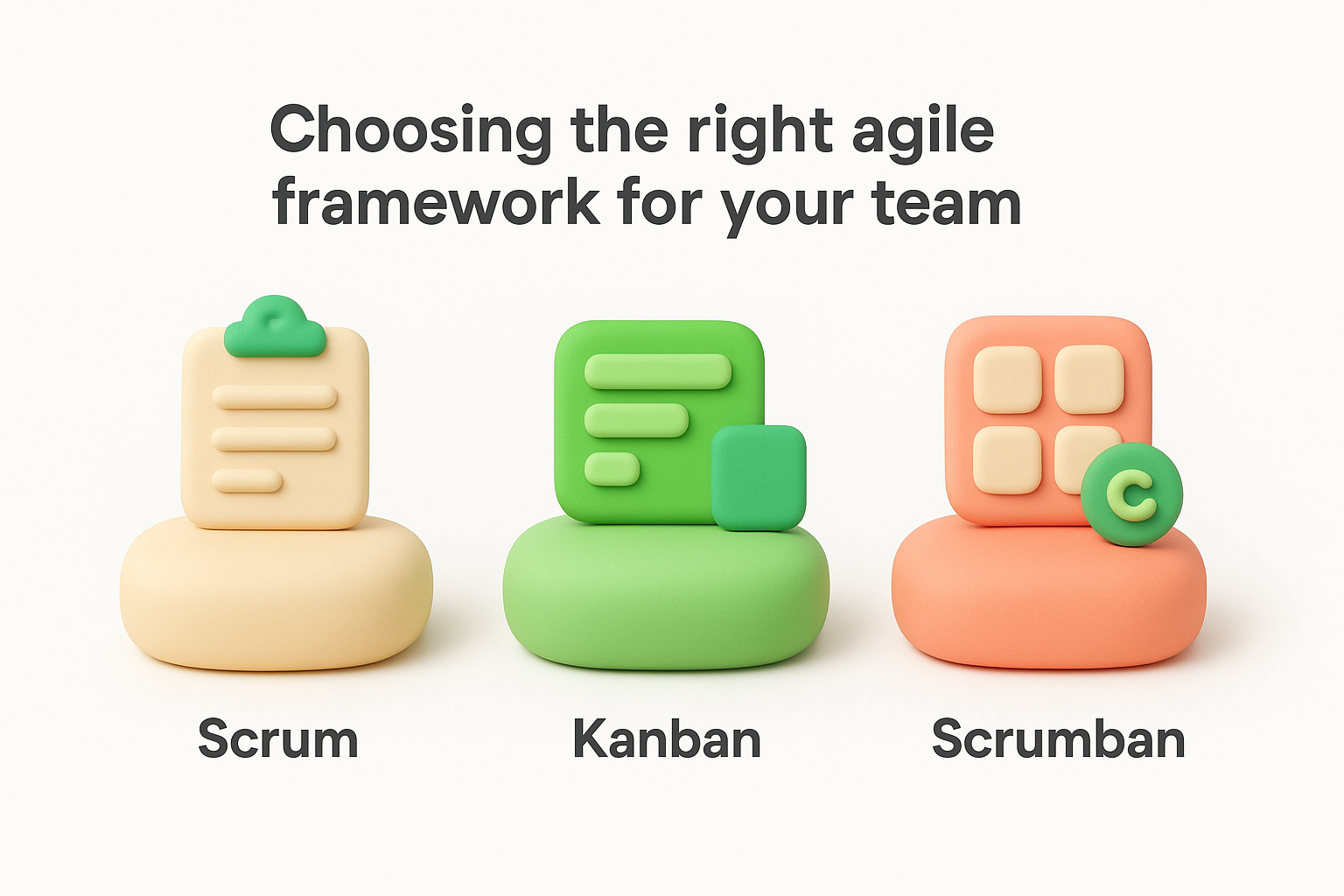
Scrum suits teams that ship in predictable, time-boxed chunks and want the structure of sprint planning, daily stand-ups, and retrospectives. Kanban fits teams with a steady stream of incoming work, like support-driven dev teams, where a continuous flow beats fixed sprint boundaries. Scrumban blends the two, giving you sprint-style planning with the flexibility to pull in urgent work mid-cycle. None of these frameworks fixes a broken agile software development workflow on its own, they just give shape to a process you still have to design.
The framework doesn't make you agile, the discipline to run it consistently does.
| Framework | Best for | Cadence | Flexibility |
|---|---|---|---|
| Scrum | Teams with stable priorities and clear release cycles | Fixed sprints (1-4 weeks) | Low mid-sprint |
| Kanban | Teams with continuous, unpredictable inflow | Continuous flow | High |
| Scrumban | Teams that want structure plus room for urgent work | Flexible sprints | Medium |
Test whichever framework you pick for two or three cycles before declaring it wrong. Most teams abandon a framework too early, blaming Scrum or Kanban for problems that are really gaps in intake, prioritization, or communication. Underneath any framework, you still need a clean way to collect requests and rank them by real demand. A prioritization board organized by product area gives you that foundation no matter which cadence you choose, so switching frameworks later doesn't mean rebuilding your entire process from scratch.
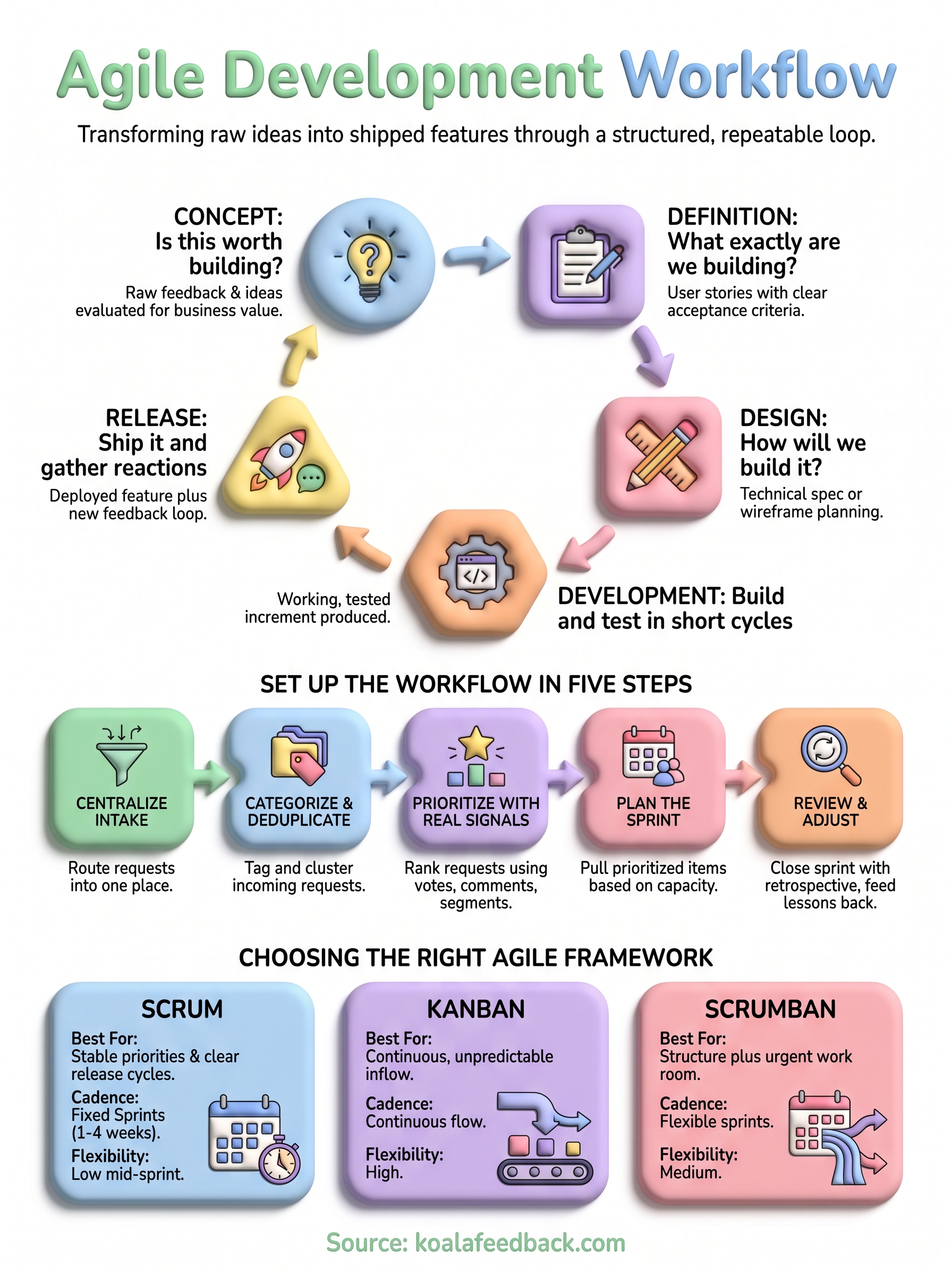
An agile development workflow only works when every stage connects, from the first piece of feedback to the release that starts the loop again. You've seen the stages, the setup steps, and the frameworks. None of it matters if intake stays scattered across Slack and spreadsheets while your backlog turns into a wish list nobody trusts. The teams that actually ship what customers want are the ones who centralize feedback, prioritize with real signals, and show progress publicly so users stop guessing where their ideas went.
Start small. Pick one product area, route its requests into a single portal, and run one full cycle from concept to release before expanding further. That first clean loop will teach you more than any framework debate. If you're ready to stop managing feedback across five different tools, collect every feature request in one feedback portal with Koala Feedback and give your team the centralized workflow this whole process depends on.

Start today and have your feedback portal up and running in minutes.